
Best Tips for a 28-Day Indoor Walking Challenge That May Support Weight Loss
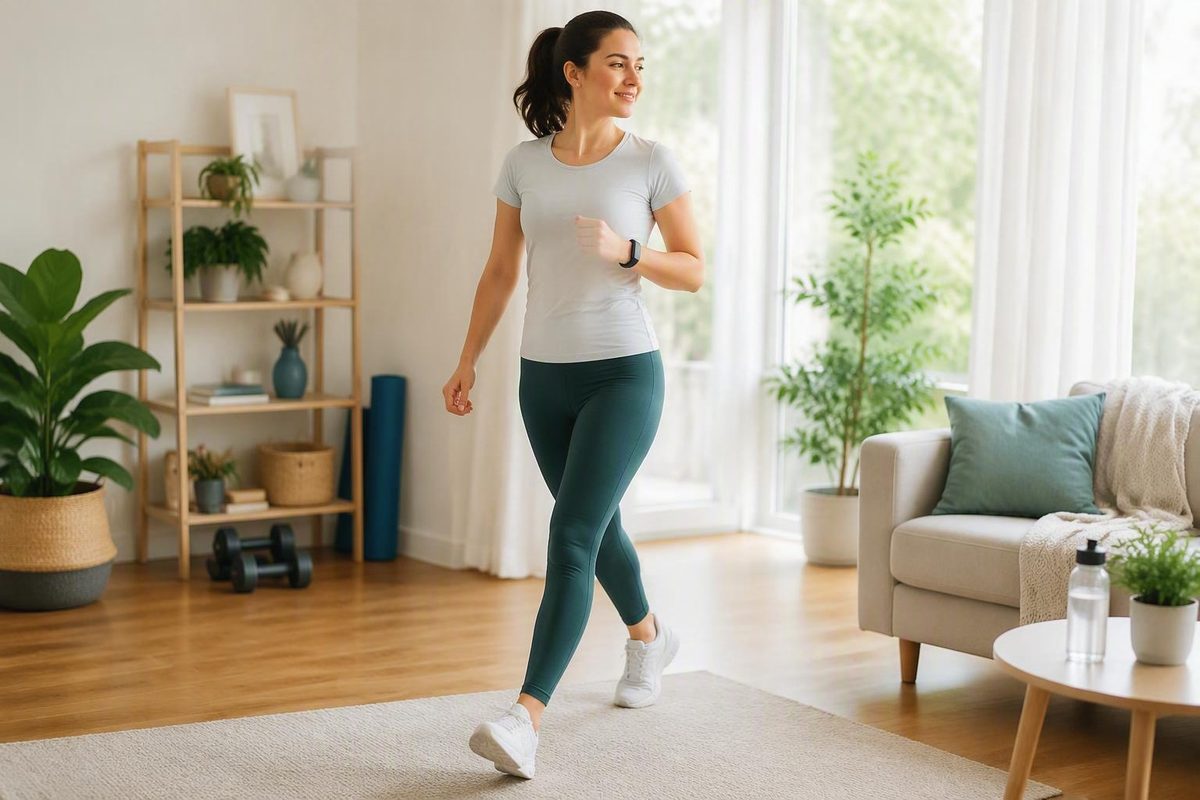
Track your steps for three normal days before starting. Increase only one variable at a time. Weight loss is possible, not guaranteed, and depends on food intake.
Overview
The most reliable way to complete a 28-day indoor walking challenge is to start from your current activity level rather than a universal target, increase only one variable at a time, gauge effort by breathing rather than fixed speeds, and track adherence over the full four weeks instead of judging single days. Weight loss is a possible outcome, not a guaranteed one, and depends on food intake alongside the walking itself.
Published plans for this challenge disagree on the specifics. One plan described by walking coach Michele Stanten in a Yahoo Lifestyle article begins with five minutes of daily walking, while the Women’s Health four-week plan schedules three to five workouts per week with paces up to 4.5 mph. That disagreement is useful information: it shows there is no single validated 28-day prescription, and that the workload should be fitted to the person doing it. The sections below cover setup, baseline selection, a flexible four-week progression, frequency and recovery decisions, effort measurement, adherence tactics, realistic weight expectations, and the symptoms that should stop a session. Recovery and safety take priority over any scheduled target throughout.
Prepare a safe, low-equipment walking setup
The equipment requirement for this challenge is smaller than many product-oriented plans imply. The Yahoo Lifestyle coverage of the 28-day indoor challenge states directly that no gym, treadmill, or special equipment is needed, and the BetterTogether guide lists comfortable shoes as the only necessary item. Two things are essential; everything else is optional.
The first essential is a clear route. The Yahoo Lifestyle plan recommends creating a dedicated walking space at home that is free of obstacles. Indoors, that means removing rugs that slide, cords across the floor, and furniture edges along the path you will repeat many times per session. The second essential is footwear. Stanten notes in the same article that walking at home is not a reason to walk in slippers or socks, and recommends walking or running shoes with good support and cushioning. Sole Treadmills’ challenge guide gives the same criteria: adequate support, cushioning, and fit.
Optional items fall into a separate category:
- Treadmill: useful for controlled pace and incline, but not required for any part of the challenge.
- Step tracker or phone pedometer: helpful for establishing a baseline and recording adherence, covered in the next section.
- Hand weights or weighted vests: mentioned in some plans as intensity additions, but these belong to week three or later at the earliest, and only after the unweighted walk is comfortable.
Deferring the optional purchases has a practical benefit beyond cost: it removes the excuse of waiting for equipment before starting, and it keeps the first two weeks focused on the walking habit rather than the gear.
Start with your baseline, not a universal target
The single most common error in walking challenges is copying someone else’s starting workload. The supplied plans illustrate why this fails: Stanten’s plan in Yahoo Lifestyle starts week one at five minutes of comfortable-pace walking per day, the BetterMe challenge recommends beginners start with 10 to 15 minutes and build gradually, and the Sole Treadmills guide uses a step-based example that starts at 5,000 steps and builds toward 10,000. The Women’s Health plan, by contrast, includes work intervals at 3.5 to 4.5 mph. These are not interchangeable workloads, and none of them was derived from your current condition.
A baseline-based start replaces the guesswork. Stanten’s specific recommendation in the Yahoo Lifestyle article is to track your steps for three normal days before the challenge, using a Fitbit or your phone’s pedometer. Those three days give you a measured picture of what your body currently does, which is a more defensible starting input than any number printed in a plan. From there, the practical rule is to begin the challenge at a workload close to what those days show, plus a small, deliberate addition, rather than jumping to a target that may be double or triple your measured activity.
A short trial walk adds a second data point. Walk at a comfortable pace for as long as the effort stays easy, note the duration, and use that as your week-one session length. If the trial ends at eight minutes, an eight-minute session is your starting point, regardless of what any published schedule prescribes. The BetterMe plan supports exactly this kind of adjustment, stating that any day can be adjusted to match energy and comfort level and that the schedule is a guide, not a strict rulebook.
Fixed treadmill speeds deserve the same skepticism as fixed durations. A pace of 3.5 mph is a moderate effort for one person and a near-maximal one for another. The effort-based approach in the section on gauging exertion below resolves this without requiring any specific speed.
Progress through four adaptable weeks
Once a starting workload is set, the four weeks become a structured progression rather than 28 identical days. The useful framing, supported by the gradual-progression language in both the ACSM preparticipation screening guidance and the ACSM scientific roundtable recommendations, is to treat duration, frequency, and intensity as three separate levers. The ACSM roundtable material describes safe exercise prescription as incorporating a progressive transitional phase during which duration and intensity are gradually increased. Increasing one lever at a time keeps each week’s change small enough to evaluate: if a week feels harder than expected, you know exactly which change caused it.
The table below is a flexible framework synthesized from the supplied plans and the ACSM progression principle. It is not a validated prescription, and it deliberately avoids universal minutes, steps, or speeds because the supplied plans do not agree on them.
| Week | Primary focus | What you may adjust | When to hold steady |
|---|---|---|---|
| 1 | Establish the habit at your measured baseline | Nothing yet; repeat your trial-walk duration at a comfortable pace | All week; week one is for consistency, not progress |
| 2 | Duration | Add a small amount of time per session, or add one short session | If any session in week 1 felt harder than “comfortable” |
| 3 | Frequency or intensity (pick one) | Add one walking day, or add brief faster segments within an unchanged duration | If week 2’s added duration has not yet become routine |
| 4 | Consolidation | Combine the changes that felt sustainable; drop any that did not | If sleep, soreness, or motivation to start sessions is declining |
This sequence mirrors the structure visible across the supplied plans. Stanten’s plan begins week one with just five minutes daily at a comfortable pace, which matches the habit-first focus of the framework’s first row. The Sole Treadmills guide’s step example, starting at 5,000 steps and increasing gradually each week, is a duration-lever progression. The BetterMe plan’s option to walk longer, add a little speed, or include short bursts of quicker steps maps onto weeks two and three as separate choices rather than simultaneous ones.
Two rules keep the framework honest. First, the “hold steady” column outranks the “adjust” column: repeating a week is a legitimate outcome, not a failure of the plan. Second, no week requires a large jump. A plan that doubles workload between weeks is making an assumption about recovery capacity that nothing in the supplied evidence supports for a general beginner population. If week four arrives and you are walking somewhat longer or somewhat more often than week one, at a comfortable and repeatable effort, the progression has done its job.
Choose daily movement or planned walking days based on recovery
The supplied plans conflict directly on frequency, and the conflict is worth stating plainly rather than papering over. The Yahoo Lifestyle challenge describes walking for exercise indoors every day for four weeks. The Women’s Health plan schedules three to five walking workouts per week. The BetterMe plan includes rest days on purpose, stating that they give the body time between sessions. No supplied source demonstrates that one of these models produces better outcomes than the others for beginners.
The practical resolution is to match the frequency model to the size of the individual sessions and to your recovery. Short, comfortable daily walks in the five-to-fifteen-minute range, like the opening weeks of the Stanten plan, impose a small enough load that daily repetition is feasible for most previously inactive adults and helps cement the habit through daily repetition. Longer or more intense sessions, like the interval workouts in the Women’s Health plan, create more fatigue per session, which is precisely why that plan caps frequency at three to five workouts per week.
Three signals indicate which model fits you. If sessions are short and end feeling easy, daily walking is a reasonable default. If you are adding duration or faster segments, or if you notice lingering leg soreness, unusually heavy legs at the start of a session, or declining willingness to begin walks, planned non-walking days are the more defensible structure. And if your schedule makes daily sessions unrealistic, three to five planned workouts is a legitimate version of the challenge rather than a diluted one. Either model can complete the 28 days; what matters is that total workload and recovery stay in balance, and the recovery signals, not the calendar label, should settle the question.
Gauge effort by breathing and perceived exertion
Fixed speeds do not transfer between people, so the more useful intensity gauge is how the effort feels and what it does to your breathing. The ACSM preparticipation screening framework, summarized in a 2018 review in PMC, defines light intensity as effort that evokes slight increases in heart rate and breathing, moderate intensity as effort that evokes noticeable increases in heart rate and breathing, and vigorous intensity as effort that evokes substantial increases in both. These definitions work anywhere: on a treadmill, in a corridor, or circling a living room.
For readers who prefer a numeric scale, the Women’s Health plan uses rating of perceived exertion (RPE) alongside its paces: a warm-up at 1 to 3 RPE, a work pace at 7 to 8 RPE, and a recovery pace at 3 to 5 RPE. The speeds attached to those ratings (2 to 3 mph for warm-up, 3.5 to 4.5 mph for work) are examples, not requirements. If 3.5 mph pushes your breathing into the “substantial increase” range, that speed is functioning as vigorous effort for you, and the correct adjustment is to slow down until the effort matches the intended category, not to hold the printed number.
For previously inactive adults, the evidence supports starting at the lower end of this range. The ACSM guidance summarized in the PMC review recommends that inactive individuals begin exercise programs at low-to-moderate intensity and progress gradually over time provided they remain asymptomatic, a pattern the review summarizes as “start low and progress slow.” For most of a 28-day beginner challenge, this means walks where breathing increases noticeably but conversation remains possible, with vigorous effort reserved for brief, optional segments in the later weeks if at all.
Session structure matters as much as the middle of the workout. The ACSM roundtable recommendations advocate an appropriate warm-up and cool-down as part of a safe exercise prescription. In practice, that means beginning each walk at an easy pace and ending the same way, rather than switching abruptly into or out of harder segments. A few easy minutes on either side of any faster work is a low-cost structural habit that the guidance supports.
Add variety only after the basic walk feels manageable
Intervals, incline, stairs, added resistance, music, and movement variations all belong to the same category: optional modifications to a routine that already works. None of them is required to complete the challenge, and adding them before the basic walk is comfortable inverts the sensible order of progression.
When the basic walk is stable and a session feels genuinely easy, conservative pace variation is the best-supported first addition. The Sole Treadmills guide describes a beginner-appropriate interval format: increase speed or incline for 30 seconds to one minute, then walk slower for one to two minutes to recover. The BetterMe plan describes the same idea less formally as short bursts of quicker steps for those who want more of a challenge. Both versions keep the hard segments brief and the recovery generous, which is consistent with the gradual-progression principle in the ACSM material.
Resistance additions warrant more caution. The Sole Treadmills guide advises starting slow with hand or wrist weights of 1 to 3 pounds and avoiding excessive muscle strain, and the Yahoo Lifestyle article quotes trainer BJ Patwell noting that light hand weights or weighted vests can increase calorie burn and muscle engagement. Those are the limits of what the supplied evidence supports. It does not compare the safety of hand weights, weighted vests, and ankle weights for beginners, so this article does not rank them. The bounded takeaway is that if resistance is added at all, it should be light, introduced after the unweighted routine is established, and dropped if it changes your walking form or produces joint discomfort. Music and route variation carry no such caveats and can be used from day one to make repetitive indoor loops more tolerable.
Make consistency easier to sustain
Completing 28 days depends less on any single workout than on a system that survives busy days and low-motivation days. The supplied plans converge on a small set of tactics that address the predictable failure points.
Scheduling is the first. Certified fitness trainer Reena Vokoun, quoted in the Yahoo Lifestyle article, recommends scheduling walking time in your calendar so it is a priority during the challenge, and the BetterTogether guide adds that walking at the same time each day supports consistency. A walk with a time slot competes with other commitments on equal terms; a walk without one loses to almost everything.
Tracking is the second. This does not require detailed logging. Recording minutes walked, steps, or simply a completion mark per day is enough to make adherence visible. The Sole Treadmills guide recommends weekly or bi-weekly check-ins to evaluate progress and adjust the routine, which pairs naturally with the week-by-week structure in the progression table above: the check-in is when you decide whether to adjust a lever or hold steady.
Splitting sessions solves the time problem. The Yahoo Lifestyle article states that a 30-minute walking goal does not have to be done in one shot, and that three 10-minute walks reach the same total. On days when a full session is unrealistic, dividing the planned total into two or three short indoor walks preserves the day rather than losing it.
Finally, the missed-day protocol. The Sole Treadmills guide is explicit: if you miss a day, pick up where you left off and continue, with no need to double up on walks unless you feel up to it. The same guide states the underlying principle, that consistency over time matters more than perfection. Adherence in this challenge is properly measured across the 28 days, not against a streak. A schedule of 24 completed days out of 28 is a completed challenge with four data points about your real constraints, not a failed one. Compensatory doubling, by contrast, converts one missed day into an oversized workload the next day, which is exactly the kind of abrupt jump the progression framework is designed to avoid.
Treat weight loss as a possible outcome, not a 28-day promise
The honest framing of the weight-loss question has three parts: walking can contribute, the contribution over 28 days is modest and variable, and food intake is a co-determinant rather than a footnote.
On the first part, controlled evidence exists but is narrower than most challenge marketing implies. A 2016 systematic review and meta-analysis by Gao and colleagues, published in Menopause, pooled randomized controlled trials of walking-only interventions lasting at least four weeks in perimenopausal and postmenopausal women. It found statistically significant mean reductions of 1.14 kg in body weight (95% CI 0.42 to 1.86 kg), 0.33 kg/m² in BMI, and 2.36 percentage points in body fat percentage compared with no-exercise controls. Two details limit how far this can be generalized. The population was perimenopausal and postmenopausal women, not all adults, and the included interventions were at least four weeks long, with many running considerably longer. The pooled 1.14 kg figure therefore cannot be converted into a forecast of what any individual reader will lose in exactly 28 days, and this article does not offer such a forecast.
On the second and third parts, the practical sources are appropriately hedged. The BetterMe plan states that indoor walking may support weight management when combined with a balanced diet, and that individual results vary with progress depending on many factors. The BetterTogether guide frames the mechanism in energy-balance terms: indoor walking can support weight loss when a consistent routine is paired with a diet that keeps calorie intake below expenditure. Food intake, baseline activity, walking intensity and duration, and individual health all modify the outcome, which is why two people completing an identical 28-day schedule can see different results on the scale.
One specific misconception deserves direct correction. The BetterTogether guide notes that spot reduction is not possible: walking contributes to overall body fat reduction, which can include abdominal fat, but no walking plan selectively targets belly fat. Claims that a particular indoor walking format melts fat from one region do not have support in the supplied evidence. Likewise, nothing in the supplied sources establishes that fasted walking or any specific workout format produces superior fat loss, so those claims are excluded here.
Know when to modify, stop, or seek professional input
A 28-day challenge aimed at beginners and recently inactive adults needs explicit boundaries, because “push through it” is bad guidance for a meaningful subset of the symptoms a new exerciser might encounter.
The clearest boundaries concern symptoms during or around exercise. The ACSM preparticipation screening framework, summarized in the 2018 PMC review, lists signs and symptoms suggestive of cardiovascular disease that warrant medical clearance before continuing an activity program. Applied to an indoor walking session, the following warrant stopping the walk and seeking medical input rather than continuing:
- Pain or discomfort in the chest, neck, jaw, or arms, at rest or with exertion
- Unusual breathlessness beyond what the effort level would explain
- Dizziness, fainting, or blackouts
- An unpleasant awareness of a forceful, rapid, or irregular heartbeat
- Burning or cramping in the lower legs when walking short distances
- Ankle swelling
The ACSM roundtable recommendations reinforce the same rule at the program level: individuals with any signs or symptoms suggestive of cardiovascular, metabolic, or renal disease should discontinue exercise and seek medical clearance, returning to activity and progressing gradually only after clearance. The roundtable material also notes that cardiovascular complications during exercise are often preceded by warning symptoms in the days and weeks before an event, which is a reason to take these signals seriously rather than attribute them to being out of shape.
Screening before the challenge is less burdensome than older guidance implied, but it is not absent. The PMC review describes the current ACSM approach as reserving medical clearance mainly for inactive individuals with known cardiovascular, metabolic, or renal disease, and for symptomatic individuals; asymptomatic people starting light-to-moderate activity generally do not need routine clearance. The roundtable document adds that people at moderate risk can usually begin light-to-moderate activity such as walking while any medical evaluation proceeds, and that screening decisions remain individual judgments rather than a checklist replacement for clinical advice. Readers who are inactive but asymptomatic can generally begin at a low-to-moderate intensity without professional clearance, following the “start low and progress slow” approach described in the ACSM guidance. Anyone with a relevant diagnosed condition, significant joint pain, balance concerns, or the warning symptoms listed above is in the group for whom individualized professional input is the appropriate first step, and the supplied evidence does not contain detailed modification protocols for mobility limitations, so this article does not improvise them.
Finally, the intensifiers discussed earlier are explicitly not requirements. Stairs, steep incline, high-intensity intervals, and added resistance are all optional, and the ACSM roundtable’s caution against unaccustomed vigorous exercise for physically inactive individuals applies directly to them. The supplied evidence also does not compare the beginner safety of hand weights, weighted vests, and ankle weights, so the conservative position stands: the challenge is completed by walking, and everything beyond walking is an elective addition that should wait until the basic routine is comfortable and symptom-free.