
Estimate Restaurant Beef and Cashew Without the Label
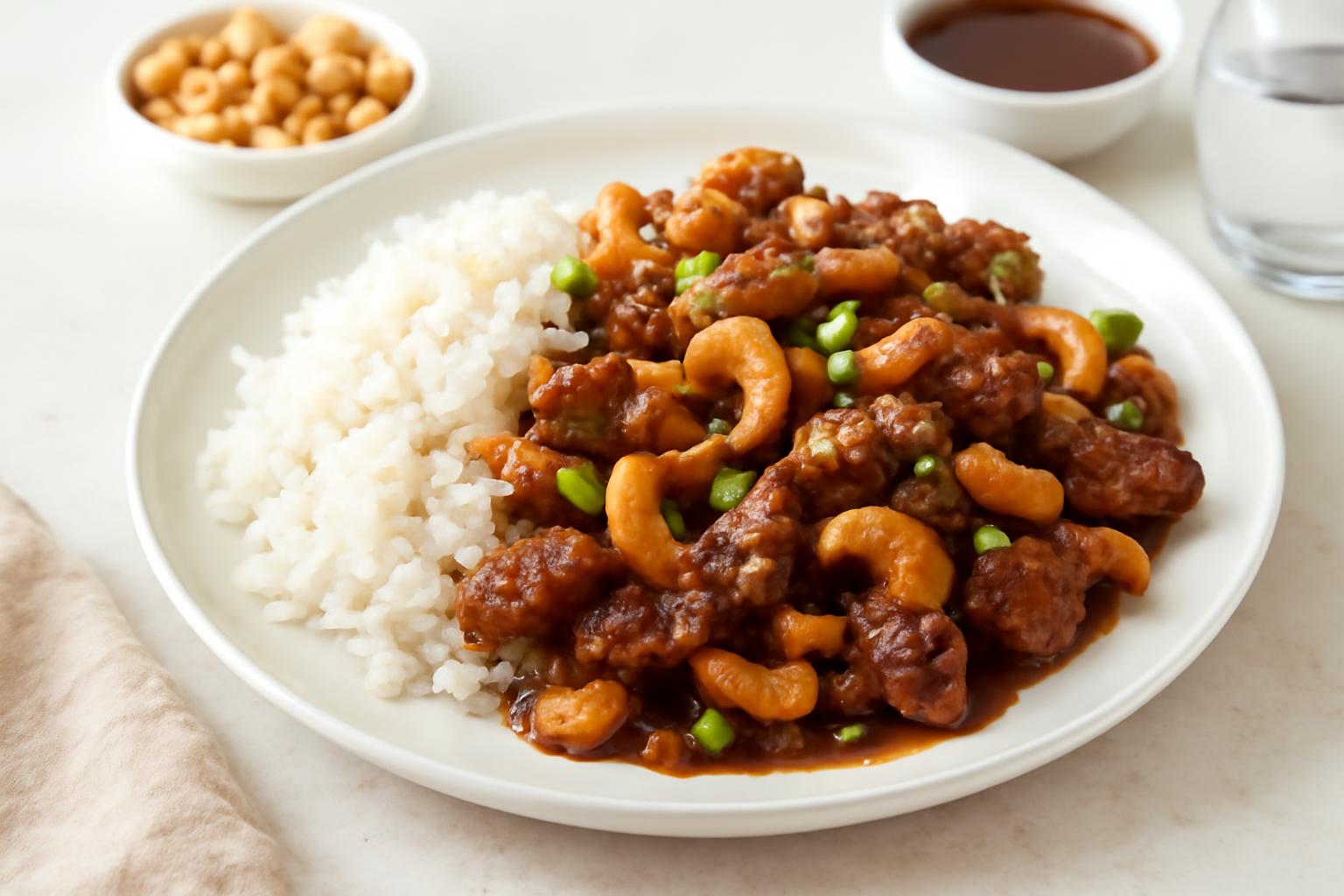
A portion resembling the Fitia 398.6 g example has a defensible 700-calorie estimate. Adjust yours for rice, portion size, oil, sauce and cashews.
Chinese beef with cashews does not have one fixed calorie count. If you are estimating a restaurant plate without nutrition information, about 750 calories for the beef-and-cashew stir-fry plus one cup of rice is a reasonable starting point. A practical range is roughly 600 to 950 calories with rice, or about 400 to 700 calories for the stir-fry alone.
Those are tracking estimates, not a claim about every recipe. The total changes with the amount and cut of beef, how many cashews are used, how much oil remains in the dish, whether the sauce contains sugar, and how much rice is on the plate. The most accurate number is always the restaurant’s own nutrition information or a calculation from the exact recipe and weighed portions.
What published servings actually show
The variation is easier to see when the serving is defined. These examples are not interchangeable, but they provide useful anchors:
| Published dish | Defined serving or meal | Reported calories | What the number includes |
|---|---|---|---|
| Fitia beef stir-fry with cashews and rice | 398.6 g | 706 | 150 g beef, 200 g rice, 14 g cashews, vegetables, soy sauce, and 2 teaspoons oil |
| Home Chef garlic sesame beef and cashew stir-fry | One quarter of a four-serving kit | 570 | Ground beef, cooked white rice, bok choy, cashews, sweetened sauces, brown sugar, and cooking oil |
| Tesco sticky beef with cashews | One of two recipe servings | 407 | Beef, 15 g cashews per person, oil, broccoli, and sauce; rice or noodles are optional and therefore not part of the listed dish |
| HelloFresh Chinese cashew beef stir-fry | One serving | 950 | Ground beef, garlic basmati rice, cashews, vegetables, hoisin, sweet chili sauce, soy sauce, and oil |
The 407- and 950-calorie figures do not describe the same plate. One excludes the optional starch, while the other includes a full rice-based meal. That is why searching for a single number without checking the serving can be misleading.
A useful calorie breakdown for one plate
For a practical estimate, separate the plate into the stir-fry and the starch rather than treating “beef with cashews” as a standard unit.
1. Beef, cashews, vegetables, sauce, and oil
Start with 400 to 600 calories for a moderate serving of the stir-fry itself. The Tesco recipe provides a lower anchor at 407 calories without rice. Larger beef portions, more nuts, a fattier cut, extra cooking oil, or a thicker sweet sauce can move the stir-fry toward or above the high end.
Cashews and oil deserve attention even when their volume looks small. Fat supplies more energy per gram than protein or carbohydrate. The FDA food-labeling guide uses 9 calories per gram of fat and 4 calories per gram of protein or carbohydrate. This does not make fat “bad”; it explains why an extra pour of oil or a larger handful of cashews can change the estimate substantially.
2. Rice or noodles
Add the starch separately. The USDA’s nutrient tables list about 205 calories for one cup of cooked long-grain white rice in the referenced entry (USDA total-calorie table). A heaped restaurant portion may be more than one cup, while a small side may be less.
The Fitia example makes the serving boundary especially clear: its 706-calorie total includes 200 g of rice as well as 150 g of beef. If you ate only half the rice, you should not log the full plated-meal estimate.
3. Extras and portion size
Add more only for what is actually present: a second scoop of rice, visibly heavy sauce, a generous cashew topping, or a portion large enough to provide leftovers. Conversely, reduce the estimate if you leave sauce or rice behind. Do not subtract calories merely because the dish contains vegetables; the vegetables are already part of the plate.
A simple working calculation is:
Moderate stir-fry (400-600) + one cup rice (about 205) = roughly 600-800 calories.
Use the upper part of the broader 600-950 range when the plate is large, oily, heavily sauced, or served with more than a cup of rice. If the portion resembles the Fitia 398.6 g example, 700 calories is a defensible estimate. If it resembles the larger HelloFresh garlic-rice meal, a number nearer 950 is more appropriate.
What about protein, carbs, fat, and sodium?
Macros vary for the same reasons as calories, so it is better to use a named serving than invent a universal profile.
The Home Chef serving reports 29 g protein, 46 g carbohydrate, 28 g fat, and 1,110 mg sodium with 570 calories. Its ingredient list includes rice and sweetened sauces. The HelloFresh serving reports 39 g protein, 106 g carbohydrate, 41 g fat, and 990 mg sodium with 950 calories; it includes garlic rice and several sauces. By contrast, the Tesco stir-fry without the optional rice reports 41.9 g protein, 7.5 g carbohydrate, 24 g fat, and 3.3 g salt at 407 calories.
These numbers should not be averaged into a supposedly standard nutrition panel. They show how the rice, sauce formula, beef portion, and recipe design change the result. Sodium can also be high when soy sauce, oyster sauce, hoisin, or another prepared sauce is used, but the amount for your meal cannot be known from the dish name alone.
How to estimate a restaurant order more accurately
Use this quick method when the restaurant does not publish nutrition facts:
- Define what you ate. Note whether your plate included rice or noodles and whether you finished them.
- Estimate the stir-fry portion. Use 400-600 calories as a starting band for a moderate beef-cashew portion, then move higher for a large, oily, or heavily sauced serving.
- Count the starch separately. Add about 205 calories for each cup of cooked white rice. Treat a heaped takeout container as more than one cup unless you measure it.
- Use leftovers as evidence. If a large entrée supplied two similar meals, divide the entrée estimate between them instead of logging the whole container twice.
- Prefer a restaurant-specific number. When a chain or meal provider lists a serving and nutrition panel, use that information over a generic estimate.
For calorie tracking, consistency is usually more useful than pretending to know an exact value. Record the serving assumption with the entry—such as “beef with cashews, about 1.5 cups, plus 1 cup rice”—so you can make the same judgment next time.
Frequently asked questions
How many calories are in Chinese beef with cashews without rice?
A reasonable starting estimate is 400 to 700 calories for the stir-fry alone. The Tesco example is 407 calories without its optional rice or noodles, while larger portions and recipes with more oil, cashews, beef, or sweet sauce can be higher. If the restaurant provides a number, use its stated serving instead.
How many calories should I log for beef with cashews and fried rice?
Do not use the plain-rice estimate for fried rice. Fried rice usually contains added oil and may include egg or other ingredients, so log it as a separate prepared item using the restaurant’s information or the exact quantity eaten. Without that information, your uncertainty is wider than for steamed rice.
Is beef with cashews low in carbohydrates?
Not necessarily. The stir-fry may contain relatively little carbohydrate when it has no rice and a minimally sweetened sauce, but rice and sweet sauces can change that quickly. The sourced examples range from 7.5 g carbohydrate for the Tesco stir-fry without rice to 106 g for the HelloFresh meal with garlic rice. “Beef with cashews” alone does not answer the carbohydrate question.
Why can two calorie listings be so different?
They may use different serving weights, beef cuts, amounts of cashews and oil, sauce recipes, or starch portions. They may also differ on whether rice is included at all. Compare the ingredient list and serving definition before comparing the calorie totals.
Bottom line
For an unspecified restaurant serving, log about 750 calories when the meal includes roughly one cup of rice, then adjust within a 600-950 calorie range based on the actual portion, oil, sauce, nuts, and rice. For the stir-fry without rice, 400-700 calories is a more useful starting range. Keep the serving description beside the number: precision comes from defining the plate, not from adding an unwarranted decimal point.