
Know Which Granola Is Actually Gluten-Free
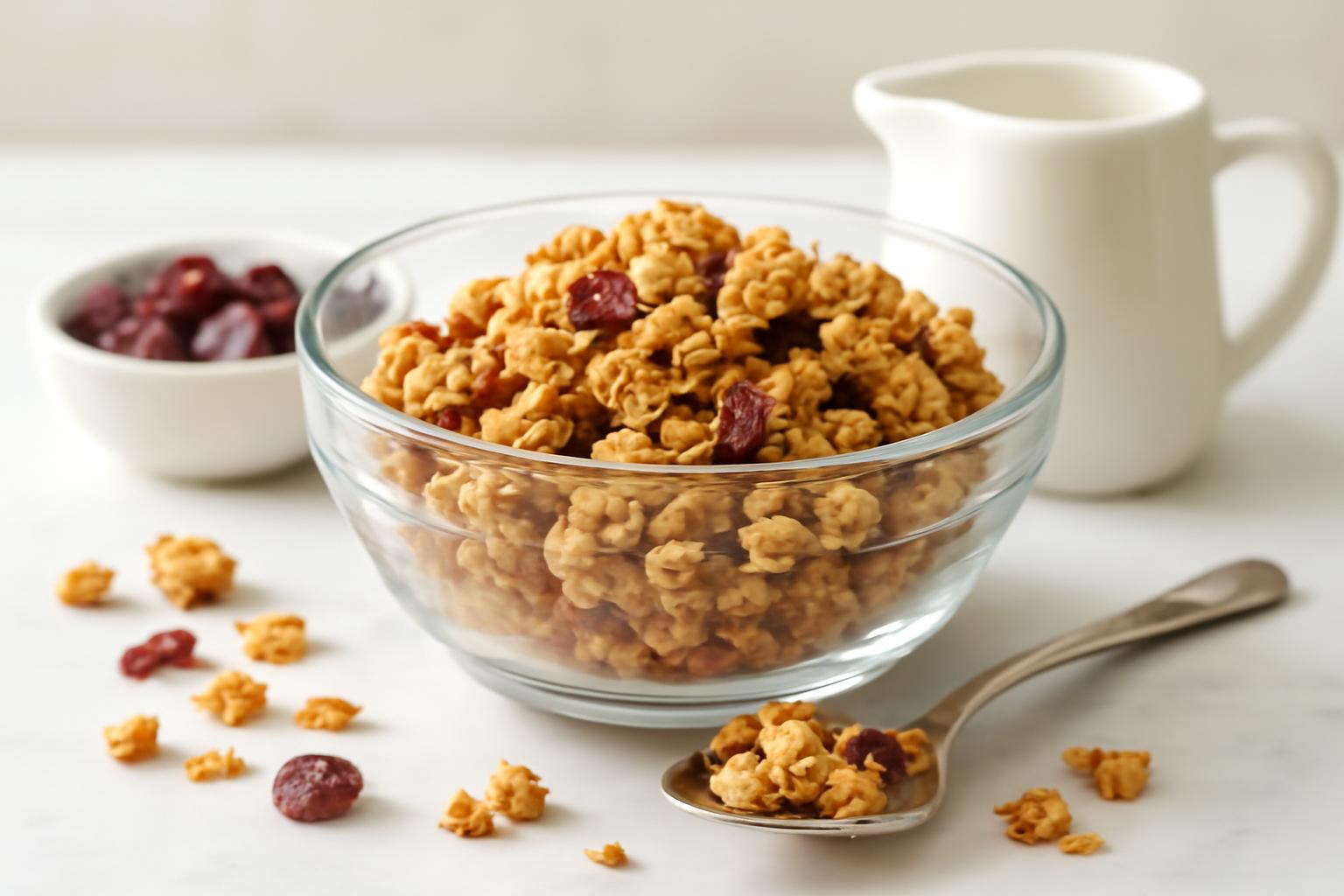
A missing gluten-free claim does not prove granola contains gluten, but grain-based foods carry cross-contact risk. Current ingredients matter too.
Granola can be gluten-free, but it is not automatically gluten-free. Oats do not naturally contain wheat, barley, or rye gluten, yet ordinary oats can pick up those grains during growing, harvesting, transport, storage, or processing. A granola recipe may also include a direct gluten source, such as wheat germ, wheat flour, barley malt, or malt extract.
For a packaged granola in the United States, the most useful first check is a clear “gluten-free” claim on the package, followed by a careful reading of the current ingredient list. If you have celiac disease, an oat-based granola deserves extra attention because the oats and the finished product both need appropriate controls against cross-contact.
Why some granola contains gluten
A basic granola may be made from oats, nuts, seeds, oil, spices, and a sweetener. Many of those ingredients are naturally gluten-free. The answer changes when you look at how the oats were handled and what else was added.
Oats are naturally gluten-free, but cross-contact is common
Oats are often grown and moved through the same agricultural system as wheat, barley, and rye. Shared fields, harvesters, trucks, storage silos, or processing equipment can mix stray gluten-containing grains into an oat supply. The FDA’s gluten-free labeling guidance describes cross-contact at both the agricultural and manufacturing stages.
That is why “made with oats” is not the same claim as “gluten-free.” The first statement identifies an ingredient. The second is a regulated voluntary claim in the United States.
The Celiac Disease Foundation explains that manufacturers generally use one or both of two approaches for gluten-free oats: controls intended to prevent contact throughout production, often called a purity protocol, and mechanical or optical sorting that removes errant grains. It also notes that there is no single standard definition for “purity protocol,” so the phrase alone should not replace checking the finished product’s label. Its guidance on oats and gluten emphasizes that products bearing a U.S. gluten-free claim must still meet the FDA rule regardless of the production approach.
Granola can include gluten-containing ingredients
Even well-controlled oats cannot make a recipe gluten-free if another ingredient introduces gluten. Check the complete list for ingredients such as:
- wheat, wheat flour, wheat germ, or wheat protein;
- barley, rye, spelt, or triticale;
- malt, malt extract, malt syrup, malt flavoring, or malt vinegar when the source is not clearly a gluten-free grain;
- cereal crisps, cookie pieces, pretzels, clusters, or flavor mixes that contain a gluten grain.
Malt is a particularly easy detail to miss. Beyond Celiac’s barley guide explains that barley malt and barley malt extract are not gluten-free and that unqualified “malt” on a U.S. ingredient list usually indicates a barley-derived ingredient. The FDA likewise says malt extract and malt syrup made from barley cannot be used in a food bearing a gluten-free claim unless the applicable gluten-free requirements are met.
How to choose gluten-free granola
Use this order when you are comparing packages. It separates meaningful label evidence from assumptions about how granola is usually made.
1. Look for an explicit gluten-free claim
In the United States, “gluten-free,” “free of gluten,” “without gluten,” and “no gluten” are equivalent regulated claims. A food using one of them must meet the FDA definition, including having less than 20 parts per million of unavoidable gluten. The claim is voluntary, so its absence does not prove that a product contains gluten; however, grain-based foods such as granola have a meaningful cross-contact risk, and the FDA says a gluten-free claim gives consumers an expectation that the finished food meets the rule.
Do not treat phrases such as “naturally gluten-free ingredients” or “made without gluten ingredients” as interchangeable with a regulated gluten-free claim. The FDA specifically cautions that, without the gluten-free claim, consumers should not assume such wording meets every condition of its rule.
2. Read the ingredients every time
Recipes change, and different flavors from one brand can use different grains, inclusions, or flavor systems. Read the package you are about to eat rather than relying on an old online list or another flavor from the same product line.
Check both the main ingredient list and any “Contains” statement, but do not stop there. In the United States, wheat is a major allergen that must be declared under federal allergen-labeling rules, while barley and rye are not part of that same major-allergen declaration. They may still appear in the ingredient list, which is one reason malt and barley deserve a deliberate check.
3. Understand what certification adds
A third-party certification mark is different from the manufacturer’s gluten-free claim. Certification is not required by the FDA, and the agency does not endorse a particular certification program. A certifier may add supplier review, facility auditing, testing, cleaning, training, and other process requirements.
For example, the Gluten-Free Certification Organization describes audits and controls across sourcing, storage, processing, and testing in its oat safety guidance. Certification can therefore provide another layer of assurance, especially for an oat-heavy food. Still, check the exact package: a brand may certify some products but not others.
4. Consider how the granola will be served
A sealed gluten-free package can encounter gluten later. Bulk bins may share scoops. A café may store regular and gluten-free granola beside each other, use the same utensils, or sprinkle both over yogurt at one station. At home, crumbs in a shared container or a scoop that touched another cereal can create the same problem.
The National Institute of Diabetes and Digestive and Kidney Diseases defines cross-contact as gluten-containing food coming into contact with gluten-free food at any point from growing through serving. If cross-contact must be avoided, ask about the original package, storage, scoops, and preparation—not only whether the menu calls the granola gluten-free.
What if the granola is grain-free?
Some granolas replace oats with nuts, seeds, coconut, or other ingredients. That removes the oat-specific cross-contact question, but “grain-free” is not automatically a gluten-free claim. A grain-free recipe can still include a flavoring, coating, chocolate piece, or other component that introduces gluten, and it can still be made on shared equipment.
Check grain-free granola the same way: look for a gluten-free claim, read the full ingredient list, and consider the handling environment. Also remember that grain-free says nothing by itself about calories, sugar, carbohydrates, or allergens. Nut- and seed-based granolas can be energy-dense, and serving sizes vary widely, so use the Nutrition Facts panel for those separate questions.
Can someone with celiac disease eat granola?
Some people with celiac disease include gluten-free oats and oat-based granola in their diet, but a product should not be called safe for every person solely because oats are naturally gluten-free. NIDDK advises people with celiac disease to discuss whether and how much oats to include with a doctor or registered dietitian and to make sure any oats they eat are gluten-free.
There is also individual variability. The Celiac Disease Foundation reports that most people with celiac disease can tolerate moderate amounts of gluten-free oats, while some report symptoms even with gluten-free oats. Oats contain a protein called avenin; if symptoms persist after eating a properly labeled product, that is a reason to stop guessing and discuss the pattern with a qualified clinician. It is not possible to determine from symptoms alone whether the cause was gluten cross-contact, oats, another ingredient, or something unrelated.
For someone newly being evaluated for celiac disease, do not begin a gluten-free diet solely because granola seems to cause symptoms. NIDDK warns that removing gluten before diagnostic testing can make test results inaccurate.
Homemade granola: what makes it gluten-free?
Homemade granola gives you control over ingredients, but the same rules still apply. Start with oats that are labeled gluten-free rather than ordinary bulk oats. Then verify each addition, especially cereal pieces, chocolate, flavor extracts, spice blends, and dried fruit with coatings or added flavoring.
Prevent cross-contact by using clean bowls, pans, measuring tools, and storage containers. If the kitchen also handles wheat flour or regular cereal, clean the work surface and avoid shared wooden or scratched utensils that are difficult to clean thoroughly. Store the finished granola in a clearly marked closed container and use a dedicated scoop when needed.
The practical answer
Granola is gluten-free only when its ingredients and handling support that claim. Oats themselves are not the whole answer: ordinary oats may have agricultural or manufacturing cross-contact, and recipes can add wheat, barley malt, rye, or other gluten sources.
For packaged granola in the United States, look for a current gluten-free claim, read the complete ingredient list, and use certification as optional additional assurance rather than as a substitute for the label. For celiac disease, also account for serving-time cross-contact and personal guidance about oats. When the package or preparation details are unclear, choose a product whose gluten-free status you can verify.