Scallions: Understanding Overlapping Names, Preparation, Cooking, and Storage
Scallions are mild vegetables in the genus Allium, identified by a slender white base and long, hollow green stalks. Both the white and green portions are…
By Mara Solletti · · 9 min read
Overview
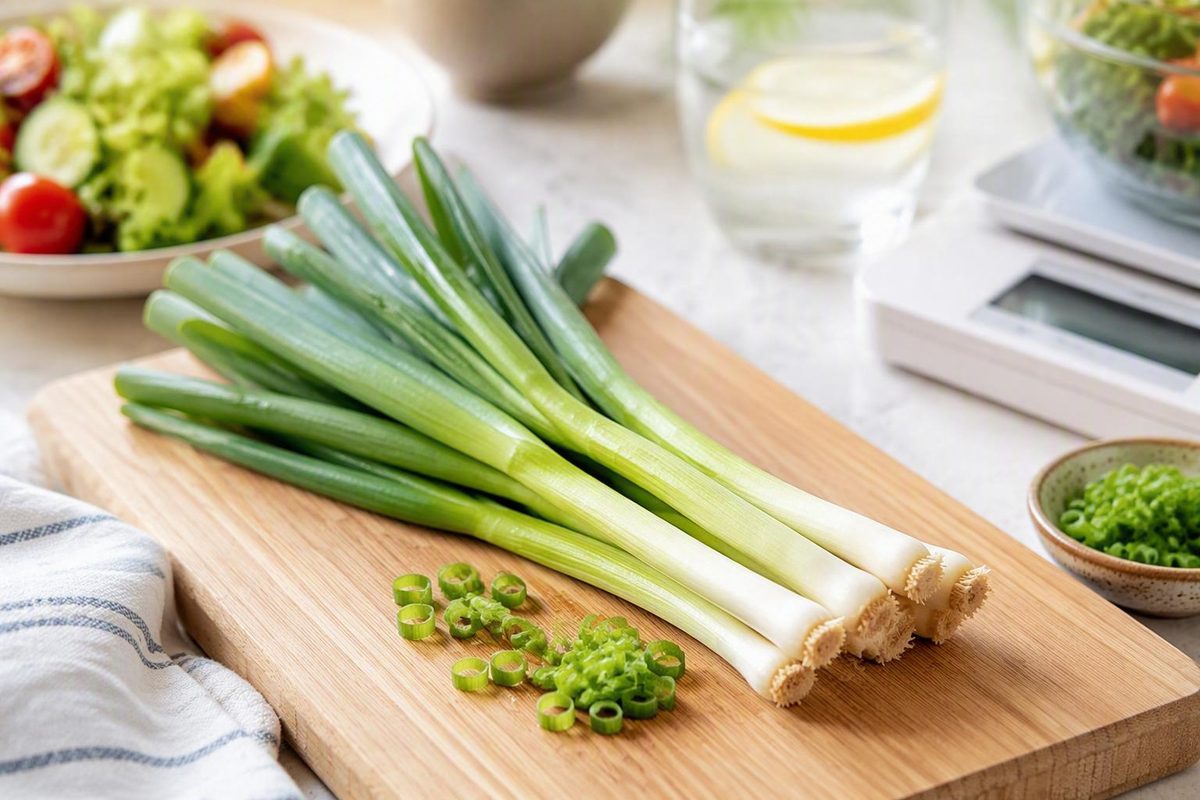
Scallions are mild vegetables in the genus Allium, identified by a slender white base and long, hollow green stalks. Both the white and green portions are edible, raw or cooked, and in everyday grocery usage “green onion” is the same product under a different label. According to Wikipedia’s entry on scallions, they generally have a milder taste than most onions, which is why recipes use them raw in salads and salsas as often as they cook them.
The name is a culinary label rather than an official plant name, and it can apply to more than one Allium species. What defines the ingredient at the store is its shape: Foodwise describes scallions by their small, white undeveloped root and long, hollow, green stalks. For a shopper or home cook, three decisions matter most. First, confirm the label question, since scallions, green onions, and spring onions overlap but are not always identical. Second, prepare the whole stalk instead of discarding healthy green tops. Third, refrigerate the bunch in a way that matches when it will be used. Each of those decisions is covered below.
Scallions, green onions, and spring onions
In common grocery usage, “scallion” and “green onion” name the same product, while “spring onion” is applied both loosely as a synonym and strictly for a plant with a developed, rounded bulb. Wikipedia lists green onion and spring onion as alternative names for scallions, and the University of Arkansas Cooperative Extension Service confirms the terms are commonly used interchangeably while noting that green onions, often called spring onions, have more of a bulb than scallions.
None of these terms is an official single-species name. Wikipedia describes scallions as edible vegetables of various species in the genus Allium, so explanations that tie the word to one species are overbroad. In practice, what a bunch is called at the store often depends on the label the producer chose, not on a botanical rule. The table below summarizes how to read the three labels when they appear on a produce shelf.
| Label | Common grocery usage | Stricter usage | Visible cue |
|---|---|---|---|
| Scallion | Interchangeable with green onion (Naturally Ella: “same thing, just different name”) | Slender, undeveloped white base | Straight white base, long green stalks |
| Green onion | Interchangeable with scallion | Terms overlap; extension guidance notes slightly more bulb development in some usage | Narrow white base, may be slightly swollen |
| Spring onion | Sometimes used loosely for scallions (Wikipedia lists it as an alternative name) | A distinct product with a developed bulb (Wikipedia; UAEX) | Distinct rounded white bulb at the base |
The practical takeaway: for most recipes, a bunch labeled scallions and a bunch labeled green onions behave the same way. A “spring onion” label may signal a genuinely different product in stricter usage, but conventions for “green onion” also vary, so the way to check is to look at the base rather than trust the sign.
The bulb-shape identification rule
The fastest visual check is the base of the stalk. A scallion has a straight or only slightly swollen white base, described by Foodwise as a small, white undeveloped root. A true spring onion, per Wikipedia, looks similar but has a distinctive white bulb at the base, and the Arkansas extension service likewise points to greater bulb development as the distinguishing feature.
Applied at the store: if the white base runs roughly straight into the green stalks, treat the bunch as scallions or green onions regardless of the sign. If the base widens into a clearly rounded bulb, the stricter “spring onion” distinction applies. Labels still vary by store and producer, so the shape of the base is a more reliable guide than the name on the tag.
How to prepare the whole scallion
Both portions of a scallion are edible, so preparation is mostly a matter of cleaning and minimal trimming rather than separating usable parts from waste. Foodwise states that both parts of the scallion can be eaten raw or cooked, and healthy green tops do not need to be discarded as a matter of routine.
The supported preparation sequence is short:
- Rinse the stalks in clear, cold water, per the University of Arkansas extension guidance, working out any grit caught where the leaves meet the base.
- Trim off the roots. Wikipedia notes that the bottom half-centimetre of the root is commonly removed before use.
- Trim the very tops of the greens only if they are damaged or dried out, following the extension service’s instruction to trim roots and the very tops of greens.
- Slice the remaining stalk as the recipe requires: thin rounds for garnish, longer segments for stir-frying or grilling, or a fine mince for a flavor base.
That is the entire job. Everything between the root end and any damaged tips is usable, which matters for reducing waste: a typical recipe direction to “slice the scallions” means the whole stalk, whites and greens together, unless the recipe separates them by part. When a recipe does separate them, the reason is flavor timing, covered in the cooking sections below.
How to cook and serve scallions
Scallions work raw, sautéed, and grilled, and they behave differently from mature bulb onions in one useful way: they cook faster. Naturally Ella notes that scallions can be used in place of regular onions and do not take as long to soften, so they need less time in the pan than a diced yellow onion would.
Raw use is the most common. Because Wikipedia describes their flavor as generally milder than most onions, thin-sliced raw scallions add onion flavor to salads, grain bowls, tacos, and noodle dishes without the harshness of raw bulb onion. Foodwise confirms that both the white and green portions can be eaten raw.
For cooked applications, heat changes the flavor profile rather than just softening the texture. Botanical Kitchen recommends grilling or sautéing scallions, whole or sliced, noting that this brings out sweetness and adds flavor depth. Whole grilled scallions work as a side or a topping; sliced scallions sautéed briefly at the start of a stir-fry or fried rice act as an aromatic base. As a garnish, sliced scallions are added after cooking so they keep their color and fresh bite. The one general rule across all methods is to watch timing: because they soften quickly, a long sauté that suits a bulb onion will overcook a scallion.
White parts and green parts play different roles
The white and green portions differ in intensity, which is why many recipes add them at different stages. Cuisine at Home describes the minced whites as sharp, hot, and oniony, suited to sautéing, and the chopped greens as more herbaceous, mild, and chive-like, suited to garnishing. Both remain edible raw or cooked, per Foodwise; the split is about flavor timing, not edibility.
A compact way to divide the work in a single dish:
- White portions: mince or slice, then sauté early so their sharper flavor mellows and spreads through the dish, the same role a small amount of onion would play.
- Green portions: chop and add at the end of cooking, or scatter raw over the finished dish, so their milder, fresher flavor and green color stay intact.
The tradeoff behind this pattern is straightforward. Heat tames the sharpness of the whites, so cooking them early converts their intensity into a background flavor base. The greens have less sharpness to lose and more freshness to protect, so late addition preserves what they contribute. In practice, this means slicing one bunch and keeping the whites and greens in separate piles: whites into the pan first, greens over the plate last. When a recipe does not distinguish, using both together is fine; the dish simply gets a blend of the two intensities.
How to choose and refrigerate scallions
Choosing and storing scallions is one connected decision: pick the freshest bunch available, then match the storage method to when you plan to use it. Naturally Ella describes the target at the store as stiff, well-colored green tops with creamy white bases, and the University of Arkansas extension service advises refrigerating green onions for up to one week, a figure best read as an estimate rather than a guarantee.
The logic is that scallions are a short-horizon purchase. A bunch bought in good condition and used within a week fits comfortably inside the supported storage window; a bunch already limp at purchase starts closer to the end of that window. The two subsections below cover the selection cues and the two supported refrigeration methods in detail.
Freshness cues at the store
A fresh bunch shows firmness and full color from top to base. Naturally Ella’s ingredient guide gives the specific criteria: look for scallions with stiff, well-colored green tops and creamy, white bases, with no limpness, browning, or shriveled-looking whites.
Checking a bunch takes a few seconds:
- Green tops should stand stiff and show even, deep green color, not yellowing or translucent patches.
- White bases should look creamy and plump, not shriveled or dried.
- The whole bunch should be free of limpness and browning.
If two bunches sit side by side, these cues break the tie. Since the same signs, limpness, browning, and shriveling, are also how stored scallions show decline, the fresher bunch at purchase gives the longer usable window at home.
Choose a storage method by intended use time
The supplied sources support two refrigeration approaches, and the sensible way to pick between them is by intended use time. Naturally Ella describes both: for scallions that will be used within a couple of days, place the bunch in the crisper drawer; for storage aiming at up to a week, stand the scallions upright in a jar with water and cover them loosely with a plastic bag. That week-long horizon matches the Arkansas extension service’s guidance to store green onions in the refrigerator for up to 1 week.
In practice:
- Using within a few days: the crisper drawer is sufficient and requires no setup.
- Aiming for closer to a week: the upright jar of water with a loose plastic-bag cover is the supported longer-horizon option.
One limitation is worth stating plainly. These sources describe household methods and approximate durations; they do not compare the two methods under controlled conditions, so the evidence cannot establish which one better prevents wilting or sliminess. Treat both as reasonable options matched to a time horizon, and treat the one-week figure as an estimate that depends on the condition of the bunch at purchase, not a fixed shelf life.
Signs scallions have lost quality
Stored scallions signal decline through the same visible changes that mark a poor bunch at the store: increasing limpness, browning on the greens, and shriveling of the white bases. These cues come from Naturally Ella’s selection criteria, which flag limpness, browning, and shriveled whites as the conditions to avoid.
These are quality indicators, not food-safety thresholds. The supplied sources do not define a point at which scallions become unsafe to eat, so no discard rule can be stated from this evidence. What the cues do support is a practical judgment: a bunch that is progressively limper, browner, or more shriveled is past its best texture and flavor, and lightly declining greens are better used cooked, where softness matters less, than raw as a garnish.