
Understanding are banana chips good for you
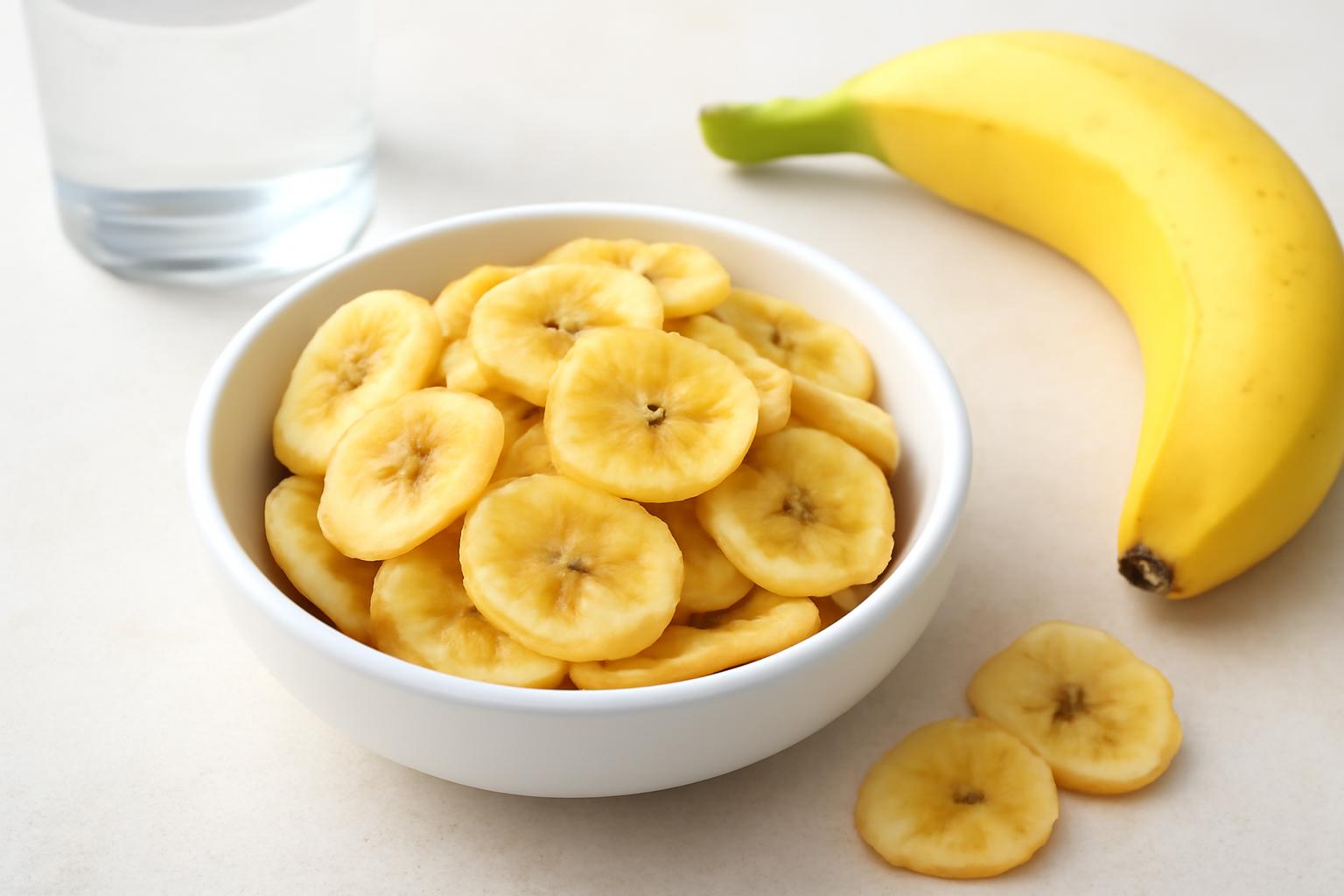
A typical 1-ounce serving can contain around 147 calories, about 10 grams of fat, roughly 8 grams of saturated fat, and about 10 grams of sugar.
Short answer: usually not, if you mean the common store-bought fried kind.
Most banana chips sold as snacks are not just dried banana. They are often sliced bananas fried in oil, commonly sweetened, and then packaged as a crunchy snack. Across USDA-linked entries, a common profile is about 147 calories, 9.5 to 10 grams of fat, around 8 grams of saturated fat, 17 grams of carbs, 2 grams of fiber, and 10 grams of sugar per 1 ounce (28 g). That is very different from eating a fresh banana.
That does not mean every banana-based crunchy snack is the same. Plain dehydrated or freeze-dried banana slices without added oil or sugar are a different category. They are still concentrated and easy to overeat, but they are generally a better choice than the typical fried, sugar-coated version.
So if you are asking, “are banana chips good for you?”, the practical answer is:
- Fresh bananas are the better everyday choice
- Standard fried banana chips are better treated as a snack food, not a fruit equivalent
- Single-ingredient dried versions can be reasonable convenience foods, but they still need portion control
The key is not the word banana. The key is how the product was made.
What are banana chips good for you means
In practical terms, this topic is really asking a few different questions at once:
- Are banana chips a healthy snack?
- Are they healthier than other chips?
- Are they a good replacement for fresh fruit?
- Are they useful for specific goals like convenience, satiety, or calorie control?
Those are not identical questions, so the answer changes depending on what you care about.
“Good for you” is not one thing
A food can be good in one sense and weak in another.
Banana chips may be:
- Convenient because they travel well and keep longer than fresh fruit
- Pleasant to eat because they are sweet and crunchy
- A source of some fiber and potassium
But they may also be:
- High in calories for a small portion
- High in saturated fat if fried in coconut or palm oil
- Higher in sugar, including added sugar, than people expect
- Less filling than snacks with more protein
So “good for you” depends on your standard.
If your standard is least processed, everyday fruit, banana chips usually lose to fresh bananas.
If your standard is better than candy or pastries, some banana chip products may look more reasonable in small amounts.
If your standard is a filling snack for appetite control, banana chips are usually not impressive because they are low in protein and easy to overeat.
Why people get confused
Banana chips benefit from a strong “fruit halo.” The package says banana, so many people assume the product behaves nutritionally like fruit.
Usually, it does not.
A fresh medium banana is roughly 105 calories and nearly fat-free. Typical fried banana chips are far more calorie-dense because two things happen:
- Water is removed, concentrating the fruit
- Oil and often sugar are added, changing the food further
That means banana chips are not best understood as “banana, but crunchy.” In many cases they are better understood as a fried sweet snack made from banana.
The right practical question
A better version of the original question is:
Which kind of banana chips are you talking about, and what are you trying to use them for?
That framing leads to better decisions than asking whether they are simply healthy or unhealthy.
For most readers, the most useful interpretation is this:
- Common fried banana chips: not a great everyday health food
- Plain dried banana slices: better, but still concentrated
- Fresh bananas: the strongest default option
How are banana chips good for you works
The answer starts with how banana chips are made, because the production method largely determines whether the final product is closer to fruit or closer to snack food.
Start with the banana itself
A fresh banana naturally contains:
- carbohydrate
- some fiber
- potassium
- vitamin B6
- very little fat
That starting point matters, because bananas are not the problem. The main nutritional shift comes from processing.
Step 1: water is removed
Drying or crisping a banana removes much of its water.
This has one immediate effect: the calories become more concentrated per bite.
A fresh banana is bulky partly because it contains water. Once that water is removed, the same fruit takes up much less space, so you can eat the equivalent of more banana more quickly without feeling like you ate much.
That is one reason dried fruit in general is easy to overconsume, even before oil or sugar enters the picture.
Step 2: some products are fried
The common commercial version of banana chips is not just dried. It is often fried in oil, with coconut oil or palm oil appearing often in ingredient lists and USDA-linked entries.
Frying changes the product in a few important ways:
- it adds fat
- it often raises saturated fat substantially
- it increases calories
- it gives the crisp texture many people like
This is where the biggest nutritional gap opens up between fresh bananas and standard banana chips.
A common USDA-linked 1-ounce serving shows roughly:
- 147 calories
- 9.5 to 10 g total fat
- about 8 g saturated fat
- 17 g carbohydrate
- 2 g fiber
- 10 g sugar
- around 1 g protein
- about 150 mg potassium
That is a very calorie-dense ounce for a snack that still does not provide much protein or much staying power.
Step 3: some products are sweetened
Many banana chip products also include added sugar or a sugar coating.
One USDA-linked entry lists the ingredients as:
- banana
- coconut oil
- sugar
That matters because people often assume the sweetness comes only from banana’s natural sugars. Sometimes it does not.
In a common 1-ounce profile, about 6 grams of the 10 grams of sugar are added sugar. In larger serving formats, such as the commonly cited 1 cup / 72 g entry, total sugar is around 25 grams.
Step 4: the texture changes how you eat them
Fresh bananas are soft, bulky, and self-limiting. Banana chips are crunchy, light, shelf-stable, and easy to snack on mindlessly.
That matters more than it sounds.
Even when a food starts from fruit, the combination of:
- concentrated calories
- small volume
- crisp texture
- sweetness
- long shelf life
can make it easier to keep eating past the point where a fresh banana would have felt like enough.
Step 5: the nutritional positives remain, but usually not enough
Banana chips are not nutritionally empty.
They can still provide:
- some fiber
- some potassium
- small amounts of other micronutrients
- often very low sodium
But for the common fried version, those benefits are usually described as modest relative to the calories, saturated fat, and added sugar.
That is why many reviews arrive at roughly the same conclusion: the product still contains some banana-derived nutrients, but the overall package is not especially strong as an everyday health food.
Step 6: satiety is a weak point
One underappreciated issue is fullness.
Most banana chip profiles are very low in protein. A common ounce has about 1 gram of protein or less. That matters because protein is generally the most filling macronutrient, with a higher thermic effect and stronger satiety signaling than fat or carbohydrate.
So from a hunger-management perspective, banana chips often give you:
- a meaningful calorie load
- very little protein
- limited staying power
That does not make them forbidden. It just means they are often a poor bargain if your goal is to feel full on fewer calories.
The start-to-finish summary
Here is the full chain in plain language:
- A banana begins as a relatively low-fat whole fruit.
- Water is removed, making the calories denser.
- If the slices are fried, oil adds a lot of fat.
- If they are sweetened, sugar rises further.
- The crunchy, compact result is easy to overeat.
- You still get some fiber and potassium, but often not enough to outweigh the calorie and saturated fat load.
That is how the same word—banana—can lead to two very different foods.
The main approaches
If you want a useful answer, compare banana chips by processing type, not by name alone.
1. Fresh bananas
This is the clearest baseline.
Best for: - an everyday fruit serving - lower calorie density - minimal processing - avoiding added fat
Why it usually wins: A medium banana is around 105 calories with negligible fat. It gives you the fruit without added oil and without the concentration effect that makes dried snacks so easy to overeat.
Main downside: Fresh bananas are less portable, more perishable, and do not give the same crunchy texture.
2. Standard fried banana chips
This is the most common product people mean.
Typical profile: About 147 calories per ounce, with 8 grams of saturated fat and 10 grams of sugar being a common USDA-linked reference point.
Best for: - occasional snacking - taste and crunch - shelf stability
Main downside: These are usually the weakest choice nutritionally because they combine concentrated fruit with added oil and often added sugar.
If you buy them expecting a fruit-equivalent snack, you are likely overrating them.
3. Baked or dehydrated banana slices
These sit in the middle.
Best for: - people who want banana flavor without frying - homemade versions where you control ingredients - lower-fat alternatives to standard chips
Potential advantages: If there is no added oil and no added sugar, these are generally a more favorable option than the fried version.
Main downside: They are still concentrated dried fruit. Even without added sugar, the sugars present are more concentrated per bite than in fresh fruit. They can still be easy to overeat.
Also, “baked” is not automatically healthy. Some baked products are still sugar-coated.
4. Freeze-dried banana slices
These are often presented as the best packaged option, and the basic logic is sound.
Best for: - a crunchy fruit product with no frying - ingredient lists that ideally just say banana - better alignment with whole-fruit nutrition
Potential advantages: Commercial sources that sell freeze-dried products describe them as retaining more of the original banana profile and avoiding added oil. That makes them conceptually stronger than fried banana chips.
Main downside: The evidence around freeze-dried products is less standardized than the common USDA-style data for fried banana chips, and many enthusiastic claims come from sellers. So the right move is not blind trust. It is label verification.
In practice, a single-ingredient freeze-dried product is usually a better bet than a fried one—but still a concentrated snack, not magic fruit.
5. Product-specific outliers
A few brand-specific entries show much lower saturated fat than the common fried profile.
That tells you something important: not all banana chips are nutritionally identical.
But it does not change the general rule. It means you should read the label before generalizing. The category is wide enough that two bags on the same shelf may behave very differently.
A simple comparison table
| Option | Usually the better use | Main strength | Main weakness |
|---|---|---|---|
| Fresh banana | Everyday fruit | Least processed, lower calorie density | Less crunchy, shorter shelf life |
| Fried banana chips | Occasional treat/snack | Crunchy, portable, long shelf life | High calories, saturated fat, often added sugar |
| Plain dehydrated banana | Better convenience choice | No frying if truly plain | Still concentrated and easy to overeat |
| Freeze-dried banana | Best crunchy fruit-style packaged option | Often single ingredient, no oil | Can be expensive; label still needs checking |
Are banana chips healthier than potato chips?
This is where the evidence gets mixed.
Some sources note that banana chips may offer: - slightly more fiber - lower sodium in some products
Others point out that they may be: - comparable in calories - worse on saturated fat - worse on sugar if sweetened
The safest conclusion is: do not assume banana chips are healthier than potato chips just because they come from fruit. Sometimes they may be better in one metric and worse in another. You have to compare the actual label.
Are banana chips better than candy?
Often, yes, they may compare more favorably than candy or pastries in some situations, especially if the portion is small and the product is less processed.
But that is a low bar. “Better than candy” is not the same as “good everyday nutrition.”
A practical process
If you want to decide whether banana chips are good for you in real life, use a short evaluation process instead of guessing from the front of the package.
Step 1: decide what role the food is supposed to play
Ask yourself which of these you want:
- a fruit serving
- a crunchy snack
- a travel-friendly food
- an appetite-controlling snack
- an occasional sweet treat
This matters because banana chips are weak at some jobs and fine at others.
For example:
- If you want a fruit serving, fresh banana usually wins.
- If you want crunchy convenience, a plain dried or freeze-dried version may be good enough.
- If you want strong fullness per calorie, banana chips are usually not ideal because they are low in protein.
Step 2: read the ingredient list before the nutrition panel
The ingredient list tells you what kind of product you are dealing with.
A short, favorable list might look like:
- banana
A more caution-worthy list might look like:
- banana
- coconut oil
- sugar
That one change tells you a lot. If oil and sugar show up early, you are probably not buying fruit in any meaningful everyday sense. You are buying a snack food made from fruit.
Step 3: standardize the serving size
This is one of the biggest mistakes people make.
Banana chip numbers get reported in all kinds of ways:
- 1 oz
- 1/3 cup
- 1/2 cup
- 60 g
- 72 g
- 1 cup
That makes easy comparisons difficult.
The simplest fix is to convert everything to per 1 ounce (28 g) if you can. For the common fried profile, that lands around:
- 147 calories
- 10 g fat
- 8 g saturated fat
- 17 g carbs
- 2 g fiber
- 10 g sugar
- 1 g protein
Once you see the product in that format, it becomes much easier to judge.
Step 4: check four things first
If you only look at four parts of the label, make them these:
- Calories
- Saturated fat
- Added sugar
- Protein
Why these four?
- Calories tell you how dense the snack is.
- Saturated fat is where many fried banana chips look especially weak.
- Added sugar tells you whether sweetness is just fruit or more than fruit.
- Protein helps you estimate fullness.
For many standard fried products, the pattern is not great: high calories for the volume, high saturated fat, some added sugar, and very low protein.
Step 5: do not let low sodium distract you
Low sodium is one of the more consistent positives across many banana chip entries.
That is fine, but it is not enough.
A snack being low in sodium does not automatically make it a strong health choice if it is still high in saturated fat and easy to overeat.
Low sodium is a useful detail, not a verdict.
Step 6: compare it to the alternative you would actually eat
The right comparison is not always banana chips versus fresh bananas.
Sometimes your real choice is between:
- banana chips and candy
- banana chips and cookies
- banana chips and potato chips
- banana chips and a protein-rich snack
- banana chips and nothing until later
That context matters.
If your true alternative is candy, some banana chip products may be the more reasonable choice.
If your true alternative is fresh fruit or a more filling snack, banana chips usually look weaker.
Step 7: choose the portion before you start
This matters more than with fresh fruit.
Because water has been removed, a small amount of banana chips can carry more calories than it looks like. If you eat directly from the bag, it is easy to turn a one-ounce serving into two or three ounces without noticing.
A practical move is to decide the portion first rather than letting the bag decide it for you.
Step 8: notice how filling they actually are for you
The label tells you part of the story. Your appetite tells you the rest.
If banana chips leave you hungry 20 minutes later, that is not a moral issue. It just means the snack may be a poor fit for your goal.
That is especially relevant if you are using the word “healthy” to mean “helps me manage hunger and total intake.” Low-protein snacks often struggle there.
A 30-second label test
If you need a fast store rule, use this:
- Single ingredient banana? Better sign.
- Oil and sugar added? More caution.
- High saturated fat per small serving? Treat as snack food, not fruit.
- Tiny serving size but you know you will eat the bag? Judge the whole bag, not the label fantasy.
That simple filter will get you most of the way.
Common mistakes and tradeoffs
Banana chips are a classic food for nutrition misreads because the packaging cues suggest fruit while the nutrition often behaves more like snack food.
Mistake 1: assuming “made from fruit” means “healthy”
This is the biggest one.
Being made from banana does not guarantee the final product still behaves like fruit in practical nutrition terms.
Once oil, sugar, and dehydration enter the picture, the health picture changes.
Mistake 2: ignoring serving size games
A product can look moderate until you notice the serving size is small and the bag holds several servings.
Because banana chips are light and easy to snack on, real intake often exceeds the listed serving.
Mistake 3: focusing on the positives and missing the main negatives
People often notice:
- potassium
- fiber
- low sodium
and stop there.
Those are real positives, but for typical fried banana chips they usually do not outweigh:
- high calorie density
- high saturated fat
- added sugar in many products
- very low protein
Mistake 4: comparing volume instead of weight
A bowl of banana chips does not look as heavy or substantial as the calories it carries.
That is a dehydration problem, not a labeling problem. Once the water is gone, the food shrinks. Your eyes can easily underestimate what you are eating.
Mistake 5: trusting marketing words too much
Terms like:
- natural
- baked
- fruit snack
- vacuum-fried
- no preservatives
can all sound reassuring.
Sometimes they do reflect a better product. Sometimes they do not.
The label still matters more than the marketing language. A “baked” product can still be sweetened. A “natural” product can still be calorie-dense. A “fruit snack” can still be mostly sugar and oil.
Mistake 6: treating banana chips as a weight-loss snack by default
This is where satiety matters.
Because banana chips are low in protein and easy to overeat, they are often not a great choice if your goal is to stay full while controlling calories. That does not mean they cannot fit into a calorie-controlled diet. It means they usually are not the most efficient snack for that purpose.
Mistake 7: assuming all banana chips are equally bad
This mistake runs the other direction.
Some products really are better than others. A single-ingredient freeze-dried or plain dehydrated banana product is not nutritionally equivalent to a sugar-coated fried chip.
So the right view is not “all banana chips are unhealthy.” It is “the category has a big split, and the label tells you which side you are on.”
Tradeoff 1: convenience versus nutrition quality
Banana chips are portable, shelf-stable, and low-mess. Fresh bananas are less durable.
That is a real advantage. It just comes with a nutritional price in many products.
Tradeoff 2: crunch versus calorie density
The crunchy texture is part of why people buy banana chips.
But crispness often arrives through drying and sometimes frying, both of which can make the food much more energy-dense than the original fruit.
Tradeoff 3: shelf life versus portion control
Long shelf life is useful.
It also means the food sits around ready to be grabbed repeatedly, which can encourage frequent snacking. That is not unique to banana chips, but it matters more when the food is concentrated.
Tradeoff 4: better ingredients versus higher cost
The more favorable versions—especially single-ingredient dried products—may cost more than standard fried banana chips.
That does not make them automatically better value for everyone. It just means there is usually a tradeoff between price, processing quality, and convenience.
What about frying-related contaminants?
Some commercial sources warn about compounds formed during frying. That may be a legitimate area of concern, but the evidence presented in the source pack is thinner and less standardized than the more straightforward issues of calories, saturated fat, and added sugar.
In practice, you do not need to resolve that debate to make a useful choice. The better-established concerns are already enough to guide most shoppers.
How to choose the next step
If you want a sound decision, do not ask whether banana chips are universally good or bad. Ask which next action fits your goal.
If your goal is the healthiest everyday default
Choose fresh bananas.
They are less processed, lower in calorie density, nearly fat-free, and much easier to understand nutritionally.
If your goal is a portable fruit-based snack
Look for single-ingredient freeze-dried or plain dehydrated banana slices.
You still need portion awareness, but these are generally a better fit than the standard fried version.
If your goal is crunch and you enjoy classic banana chips
Treat them as an occasional snack, not a fruit replacement.
That framing is honest and useful. Plenty of foods can fit occasionally without needing to be rebranded as health foods.
If your goal is appetite control or dieting efficiency
Be cautious.
Typical banana chips are low in protein and easy to overeat, which makes them a weaker choice for fullness than many other snacks. If satiety matters most, banana chips are usually not the strongest option.
If your goal is comparing products in the store
Use this order:
- ingredient list
- serving size
- calories per ounce
- saturated fat
- added sugar
- protein
If the product is mostly banana, that is a better sign. If it is banana plus oil plus sugar, judge it accordingly.
A simple decision rule
You can reduce the whole topic to this:
- Fresh banana: best default
- Plain dried banana: reasonable convenience choice
- Fried sweetened banana chips: snack food, not health food
That rule will be right more often than not.
Your concrete next step
The next time you buy or eat banana chips, answer these three questions before opening the bag:
- Does the ingredient list say only banana, or does it add oil and sugar?
- How much saturated fat and sugar are in the amount I will actually eat, not just the listed serving?
- Am I choosing this as fruit, as a convenience snack, or as a treat?
If you do that, the decision gets much clearer very quickly.
If you have a medical condition or a prescribed diet, treat this as general information and get personal guidance before making bigger dietary changes.
What should a beginner know about are banana chips good for you?
A beginner should know that “banana chips” can mean very different products.
The common store version is often fried and sweetened, which makes it much more calorie-dense than fresh banana. A typical 1-ounce serving can contain around 147 calories, about 10 grams of fat, roughly 8 grams of saturated fat, and about 10 grams of sugar.
So the beginner rule is simple: do not assume banana chips are equivalent to fruit just because they come from bananas.
If you are new to evaluating them, start with the ingredient list:
- banana only is usually a better sign
- banana, oil, sugar usually means a snack-food version
And remember that fresh bananas are usually the better everyday choice.
What are the main risks of are banana chips good for you?
The main risks are mostly practical nutrition risks rather than mysterious ones.
For typical fried banana chips, the main concerns are:
- high calorie density
- high saturated fat
- added sugar in many products
- easy overeating because they are concentrated and crunchy
- low protein, which can make them less filling
There is also a common judgment error: people may eat them more freely because they think of them as fruit.
A few sources also raise concerns about frying-related compounds, but the clearest and most consistent concerns are still the basic label issues: calories, saturated fat, sugar, and portion size.
How do you evaluate are banana chips good for you options?
Evaluate them in this order:
-
Ingredient list If it is just banana, that is usually better than banana plus oil and sugar.
-
Serving size Standardize to 1 ounce if possible so products are easier to compare.
-
Calories and saturated fat These often separate fried products from less processed ones quickly.
-
Added sugar This tells you whether sweetness comes only from fruit or from extra sweetening.
-
Protein and fiber These help you estimate how filling the snack may be.
-
Your actual use case Are you trying to replace fruit, satisfy a craving, or carry a shelf-stable snack?
If you want the shortest possible rule: choose fresh first, plain dried second, fried sweetened last.