
The Hidden Calorie Math in a Bag of Chips: What Labels Really Tell You
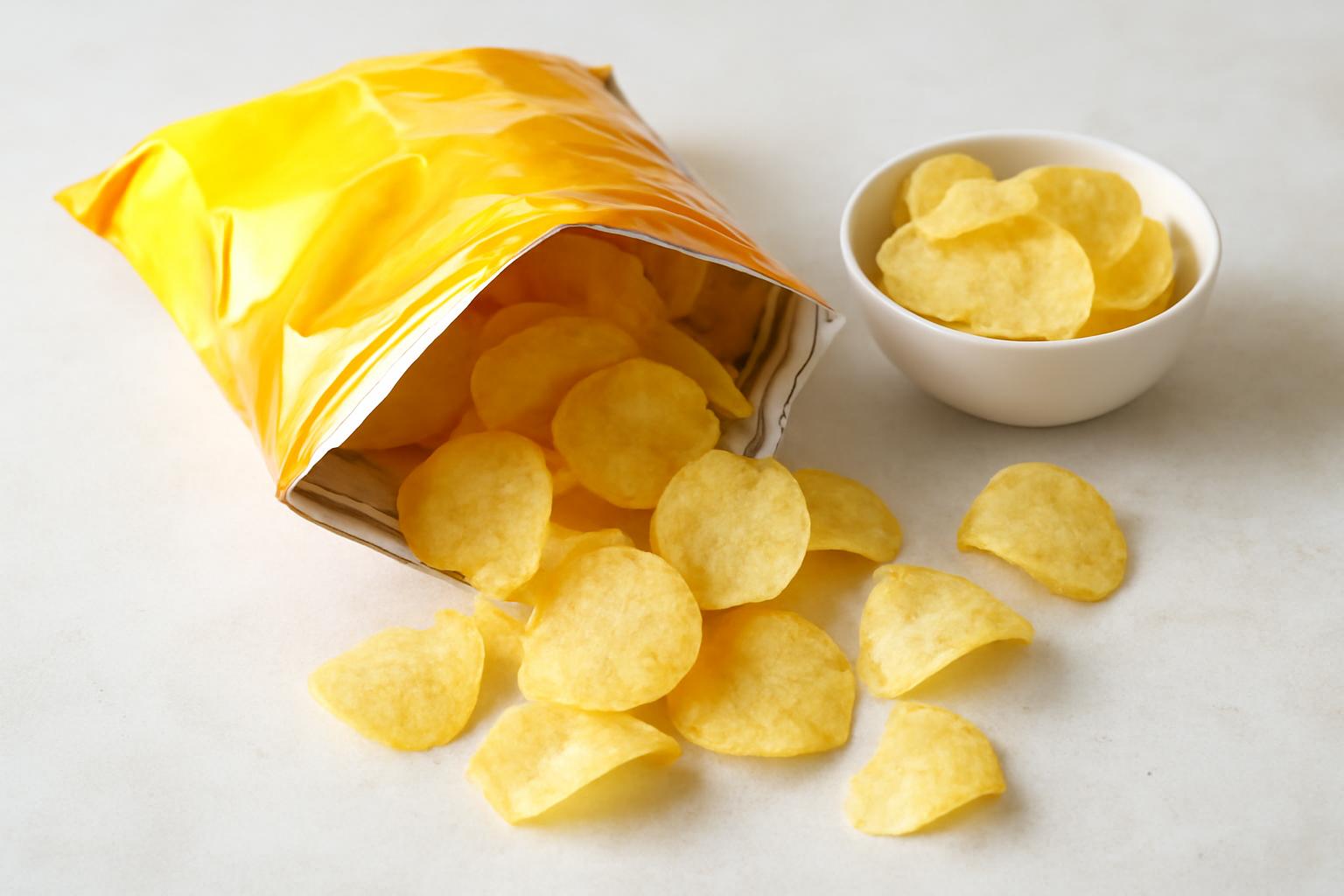
A bag labeled 150 calories per serving and 2.5 servings per container has 375 calories in total, rather than 150 for the whole package.
A bag of chips looks like one food item. For tracking purposes, that is often the mistake.
When people search for bag of chips calories, they usually want a single number. But the label on the package is not always answering that question. Most chip bags are labeled per serving, and the serving may be much smaller than what you casually eat in one sitting. If you treat the bag in your hand as the unit the label is describing, you can undercount fast.
The good news is that chip math is not hard once you know where to look. Three habits do most of the work:
- Read serving size and servings per container before you read calories.
- Convert odd portions by grams, not by rough handfuls.
- Treat label calories as useful estimates, not exact physiological measurements.
Do that, and a bag of chips stops being a tracking trap. It becomes a label-reading exercise.
Why Bags of Chips Challenge Calorie Tracking
Chip bags feel misleading because your eyes register the package, while the Nutrition Facts panel often answers a narrower question: what is in one serving? The FDA explains that serving sizes reflect amounts people typically eat, not recommended amounts, and that larger packages may use dual-column labels showing both per serving and per package values; it also notes that % Daily Value is based on a 2,000-calorie reference diet, which may not match your own needs (FDA guide to the Nutrition Facts label).
That setup creates a very ordinary error. You glance at “150” or “160 calories,” assume that number belongs to the whole bag, and move on. But if the bag contains 2, 2.5, or 3 servings, the number you logged is only a fraction of what you actually ate.
Chips make this easier to do than many other foods. They are dry, salty, and light. They are often eaten straight from the package rather than plated. They do not create a clear stopping point the way a sandwich, yogurt cup, or protein bar does. Most people do not pause halfway through an open bag and ask whether they have eaten 28 grams or 63 grams.
There is also a psychological mismatch built into the label. The package is the unit you purchased, opened, and finished. The label may be built around a smaller unit that matters for regulation but not for how you snack. That does not make the label deceptive. It just means you have to translate it.
A second source of confusion is the 2,000-calorie framework behind the label. It is a reference point, not a personalized target. Two people can eat the same bag of chips and have very different calorie budgets, sodium priorities, or macro targets. So even when the label is doing exactly what it is supposed to do, it may still feel out of sync with real-life tracking.
The practical takeaway is simple: a bag of chips is not automatically one labeled unit. Until you verify serving size and servings per container, you do not yet know what the calorie number means.
Decoding Serving Size and Servings Per Container
Start at the top of the label, not the middle. The serving size sits there for a reason: every calorie, macro, and nutrient number below it is calculated from that amount.
An educational label example often used to show how badly people can misread snack foods imagines a bag of potato chips labeled 160 calories per serving, with 15 chips per serving and 15 servings per container. That would mean 2,400 calories for the full bag, not 160. The point of the example is not that every bag is that large, but that the math changes completely once you multiply calories per serving by servings per container (food-label example).
That multiplication is the core rule:
- Calories per serving tell you the energy in the label unit.
- Servings per container tell you how many of those units are in the package.
- Full-bag calories are the two multiplied together.
So if a bag lists 150 calories per serving and 2.5 servings per container, the whole bag is 375 calories. If it lists 160 calories per serving and 3 servings per container, the whole bag is 480 calories. If it lists 150 calories and 1 serving per container, then yes, the bag is 150 calories. The only way to know which situation you are in is to read both lines together.
Serving size is also often smaller than what people would naturally eat. Ohio State Wexner Medical Center notes that the serving size appears in bold at the top of the label, may be much less than what you normally consume, and that people may discover they are eating two to three servings at a meal when they thought they were eating one (Ohio State label guide).
That matters with chips because household measures can create false confidence. A label might say “15 chips (28g).” The chip count helps you picture the serving, but the gram weight is usually the better anchor. Chips vary in size, thickness, curvature, breakage, and oil uptake. Fifteen perfectly uniform chips would be convenient; real bags are messier than that.
For accurate logging, the order of trust is usually:
- Gram weight
- Household measure
- Chip count
There is another reason to prioritize weight: it makes partial portions easy. If you eat a random amount from a bowl or directly from the bag, you can still log it accurately if you know the grams eaten. That is much harder to reconstruct from memory as “maybe 12 chips” or “one and a half handfuls.”
If you want one practical rule from this section, it is this: trust the grams before the chip count.
Calories and Percent Daily Value (%DV) Explained
Once you have identified the serving unit, calories become straightforward. On a standard label, the calorie number refers to one serving unless the package includes a separate per-package column. % Daily Value, or %DV, is answering a different question: how much one serving contributes to a standard daily intake for that nutrient.
The FDA’s rule of thumb is that 5% DV or less is low and 20% DV or more is high. On the same 2,000-calorie reference diet used for label calculations, Daily Values include 20 grams for saturated fat and 2,300 milligrams for sodium (FDA %DV explanation).
That distinction matters because chips are rarely just a calorie issue.
But if that serving also carries a notable share of your sodium or saturated fat limit, the nutritional cost of the bag rises faster than the calorie number alone suggests. Three servings do not just triple calories. They triple sodium, saturated fat, and everything else listed per serving.
This is where %DV becomes useful. It gives you a quick way to see where a bag is expensive. If sodium is already high per serving, finishing the bag may matter much more for sodium than you realized. If saturated fat is high per serving, the same logic applies.
Fiber is usually the opposite story. The American Diabetes Association says healthy adults generally need about 25 to 38 grams of fiber per day on average (ADA food-label explainer).
So the label gives you two different tools:
- Calories help you budget energy.
- %DV helps you judge nutrient load.
For chips, the pattern is often predictable. The calories may seem manageable in one serving, while sodium and fat become the more meaningful constraints when the portion expands. That is why two bags with similar calories can feel different from a tracking perspective: one may be relatively easy to fit, while the other is “expensive” in sodium or saturated fat.
A good way to read a chip label is to ask three quick questions in order:
- What is one serving?
- How many servings am I actually eating?
- Which nutrients get expensive fastest when I multiply?
That last question is what %DV is for.
Calculating Calories for Partial Bags
If you eat only part of a bag, weight-based math is the cleanest method.
When the label gives nutrition per 100 grams, use:
Calories eaten = (grams eaten / 100) × calories per 100g
If a bag lists 522 calories per 100 grams and you eat 18 grams, the calculation is:
(18 / 100) × 522 = 93.96
Rounded for logging, that is 94 calories.
You can do the same math a second way by converting the food to calories per gram first:
522 ÷ 100 = 5.22 calories per gram
Then:
5.22 × 18 = 93.96
Same answer, different route.
If your label is built around a serving rather than 100 grams, the logic stays the same. Suppose the serving is 28 grams and 150 calories. First find calories per gram:
150 ÷ 28 = 5.36 calories per gram Then multiply by what you ate.
So if you ate 14 grams:
5.36 × 14 ≈ 75 calories
If you ate 35 grams:
5.36 × 35 ≈ 188 calories
This works because chip calories scale roughly with weight. Double the grams and you roughly double the calories. Half the grams and you roughly halve the calories.
For tracking, that means you do not need the perfect number of chips. You need a decent weight and ordinary arithmetic.
Three easy ways to do that:
- Weigh the portion before eating.
- Weigh the full bag, then weigh what remains.
- Pour chips into a bowl and weigh the bowl portion.
The before-and-after method is especially helpful if you tend to snack from the package. You do not have to guess afterward how much was eaten. The scale tells you.
Weight-based logging is also useful because chip count becomes less reliable as soon as the bag contains broken pieces.
If you want a shortcut, build your own conversion rule from the label. Once you know a product is about 5.3 calories per gram or 530 calories per 100 grams, weird portions become routine. A 17-gram nibble, a 41-gram movie snack, or the last 9 grams in a half-finished bag all become simple math instead of guesswork.
This is where calorie tracking gets much easier than people expect. The hard part is not advanced nutrition science. It is just remembering that “part of a bag” is best logged by weight, not by intuition.
How Labels Calculate Chip Calories: The Atwater System
Food labels are estimates partly because the calorie number is not determined by burning every bag of chips and measuring that exact package’s usable energy. Modern labels are generally built from the Atwater system, which assigns average calorie values of 4 calories per gram of carbohydrate, 4 per gram of protein, and 9 per gram of fat; labels also round values for display rather than reporting lab-perfect decimals (how food-label calories are calculated).
That is useful, but it is not the same thing as saying a chip label is exact.
The Atwater factors are averages. They are a standardized way to turn macronutrient composition into a calorie estimate. Real digestion is messier than that. Food structure matters. Fiber contributes fewer calories because it is poorly digested. Different foods release energy differently in the body than they do in a pure combustion test. Food and Health Communications also notes that the bomb calorimeter method is not what manufacturers use for ordinary label calories.
Why does that matter for chips?
Because a chip label is accurate in a regulatory, standardized sense, not in a personalized physiological sense. It tells you the expected energy based on the food’s nutrient makeup and the label rules. It does not promise that every chip, every batch, and every digestive system will produce identical net energy.
A good example of that broader limitation comes from foods where measured usable energy differs from Atwater estimates. The same source notes that for nuts, Atwater values overestimated energy by 32% for almonds and 5% for pistachios. Chips are not nuts, so those numbers should not be transferred directly to chips. But they do show why label calories should be treated as approximations rather than exact biological truths.
That is the useful middle ground for tracking:
- The label is not random.
- The label is not exact.
- The label is still the right starting point.
For everyday logging, consistency matters more than theoretical perfection. If you weigh the portion and use the package numbers the same way every time, you are already doing the part that matters most. Over days and weeks, your body-weight trend will tell you whether your logging system is close enough.
So the right question is not “Are chip label calories flawless?” It is “Are they standardized enough to be useful when combined with portion math?” For practical tracking, yes.
Typical Nutrition Profile of Potato Chips
Plain potato chips are usually fairly predictable at the one-ounce level.
In a short-term satiety study published on PMC, the potato chip test portion was 28 grams and provided 150 calories, 9.5 grams of fat, 15 grams of carbohydrate, 1 gram of fiber, and 1 gram of protein (PMC study).
A lower-authority but directionally similar comparison article gives a generic one-ounce serving of potato chips as about 154 calories, 10 grams of fat, and 170 milligrams of sodium. Exact brand labels vary, but the numbers are close enough to reinforce the general picture (generic potato chip comparison).
From a macro-tracking standpoint, the usual pattern looks like this:
- Around 150 to 154 calories per ounce
- Roughly 9 to 10 grams of fat
- About 15 grams of carbohydrate
- Low protein
- Low fiber
- Often meaningful sodium
That combination explains a lot about why chips can fit into a diet easily in small amounts and derail logging in larger ones.
They are not unusually mysterious foods. They are calorie-dense enough that a few loose handfuls matter, but not so dense that the serving looks alarming at first glance. Their macros also do not buy much fullness relative to the calories. There is usually not much protein to slow you down, and there is usually not much fiber to add staying power.
Style still matters. Kettle-cooked chips, ridged chips, flavored chips, tortilla chips, and baked chips can all shift the exact label. But the broad pattern tends to hold: chips are mainly a fat-plus-starch snack, and the label is often more informative than the front-of-pack marketing language.
That is why the Nutrition Facts panel matters more than words like “kettle,” “small batch,” or “natural” when your goal is accurate intake. Those terms may describe texture, ingredients, or branding. They do not reliably tell you the calorie load.
Satiety and Portion Control for Chip Bags
Tracking accuracy is only half the story. Chips are also easy to overeat before fullness catches up.
In the PMC study above, researchers compared potato chips with low-fat popcorn in 35 normal-weight adults. One cup of potato chips weighed 28 grams and provided 150 calories; six cups of popcorn weighed 27 grams and provided 100 calories. The popcorn condition reduced hunger more, and combined later energy intake was higher after the potato chip condition (satiety comparison). It is worth treating that as directional rather than final evidence: the study was short-term, limited to a specific population, and the authors had ties to a popcorn producer.
Even with those caveats, the result fits ordinary tracking experience. Chips are crunchy, rewarding, portable, and easy to keep eating. They offer very little friction. A bowl empties quickly. An open bag empties even faster.
That is why portion control works best before the first bite. Once you are eating from a large bag while watching something, driving, working, or talking, the label has usually lost the battle.
A practical compromise is to stop asking chips to be a complete snack. They often work better as the crunchy side of a more filling snack. For the broader calorie-and-satiety logic behind that, see our explainer on protein and calorie density.
In practical terms, that can look like:
- a measured serving of chips with Greek yogurt dip
- chips beside cottage cheese
- a smaller chip portion with a turkey sandwich
- chips as the crunchy add-on rather than the entire snack
This is not about moralizing chips. They are good at taste, texture, convenience, and predictable label information. They are just not usually the most filling calories in the room.
If you are trying to understand how chips fit into maintenance, fat loss, or muscle gain, the most useful step is consistency. Log the portion honestly, then calibrate intake against your weight trend over time rather than against one snack in isolation. Our guide to TDEE calibration lays out that longer-view approach.
That matters because portion control and calorie accuracy are only meaningful inside the bigger system. If your logged intake and weight trend line up over a few weeks, your chip math is probably good enough. If they do not, the fix is usually not to argue over three chips. It is to tighten the logging method and recalibrate.
Practical Tracking Tips for Bags of Chips
If your goal is better intake estimates, chips reward dull, repeatable habits.
1. Read the first two lines first. Serving size and servings per container tell you what every other number means. If you skip those lines, the calorie number can be misleading even when the label itself is correct.
2. Look for a dual-column label. Some larger packages show both per-serving and per-package values. When that is available, use the column that matches what you actually ate. It saves time and reduces math errors.
3. Log by grams whenever possible. Chip counts are rough. Gram weights travel better across broken chips, large chips, dense varieties, and partial bowls.
4. Build a per-gram shortcut for repeat foods. If your favorite chips are 150 calories per 28 grams, learn that they are about 5.36 calories per gram. Once you know that, odd portions stop being annoying.
5. Pre-portion when you can. If you tend to finish the bag automatically, decide the portion before the first bite. Pour it into a bowl, weigh it, and put the bag away.
6. If you snack from the bag, use before-and-after weights. Weigh the bag, eat, then weigh what remains. The difference is what you ate. This is often more accurate than trying to reconstruct the portion from memory.
**7. ** “Kettle,” “small batch,” “gluten-free,” or “natural” may matter for texture or ingredients. They do not tell you the energy content nearly as well as the Nutrition Facts panel does.
8. Treat tracking as calibration, not courtroom testimony. Food labels are standardized tools. Your body is noisier than the label. Daily water shifts, appetite changes, and activity changes all add variation, so do not overreact to tiny snack-level discrepancies.
9. Use precision where it pays off. Weighing chips is worth the effort because portions are easy to overshoot. Obsessing over whether a serving was theoretically 148 or 153 calories usually is not.
10. Let real outcomes refine the math. If your logs say maintenance but your weekly weight trend keeps drifting up or down, update your intake estimate. Tracking is an iterative process. The label gives you a starting number; your trend tells you how well your system is working.
A final practical note: chips are easiest to log well when you make the process simple enough to repeat. A cheap scale, a basic per-gram shortcut, and honest portioning beat “perfect” nutrition knowledge that you never actually use.
How many calories are in a full bag of chips?
There is no single answer because full-bag calories depend on the calories per serving and the servings per container listed on that specific package. To get the total, multiply the two. In the commonly cited label example, 160 calories per serving × 15 servings equals 2,400 calories for the whole bag (example).
How do I calculate calories for half a bag of chips?
If the bag is truly split evenly, half the bag is half the full-bag calories. For better accuracy, weigh what you ate and use the label’s per-gram math: divide calories by the serving grams, then multiply by your portion grams.
What does %DV mean on a chip bag label?
%DV means Percent Daily Value. It shows how much one serving contributes to a reference daily intake for a nutrient. As a rule of thumb, 5% DV or less is low and 20% DV or more is high, based on a 2,000-calorie reference diet rather than your personal calorie needs (FDA explanation).
Why might chip label calories be inaccurate?
Because label calories are standardized estimates rather than exact measurements of what every person will absorb. They are generally calculated from average Atwater factors, rounded for labeling, and affected by differences between food composition and real digestion (Atwater overview).
If you master serving-size math, weigh portions when needed, and treat labels as close approximations rather than perfect truths, a bag of chips becomes much easier to track honestly. This article is for general informational purposes only and does not constitute medical or dietary advice; before making diet changes, especially if you have a health condition, consult a registered dietitian or physician (important notice).