
Prosecco Calories by Glass and Bottle
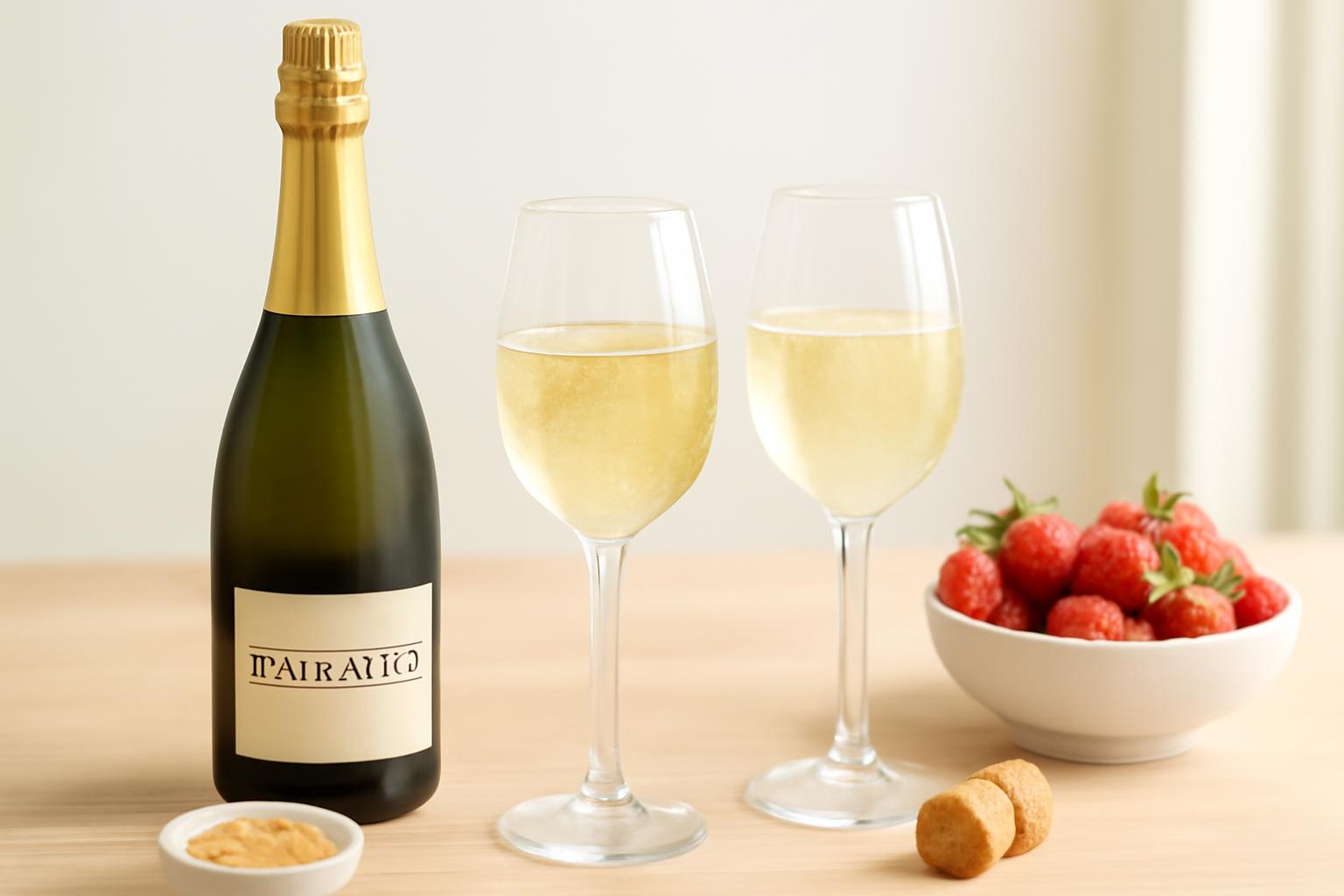
One labelled Brut has about 86 calories per 125 ml and 518 per bottle at 11% ABV. Serving size, sweetness and the producer's label refine your estimate.
Most Prosecco lands near 85–115 calories for a 125 ml glass, 102–138 calories for a 150 ml (about 5 oz) glass, and 510–690 calories for a 750 ml bottle. The lower end fits drier styles; sweeter styles can sit higher. Many Brut and Extra Dry bottles are in a narrower band of roughly 85–91 calories per 125 ml.
Alcohol is usually around 11–12% alcohol by volume (ABV), although the exact number belongs to the bottle in front of you. Prosecco DOC rules set a minimum total alcohol content of 11% for sparkling Prosecco, while retail bottles and guidance commonly show 11–12%. Check both the nutrition information and ABV on the producer’s label when you need a product-specific answer.
Prosecco calories by glass and bottle
The table below converts European wine-sector reference values for sparkling wine into common serving sizes. These are useful estimates, not a substitute for a producer’s nutrition declaration.
| Prosecco sweetness style | Reference kcal per 100 ml | 125 ml glass | 150 ml / about 5 oz | 750 ml bottle |
|---|---|---|---|---|
| Brut Nature or Extra Brut | 68 | 85 | 102 | 510 |
| Brut | 70 | 88 | 105 | 525 |
| Extra Dry | 73 | 91 | 110 | 548 |
| Dry | 77 | 96 | 116 | 578 |
| Medium Dry | 84 | 105 | 126 | 630 |
| Sweet | 92 | 115 | 138 | 690 |
The underlying sparkling-wine reference table published by the European Commission describes generally accepted energy values, so a particular wine may differ.
Current product labels illustrate the point. Mionetto Prestige Prosecco DOC Treviso Brut declares 68 calories per 100 ml, or about 85 calories in 125 ml and 510 calories if that value is multiplied across 750 ml. Verrocchio Prosecco DOC Brut declares 69 calories per 100 ml and 11% ABV, equivalent to about 86 calories per 125 ml and 518 per 750 ml.
Those examples are evidence for those products, not a promise about every Prosecco. A home pour can also be larger than 125 ml. If a bottle says 69 calories per 100 ml, multiply by your pour in millilitres and divide by 100:
69 × 150 ÷ 100 = about 104 calories
For a full 750 ml bottle:
69 × 750 ÷ 100 = about 518 calories
How much alcohol is in Prosecco?
ABV is the percentage of a drink’s volume that is alcohol. The Prosecco DOC production regulation lists a minimum total alcohol content of 11% for sparkling Prosecco and 10.5% for semi-sparkling or still Prosecco. Drinkaware describes Prosecco’s usual strength as around 12%, while the Verrocchio example above is 11%. The printed ABV remains authoritative for the wine in your glass.
At 11–12% ABV, the alcohol in common portions works out as follows:
| Serving | At 11% ABV | At 12% ABV |
|---|---|---|
| 125 ml glass | 13.75 ml pure alcohol; 1.38 UK units | 15 ml; 1.5 UK units |
| 150 ml / about 5 oz | 16.5 ml; 1.65 UK units | 18 ml; 1.8 UK units |
| 750 ml bottle | 82.5 ml; 8.25 UK units | 90 ml; 9 UK units |
The UK-unit calculation is volume in millilitres multiplied by ABV, divided by 1,000. This is why a larger glass changes both alcohol and calories even when the wine itself stays the same.
U.S. standard-drink definitions use a different unit. The National Institute on Alcohol Abuse and Alcoholism defines one U.S. standard drink as 14 grams of pure alcohol, approximately the amount in 5 oz of 12% wine. It also estimates five standard drinks in a 750 ml bottle of 12% wine. A 5 oz glass of 11% Prosecco is slightly less than one U.S. standard drink; at 12%, it is about one.
“One glass” is therefore too vague for careful tracking. A 125 ml flute, a 150 ml restaurant pour, and a generously filled home glass do not contain the same calories or alcohol.
Alcohol contributes more calories than residual sugar
Prosecco begins with grape sugar. Yeast converts much of that sugar into alcohol during fermentation, while some sugar can remain in the finished wine. Both matter for the final energy value, but alcohol is usually the larger contributor.
The NHS explains that alcohol provides 7 calories per gram. That makes ABV a major clue: for equal-size pours, a higher-ABV wine will generally bring more alcohol-derived calories.
Residual sugar explains why wines at similar ABV can still have different calorie counts. It also explains the counterintuitive style names. Under the EU sparkling-wine sweetness categories:
- Brut Nature contains less than 3 grams of sugar per litre and has no sugar added after secondary fermentation.
- Extra Brut contains 0–6 g/L.
- Brut contains less than 12 g/L.
- Extra Dry contains 12–17 g/L, so it is sweeter than Brut despite the name.
- Dry contains 17–32 g/L.
- Demi-Sec or Medium Dry contains 32–50 g/L.
- Sweet contains more than 50 g/L.
Moving from Brut to Extra Dry or Dry can raise calories, but it does not erase the alcohol. For example, the Verrocchio label lists 1.35 grams of sugar and 69 calories per 100 ml while also listing 11% ABV. The modest sugar figure does not make the drink calorie-free because ethanol still supplies energy.
How to get the best estimate for your bottle
Use this order of preference:
- Find a calorie or energy declaration. It may be printed on the bottle, reached through a QR code, or listed on the producer’s official product page. If it is given per 100 ml, scale it to your measured pour.
- Check the ABV. Do not assume every Prosecco is identical. At the same serving size, 12% contains more alcohol than 11%.
- Read the sweetness term. Brut is lower in residual sugar than Extra Dry, Dry, or Demi-Sec under the regulated categories. It is a clue, not a complete calorie label.
- Measure the serving. A 150 ml pour is 20% larger than a 125 ml pour, so it has 20% more calories and alcohol from the same bottle.
- Treat generic database entries as estimates. Match the style, ABV, and serving size as closely as possible instead of selecting the lowest search result.
If only the bottle’s total calories are listed, divide by six for a 125 ml serving or by five for a 150 ml serving. This assumes equal pours and a standard 750 ml bottle.
Common questions
Is Prosecco low in calories?
“Low” depends on the serving and comparison. A measured 125 ml Brut can be around the high 80s in calories, but a larger pour or sweeter style can be higher. Prosecco is still an alcoholic drink, and a bottle contains several servings. Calorie count alone is not a measure of health or safety.
Is Extra Dry lower in calories than Brut?
Usually not when other factors are similar. Extra Dry is a sweeter regulated category than Brut: 12–17 g/L versus less than 12 g/L. ABV and the producer’s actual formulation still matter, so compare the nutrition declarations rather than relying only on the style name.
How many glasses are in a bottle of Prosecco?
A 750 ml bottle provides six 125 ml glasses or five 150 ml glasses. Smaller event pours produce more servings; oversized home pours produce fewer. The number of servings changes how calories and alcohol are distributed, not what the bottle contains in total.
Does lower sugar mean alcohol-free or calorie-free?
No. Brut Nature and Extra Brut can have very little residual sugar while still containing alcohol. Alcohol supplies calories independently of sugar. Alcohol-free sparkling wine is a separate product and should be checked on its own label.
Bottom line
For a practical starting point, estimate 85–115 calories per 125 ml glass or 510–690 per 750 ml bottle, then narrow the number using the producer’s label. Many Brut and Extra Dry examples are closer to 85–91 calories per 125 ml. Expect roughly 11–12% ABV, measure the pour, and remember that alcohol—not just residual sugar—accounts for much of Prosecco’s energy.