
How Much Caffeine Your Kombucha Actually Contains
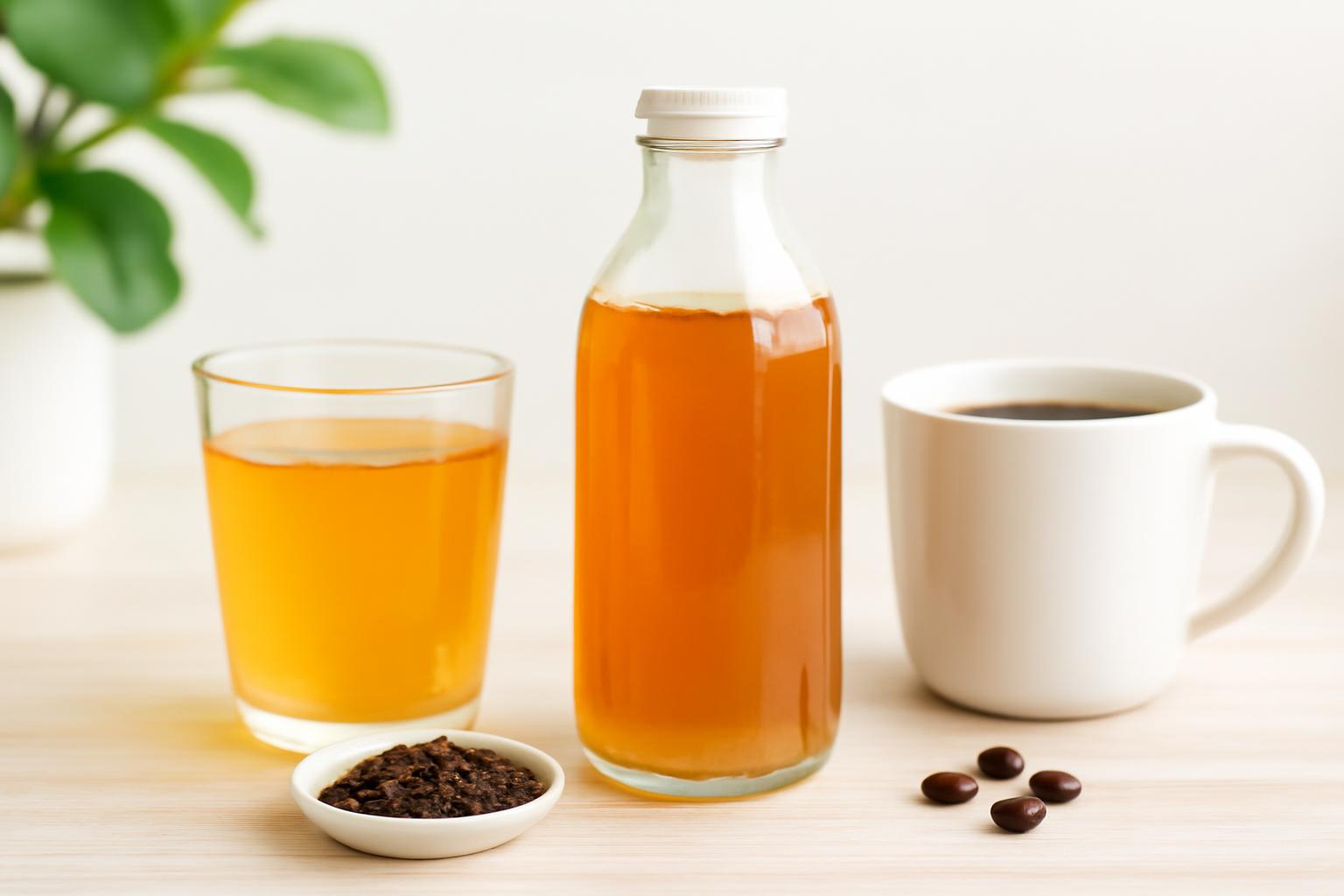
The three current brand disclosures range from 8 mg per serving to less than 19 mg in a 330 mL bottle. A per-serving amount may not be the bottle total.
Most kombucha made from black or green tea contains caffeine, but there is no single amount that applies to every bottle. Current brand disclosures give a useful real-world reference: Health-Ade says its kombucha has 8–15 milligrams (mg) per serving, GT’s lists 8–14 mg per serving, and Remedy lists less than 15 mg in a 250 mL can or less than 19 mg in a 330 mL bottle.
That makes roughly 8 mg to under 19 mg per labeled serving or small container a practical range for those examples—not a rule for all kombucha. The most accurate answer for the drink in your hand is the amount on its label or the manufacturer’s current product information.
Caffeine amounts from current kombucha brands
Serving size matters as much as the number. “Per serving” is not always the same as “per bottle,” so compare both before deciding how much caffeine you will drink.
| Product disclosure | Stated caffeine amount | What to notice |
|---|---|---|
| Health-Ade kombucha | 8–15 mg per serving | The brand says the amount depends on flavor. |
| GT’s kombucha | 8–14 mg per serving | This is the range in the brand’s product FAQ. |
| Remedy kombucha | Less than 15 mg per 250 mL; less than 19 mg per 330 mL | The stated total changes with container size. |
These figures are brand statements, not a market-wide standard. Another kombucha may use a different tea blend, brewing method, portion size, or formulation. A product marketed for energy may also contain added caffeine or other caffeine-bearing ingredients, so its amount could sit outside this group.
How kombucha compares with tea and coffee
For context, the U.S. Food and Drug Administration’s caffeine guide lists these typical amounts for 12-fluid-ounce drinks:
- Green tea: 37 mg
- Black tea: 71 mg
- Regular brewed coffee: 113–247 mg
The cited kombucha examples therefore contain much less caffeine than a typical same-occasion coffee, although the serving sizes in the two sets of numbers are not identical. Comparing a full bottle of one drink with a small serving of another can give a misleading impression. Use the caffeine total for the amount you will actually consume.
For example, suppose a label states 10 mg per 8-fluid-ounce serving and the bottle contains two servings. Drinking the whole bottle would provide 20 mg, not 10 mg. This is only a math example; it is not a claim about a particular brand.
Why the amount varies
The starting tea is different
Traditional kombucha begins with sweetened tea. Black tea, green tea, or a blend can supply caffeine before fermentation starts. Tea variety, the amount of leaf used, water temperature, and steeping time can all affect the starting brew, so two producers do not necessarily begin with the same caffeine concentration.
Recipes and finished products differ
Brands use their own batch sizes, cultures, flavor ingredients, and production controls. Some products blend kombucha with juice or other drinks. Others may be positioned as energy beverages and include added caffeine or ingredients that naturally contain it. The word “kombucha” on the front does not make the formulas equivalent.
Serving and bottle sizes differ
A value per serving only answers the question if you know how large that serving is and how many servings are in the container. A 250 mL can, an 8-fluid-ounce serving, and a 16-fluid-ounce bottle are different quantities. Check “servings per container” before treating a front-label or FAQ number as the bottle total.
Fermentation is not a reliable calculator
You may see broad claims that fermentation always leaves a fixed fraction of the tea’s caffeine. That shortcut is too confident for an individual product. It does not account for the starting tea, recipe, process, or serving size, and it cannot replace a finished-product measurement. Use a current label or a value supplied by the manufacturer instead of calculating from the tea alone.
How to check your bottle
Use this quick sequence:
- Look for a caffeine statement. It may appear on the front, near the ingredient list, elsewhere on the package, or on the manufacturer’s product page.
- Confirm the unit. Determine whether the number is per serving, per 8 fluid ounces, per 100 mL, or per container.
- Check servings per container. Multiply the per-serving amount by the number of servings you plan to drink.
- Read the ingredients. Tea, coffee, guarana, yerba mate, and separately added caffeine can all signal a caffeine source.
- Ask the manufacturer when no amount is given. The FDA notes that many companies provide caffeine amounts voluntarily and recommends contacting the manufacturer with product-specific questions.
An ingredient list may not state “caffeine” even when the drink contains it naturally. FDA guidance explains that stand-alone added caffeine must appear in the ingredient list, while an ingredient that naturally contains caffeine can be listed without breaking out caffeine separately. That is why seeing tea in the ingredients but no caffeine number does not prove the product is caffeine-free.
What if you are avoiding caffeine?
Do not assume that “low caffeine,” “decaffeinated,” or a modest brand average means zero. The FDA notes that even decaffeinated coffee and tea can retain some caffeine. If you need to avoid caffeine completely, choose a product that explicitly says caffeine-free and verify that statement with the manufacturer when the label is unclear.
Individual responses also vary. A small amount may still matter to someone who is sensitive to caffeine, is combining several caffeinated foods and drinks, or has been advised to limit it. Product information can tell you the dose; a qualified health professional can help with a limit that depends on pregnancy, medication, a health condition, or another personal factor.
Caffeine is separate from calories, sugar, and alcohol
The caffeine amount does not tell you how many calories or grams of sugar a kombucha contains. Those depend on the finished recipe and serving size and should be read separately on the Nutrition Facts label.
Alcohol is also a different measurement. Fermentation can produce alcohol, but an alcohol percentage does not reveal caffeine content, and a caffeine number does not reveal alcohol content. Check each relevant disclosure rather than using one as a stand-in for another.
Bottom line
Kombucha usually contains some caffeine when it is brewed from caffeinated tea. In three current manufacturer disclosures, the stated amounts run from 8 mg per serving to less than 19 mg in a 330 mL bottle. That is a helpful shopping reference, but the real answer depends on the brand, flavor, formula, serving size, and container.
For the most reliable total, find the product’s caffeine amount, match it to the stated serving size, and account for how much of the bottle you will drink. If the number is missing, contact the manufacturer rather than relying on a generic fermentation formula.