
Why Two 20-Gram Yogurts Are Not Equal
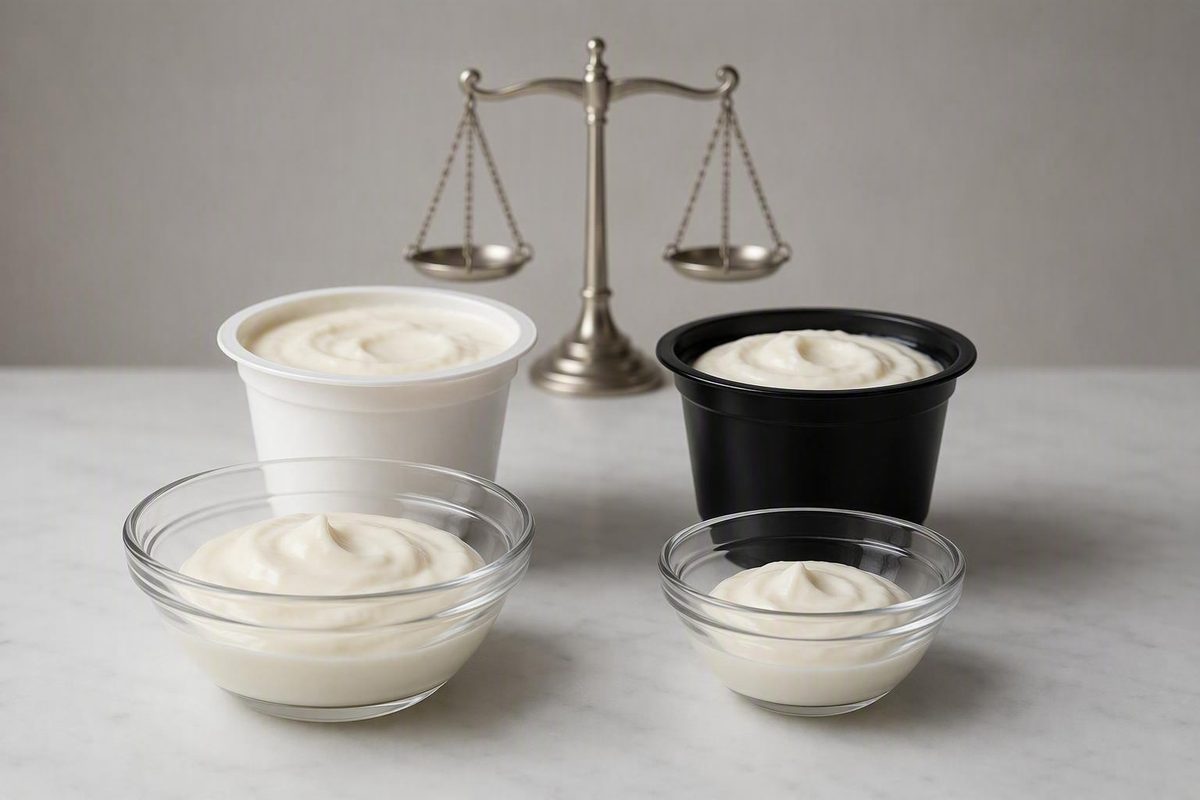
See why two yogurts labeled 20g are not equal: normalize Chobani and Oikos by ounces, compare protein density, and understand the 2026 suits.
Chobani’s “20G Protein” tub reaches 20 grams in a reported 6.7-ounce serving, while Oikos Pro reaches the same number in 5.3 ounces. That works out to about 2.99 versus 3.77 grams of protein per ounce—a roughly 20% protein-density gap concealed by identical front-label numbers. The lawsuits allege that Chobani’s serving-size presentation makes that comparison misleading; they do not establish that 6.7 ounces of the yogurt physically contains less than 20 grams. Reuters reported Danone’s complaint and the Oikos comparison.
The Received Wisdom Is Reasonable but Incomplete
Shoppers normally read “20G Protein” as a per-serving claim. If two yogurt tubs both display 20 grams, treating them as equivalent per serving is understandable. Nutrition labels are organized around servings, and the stated amount is useful when the serving corresponds to what someone plans to eat.
That comparison is incomplete when the servings differ substantially in weight. Chobani’s reported serving is 6.7 ounces; Oikos Pro’s is 5.3 ounces. The products reach the same headline number using different denominators.
The shared claim therefore answers one narrow question: how much protein is declared in each manufacturer’s labeled serving? It does not answer how much protein each yogurt provides ounce for ounce.
The consensus view remains right in one respect. A correctly stated 20-gram serving still delivers the labeled amount for that serving; protein density is not the only valid way to choose food. The narrower verdict is that the two 20-gram claims are not directly comparable until serving weight is normalized.
Normalizing the Labels Changes the Ranking
The calculation is protein grams divided by labeled serving ounces.
| Product | Label Claim | Serving | Protein Per Ounce |
|---|---|---|---|
| Chobani 20G Protein | 20 g | 6.7 oz | 2.99 g |
| Oikos Pro | 20 g | 5.3 oz | 3.77 g |
| Oikos Triple Zero | 15–18 g | 5.3 oz | 2.83–3.40 g |
The Chobani and Oikos Pro labels tie at 20 grams only before adjusting for serving weight. On an equal 5.3-ounce basis, the reported Chobani density supplies approximately 15.8 grams, while Oikos Pro supplies 20 grams.
Oikos Triple Zero reportedly contains 15 to 18 grams depending on variety. At 5.3 ounces, its range is approximately 2.83 to 3.40 grams per ounce. Danone presents Triple Zero as a closer protein-density comparison to Chobani, while arguing that shoppers choosing strictly for more protein would favor Oikos Pro. That is Danone’s competitive position, not an independent recommendation.
Enter each label’s serving weight, protein and serving price; the normalizer shows which product wins for your numbers.
Use the serving printed on each label. Protein may be one number or a range such as 15–18. Price is optional and must correspond to that labeled serving.
Reported label figures: 20 g per 6.7 oz.
Reported label figures: 20 g per 5.3 oz.
Reported range: 15–18 g depending on variety; 5.3 oz comparison serving.
| Product | Protein/Oz | At 5.3 Oz | Cost/Protein |
|---|---|---|---|
| Oikos Pro | 3.77 g | 20.0 g | — |
| Oikos Triple Zero | 2.83–3.40 g | 15.0–18.0 g | — |
| Chobani 20G Protein | 2.99 g | 15.8 g | — |
Density ranks products by protein per ounce. Cost ranks only products with a serving price entered. A range is displayed when the protein field contains two reported values.
Source: reported label figures cited in the article; normalized amounts are arithmetic estimates marked by rounding. Product prices were not supplied and remain — until entered.
A price comparison requires the price allocated to the same labeled serving. The supplied evidence contains no product prices, so the calculator leaves those fields blank rather than inventing them. Once prices are entered, cost per gram equals serving price divided by protein grams.
A Larger Serving Can Create the Round Number
Starting with Chobani’s reported label figures, the density calculation is 20 divided by 6.7, or approximately 2.985 grams of protein per ounce.
If the recipe and density stay unchanged, increasing or decreasing the declared portion changes the protein number attached to “one serving”:
| Portion | Calculation | Approximate Protein |
|---|---|---|
| 6.7 oz | 20 ÷ 6.7 × 6.7 | 20.0 g |
| 6.0 oz | 20 ÷ 6.7 × 6.0 | 17.9 g |
| 5.3 oz | 20 ÷ 6.7 × 5.3 | 15.8 g |
Nothing about the assumed recipe changes across those rows. Only the denominator changes. A 6.7-ounce serving crosses the round 20-gram threshold; a 6-ounce serving comes out near 18 grams; a 5.3-ounce serving comes out near 16 grams.
That is the arithmetic at the center of the dispute. It demonstrates how serving selection changes a front-label nutrient claim, but it does not determine which serving federal rules legally require.
The Lawsuits Challenge the Multiserve Presentation
The most consistently reported target is the 32-ounce Chobani 20G Protein multiserve tub. Danone alleges that Chobani carried the 6.7-ounce portion associated with its single-serve cup into the multiserve tub’s nutrition presentation to preserve the 20-gram statement.
Food Business News reported that Danone’s action concerned the 32-ounce multiserve product and excluded single-serving products because the full 6.7-ounce packages provide 20 grams. Its report distinguishes the single cup from the challenged tub calculation.
Some secondary coverage describes the affected products more broadly. Based on the more specific reporting, the narrowest supported reading is that the single cup explains where 6.7 ounces comes from, while the multiserve tub is the central target of Danone’s serving-size theory. The evidence does not establish that every Chobani cup, flavor, label version or production period is covered.
Package format matters because the plaintiffs contend that a multiserve container should use a different serving-size calculation. The available reports do not include enough primary regulatory analysis to treat that contention as an established legal rule for these products.
The 18-Gram and 16-Gram Figures Use Different Denominators
Reports describing “about 18 grams” and comparisons producing “about 16 grams” are not necessarily contradicting one another. They apply different portion weights to the same reported density.
At six ounces, the calculation is 2.985 multiplied by 6, which equals approximately 17.9 grams. Inc. reported Danone’s allegation that the applicable multiserve approach would produce fewer than 18 grams and separately quoted a food-law expert whose research indicated a six-ounce FDA standard. The report presents those positions as allegations and expert analysis, not a ruling.
At 5.3 ounces, the calculation is 2.985 multiplied by 5.3, or approximately 15.8 grams. That is the useful ounce-for-ounce comparison with Oikos Pro’s reported serving, not necessarily the legally controlling serving for Chobani.
The consumer plaintiff’s reported one-half-cup theory is different again. A cup is a household volume measure, while the calculations above treat ounces as weight. The supplied evidence provides no product-specific conversion between half a cup and an ounce weight, so the half-cup allegation cannot be converted reliably from the available figures.
Two Cases Make Different Claims
The phrase “Chobani 20g protein lawsuit” refers to two reported federal proceedings. Both concern the multiserve presentation, but their plaintiffs and alleged injuries differ.
| Proceeding | Plaintiff | Reported Filing | Claimed Injury |
|---|---|---|---|
| Competitor action | Danone US | June 15, 2026 | Misleading advertising and diverted sales |
| Knox v. Chobani LLC | Hale Knox | Reported July 1, 2026 | Purchaser deception and unjust enrichment |
Danone owns Oikos Pro and therefore has a direct commercial interest in the comparison. Its complaint reportedly seeks injunctive or advertising changes, corrective advertising, unspecified damages and disgorgement. The syndicated Food Dive account identifies the filing, products, allegations and requested relief. The report says Danone filed in the Southern District of New York.
Danone alleges that applying the multiserve serving-size method it considers controlling would support approximately 18 grams—or fewer—rather than 20 grams. It also alleges that the existing presentation diverts customers from Oikos products. Those are a competitor’s allegations, not neutral nutritional findings or proven losses.
The separate consumer action was reported as Knox v. Chobani LLC, No. 1:26-cv-05093, in the Southern District of New York. Hale Knox reportedly alleges consumer deception, unjust enrichment and violations of New York General Business Law. He requested a jury trial, declaratory and injunctive relief, and actual, statutory and punitive damages for proposed nationwide and New York classes.
The supplied evidence establishes July 1 as the publication date of the report about Knox, not necessarily the complaint’s filing date. It also identifies no order certifying a class. A proposed class action does not create an automatic claims process or prove the allegations.
Accurate Serving Arithmetic Can Still Produce a Misleading Comparison
Danone’s theory separates four issues that are sometimes collapsed into one.
First, 6.7 ounces may contain the declared 20 grams. The supplied reporting offers no laboratory evidence showing otherwise.
Second, the parties dispute whether 6.7 ounces was an appropriate serving to declare on the 32-ounce tub. Correct arithmetic for a selected serving does not, by itself, prove that the serving was selected correctly under labeling rules.
Third, two accurate per-serving claims can create an inaccurate comparative impression if shoppers overlook the different serving weights. Oikos Pro provides its reported 20 grams in 1.4 fewer ounces than Chobani. That is why density changes the ranking even though the headline numbers match.
Fourth, a plaintiff must still prove legally recognized harm. A questionable comparison would not automatically establish consumer damages or the sales losses Danone alleges.
The available arithmetic supports the comparative point: Oikos Pro is more protein-dense using the reported label figures. It does not prove that Chobani violated a regulation, deceived a particular buyer or caused Danone a measurable loss.
The FDA Serving-Size Question Remains Unresolved
The reporting presents three benchmarks: Oikos Pro’s 5.3-ounce serving, the six-ounce standard attributed to a food-law expert, and the half-cup household measure reportedly advocated by Knox.
They should not be treated as interchangeable. Dairy News reported Danone’s comparison with Oikos Pro and its allegation that Chobani would fall below 18 grams under the FDA guidelines Danone invokes. That report does not reproduce a complete regulatory calculation.
A definitive product-specific answer would require the complaints and exhibits, complete versions of the relevant labels, the food’s regulatory classification and reference amount, package-format rules, household-measure conversions and applicable rounding provisions. Those materials were not included in the supplied evidence.
No cited source reports an FDA determination or judicial ruling fixing the lawful serving at 5.3 ounces, six ounces or one-half cup for the challenged tubs. A court could accept, reject or narrow either plaintiff’s interpretation.
The Reported Case Status Does Not Establish Liability
The supplied reporting runs from June 15 through July 1, 2026 and does not include a later docket check. It reported no judgment, dismissal, settlement, class-certification order, compensation program or finding that Chobani violated FDA rules.
Early reports either said Chobani or its lawyers had not immediately responded to requests for comment or did not contain a substantive defense. That describes the articles at publication; it does not establish that Chobani made no later filing or response.
The practical reading of the labels does not depend on the eventual legal outcome. Divide protein grams by serving ounces before comparing products. With the reported figures, Chobani provides approximately 2.99 grams per ounce and Oikos Pro approximately 3.77 grams per ounce. For an amount actually eaten, estimated protein equals ounces eaten multiplied by label protein grams, divided by labeled serving ounces.
That arithmetic supports a limited verdict: the matching “20G” claims do not describe matching protein density. Whether the larger serving was legally improper, materially misleading or compensable remains for the litigation and any regulatory analysis to resolve.