
A David Protein Shake Lists 140 or 150 Calories; the Macros Say 162
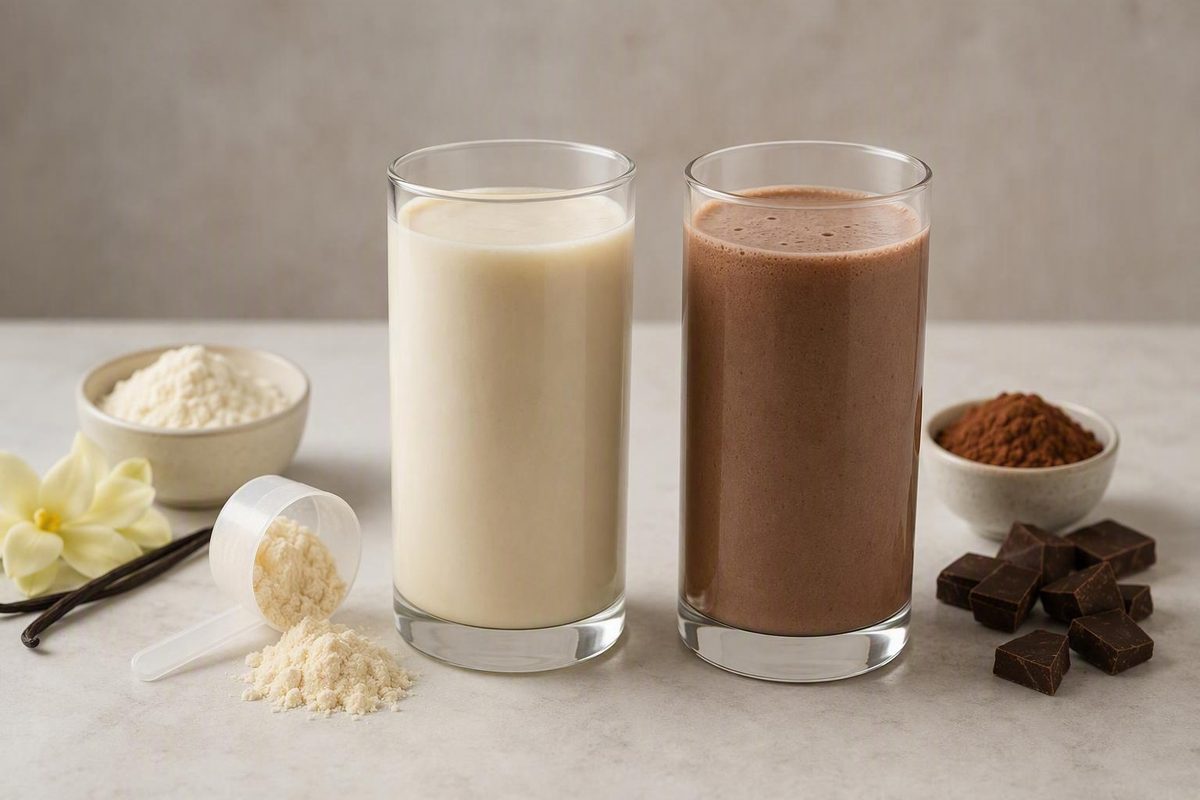
David's 12 oz shakes list 140 (Vanilla) or 150 (Chocolate) calories with 30 g protein. See why the macros sum to 162 and which number to log in a tracker.
A 12 oz David Protein ready-to-drink shake lists 140 calories in Vanilla and 150 calories in Chocolate, each with 30 g protein and less than 1 g sugar, according to David’s September 8, 2026 launch announcement. Log the label number for the flavor in your hand.
The label does not quite match its own macros, though. Chocolate’s published 30 g protein, 6 g carbohydrate and 2 g fat add up to 162 calories at the standard 4-4-9 factors, not 150. The 12-calorie gap is small enough to come from label rounding and from how the shake’s fat replacer, EPG, is counted: David uses about 0.7 calories per gram for it, where ordinary fat gets 9.
Pick a flavor, then move the EPG slider and switch its calorie factor; the total and the gap to the label update as you go.
Shake Calorie Math: Macros vs. the Label
Macro-math total, one 12 oz bottle
162 kcal
+12 kcal vs the 150 label (+8.0%)
A US label rounds this to 160 kcal, not the 150 printed on the bottle.
Edit label macros (grams)
Defaults are Chocolate's published macros. Vanilla's carbs and fat are not published, so copy them from your bottle.
| Component | Grams | kcal/g | kcal |
|---|---|---|---|
| Protein | 30 | 4 | 120 |
| Total carbs | 6 | 4 | 24 |
| Non-EPG fat | 2 | 9 | 18 |
| EPG (what-if) | 0 | 0.7 | 0 |
| Macro-math total | 162 | ||
| Label | 150 |
Try it: set non-EPG fat to 0 and EPG to 2 at 0.7 to get 145.4, which a label rounds to 150. Printed macros are themselves rounded, and fiber or gums in the carb line may be counted below 4 kcal/g, so a few calories of drift is normal.
Sources: David Protein Chocolate shake product page and the Sept 8, 2026 launch release (label values). 0.7 kcal/g is the company's counting figure for EPG. David does not publish EPG grams for the shake, so the slider is a what-if, not a measurement.
Label Calories Are 140 for Vanilla and 150 for Chocolate
David’s launch release gives these values for one 12 oz bottle:
| Flavor, 12 oz | Calories | Protein | Sugar |
|---|---|---|---|
| Vanilla | 140 | 30 g | Less than 1 g |
| Chocolate | 150 | 30 g | Less than 1 g |
Chocolate lists 10 more calories than Vanilla. That is the difference between two manufacturer totals. It does not show that either flavor has a meaningful nutritional advantage.
These figures apply only to David’s ready-to-drink shakes. Do not use them for a David protein bar, a protein powder, a homemade shake or another bottled product with a similar name. A tracker record labeled only “David Protein Shake” may not distinguish the flavors, so pick a flavor-specific record or build one from the bottle.
Chocolate’s Macros Sum to 162 Calories at 4-4-9
The official Chocolate shake product page adds two fields the launch release leaves out: 6 g total carbohydrate and 2 g total fat. With those, the general Atwater arithmetic is one line: calories equal 4 times protein grams plus 4 times carbohydrate grams plus 9 times fat grams.
| Chocolate, per bottle | Listed | Factor | Calories |
|---|---|---|---|
| Protein | 30 g | 4 | 120 |
| Total carbohydrate | 6 g | 4 | 24 |
| Total fat | 2 g | 9 | 18 |
| Sum | 162 |
The label says 150. The sum is 12 calories higher, or 8% of the label value. The less than 1 g of sugar is already inside the carbohydrate line, so it adds nothing.
Rounding Covers Most of the 12-Calorie Gap
US labels round every line. Calories above 50 print to the nearest 10, protein and carbohydrate to the nearest gram, and fat under 5 g to the nearest half gram. A printed 150 therefore covers anything from 145 to just under 155. A printed 6 g of carbohydrate covers roughly 5.5 to 6.4 g.
Take every macro at the bottom of its range (29.5 g protein, 5.5 g carbohydrate, 1.75 g fat) and the 4-4-9 sum falls to about 155.8. That is still a hair above what rounds down to 150. Rounding explains most of the gap, but not all of it.
The rest most likely comes from a gram that is not counted at its general factor. There are two candidates. One is carbohydrate that is not digested: fiber and gums can be counted below 4 calories per gram. The figures available here do not include a fiber line for the shake, so that part cannot be computed. The other candidate is the fat.
EPG Is Counted at About 0.7 Calories per Gram Instead of 9
The Chocolate ingredient list names ultrafiltered skim milk with lactase, a modified plant fat identified as EPG, sucralose and acesulfame potassium. EPG stands for esterified propoxylated glycerol. It is a fat replacer: a plant oil altered so that, by the company’s account, most of it is not digested. David counts it at about 0.7 calories per gram.
Neither the product page nor the launch release says how many grams of EPG are in a bottle. They also do not say whether those grams sit inside the 2 g Total Fat line. That is why the calculator treats EPG as a what-if rather than a fact.
Each gram of EPG is worth 8.3 calories of disagreement, which is 9 minus 0.7. The gram amounts below are hypothetical, not label values:
| EPG in bottle | At 0.7 | At 9 | Difference |
|---|---|---|---|
| 2 g | 1.4 | 18 | 16.6 |
| 6 g | 4.2 | 54 | 49.8 |
| 12 g | 8.4 | 108 | 99.6 |
One scenario reconciles the label by itself. If the 2 g of listed fat were entirely EPG counted at 0.7, the sum would be 120 plus 24 plus 1.4, or 145.4, which rounds to 150. Set non-EPG fat to 0 and EPG to 2 in the calculator to see it. That is arithmetic consistent with the label, not evidence of the formula.
The same logic sets a ceiling. If the EPG is inside the 2 g fat line, then 162 already counts it as ordinary fat, and the worst case is 12 calories over the label. If it is declared outside that line, the ceiling depends on a gram figure David has not published.
The Bar Lawsuits Do Not Supply a Shake Number
The 0.7 counting method is disputed. A class action filed January 23, 2026 alleges that David’s EPG protein bars carry far more calories and fat than labeled, as Nutritional Outlook reported. Separate suits filed August 24–25, 2026 target the brand’s zero-sugar and allulose claims, as Food Dive reported.
These are allegations. Neither report provides nutrition facts for the ready-to-drink shakes, so they give no number to add to or subtract from a shake entry.
Log the Label Number Against the Right Flavor
For one standard bottle:
- Vanilla: 140 calories and 30 g protein.
- Chocolate: 150 calories, 30 g protein, 6 g total carbohydrate, 2 g total fat.
Some trackers recompute calories from the macros you enter. If yours shows 162 for a Chocolate entry, that is the 4-4-9 sum, not a data error. Keep the label’s 150 in the calorie field and leave the macros as printed.
For more than one bottle, multiply the per-bottle values:
| Amount | Vanilla | Chocolate | Protein |
|---|---|---|---|
| One bottle | 140 | 150 | 30 g |
| Two bottles | 280 | 300 | 60 g |
| Three bottles | 420 | 450 | 90 g |
For a partial bottle, log the fraction you drank. Half a Vanilla is 70 listed calories, and half a Chocolate is 75. That assumes the contents are evenly mixed and the bottle is the 12 oz product David describes.
Before saving an entry, check four fields against the bottle:
- Flavor: Vanilla or Chocolate.
- Container size: 12 oz.
- Servings per container: whether the whole bottle is one serving.
- Label values: calories and macros match the tracker record.
If the label treats the bottle as more than one serving, multiply the per-serving calories by the number of servings consumed. When a tracker holds several conflicting records, the physical package wins. Branded-food records can reflect different flavors, sizes or versions.
Vanilla’s Carbohydrate and Fat Are Not Published
Both flavors are confirmed as 12 oz shakes with 30 g protein and less than 1 g sugar. Calories are flavor-specific. Beyond that, the detailed fields come from the Chocolate page only.
Do not copy Chocolate’s 6 g carbohydrate or 2 g fat into a Vanilla entry. A 10-calorie difference cannot be used to reconstruct the missing Vanilla macros, and it cannot be pinned on a single ingredient. The Chocolate ingredient list does not establish that Vanilla uses the same sweeteners or the same fat system. For Vanilla, the macro-sum check in the calculator needs the numbers from your own bottle.
Every Figure Here Is Manufacturer-Stated
These calorie and nutrient values are label information from David. They are not measurements independently reproduced in the sources available here.
The Chocolate product page says Light Labs conducted third-party testing in August 2026. The page does not publish a report or say which properties were tested, so that statement does not show that an outside lab confirmed each calorie, macro or ingredient figure.
There is also a date discrepancy. Preliminary trade coverage described the shakes as 140–150 calories per bottle without assigning a total to each flavor. The September 8 release supplied the mapping. That earlier coverage also listed 3 g carbohydrate, while the current Chocolate page lists 6 g total carbohydrate. The sources do not explain the difference, so the earlier figure should not replace the current listing.
If the bottle in your hand conflicts with anything online, the bottle wins. If it matches the announced 12 oz product, enter 140 for Vanilla or 150 for Chocolate, plus whatever other fields that flavor’s label shows.