
Dunkin' Donut Calories by Variety, Serving Size, and Source
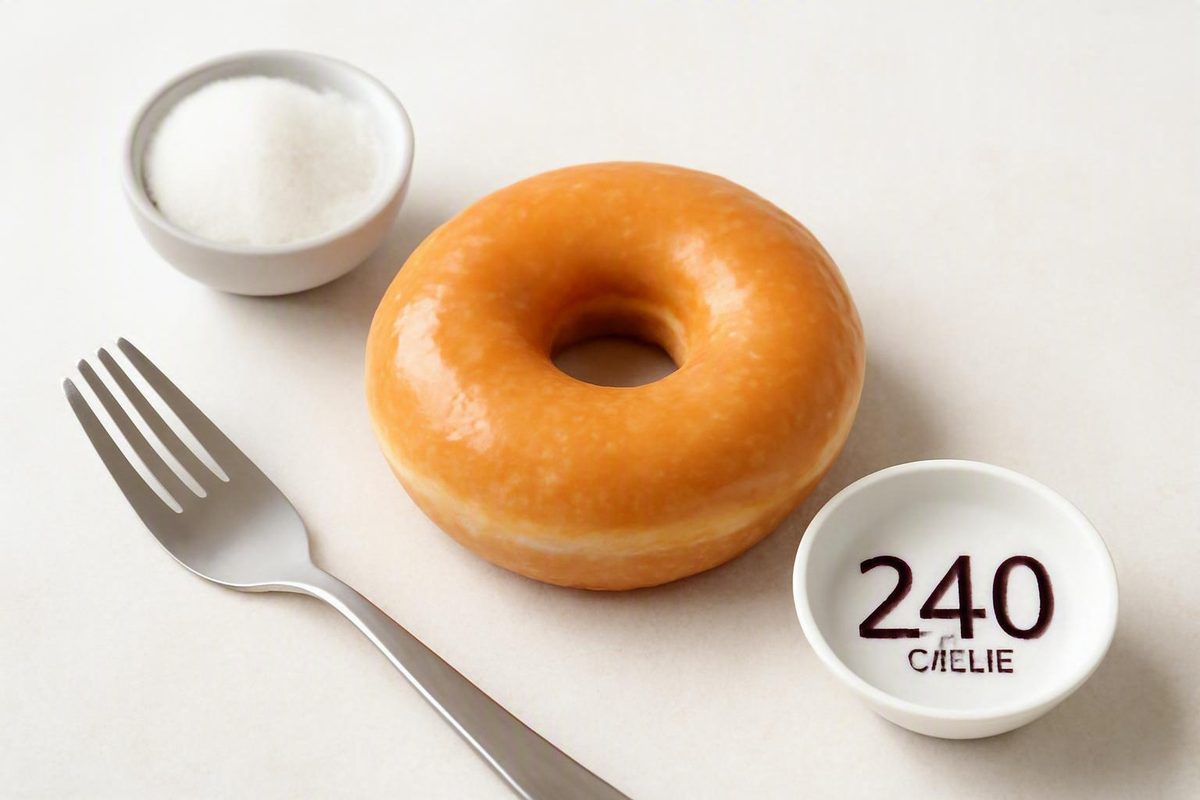
Official guide examples range from a 210-calorie Sugared Donut to a 470-calorie Peanut Donut. Match your exact variety instead of relying on an average.
Overview
A Dunkin’ Glazed Donut contains 240 calories per one donut, according to Dunkin’s official U.S. nutrition guide, which states its information was last updated on July 8, 2026. That branded figure is the number to use when ordering or logging this specific item — not a generic glazed-donut average.
The distinction matters because generic references describe a different product category. Editorial nutrition guides such as Noom put a standard glazed donut at around 250 to 300 calories, and Suzie the Foodie’s donut guide gives the same 250–300 range for a medium plain glazed donut. Those are category estimates for glazed donuts in general; Dunkin’s own disclosure for its named Glazed Donut sits below that range at 240 calories, a value independently corroborated by CalorieKing.
Because Dunkin’ notes that its information can change frequently, check the current official disclosure at DunkinDonuts.com before relying on any figure — including the ones on this page — when precision matters for your food log.
Dunkin’ donut calories by named variety
Named Dunkin’ full donuts span a wide calorie range per listed serving: the official guide’s documented examples run from a 210-calorie Sugared Donut to a 470-calorie Peanut Donut. That 260-calorie spread means the specific donut you pick matters far more than the fact that you picked “a donut.”
The decision matrix below groups selected full donuts from the official nutrition guide into relative calorie bands. Two things to keep in mind while reading it: the bands are relative only to the items listed here, not to the entire menu, and a lower calorie band is not a health ranking — it is simply a per-serving energy comparison.
| Product | Listed serving | Calories | Relative band (these items only) |
|---|---|---|---|
| Sugared Donut | 1 Donut | 210 | Lower |
| French Cruller | 1 Donut | 230 | Lower |
| Glazed Donut | 1 Donut | 240 | Lower |
| Boston Kreme Donut | 1 Donut | 270 | Middle |
| Double Chocolate Donut | 1 Donut | 380 | Higher |
| Peanut Donut | 1 Donut | 470 | Higher |
All figures come from Dunkin’s official nutrition PDF, dated June 10, 2026, and each is listed per one donut — the same serving unit across every row, which is what makes the comparison fair.
A few practical readings of the table: swapping a Peanut Donut for a Sugared Donut changes the per-item count by 470 − 210 = 260 calories, more than an entire additional Glazed Donut. The three lower-band options cluster tightly between 210 and 240 calories, so choosing among them changes the total by at most 30 calories. And the filled Boston Kreme, at 270 calories, sits well below the unfilled Double Chocolate at 380 — a first hint that appearance alone is a poor predictor of the actual number, a point covered in more detail below.
This table reflects the documented U.S. menu as of the guide’s stated date. It does not mean every item is sold at every restaurant, and it does not cover limited-time or regional products, which the official guide lists separately.
Full donuts, Munchkins, and specialty items use different serving units
One full donut and one Munchkin donut hole are different serving units, so their calorie figures should never be compared as if they were equal items. The official guide lists Munchkins per single donut hole: an Old Fashioned Munchkin is 50 calories per donut hole and a Glazed Old Fashioned Munchkin is 70 calories per donut hole, compared with 240 calories for one full Glazed Donut.
Read literally, that makes a Munchkin look dramatically “lower calorie” — but only because the serving is much smaller. Four Glazed Old Fashioned Munchkins (70 × 4 = 280 calories) already exceed one full Glazed Donut. Before comparing any two numbers, confirm they belong to the same category:
- Full donuts — listed per one donut (for example, Glazed Donut, 240 calories).
- Munchkins — listed per one donut hole (50–70 calories for the permanent Old Fashioned and Glazed Old Fashioned examples), so a handful multiplies quickly.
- Specialty bakery items — sticks, fritters, and Bismark-style filled products are distinct items with their own rows; a third-party Dunkin’ nutrition guide reports an Apple Fritter at roughly 510 calories and a Glazed Jelly Stick at roughly 540, figures you should verify against the current official disclosure rather than assume.
Limited-time products deserve the same caution: the official guide lists them in a separate section (a Chocolate Frosted Donut with Patriotic Sprinkles appears there at 270 calories per donut, for instance), and those items rotate. When logging food, match the exact product name and the exact serving unit from the official row — “one donut” and “one donut hole” are not interchangeable entries.
Why Dunkin’ calorie counts can differ
Published Dunkin’ calorie figures can legitimately differ from one source to another, and the official guide itself explains part of the reason. Dunkin’ states that variations may occur due to seasonal conditions, regional differences, ingredient substitutions, and differences in product assembly or size at the restaurant. In other words, even the first-party number describes a standard listed serving, not a guarantee that the donut handed to you was assembled identically at every location.
Source date is the second major factor. The official guide notes that its information was last updated on July 8, 2026 and that information can change frequently, directing readers to DunkinDonuts.com for the most current figures. Third-party nutrition pages and calculators capture the menu at whatever point they last synced; the Mist nutrition calculator makes the same point in its own disclaimer, noting that values may vary slightly based on location, preparation, and seasonal ingredient changes.
General editorial factors compound this. As Suzie the Foodie’s guide explains, size, frying oil absorption, and toppings or fillings all move a donut’s calorie count — mini donuts often land under 100 calories while oversized bakery donuts can exceed 500. Formulations also change over time, so an older third-party number may have been accurate when captured and simply stale today.
The practical rule: this article’s comparison applies to the documented U.S. menu as of the official guide’s stated date, does not imply every item is available at every restaurant, and should be re-checked against the current official disclosure before you treat any single number as final.
Why some pages show 260 calories for the Glazed Donut
Use 240 calories for the Dunkin’ Glazed Donut. That is the figure in the current official nutrition guide (dated July 8, 2026), and CalorieKing independently lists the same 240-calorie value for the item.
Some third-party menu and nutrition comparison pages report 260 calories for the same donut instead. Nothing in the available evidence establishes that those pages made a specific error; the more likely explanation is a freshness or formulation gap — a figure captured from an earlier version of the menu, or from a period with a slightly different recipe. Generic references add further noise: Healthline lists a generic plain glazed donut at 269 calories while correctly showing Dunkin’s plain glazed at 240, illustrating how easily a category average gets mistaken for the branded value. When sources disagree, prefer the current first-party disclosure and treat older secondary numbers as historical snapshots.
Calories are not a complete nutrition score
A calorie count tells you the energy in a listed serving, not the overall nutritional character of the item. The official row for the Glazed Donut provides fuller context: alongside its 240 calories, one donut contains 11 grams of total fat, 33 grams of total carbohydrate, 13 grams of total sugars (12 of them added sugars), and 4 grams of protein. CalorieKing’s independent listing matches on the key figures — 11 grams of fat, 33 grams of carbohydrate, 1 gram of fiber, and 4 grams of protein.
Two donuts with similar calorie counts can differ meaningfully in sugar, fat, or protein, and a lower-calorie item is not automatically the “healthiest” choice — calorie position alone does not establish healthfulness, and this article deliberately makes no such ranking.
Appearance is an equally unreliable shortcut. It is tempting to assume a filled donut always outranks a plain-looking one, but the official rows contradict that: the cream-filled Boston Kreme is 270 calories, while the unfilled Double Chocolate Donut is 380. Visible frosting or filling signals something about ingredients, but it does not determine the number. When you want the real figure, look up the actual product row in the official guide rather than inferring it from how the donut looks in the case.
How should readers calculate calories for a mixed box containing several different donut varieties?
Multiply each variety’s official per-serving calories by how many of that item the box contains, then add the subtotals. Using the official rows: a box with two Glazed Donuts, one Boston Kreme, and one Double Chocolate works out to (240 × 2) + 270 + 380 = 1,130 calories for the full box, or the relevant subtotal for whatever portion you actually eat.
Two cautions keep the arithmetic honest. First, use the same serving units throughout — Munchkins are listed per donut hole (50–70 calories for the permanent Old Fashioned varieties), so count each hole individually rather than treating a handful as “one donut.” Second, sticks, fritters, and other specialty bakery items have their own rows; pull each item’s current figure from the official disclosure instead of substituting the nearest full-donut value.