
Unlock Exact Servings from Your Half Sheet Cake with This Simple Math
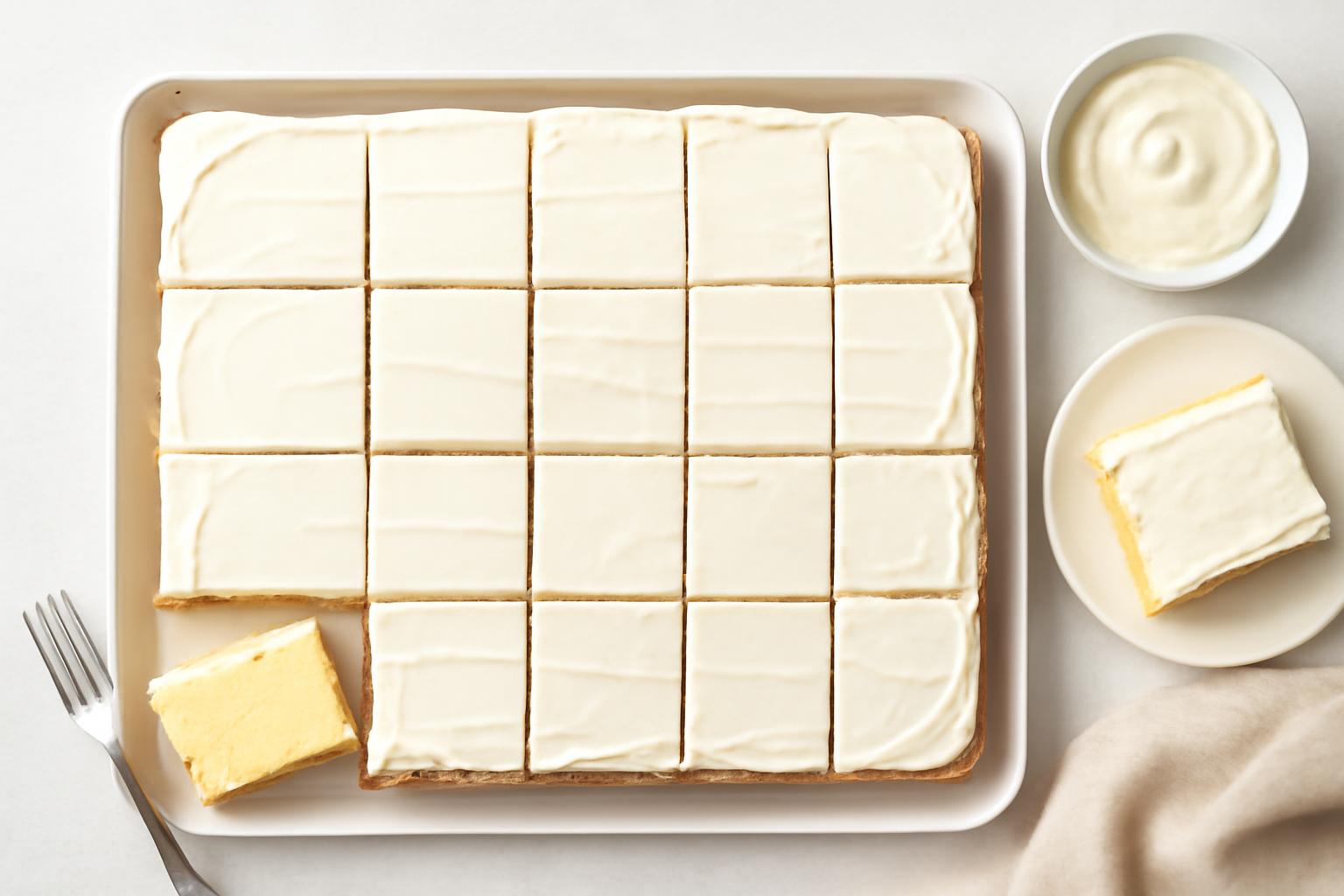
A 12 x 18 to 13 x 18-inch cake usually covers 30 to 40 guests with 2 x 3-inch party cuts. Clean-grid yield can fall below the area calculation.
If you are trying to estimate half sheet cake servings for a party, office event, birthday, or wedding, the hard part is usually not the math. It is the label.
“Half sheet” is not one universal pan size. Depending on the bakery, manufacturer, or chart, a half sheet may be 12 x 18 inches, 13 x 18, 13 x 17, or 12 x 16. That is why one source says a half sheet serves 36, another says 54, and another pushes much higher numbers under wedding or tall-cake cutting standards.
The useful news is that the core calculation is simple once you know two things:
- the cake’s actual dimensions
- the slice size you plan to serve
For planners who also care about portion consistency, that distinction matters. A 2 x 2-inch slice covers 4 square inches of cake surface. A 2 x 3-inch slice covers 6 square inches—50% more top-surface cake before you even get into height, layers, or filling.
So the practical way to estimate half sheet cake servings is:
- start with the top surface area
- divide by the slice footprint
- then adjust for how the cake can actually be cut and add a 10% to 15% event buffer
That approach will get you much closer than relying on the words “half sheet” alone.
What Defines a Half Sheet Cake Size?
The first thing to know is that there is no strict industry-wide standard for half sheet cake dimensions. Several sources explicitly note that sizes vary by bakery and pan manufacturer, which is why ordering by name alone can be misleading.
Across the evidence, half sheet cakes commonly fall into this general range:
- Length: about 12 to 18 inches
- Width: about 13 to 18 inches
- Height: about 1 to 3 inches for general half-sheet listings
Some serving charts also use taller, layered cakes around 4 inches high, but those are best treated as a separate serving standard rather than the default half-sheet height.
Common half sheet sizes
These are the half sheet dimensions most often cited:
| Size | Surface area |
|---|---|
| 12 x 16 in | 192 sq in |
| 12 x 18 in | 216 sq in |
| 13 x 17 in | 221 sq in |
| 13 x 18 in | 234 sq in |
Two of the most common modern references are 12 x 18 and 13 x 18, while some bakers use 13 x 17 as their standard half sheet.
That difference is not trivial. A 13 x 18 cake has 234 square inches of top surface. A 12 x 16 cake has 192 square inches. Those cakes should not be expected to yield the same number of servings.
How half sheets compare with quarter and full sheets
Half sheets make more sense when you compare them with the sizes around them:
| Cake type | Common size(s) | Surface area |
|---|---|---|
| Quarter sheet | 9 x 13 in | 117 sq in |
| Half sheet | 12 x 16 to 13 x 18 in | 192 to 234 sq in |
| Full sheet | 16 x 24 in or 18 x 26 in | 384 to 468 sq in |
This is why generic labels can mislead. A quarter sheet at 9 x 13 has 117 square inches. A full sheet might be 384 or 468 square inches, depending on the pan. A half sheet sits in the middle, but not at one fixed size.
The practical takeaway
If you are ordering a cake and want a reliable serving estimate, ask the bakery two direct questions:
- What are the exact dimensions?
- What slice size are you using for the serving count?
That resolves most of the confusion before the cake is ever cut.
The Surface Area Formula for Servings
The baseline formula for rectangular cake servings is straightforward:
Servings = cake surface area ÷ slice area
Where:
- cake surface area = length × width
- slice area = slice length × slice width
This is the cleanest starting point for any sheet cake, including half sheets.
Step 1: Calculate the cake’s surface area
For a 13 x 18-inch half sheet:
- 13 × 18 = 234 square inches
For a 12 x 18-inch half sheet:
- 12 × 18 = 216 square inches
Step 2: Calculate the slice area
Common slice footprints include:
- 1 x 2 inches = 2 sq in
- 2 x 2 inches = 4 sq in
- 2 x 3 inches = 6 sq in
For anyone trying to keep portions consistent, this is the key part. The footprint you choose defines the serving size much more clearly than the phrase “one slice.”
Step 3: Divide cake area by slice area
For a 13 x 18-inch cake:
- 234 ÷ 4 = 58.5, or about 58 servings at 2 x 2 inches
- 234 ÷ 6 = 39, or about 39 servings at 2 x 3 inches
- 234 ÷ 2 = 117 servings at 1 x 2 inches
For a 12 x 18-inch cake:
- 216 ÷ 4 = 54 servings at 2 x 2 inches
- 216 ÷ 6 = 36 servings at 2 x 3 inches
- 216 ÷ 2 = 108 servings at 1 x 2 inches
That is the core math behind most sheet-cake serving charts.
Why the formula and the real-world count can differ
Area math gives a theoretical yield. Real cakes are cut in grids, and the dimensions do not always divide evenly.
For example, take a 13 x 18-inch cake cut into 2 x 2-inch pieces:
- along the 18-inch side: 18 ÷ 2 = 9
- along the 13-inch side: 13 ÷ 2 = 6 full rows, with 1 inch left over
That produces:
- 9 × 6 = 54 full servings
So the clean grid gives 54, even though the area formula suggests about 58.
The same thing happens with 2 x 3-inch cuts on a 13 x 18-inch cake:
- 18 ÷ 3 = 6
- 13 ÷ 2 = 6, with 1 inch left over
- 6 × 6 = 36 full servings
Area says 39. A neat grid says 36.
That gap explains a lot of the conflicting numbers online. Often, people are not disagreeing about cake size. They are using different assumptions about whether to count only clean full slices or the theoretical maximum by area.
The best way to use the formula
Think in two layers:
- Theoretical yield: area ÷ slice area
- Practical yield: what a clean grid actually gives you
For planning, the area calculation is your starting point. The grid check tells you whether that number is realistically achievable.
Add a 10% to 15% buffer
For actual events, especially if someone else is cutting the cake, several sources recommend adding a 10% to 15% buffer.
That buffer helps account for:
- uneven slices
- serving drift
- messy cuts
- the leftover strip when dimensions do not divide evenly
- guests wanting slightly larger pieces
So if your math says a cake should cover 40, it is smart to plan as though the usable count may land somewhat lower.
Party vs. Wedding Slice Sizes and Yields
When people disagree about half sheet cake servings, they are usually not disagreeing about the cake itself. They are disagreeing about the slice template.
The two main serving styles are:
- party slices, which are larger
- wedding or banquet slices, which are smaller and meant to stretch further
Common slice standards
For half sheet cakes, these are the most common slice footprints in the evidence:
| Slice type | Typical size | Use case |
|---|---|---|
| Wedding / banquet | 1 x 2 in | Weddings, formal events, dessert service |
| Party, modest | 2 x 2 in | Birthdays, office parties, standard dessert |
| Party, generous | 2 x 3 in | Casual parties, larger portions, thinner cakes |
Some taller cake charts also use 1.5 x 2-inch party servings for 4-inch-high cakes. That is a different standard from a typical 2-inch sheet cake cut into 2 x 2 or 2 x 3 pieces.
Typical half sheet cake servings by slice size
Across commonly cited half sheet sizes, these are the most useful working ranges:
- 2 x 2-inch party slices: about 48 to 58 servings
- 2 x 3-inch generous party slices: about 32 to 39 servings
- 1 x 2-inch wedding slices: about 98 to 117 servings for common larger half sheets
That is why one half sheet may be listed as serving 36 people in one place and well over 100 in another. The slice size changed.
Side-by-side chart for 12 x 18 and 13 x 18 half sheets
| Cake size | Slice size | Area method | Clean grid / practical count |
|---|---|---|---|
| 12 x 18 in | 2 x 3 in | 36 | 36 |
| 12 x 18 in | 2 x 2 in | 54 | 54 |
| 12 x 18 in | 1 x 2 in | 108 | 108 |
| 13 x 18 in | 2 x 3 in | 39 | 36 |
| 13 x 18 in | 2 x 2 in | 58 | 54 |
| 13 x 18 in | 1 x 2 in | 117 | 117 |
This table reconciles most of the apparently conflicting half-sheet numbers:
- 36 usually means a 12 x 18 cake cut into 2 x 3 servings, or a 13 x 18 cake cut into a clean 2 x 3 grid
- 54 usually means a 12 x 18 cake cut into 2 x 2 servings, or a 13 x 18 cake cut into a clean 2 x 2 grid
- 58 is the area-based maximum estimate for a 13 x 18 cake at 2 x 2
- 108 to 117 are common 1 x 2 wedding-style yields for 12 x 18 and 13 x 18
Why wedding slices can nearly double the count
A 1 x 2-inch slice uses 2 square inches of cake surface. A 2 x 2-inch party slice uses 4 square inches. So before cutting inefficiencies, the smaller wedding slice can nearly double the serving count.
That is why a half sheet that serves around 54 at a party can also appear as 108 to 117 servings in formal service charts.
A note on tall-cake charts
Some charts publish higher party yields because they assume a 4-inch-high, two-layer cake and a smaller party footprint such as 1.5 x 2 inches.
For example:
- a 12 x 18-inch cake may be listed at 72 party servings and 98 wedding servings in a 4-inch-high chart
- another bakery-style source describes a half sheet roughly 12 x 18 inches and about 4 inches tall as giving 50 to 54 party servings and 100 to 108 banquet servings
Those numbers are not contradictions. They come from different cutting standards and different cake builds.
For most typical sheet-cake planning, the most practical working templates are still:
- 2 x 3 for generous party slices
- 2 x 2 for standard party slices
- 1 x 2 for wedding or banquet slices
Impact of Cake Height, Layers, and Filling
Cake height does not change the top-surface geometry. It does change what feels like a reasonable serving.
That is the most accurate way to think about the “does height matter?” question.
What height changes, and what it does not
If two cakes both measure 12 x 18 inches on top, each has 216 square inches of surface area. From a geometry standpoint, they start with the same base math.
But serving size is not only geometry. It is also about how substantial each piece feels to the guest.
A cake that is:
- 1 to 2 inches tall
- a single layer
- lightly frosted
will usually feel less substantial per slice than a cake that is:
- built taller
- made with two layers and filling
- cut using a 4-inch-tall serving standard
That is why different charts can show different yields for the same pan footprint.
Why sources disagree on serving charts
This is where many chart conflicts come from.
A thinner half sheet may be best planned as:
- 2 x 3-inch slices for a casual party
- or 2 x 2-inch slices when dessert is one of several offerings
A taller layered cake may reasonably be served in:
- 2 x 2-inch pieces
- or, in some 4-inch-tall serving charts, 1.5 x 2-inch party slices
- or 1 x 2-inch wedding slices
That is why one source can show a 12 x 18 cake at 54 party servings, while another 4-inch-tall chart shows 72 party servings for the same footprint. The pan did not change. The serving standard did.
Practical rules for half sheet cake servings
A useful framework is:
- Shorter or thinner cake: expect larger slices and lower yield
- Typical sheet-cake planning: 2 x 2 or 2 x 3 slices are the most realistic starting templates
- Taller, layered cake charts: smaller slice footprints can be reasonable
- Wedding or banquet service: 1 x 2 slices are common because servings are intentionally smaller
Do fillings increase servings?
Fillings do not increase surface area, so they do not create more cake in the geometric sense.
What fillings and extra layers can do is make smaller slices feel more reasonable, which is why layered cakes are often paired with smaller serving templates in bakery charts.
Why “height doesn’t matter” is incomplete
Height does not change the starting area calculation. That part is true.
But for actual planning, height and layers still matter because they influence:
- which slice size seems appropriate
- whether a smaller serving feels acceptable
- how generous the cutter is likely to be
So height does not automatically raise the count. It changes which count is realistic.
Serving Examples Across Half Sheet Variations
Looking at specific half sheet sizes makes the math easier to use in practice.
Common half sheet examples
| Cake size | Area | 2 x 3 party | 2 x 2 party | 1 x 2 wedding |
|---|---|---|---|---|
| 12 x 16 x 3 in | 192 sq in | 32 | 48 | — |
| 12 x 18 x 2 in | 216 sq in | 36 | 54 | 108 |
| 13 x 18 x 2 in | 234 sq in | 36 to 39* | 54 to 58* | 117 |
*Lower number reflects a clean grid of full slices. Higher number reflects the theoretical area-based estimate.
13 x 18 x 2-inch half sheet
This is one of the most common modern half-sheet references.
Useful working counts:
- 54 party servings at a clean 2 x 2-inch cut
- 117 wedding servings at 1 x 2-inch cuts
If you use pure area math, the same cake contains enough surface for about:
- 58 servings at 2 x 2
- 39 servings at 2 x 3
In practice, those are better treated as high-end estimates than guaranteed yields.
12 x 18 x 2-inch half sheet
This is another common bakery size and one of the cleanest to calculate because the dimensions divide evenly.
It yields:
- 54 servings at 2 x 2 inches
- 36 servings at 2 x 3 inches
- 108 servings at 1 x 2 inches
Since both 12 and 18 divide neatly by 1, 2, and 3, the theoretical and grid counts match.
12 x 16 x 3-inch half sheet
This smaller variation yields:
- 48 servings at 2 x 2 inches
- 32 servings at 2 x 3 inches
This is a good reminder that “half sheet” by itself is not specific enough. Depending on the actual pan, the same label may mean something closer to 32 generous party servings or something closer to 58 modest party servings.
Why “36 to 48 servings” appears so often
Many consumer guides summarize half sheet cake servings as about 36 to 48 people. That is not wrong, but it is usually a conservative summary built on one or more of these assumptions:
- the bakery is using a smaller half sheet
- the cake is being cut into 2 x 3 party slices
- the cake is relatively thin
- the source is avoiding the mathematical maximum
That is why you can see a broad headline range like 36 to 48, while the geometry for some larger half sheets reaches 54 to 58 at 2 x 2 slices.
A useful planning split
If you want a quick shortcut:
- Conservative party estimate: use 2 x 3
- Standard party estimate: use 2 x 2
- Formal high-count estimate: use 1 x 2
That gives you a realistic range without pretending every half sheet is identical.
Cutting Techniques for Accurate Servings
Even solid math falls apart if the cutting is inconsistent. With half sheet cake servings, technique is what turns the estimate into actual portions.
1. Mark the grid before cutting
Do not eyeball the first cut.
Use a ruler, toothpicks, or the back of a knife to mark the serving grid before cutting deeply.
For a 13 x 18-inch cake with 2 x 2-inch servings, the clean target grid is:
- 9 columns across the 18-inch side
- 6 rows across the 13-inch side
- total: 54 full servings
For 1 x 2-inch cuts on the same cake:
- 9 columns of 2 inches
- 13 rows of 1 inch
- total: 117 servings
For 2 x 3-inch cuts:
- 6 columns of 3 inches
- 6 rows of 2 inches
- total: 36 full servings
Once the grid is marked, the count is much easier to protect.
2. Use a sharp, warm knife
A sharp knife helps keep cuts clean, and a warm blade helps it pass through frosting more neatly.
This matters because ragged cuts can lead servers to trim, merge, or resize portions on the fly, which changes the final yield.
3. Cut straight down, full height
Make vertical cuts all the way through the cake.
This is especially important on layered or taller cakes. Angled cuts can make slices wider at the bottom than they appear from the top, which quietly enlarges portions.
4. Decide how to handle the leftover strip
Some cakes do not divide evenly.
On a 13 x 18-inch cake cut into 2 x 2-inch servings, there is 1 inch left over on the 13-inch side.
You can:
- trim it away for a neat presentation
- save it for seconds or staff
- cut smaller extra pieces if appearance matters less than yield
What you should not do is assume that the leftover strip automatically becomes full-size servings.
5. Expect some loss from trimming and presentation
One source notes that round-cake calculations may include about 12% edge waste, while sheets and squares lose less. That is one advantage of rectangular cakes.
Still, sheets are not loss-free. If the border is messy, if the server trims edges for appearance, or if pieces drift larger than planned, the final usable count can come in below the mathematical maximum. That is why the 10% to 15% event buffer remains helpful even for sheet cakes.
Best cutting rule for planners
If you need servings to be predictable, decide all of this before the event:
- exact pan size
- slice size
- grid layout
- who is cutting
- whether the leftover strip counts
That matters far more than the phrase “half sheet.”
Guest Count Guide: Right Size for Your Event
The most practical question is usually not theoretical. It is: What half sheet cake should I use for my guest count?
For 30 to 40 guests
A half sheet in the 12 x 18 to 13 x 18-inch range usually works for 30 to 40 guests if you are serving 2 x 3-inch party slices or modest portions as part of a dessert spread.
Examples:
- 12 x 18 at 2 x 3: about 36 servings
- 13 x 18 at 2 x 3: about 36 clean-grid servings, up to 39 by area math
That means a half sheet can cover 40 if:
- portions are moderate
- there are other desserts
- not every guest takes cake
- you are comfortable with a little flexibility
If you need a firm 40 servings with less margin for error, a 2 x 2-inch plan or an additional buffer is safer.
For 50 or more guests
A half sheet can still work for 50+ guests, but now slice size matters even more.
Examples:
- 12 x 18 at 2 x 2: 54 servings
- 13 x 18 at 2 x 2 clean grid: 54 servings
- 12 x 18 at 1 x 2 wedding cuts: 108 servings
- 13 x 18 at 1 x 2 wedding cuts: 117 servings
So for guest counts above 50, a half sheet remains viable if:
- it is cut into 2 x 2 party pieces
- or served as 1 x 2 wedding or banquet portions
If you want large, casual party slices for more than 50 people, one half sheet is usually not enough.
Adjust for the audience
The evidence also notes that audience matters.
Kids’ parties
Sources explicitly note that audience affects realistic servings. For kids’ events, cutting may be less precise, which often makes conservative planning wiser.
Dessert buffets
If cake is only one dessert among many, smaller slices are more realistic, so a half sheet tends to stretch further.
Adult gatherings with cake as the main dessert
If cake is the clear featured dessert, more generous servings may be appropriate, making 2 x 3-inch planning more realistic than formal wedding cuts.
A simple event-planning shortcut
Use this rule of thumb:
- Need generous slices for 30 to 40 guests? A half sheet often works.
- Need standard party slices for about 50 guests? A half sheet can still work.
- Need small formal slices for a large crowd? A half sheet can serve roughly 100+.
For anyone tracking portions carefully, the important step is to choose the serving template first—2 x 3, 2 x 2, or 1 x 2—and keep that definition consistent.
Quarter, Half, and Full Sheet Comparisons
It is easier to judge half sheet cake servings when you compare them with quarter and full sheets.
Size and serving overview
| Cake type | Common size(s) | Area | Typical party range | Typical wedding range |
|---|---|---|---|---|
| Quarter sheet | 9 x 13 in | 117 sq in | 18 to 36 | 29 to 54 |
| Half sheet | 12 x 16 to 13 x 18 in | 192 to 234 sq in | 32 to 58 | 98 to 117 for common larger half sheets |
| Full sheet | 16 x 24 in or 18 x 26 in | 384 to 468 sq in | about 70 to 117+ | 192+ on common formal cuts |
Those wide ranges exist because charts use different assumptions:
- thinner versus taller cakes
- 2-inch versus 4-inch serving standards
- 2 x 3, 2 x 2, 1.5 x 2, or 1 x 2 slice templates
- practical grid cutting versus pure area math
Why scaling by area works best
The most reliable way to compare sheet cakes is by surface area, not by label.
For example:
- Quarter sheet 9 x 13 = 117 sq in
- Half sheet 12 x 18 = 216 sq in
- Full sheet 16 x 24 = 384 sq in
A 12 x 18 half sheet has about 1.85 times the area of a 9 x 13 quarter sheet. So at the same slice size, it should serve about 1.85 times as many people.
That scales much more reliably than the words quarter, half, and full.
What this means in practice
If you already know one sheet size works for your event style, area math helps you scale up:
- if a 9 x 13 quarter sheet gives 24 servings at 2 x 2
- then a 12 x 18 half sheet gives 54 servings at 2 x 2
- and a 16 x 24 full sheet gives 96 servings at 2 x 2
The ratios make sense because the area scales.
The planning lesson
The names quarter, half, and full are useful shorthand. But for accurate planning, the better method is:
- confirm the exact dimensions
- calculate the surface area
- choose the slice size
- check the grid
- add a 10% to 15% buffer for real service
That is the cleanest way to avoid both cake shortages and inflated serving claims.
For portion-focused planners, that method is also the most useful one. It gives you a defined serving size instead of a vague “slice,” which is exactly what you need if you want your event math to stay consistent.
Is there a standard half sheet cake size?
No. A half sheet cake does not have one universal standard size across all bakeries and manufacturers. Common versions include 12 x 18 inches, 13 x 18 inches, 13 x 17 inches, and 12 x 16 inches. That is why it is safer to order by exact dimensions or by target servings rather than assume every half sheet is identical.
How many 2x2 inch servings in a half sheet cake?
It depends on the exact half-sheet size.
Typical examples:
- 12 x 16 half sheet: 48 servings
- 12 x 18 half sheet: 54 servings
- 13 x 18 half sheet: 54 full-grid servings, up to about 58 by area math
So a practical answer for 2 x 2-inch half sheet servings is usually about 48 to 54, with 58 as the area-based high end on a larger 13 x 18 cake.
Does cake height affect the number of servings?
Height does not change the top-surface area, so it does not change the starting geometry. But it does affect what slice size feels reasonable.
- a thinner cake usually calls for larger slices
- a taller, layered cake can support smaller slices in some serving charts
So height does not automatically create more servings, but it does change the practical yield by changing the serving standard.
How to calculate servings for any sheet cake pan?
Use this formula:
Servings = (length × width) ÷ (slice length × slice width)
Example for a 12 x 18-inch cake cut into 2 x 2-inch servings:
- cake area: 12 × 18 = 216 sq in
- slice area: 2 × 2 = 4 sq in
- servings: 216 ÷ 4 = 54
Then check whether the dimensions divide evenly in a grid and add a 10% to 15% buffer for real-world cutting and service.
Party slices vs. wedding slices: what’s the difference?
The main difference is the slice footprint.
- Party slices are larger, commonly 2 x 2 inches or 2 x 3 inches
- Wedding slices are smaller, commonly 1 x 2 inches
- some tall-cake party charts also use 1.5 x 2-inch slices
Because a 1 x 2-inch slice uses only 2 square inches of surface and a 2 x 2-inch slice uses 4 square inches, wedding cuts can nearly double the serving count compared with standard party cuts. That is why the same half sheet might serve about 54 in a party setup but 108 to 117 in a wedding-style setup.