
The Calorie Math Behind Chocolate Caramel Coconut Clusters
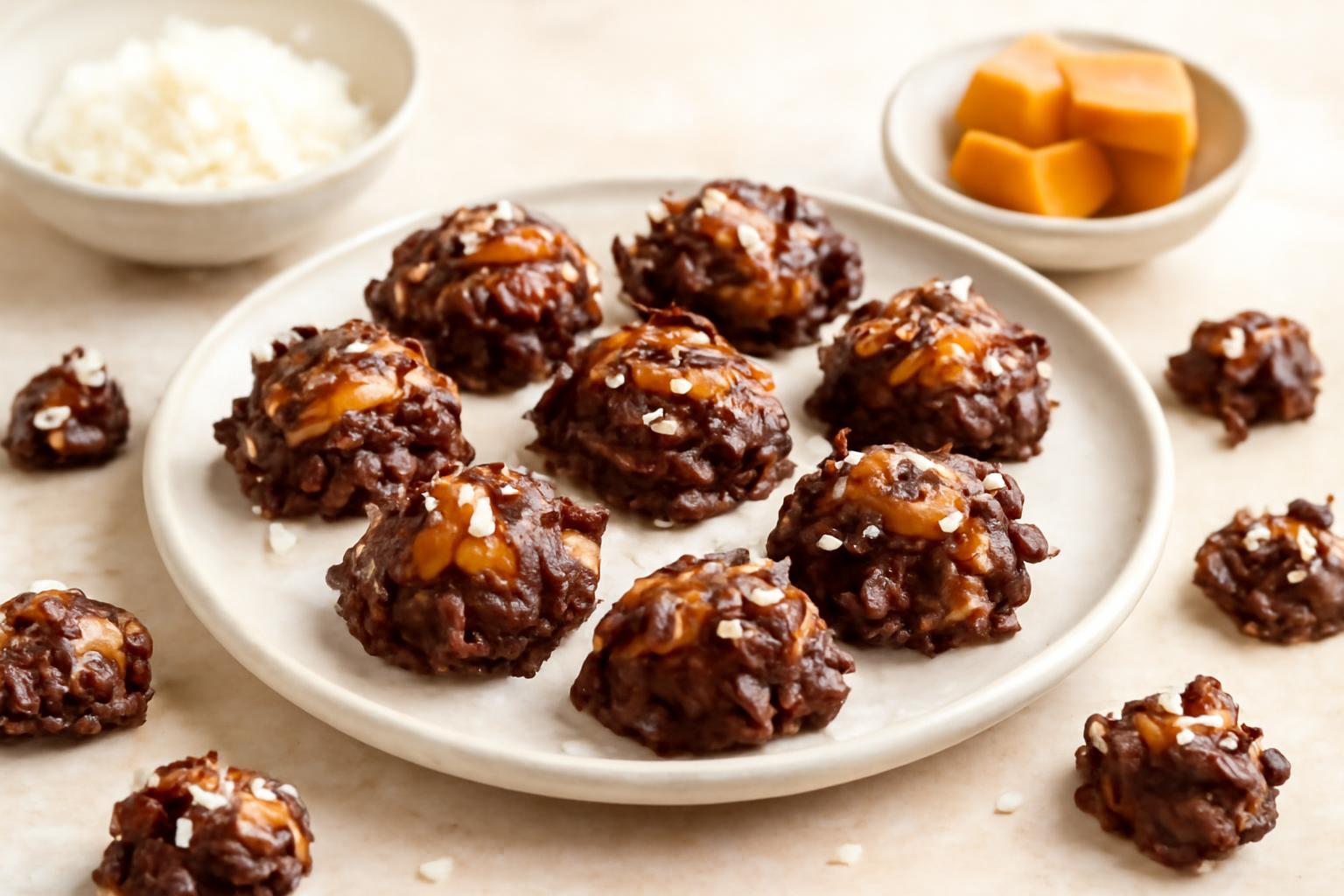
Packaged servings range from just over 100 to 240 calories in the evidence reviewed; one homemade recipe lists 221 calories per serving.
Chocolate caramel coconut clusters are a tracking headache for a simple reason: the name covers several similar foods, not one standardized product. Some are true candy clusters made from coconut, caramel, and chocolate. Some are Samoa-style cookie hybrids with shortbread, wafers, or graham crackers. Some packaged items match only part of the flavor combination, while one exact-match packaged example in this evidence is actually sold as trail mix rather than as a solid cluster.
For calorie tracking, that means the name is less useful than the structure. The three questions that matter most are: how much does the serving weigh, what do the label macros say, and how dense are the ingredients? Once you sort those out, the logging problem gets much easier.
What Are Chocolate Caramel Coconut Clusters?
At their simplest, chocolate caramel coconut clusters are no-bake candies built from coconut, caramel, and chocolate. One three-ingredient version uses toasted unsweetened shredded coconut, melted chocolate, and caramel, then portions the mixture into clusters and tops it with caramel and sea salt (The Saucy Fig).
The category gets wider once you move into Samoa-style versions. A Food52 recipe called “Chocolate Caramel Coconut Clusters” is actually a cookie: it uses a shortbread base, a toasted coconut-caramel topping, and dark chocolate dip or drizzle, baked at 350°F with coconut toasted for 8 to 10 minutes (Food52).
Other homemade versions push the structure back toward candy. One no-bake example combines toasted sweetened shredded coconut, crushed vanilla wafers, sweetened condensed milk, dulce de leche, and dark chocolate melting wafers; the filling is scooped into roughly 1- to 1.5-inch balls, chilled or frozen for about 30 minutes, then dipped and drizzled in chocolate (Young Wild Me).
Calories in Commercial Chocolate Caramel Coconut Clusters
The cleanest way to read the market is to separate exact matches from proxies. In the evidence here, the only exact product name that includes chocolate, caramel, and coconut is Southern Grove Chocolate Caramel Coconut Trail Mix, which lists 160 calories per 3 tablespoons (30g)—useful as an exact flavor match, but still not a true solid cluster (MyNetDiary, Southern Grove).
The other commercial examples are best treated as brackets, not definitions of the category. Natural Candy Chocolate Coconut Clusters Bites lists 106 calories per 4 tablespoons (20g), Bulk Candy Milk Chocolate Coconut Clusters lists 240 calories per 2 pieces (1.5 oz/43g), and Chocolate Caramel Clusters lists 200 calories per 2 pieces (MyNetDiary, Natural Candy, CalorieKing, Bulk Candy, Ketogenic.com, Chocolate Caramel Clusters).
| Product | Serving size | Calories | How to use it |
|---|---|---|---|
| Natural Candy Chocolate Coconut Clusters Bites | 4 tbsp (20g) | 106 | Proxy for chocolate-coconut cluster density |
| Bulk Candy Milk Chocolate Coconut Clusters | 2 pieces (1.5 oz/43g) | 240 | Proxy for a larger chocolate-coconut candy serving |
| Chocolate Caramel Clusters | 2 pieces | 200 | Proxy for chocolate-caramel candy serving |
| Southern Grove Chocolate Caramel Coconut Trail Mix | 3 tbsp (30g) | 160 | Exact flavor match, but trail mix rather than a solid cluster |
Used that way, the table is helpful. It does not prove one universal calorie number for “chocolate caramel coconut clusters.”
That is why piece-count logging is risky. “Two clusters” can mean very different things when one product uses a 20g scoop and another uses a much heavier candy portion.
Macro Breakdowns from Product Labels
The macro pattern is fairly consistent in the cluster-style proxy labels: fat is usually the biggest contributor, carbs come next, and protein stays low.
The clearest fat-heavy example is the Natural Candy 20g serving. It lists 8.5g fat, 5g carbs, and 2g protein for 106 calories. Using standard label math, that works out to about 76.5 calories from fat, 20 from carbohydrate, and 8 from protein, or roughly 73% fat, 19% carbs, and 8% protein (MyNetDiary, Natural Candy).
The larger Bulk Candy proxy points in the same direction, but with a heavier total load. Its 43g serving lists 18g fat, 19g carbs, and 3g protein for 240 calories. If you multiply the macro grams, you get about 250 calories, not 240, which is a good reminder that third-party label transcriptions and rounded gram values do not always sum perfectly to the listed calorie total. Even with that mismatch, the pattern is still clear: this is a fat-forward, sugar-containing candy with very little protein (CalorieKing, Bulk Candy).
At 30g, it lists 12g fat, 14g carbs, and 3g protein, and the page displays calories as 61% from carbs, 32% from fat, and 7% from protein. That is not a reason to assume all chocolate-caramel-coconut products are carb-dominant; it is a reason to log the product format you actually bought rather than forcing everything into a generic cluster entry (MyNetDiary, Southern Grove).
Estimating Calories in Homemade Clusters Using Atwater Factors
For homemade chocolate caramel coconut clusters, the most useful method is batch math first, piece math second.
In plain English, that means using standard label-style calorie arithmetic: fat contributes 9 kcal per gram, carbohydrate 4 kcal per gram, and protein 4 kcal per gram, then dividing the batch total by either the finished batch weight or a truly consistent number of pieces. That gives you a practical tracking estimate, not a lab measurement. CaloriePages’ Terms of Use make the broader point that the content is for general informational reading rather than personalized dietary advice.
A concrete worked example comes from the Crispy Coconut Caramel Clusters recipe from Num’s the Word. It lists 221 calories, 12g fat, 27g carbs, and 2g protein per serving. Running the macro math gives about 108 calories from fat, 108 from carbohydrate, and 8 from protein, or roughly 224 calories total—very close to the stated 221.
That example is useful because it shows what homemade “close enough” math looks like in practice. You are not trying to discover the one true calorie number for a cluster. You are trying to get a repeatable estimate from the ingredients you actually used.
A practical workflow looks like this:
- Log every ingredient in the full recipe, including chocolate coating, caramel, wafers, graham crackers, nuts, or seeds.
- Add the recipe totals for fat, carbs, and protein.
- Convert those macro totals into calories using standard label math.
- Weigh the finished batch after it is fully set.
- Divide total calories by total batch weight to get calories per gram.
- Weigh each portion or each cluster and multiply by that calories-per-gram figure.
That approach matters because homemade yields are slippery. “Makes 24” is only accurate if your scoops, chocolate coating, caramel thickness, and final weight match the recipe author’s version. Often they do not.
Within the evidence here, one rich homemade example already lands above 200 calories per serving: Num’s the Word lists 221 calories for one of 40 servings in its graham-cracker, pecan, coconut, caramel, and chocolate cluster recipe. So if your own version also includes dense add-ins and a full chocolate coating, a surprisingly high per-piece total is not unusual.
Serving Size Variations and Label Error Risks
Most calorie confusion with chocolate caramel coconut clusters starts with serving size, not with mysterious ingredients.
A 20g packaged serving at 106 calories and a 43g packaged serving at 240 calories sound very far apart, but they are actually quite similar in energy density: about 5.3 calories per gram versus 5.6 calories per gram when you divide calories by serving weight. The headline numbers look different mostly because the serving weights are different.
That is why “one cluster” is such a weak unit for tracking. If you portion one homemade batch into 18 mounds and another into 30, the calories per piece can swing dramatically without any change in ingredients.
Even labels themselves are not exact chemistry. CaloriePages says calorie counts on labels can be off by about 20%, which is one reason to treat food logs as estimates rather than promises.
Your own daily burn adds another layer of uncertainty. CaloriePages’ TDEE explainer says basal metabolic rate typically accounts for about 60% to 70% of TDEE, protein’s thermic effect runs around 20% to 30%, carbohydrate about 5% to 10%, fat about 0% to 3%, NEAT can differ by up to 2,000 kcal/day between similar people, and common calculator estimates can miss by about ±10%. Its practical recommendation is to calibrate with a food log and body-weight trend over 2 to 4 weeks rather than trusting a calculator blindly.
Put simply: the label is approximate, your homemade estimate is approximate, and your TDEE is approximate. That does not make tracking useless. It means ranges and trends are more honest than pretending a candy cluster is ever known to the exact calorie.
Macro Impacts on Satiety and TDEE
For most trackers, chocolate caramel coconut clusters fit better as dessert calories than as hunger-management food.
The reason is composition. In the packaged examples and recipe evidence here, protein stays low—usually around 2 to 3 grams per serving where listed—while most calories come from fat and sugar-heavy carbs. CaloriePages’ protein article summarizes protein’s thermic effect at about 20% to 30% of its calories, versus roughly 5% to 10% for carbohydrate and 0% to 3% for fat, which helps explain why higher-protein foods often feel more filling for the same label calories.
That does not make clusters “bad.” It just changes how to budget them. A dessert with low protein and dense fat-and-sugar calories can fit into maintenance or a deficit, but it usually works best when it is logged deliberately rather than eaten as an invisible extra.
TDEE context helps here. Total daily energy expenditure is not just workouts; it includes BMR, the thermic effect of food, formal exercise, and the everyday movement grouped under NEAT. Because BMR usually supplies about 60% to 70% of total daily burn and NEAT can vary enormously from person to person, the best question is not “Are clusters fattening?” but “How often and in what portion can I fit them into my actual intake trend?”.
The practical tracking rules are straightforward:
- log the product you actually bought, not a wishful generic entry
- weigh homemade pieces instead of trusting the recipe yield
- count chocolate coating and caramel, not just the “inside” ingredients
- if body weight is not moving as expected after a few weeks, recalculate total intake and TDEE before blaming one food
Customizing for Lower Calories or Macros
Yes, you can make chocolate caramel coconut clusters lighter—but most changes shift the profile rather than turning them into a low-calorie food.
One of the cleaner ways to alter the recipe is to change the caramel itself. Blissful Basil’s chocolate-covered caramel-coconut bars use a date-based filling made from Medjool dates, coconut oil, almond butter, vanilla, salt, and shredded coconut. That can reduce reliance on conventional added-sugar caramel, but it does not make the dessert low in energy, because dates, coconut oil, and nut butter still contribute substantial calories.
Another lever is chocolate choice. A darker chocolate in the 70% to 85% range can reduce sugar compared with milk chocolate and may make smaller portions feel richer, though it does not automatically cut calories.
Bake It Paleo’s dark chocolate coconut clusters use toasted coconut chips, pumpkin seeds, sunflower seeds, chia seeds, and dark chocolate, with no caramel at all. That makes it a useful template for a lower-sugar coconut-chocolate cluster, but not a direct keto version of classic chocolate caramel coconut clusters.
For everyday tracking, the most reliable calorie reduction is usually simpler than ingredient marketing:
- use less caramel
- use a thinner chocolate coating
- skip wafers or graham crackers if you do not need the Samoa-style crunch
- portion the finished batch into smaller weighed servings
For scale, there was also a packaged Special K Caramel Coconut snack bar at 100 calories per bar, but that is a bar product, not a cluster..
Storage and Practical Tracking Tips
Homemade clusters store well enough to make ahead, which is convenient for prep and inconvenient for casual over-snacking.
For no-bake cluster-style candy, Young Wild Me says they keep about 5 days in the fridge and up to 2 months frozen. For the Samoa-style cookie version, Food52 says they keep about 1 week sealed and for several weeks in the freezer.
That makes a sensible general takeaway: refrigerate for about 5 to 7 days, freeze for roughly 1 to 2 months, and expect texture to firm up in the cold.
For tracking accuracy, the best routine is still the boring one:
- weigh the full finished batch once it is set
- log the full ingredient list
- calculate calories per gram
- store pieces with either average piece weight or remaining batch weight noted on the container
Chocolate caramel coconut clusters are manageable in a food log. They just punish vague portion estimates more than simpler foods do.
How many calories in one chocolate caramel coconut cluster?
There is no single answer because “one cluster” is not standardized. In the evidence here, packaged examples range from small servings a little over 100 calories to larger servings at 240 calories, and one homemade Crispy Coconut Caramel Clusters recipe lists 221 calories per serving.
Are chocolate caramel coconut clusters keto-friendly?
Classic versions usually are not, because caramel and chocolate push carbs up quickly. A lower-carb coconut-chocolate cluster template exists—Bake It Paleo uses dark chocolate, coconut, and seeds—but it omits caramel, so it is not a direct keto version of the classic treat.
What is the macro split for a typical 30g serving?
The clearest 30g exact-flavor label in this evidence is Southern Grove Chocolate Caramel Coconut Trail Mix, which lists 12g fat, 14g carbs, and 3g protein for 160 calories. That is useful as a 30g reference point, while candy-style clusters can skew differently depending on structure and coating.
How to estimate homemade cluster calories from ingredients?
The Num’s the Word example shows how close that can get in practice: its listed 221 calories per serving are very close to what the macro arithmetic produces.
Do food labels overstate cluster calories by 20%?
CaloriePages summarizes that label counts can be off by about 20%, which is why food logs work best as trend tools rather than exact chemical measurements.