
Magic Cup Frozen Desserts Nutrition: Breaking Down 290 Calories, Protein Boosts, and High Sugars Per Cup
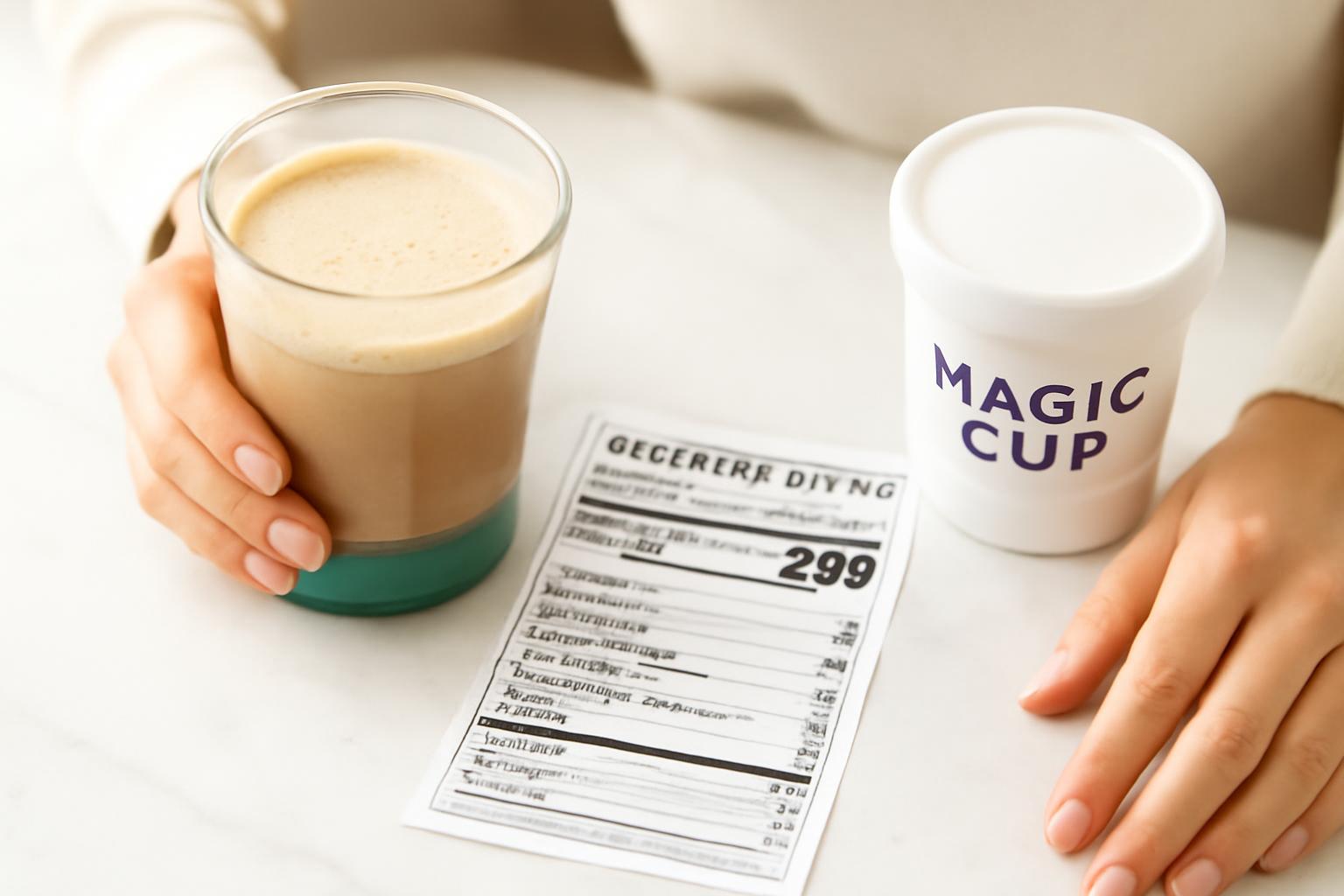
Its protein is useful, but calories come from carbohydrate and fat, with a large share of the carbohydrate coming from sugar.
If you are searching for magic cup nutrition, the useful questions are usually the practical ones: how large one cup is, how many calories it adds, how much protein comes with those calories, how much sugar is in that small serving, and whether the label makes sense for your reason for buying it.
There is also one important limitation to state plainly up front. In the evidence available here, the clearest Magic Cup nutrition data come from retailer, marketplace, and third-party nutrition listings rather than a manufacturer spec sheet or official Hormel product PDF. So the most accurate publication-ready framing is not “this is the one universal label for every Magic Cup,” but rather “these are the nutrition facts consistently reported across the documented listings, especially for vanilla and wild berry.” Across those listings, a standard 4-ounce cup is reported at 290 calories with 9 grams of protein, 38 grams of carbohydrate, 11 grams of fat, 31 grams of total sugars, 22 grams of added sugars, and 6 grams of saturated fat per serving (Magic Kitchen vanilla listing).
That profile tells you what Magic Cup is, nutritionally: a small-volume, high-calorie dessert-style supplement. The protein is real and useful, but it is not a lean, low-sugar protein food. The calories come from a mix of carbohydrate and fat, and a large share of the carbohydrate is sugar. For someone who needs a compact way to get more energy in, that can be a feature. For someone trying to keep added sugars or saturated fat modest, it is the main tradeoff.
How Food Labels Calculate Calories (And Where the Number Can Be Wrong): Food labels use the Atwater system, not direct measurement. Here’s how the 4-4-9 factors work, why they allow a 20% margin of error, and what that means for tracking.
What Is Magic Cup and Its Role as a Nutrition Supplement
Magic Cup is sold as a frozen dessert supplement with a two-stage texture: more ice-cream-like when frozen, softer and more pudding-like after thawing. Those same listings also show that Magic Cup is sold in multiple flavors and pack formats, including vanilla, chocolate, butter pecan, orange cream, wild berry, and reduced sugar vanilla, with case sizes and smaller packs listed across sellers.
Magic Cup is not presented as an everyday frozen dessert first and a nutrition product second.
Marketplace listings also reinforce the product format. Amazon describes the vanilla version as 4-ounce individual cups sold in a 48-pack, identifies it as gluten-free, and notes that it contains milk (Amazon Magic Cup vanilla page).
There are a few label-screening points worth keeping separate from the general nutrition question. Some seller pages note that Magic Cup is not kosher. The product also contains milk, which matters far more than the dessert format if you are screening for allergens. And while gluten-free badges appear on listings, that should be read as a specific gluten status claim, not as a shortcut for “light,” “low carb,” or “healthy.” Those are different questions.
Serving Size and Total Calories in Magic Cup
For tracking purposes, the standard serving is simple: 1 cup/container = 4 ounces, with 1 serving per container, and the documented flavors most clearly shown here report 290 calories per serving. Seller instructions also note that the dessert can be served frozen or softened to about 40°F for a smoother consistency, but that texture change does not change the label math for the cup itself (Magic Cup wild berry listing).
The more confusing part usually comes from online pack layouts, not from the individual cup. A listing might be organized around a case, a 12-pack, or a 48-pack, while the Nutrition Facts panel still applies to one 4-ounce cup. The FDA’s guidance on Nutrition Facts labels is useful here: serving sizes are standardized to reflect how foods are typically consumed so shoppers can compare products, and they are not recommendations for how much any one person should eat. The same guidance also explains why multi-serving packages may use different label formats, including dual-column panels that show both per-serving and per-package values (FDA Nutrition Facts guidance).
In practice, that means the safest logging rule is this: if you opened and ate one sealed Magic Cup, count one serving unless the package in front of you clearly says otherwise. Do not let a case listing make you think the whole shipping box is one serving, and do not let a warehouse-style description make you miss the fact that the nutrition panel is usually written for a single cup.
There is also a label-accuracy caveat worth remembering. CaloriePages describes food-label calories as being measured with the Atwater system and says those label calorie numbers can be off by 20%. That does not mean Magic Cup should be logged with some custom correction factor. It means the printed label is still the right number to track, while also recognizing that food labels are estimates rather than perfect metabolic measurements (CaloriePages About page).
So the practical answer is straightforward: one Magic Cup is a small, single-serving dessert cup, and the reported calorie load is high for that volume. Whether that is helpful or excessive depends almost entirely on why you are using it.
Macronutrients: Protein, Carbs, Fat Breakdown
A third-party nutrition listing for “orange cream or vanilla” Magic Cup reports a calorie split of about 53% carbohydrate, 34% fat, and 13% protein, alongside 38 grams of net carbs, 0 grams of fiber, 31 grams of sugar, and 6 grams of saturated fat per container (Eat This Much Magic Cup listing).
Read that macro breakdown carefully and the product becomes easier to place. The protein is meaningful, but it is not the dominant feature. A standard documented cup lands around 9 grams of protein, which is useful in only 4 ounces, yet protein still supplies the smallest share of total calories. The bigger contributors are carbohydrate and fat.
That matters because “9 grams of protein” can sound more impressive than it is unless you set it next to the calorie total. For a person who simply needs more intake, 9 grams in a small cup may be enough to make the product worthwhile. For a macro-conscious reader comparing foods by protein efficiency, it is more accurate to call Magic Cup moderate-protein and high-calorie than “high-protein.”
The carbohydrate line deserves special attention. With 0 grams of fiber in the documented listings, essentially all of the reported carbohydrate count functions as net carbs. There is no fiber buffer doing any meaningful reduction of that number. That does not make the product inappropriate on its own, but it does make it a poor choice for anyone assuming the carb total will be softened by fiber.
Fat is the other major energy source here. The standard documented label is about 11 grams of total fat, with 6 grams of saturated fat and 0 grams of trans fat. That is part of why such a small cup can carry so many calories. It is also why Magic Cup can look dense or unbalanced if you approach it as a dessert first rather than as a calorie-support product.
A practical way to summarize the macros is:
- Protein: useful, but not the main driver of calories
- Carbohydrate: substantial, with no fiber offset
- Fat: enough to boost calorie density, with a notable saturated-fat share
That is not praise or criticism by itself. It is just the correct reading of the label pattern.
Sugars Content: Total, Added, and Daily Value Context
Sugar is the clearest nutritional tradeoff in Magic Cup. In the documented vanilla label, the 31 grams of total sugar include 22 grams of added sugars, and the ingredient list starts with skim milk and places high fructose corn syrup near the top, which is exactly what you would expect from a product designed to deliver a lot of calories in a small, sweet, easy-to-finish cup. That is why the sugar line deserves its own section rather than being buried inside “carbs” (Magic Kitchen vanilla listing).
The FDA’s label guidance gives useful context for reading that number. On a standard 2,000-calorie Daily Value framework, 50 grams is the Daily Value for added sugars, and the FDA’s quick rule of thumb is that 5% DV or less is low while 20% DV or more is high. A Magic Cup serving that reports 22 grams of added sugar therefore lands at 44% DV, which is firmly in the high range for a single 4-ounce serving (FDA Nutrition Facts guidance).
That does not automatically make the product a bad choice. It means the product has to be judged by purpose. If someone is struggling to finish meals and will willingly eat a cold, sweet, soft dessert cup, the sugar may be part of what makes the product workable. If someone is deliberately trying to keep added sugars low, the same label is hard to justify as a routine choice.
It also helps to separate total sugars from added sugars. Total sugars include sugars naturally present in dairy ingredients as well as added sweeteners. The label here makes clear that a large share is added. So the sweetness is not incidental. It is a core part of the formula.
A reduced sugar vanilla version appears in seller flavor lists, which is useful to know. But without a flavor-specific label in the evidence here, that phrase should be treated as a prompt to verify the exact cup you bought, not as permission to assume that every reduced-sugar version is automatically low-calorie or low-carb.
Vitamins, Minerals, and Fortification Profile
Magic Cup is not just calories plus sugar. The available listings also describe it as a fortified product. A Lyons HealthLabs listing reports roughly 200 mg calcium (15% DV) and 190 mg phosphorus (15% DV) per 4-ounce serving, along with vitamin D around 1.6 mcg (8% DV), iron around 1.8 mg (10% DV), potassium around 190 mg (4% DV), and vitamin A at 25% DV on that page (Lyons HealthLabs Magic Cup listing).
That fortification profile changes the comparison slightly.
The caution is that exact micronutrient lines are the part of the evidence that looks least uniform across seller pages. Calories, protein, carbs, fat, and sugar are fairly consistent in the documented flavors. Micronutrient panels look more dependent on the specific listing, the flavor shown, and the version of the label captured there. So the safest publication-grade phrasing is not “every Magic Cup has exactly this micronutrient panel,” but “seller listings report modest fortification, with exact lines best checked on the cup you actually have.”
When you interpret those numbers, %DV is the right shortcut. Ohio State University Extension’s label guide uses the familiar rule that 5% DV or less is low and 20% DV or more is high (Ohio State University Extension label guide). Applied to the documented Magic Cup listings, that means:
- Potassium around 4% DV reads as low
- Calcium and phosphorus around 15% DV are meaningful but not high
- Iron around 10% DV is moderate
- Added sugars at 44% DV are high
- Saturated fat at 30% DV is high
That is the right balance of emphasis. The micronutrients are a real positive. They are just not the whole story, and they do not erase the sugar or saturated-fat load.
Ingredients, Allergens, and Dietary Labels
The ingredient list matches the nutrition profile closely. Marketplace and retailer pages consistently start the formula with skim milk, high fructose corn syrup, water, palm oil, and milk protein concentrate, then move into smaller amounts of stabilizers, gums, gelatin, starches, flavors, and vitamin-mineral mixes. The Amazon listing also identifies the product as gluten-free and notes that it contains milk (Amazon Magic Cup vanilla page).
That top-of-label ingredient order tells you most of what you need to know. The milk ingredients explain the dairy base and the protein. High fructose corn syrup helps explain the large sugar total. Palm oil helps explain part of the calorie density and saturated fat load.
Flavor-specific details can still change. One seller page for wild berry, for example, lists beet juice color blend among the added ingredients, while broader listings mention artificial colors on some versions. So even when the headline calories look similar, you should not assume that every flavor has an identical ingredient list.
Dietary badges are useful, but they need context. Seller pages use terms such as single serving, gluten free, low sodium, and sometimes dialysis friendly to help buyers screen products. Those badges are not meaningless, but they are also not a substitute for reading the full panel. A product can be low in sodium for its serving size and still be high in added sugar. A product can be gluten-free and still be a poor fit for a low-carb plan. And a retailer badge related to dialysis or another medical context does not prove universal suitability for every person with that condition.
That is the larger label-reading lesson: front-end claims help you narrow choices, but the Nutrition Facts panel and ingredients list tell you what you are actually buying. If you are using Magic Cup within a medical nutrition plan, verify the exact package and check it with your clinician or dietitian rather than relying on seller badges alone.
Flavor Variations and Label Reading Tips for Magic Cup
The documented evidence supports a narrow conclusion about flavor variation, not a broad one. Vanilla and wild berry seller pages report the same headline serving size and very similar calories and macros. A third-party “orange cream or vanilla” listing also sits in that same general range. That suggests the standard flavors shown here are often similar, but it does not prove that all Magic Cup flavors are nutritionally identical.
That distinction matters. The evidence here does support saying that the documented flavors cluster around the same core pattern: small 4-ounce cup, about 290 calories, moderate protein, substantial carbs, notable sugar, and meaningful saturated fat. The evidence does not support saying that every flavor, every package version, and every special variant shares one universal label.
Reduced sugar vanilla is a good example. It clearly exists in retailer flavor menus, but the evidence here does not include a flavor-specific label panel detailed enough to publish exact calories or sugars for it. So the right message is not “reduced sugar vanilla must be much lower.” The right message is “reduced sugar vanilla should be checked directly on the package.”
For day-to-day label reading, a simple sequence works well:
- Check serving size first. For Magic Cup, the standard documented serving is one 4-ounce cup.
- Confirm whether the page is describing one cup or a full pack. Online case listings are a common source of confusion.
- Look at calories next. Magic Cup is small in volume but high in calories.
- Then check the limit nutrients. For this product, added sugars and saturated fat are the main ones.
- Only after that, check the positives. Protein and fortification are real benefits, but they should be read in context.
- Finish with the ingredients list. That is where allergen status, sweeteners, oils, gelatin, and color additives become clear.
The other important tip is to separate label comparison from personal response. Standardized serving sizes make products easier to compare. They do not tell you how much is right for you. And the printed calorie number is still best treated as a tracking estimate, not a laboratory-perfect reading of how many calories your body will absorb in every situation.
So if you are using Magic Cup intentionally, the best approach is simple: log the cup as labeled, pay close attention to sugars and saturated fat, and judge usefulness by the context that led you to it. For poor intake or weight-maintenance support, it may do exactly what it is meant to do. For everyday macro efficiency, it is a much harder sell.
Is Magic Cup gluten-free and low-sodium?
Documented seller pages for Magic Cup list it as gluten free and low sodium, with sodium reported around 130 mg per 4-ounce cup (6% DV) on the wild berry listing. That supports calling it relatively low in sodium for the serving size, but it does not change the fact that the same cup is still high in sugar for its size.
How much protein and calories in one Magic Cup serving?
A standard documented serving is one 4-ounce cup, and the vanilla listing reports 290 calories with 9 grams of protein per serving.
What are the main sugars and fats in Magic Cup?
The documented vanilla label reports 31 grams of total sugars, 11 grams of total fat, 6 grams of saturated fat, and 0 grams of trans fat per 4-ounce serving. In practical terms, the numbers that stand out most are the high sugar total and the relatively heavy saturated-fat load for such a small cup.
Does Magic Cup nutrition vary by flavor like vanilla vs. wild berry?
Probably at least somewhat. Retailer collections show multiple flavors, including vanilla, chocolate, butter pecan, wild berry, orange creme, and reduced sugar vanilla. The documented standard flavors in this evidence look broadly similar on serving size and headline macros, but that is not the same as proving every flavor shares one identical panel.
How accurate are Magic Cup nutrition labels?
They are useful for tracking, but not perfectly exact. CaloriePages says food-label calories are measured using the Atwater system and can be off by 20%, which is a good reminder to log the printed panel while still treating it as an estimate rather than a perfect measure of absorbed energy.