
Count Medium Cheddar by Weight, Not Appearance
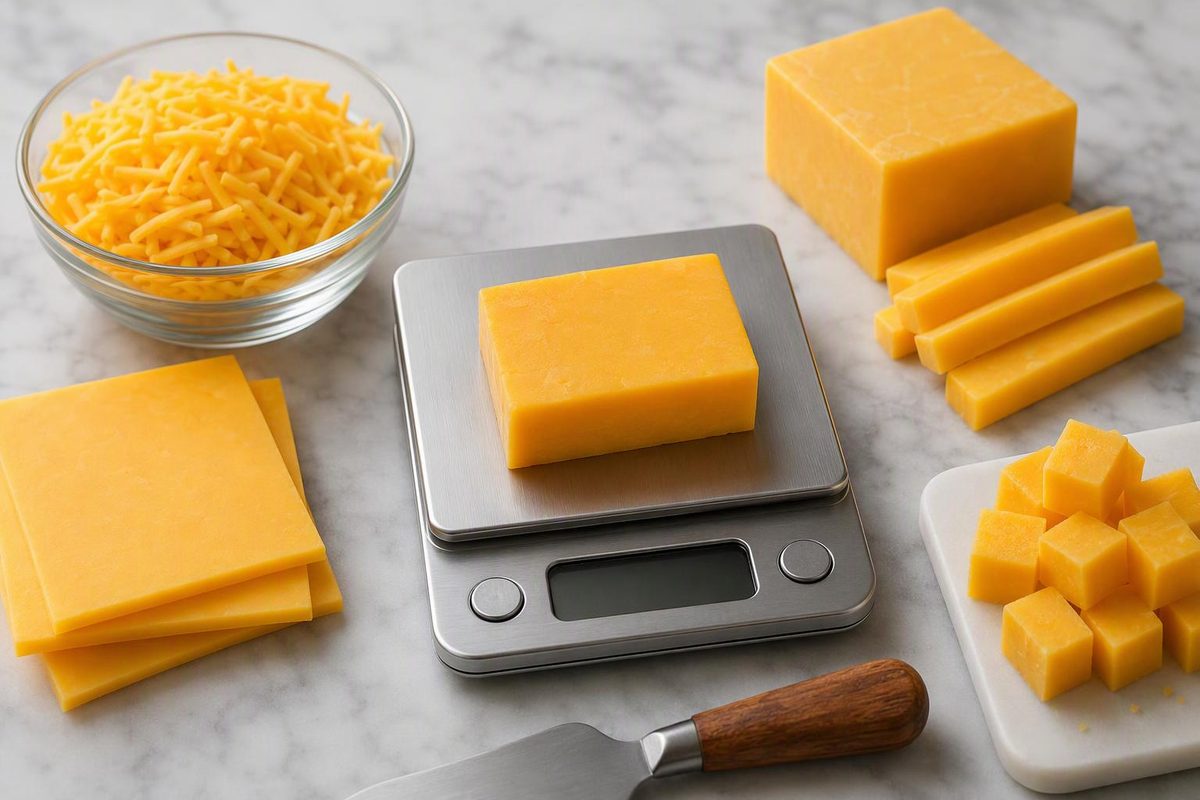
Medium cheddar has about 110–120 calories and 6 g protein per ounce. Calculate any weighed portion and see how slices, shreds and blocks differ.
A practical estimate for medium cheddar cheese is 110–120 calories per 1 ounce (28 g), with about 6 g protein. “Medium” describes flavor between milder and sharper cheddar; it does not mean lower-fat cheese or a smaller serving. For the closest count, weigh the amount eaten and scale the calories from that package’s Nutrition Facts panel.
Enter the serving numbers from your label and the grams you ate.
Medium Cheddar Portion Calculator
Estimated calories eaten
~180 calories
120 × 42 ÷ 28 = 180
Source: Essential Everyday, Lucerne and Tillamook product labels cited in the article. Calculations use rounded label values, so results are estimates.
One Ounce Has About 110–120 Calories
Product pages checked September 27, 2026 illustrate the expected label range. Essential Everyday and Lucerne each list 110 calories per 28 g, while Tillamook lists 120 calories per 28 g. Across those products, a 28 g serving has 9–10 g fat, 5–6 g saturated fat and 180–200 mg sodium (Essential Everyday, Lucerne, Tillamook).
Those figures make 110–120 calories a reasonable estimate when the cheese is unlabelled or separated from its package. They do not replace the label when one is available. Brands can use different formulations, and product information can change.
The calorie difference between the reviewed products is small for one serving but becomes larger as the portion grows. Two ounces scale to 220–240 calories, a 20-calorie range. An 8 oz block scales to about 880–960 calories, an 80-calorie range. Using the actual label prevents that uncertainty from accumulating across a large portion or recipe.
Medium Cheddar Calories by Weight
| Portion | Estimated Calories | Protein |
|---|---|---|
| 1/2 oz (14 g) | 55–60 | about 3 g |
| 3/4 oz (21 g) | 83–90 | about 4.5 g |
| 1 oz (28 g) | 110–120 | about 6 g |
| 1 1/2 oz (42 g) | 165–180 | about 9 g |
| 2 oz (56 g) | 220–240 | about 12 g |
The table scales the cited 28 g labels rather than treating each amount as a separately tested serving. Nutrition-label values are rounded, so the calculated results should also be treated as estimates. A result such as 83–90 calories communicates that uncertainty better than an apparently exact figure for a small portion.
Protein scales in the same way when the reviewed label lists 6 g per 28 g. Half of that serving provides about 3 g; one and a half servings provide about 9 g. The same calculation can be applied to fat, saturated fat or sodium by substituting the relevant label value.
Weight is the useful variable here. A 28 g piece has the same label-scaled calorie count whether it came from the end of a block, was cut into cubes or melted into a sandwich. Cutting or melting changes its shape, not the amount of cheese being counted.
Calculate Calories From the Package Label
Use one equation for any weighed portion: calories eaten = label calories × grams eaten ÷ label serving grams.
For example, 42 g from a medium cheddar labelled 120 calories per 28 g gives 120 × 42 ÷ 28 = 180 calories. The 42 g portion is one and a half label servings, so the same result can be understood as 120 calories multiplied by 1.5.
The order matters less than keeping the units consistent. The amount eaten and the serving size must both be entered in grams. Dividing grams eaten by serving grams produces the number of label servings; multiplying that number by calories per serving produces the calorie estimate.
Do not substitute package weight for serving weight. If the front of a block says 8 oz but its Nutrition Facts panel lists a 28 g serving, the 28 g figure belongs in the denominator. The 8 oz figure describes the whole package.
The equation also handles portions smaller than one serving. For 14 g from a 28 g serving, the fraction is one-half, so a 110-calorie label scales to 55 calories and a 120-calorie label scales to 60. Nothing special happens below one serving; the same proportional calculation applies.
Label rounding remains part of the result. Multiplying a rounded calorie number does not recover the product’s unrounded laboratory value. Record the scaled figure consistently, but do not interpret decimal-level precision as a nutritional distinction between two pieces of cheese.
A Slice Is Not Always One Ounce
Use the grams printed beside “1 slice” rather than assuming every slice weighs 28 g. Tillamook’s medium-cheddar slices, for example, list one 25 g slice as 110 calories and 6 g protein (Tillamook sliced medium cheddar). That product’s slice is lighter than the 28 g serving used on the reviewed block labels.
A slice count works when all slices come from a package with a stated per-slice weight and they remain reasonably intact. If a sandwich contains two of those labelled slices, multiplying the per-slice value is straightforward. If part of a slice is left behind, weighing the cheese used gives a better estimate than rounding the portion to a whole slice.
Deli-cut cheese needs more caution because “one slice” does not specify thickness or weight. A thin 21 g slice and a thicker 28 g piece are both one slice in ordinary language, but they are not equivalent calorie portions. The 21 g entry in the table scales to about 83–90 calories, while 28 g scales to 110–120.
The visual area of a slice is not enough to settle the difference. One slice may be broad and thin while another is narrow and thick. Grams capture both dimensions without requiring a judgment about what an average slice should look like.
When no scale or package information is available, the 110–120 calories per 28 g range remains the defensible estimate. The uncertainty comes from both the product and the unknown slice weight, so it should not be presented as an exact count.
Shredded Cheddar Is Most Consistent When Weighed
Shredded medium cheddar is also easiest to track in grams. Cup measures can change with shred size and with how loosely or firmly the cheese sits in the cup. A weight does not depend on how the pieces settle.
Tillamook’s thick-cut shreds use the same 28 g, 120-calorie serving as its medium cheddar block. The shredded product also contains potato starch and natamycin (Tillamook shredded medium cheddar). That product example shows why the package label should remain the source for the finished food: a shredded product may not have an ingredient list identical to a block even when its listed serving calories match.
For a recipe, place the bowl on the scale, zero it, and add the cheese. Use the total cheese weight with the package equation before cooking. After serving, divide the cheese calories according to the portions actually eaten rather than the portions originally planned.
If the finished dish is divided evenly, each portion receives an equal share of the cheese calculation. If portions differ substantially, the cheese calories cannot be allocated precisely from the total alone. The arithmetic can calculate the recipe total, but it cannot determine how much cheese ended up in each uneven serving.
Melting does not turn a weighed amount into a different starting portion. The practical tracking problem is usually distribution: melted cheese may stay on a pan, adhere to a serving utensil or be divided unevenly. Those are portion-measurement limits, not reasons to replace the package value with a different generic calorie figure.
An 8 Oz Block Contains About 880–960 Calories
An 8 oz block contains eight 1 oz portions. Applying the reviewed range gives about 880–960 calories for the entire block. This is a package-level estimate based on the cited 110–120 calories per ounce, not a statement that every 8 oz medium cheddar block has exactly that total.
Package size and serving size answer different questions. Package weight tells you how much cheese was sold. Serving weight tells you the amount associated with the calories and nutrients on the Nutrition Facts panel. A multi-serving block can be cut into any number of pieces, but changing the number of pieces does not change the block’s calculated total.
This distinction matters when a block is used gradually. Counting “a piece” each time can drift because hand-cut pieces vary. One approach is to record the grams removed on each occasion. Another is to weigh the remaining block and calculate the difference, provided the original net weight and any packaging are handled consistently.
The full-block range is also useful as a check on recipe entries. If an entire 8 oz block was used, a cheese entry far below 880 calories or far above 960 calories would not match the reviewed product range. The package’s own label still takes priority if it produces a different result.
“Medium” Describes Flavor, Not a Calorie Tier
Longer aging generally produces a more pronounced cheddar flavor. Cabot describes medium cheddar as slightly stronger than mild and says sharpness increases with aging (Cabot Creamery). The word helps shoppers anticipate flavor, but it does not provide a calorie calculation.
There is no separate federal composition standard for “medium” cheddar. The U.S. cheddar standard specifies no more than 39% moisture and at least 50% milkfat by weight of the solids, but it does not establish mild, medium and sharp nutrition categories (21 CFR 133.113).
Sharpness is therefore not a dependable calorie shortcut. Within Tillamook’s range, its medium and sharp cheddar blocks both list 120 calories, 10 g fat and 6 g protein per 28 g (Tillamook sharp cheddar). Medium does not mathematically fall halfway between mild and sharp, and sharp does not automatically mean more calories.
The reliable comparison is label against label, using equal gram amounts. Check serving grams first, because two panels can appear to disagree when they use different serving weights. Then compare calories, protein, total fat, saturated fat or sodium according to the value being tracked.
For another cheese with similar portion questions but a wider product range, see part-skim mozzarella calories and portion math.