
Two Part-Skim Mozzarella Labels List 80–90 Calories per Ounce
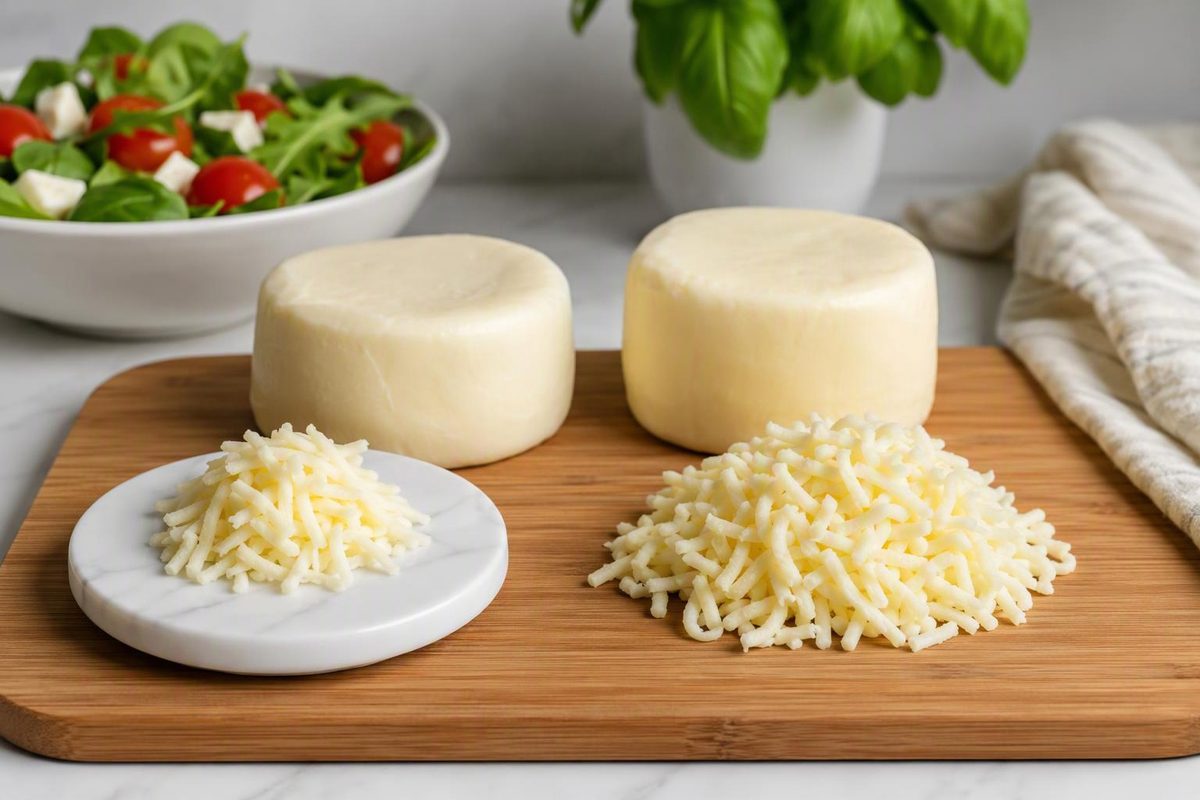
Two low-moisture part-skim mozzarella labels list 80–90 calories and 7 g protein per 28 g. Scale the label to your portion in grams.
Two U.S. labels for low-moisture part-skim mozzarella list 80–90 calories, 7 g protein and 6 g fat per 1-ounce (28 g) serving. That range is a useful fallback, not a value guaranteed by the words “part-skim.” For the closest match, use the Nutrition Facts panel on your package and scale it to the amount eaten.
Nutrition per ounce
The following range comes from Food Club block mozzarella and Sargento string cheese labels checked in September 2026. The larger portions are calculated from the 28 g servings rather than separately measured values.
| Portion | Calories | Protein | Fat | Saturated fat | Carbohydrate | Sodium |
|---|---|---|---|---|---|---|
| 1 label serving (28 g; about 1 oz) | 80–90 | 7 g | 6 g | 3 g | 1–2 g | 190 mg |
| 2 label servings (56 g; about 2 oz) | 160–180 | 14 g | 12 g | 6 g | 2–4 g | 380 mg |
| 4 label servings (112 g; about 4 oz) | 320–360 | 28 g | 24 g | 12 g | 4–8 g | 760 mg |
Food Club’s low-moisture part-skim mozzarella lists 80 calories, 7 g protein, 6 g fat, 3 g saturated fat, 2 g carbohydrate and 190 mg sodium per 28 g. It also lists 200 mg calcium, or 15% of the Daily Value. Food Club’s SmartLabel provides the complete panel.
Sargento’s low-moisture part-skim mozzarella string cheese lists 90 calories, 7 g protein, 6 g fat, 3 g saturated fat, 1 g carbohydrate and 190 mg sodium per 28 g stick. See the Sargento product label.
Multiplying label values is practical, but Nutrition Facts values are rounded. A four-serving calculation therefore should not be treated as a laboratory-precise nutrient total.
What “part-skim” means
Part-skim mozzarella is not fat-free mozzarella. Under the U.S. standard of identity for low-moisture part-skim mozzarella, milkfat must be at least 30% but less than 45% when calculated on the cheese’s solids. This is a dry-matter calculation—not a statement that 30% to 45% of the finished cheese’s total weight is fat. The federal standard defines the milkfat range.
“Low-moisture” and “part-skim” describe different characteristics: the first concerns water content, while the second concerns milkfat relative to solids. Neither phrase establishes one calorie count for every product. Compare equal weights and the actual Nutrition Facts panels rather than relying only on the wording on the front of the package.
How to log shredded, sliced or string mozzarella
Weigh the cheese in grams, then use:
Calories eaten = label calories × grams eaten ÷ label serving grams
For cheese labeled 80 calories per 28 g, a 42 g portion is:
80 × 42 ÷ 28 = 120 calories
A string-cheese stick may already equal one labeled serving. Shredded cheese may list both a cup measure and a gram weight, but scoops can be loosely filled or packed. The gram amount avoids that variation.
FDA explains that a Nutrition Facts serving size reflects the amount people typically consume; it is not a recommendation of how much to eat. Check both the serving size and servings per container before scaling the nutrients. FDA explains how serving sizes work on Nutrition Facts labels.
For an unbranded entry, 80–90 calories per 28 g is a defensible estimate based on these two labels. When the package is available, its gram-based values are the better numbers to log.