
How Pour Size and Proof Change Tequila’s Calorie Count
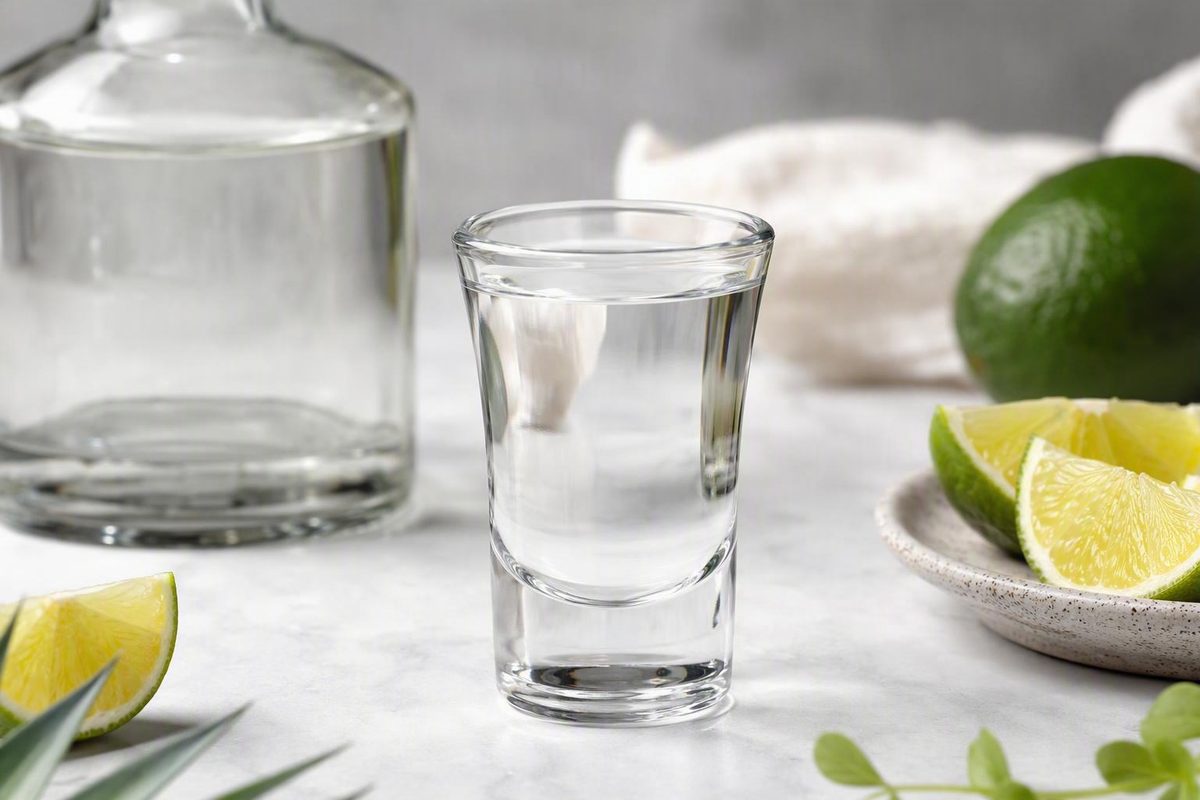
At 40% ABV, a 30 ml pour has about 64-65 calories. A larger reference pour, higher proof, sweetening or mixers can all change the total.
The short answer: about 97 calories in a standard U.S. shot
A measured 1.5 fl oz serving of plain, 80-proof tequila contains approximately 96–100 calories and is commonly listed as 97 calories. That serving is about 44–45 ml, while 80 proof means 40% alcohol by volume (ABV). These serving-specific estimates are summarized by a commercial tequila nutrition guide, so they are best treated as approximations rather than laboratory-exact values (serving-size estimates for 80-proof tequila).
For everyday calorie tracking, 97 calories is a reasonable default—but only when the pour and alcohol strength match those assumptions. “A shot” is not a fixed measurement. A smaller 1 fl oz pour contains fewer calories, while a 2 fl oz pour contains more.
| Plain tequila serving | Approximate metric volume | Assumed strength | Estimated calories |
|---|---|---|---|
| 1 fl oz | About 30 ml | 40% ABV / 80 proof | 64–65 |
| 1.5 fl oz | About 44–45 ml | 40% ABV / 80 proof | 96–100, commonly 97 |
| 2 fl oz | About 59 ml | 40% ABV / 80 proof | 128–130 |
The differences among 96, 97, and 100 calories are not meaningful nutritional disagreements. They can result from rounding the serving volume, using slightly different energy factors for alcohol, or rounding the final calorie result. Treating any one of those figures as exact would imply more precision than the underlying estimates support.
The count scales with the number of measured servings:
- One 1.5 fl oz serving: about 97 calories
- Two 1.5 fl oz servings: about 194 calories
- Three 1.5 fl oz servings: about 291 calories
Those totals are simple multiples of the serving estimate. They assume plain tequila at 40% ABV and exclude soda, juice, tonic, syrup, liqueur, a sugared rim, and every other cocktail ingredient. They also assume each pour really is 1.5 fl oz. Commercial tequila nutrition tables list approximately 64 calories per ounce, 96 calories per 1.5 fl oz, and 128 calories per 2 fl oz under those assumptions.
Two unmeasured bar pours or two drinks served in large glasses may contain more or less tequila than two nominal servings. The most useful answer is therefore not simply “97 calories.” It is:
Approximately 97 calories in 1.5 fl oz, or 44–45 ml, of plain tequila at 40% ABV.
Change the volume, proof, formulation, or mixers, and the estimate needs to change with them.
Why one source says 64 calories and another says 97
The apparent conflict between 64 and 97 calories usually comes from serving size, not from a major disagreement about tequila.
FatSecret defines one tequila shot as 30 ml and lists it at 64 calories. A common U.S. nutrition reference serving is 1.5 fl oz, or approximately 44–45 ml, and is commonly placed near 96–100 calories. The larger serving contains roughly 50% more liquid, so it should also contain roughly 50% more alcohol and calories when the ABV is equal (FatSecret’s 30 ml tequila serving).
In practical terms:
- 30 ml: about 64–65 calories
- 44–45 ml: about 96–100 calories
Both can be reasonable estimates. Calling both servings “one shot” is what makes them appear inconsistent.
International measures add another layer of ambiguity. Drinkaware describes a typical 25 ml UK measure of spirits as one UK alcohol unit when served at a typical strength. That measure is smaller than both a 30 ml pour and the common 1.5 fl oz U.S. reference serving (Drinkaware’s unit and calorie calculator guidance).
These terms should not automatically be treated as synonyms:
- A bar shot is the volume that a particular venue serves.
- A jigger is a measuring tool, often with a different capacity on each side.
- A UK single may be 25 ml in the context described above.
- A 30 ml shot is approximately 1 U.S. fl oz.
- A 1.5 fl oz serving is approximately 44–45 ml.
- A free pour has no dependable volume until it is measured.
Alcohol strength: A higher ABV means more ethanol in the same volume. Because ethanol supplies energy, a 50% ABV pour contains more calories than an equal-sized 40% ABV pour.
Rounding: One publisher may round a calculated result to 96, another to 97, and another to 100. A calculation based on 44 ml will also differ slightly from one based on 45 ml.
Pouring accuracy: A glass described casually as holding “one shot” may contain substantially more or less than 1.5 fl oz.
Product formulation: Plain tequila can be estimated primarily from its ethanol content. Flavored, sweetened, or liqueur-style products may contain additional calorie sources.
Mixers: Calories from juice, regular tonic, sweetened soda, syrup, liqueur, or premade cocktail mix belong to the complete drink total. They are not included in a straight-tequila estimate.
When checking a tequila calorie entry, use this sequence:
- Identify the actual volume. Look for milliliters or fluid ounces rather than relying on the word “shot.”
- Read the bottle’s ABV. Do not assume every tequila is 40%.
- Identify the product type. Determine whether it is plain tequila, flavored tequila, a liqueur, or a premixed drink.
- Count mixers separately. Use the quantity actually poured.
- Use a range when the serving is unknown. A defensible range is better than an exact-looking guess.
This approach resolves most database discrepancies without requiring one estimate to be labeled categorically wrong.
The calorie math: volume, ABV, and ethanol
Nearly all the calories in plain tequila come from ethanol. Ethanol provides approximately 7 calories per gram, so the two main variables are the quantity poured and the fraction of that pour that is alcohol.
A useful estimate is:
calories = volume in milliliters × ABV as a decimal × 0.789 grams of ethanol per milliliter × 7 calories per gram
The formula and its rounded constants are used in published tequila calorie estimates.
Each input has a specific meaning:
- Volume in milliliters: the measured quantity of tequila in the glass
- ABV as a decimal: 40% becomes 0.40, while 50% becomes 0.50
- 0.789 grams per milliliter: the approximate density of ethanol
- 7 calories per gram: the rounded energy supplied by ethanol
This is an ethanol-based estimate. It works best for plain distilled tequila and may undercount products containing caloric flavorings, sweeteners, syrup, cream, or other ingredients.
For a 45 ml pour at 40% ABV, the calculation is:
45 × 0.40 × 0.789 × 7 = 99.4 calories
Rounded, that is approximately 99 calories. If the nominal 1.5 fl oz serving is treated as 44 ml instead, the result is:
44 × 0.40 × 0.789 × 7 = 97.2 calories
This helps explain why a 1.5 fl oz serving may appear as 97, 99, or 100 calories. A published entry may also use a slightly different alcohol energy factor, an underlying serving weight, or a volume that is more precise than the rounded figure displayed to readers.
How proof changes the result
In the United States, a spirit’s proof number is twice its ABV percentage:
- 80 proof = 40% ABV
- 100 proof = 50% ABV
For the same 1.5 fl oz pour, moving from 40% to 50% ABV increases the quantity of ethanol by 25%. The calorie estimate rises proportionally when no other calorie-bearing ingredients are present.
| 1.5 fl oz pour | ABV | Approximate calories |
|---|---|---|
| 80-proof tequila | 40% | About 97 |
| 100-proof tequila | 50% | Roughly 121–124 |
Third-party tequila estimates similarly place a 1.5 fl oz serving near 96–100 calories at 80 proof and about 124 calories at 100 proof. The precise endpoint depends on the assumed volume and rounding method (proof-based tequila estimates).
This comparison also shows why bottle strength can matter more than aging category. A 50% ABV blanco contains more ethanol—and therefore more ethanol-derived calories per equal-sized pour—than a 40% ABV añejo.
Scaling a known estimate
If you already have a reasonable calorie estimate for the same tequila, you can scale it by measured volume.
Starting with 97 calories for 1.5 fl oz:
calories for new pour = 97 × new volume ÷ 1.5 fl oz
For a 2 fl oz pour:
97 × 2 ÷ 1.5 = 129.3 calories
That gives approximately 129 calories, consistent with the practical range of 128–130.
If both the volume and ABV change, scale for both:
new calories = known calories
             × (new volume ÷ known volume)
             × (new ABV ÷ known ABV)
For example, scaling a 97-calorie, 1.5 fl oz, 40% ABV reference to the same volume at 50% ABV gives:
97 × (1.5 ÷ 1.5) × (50 ÷ 40) = 121.25 calories
These calculations remain estimates because the starting value is rounded. Their practical value is in adjusting for meaningful differences in pour size and strength, not in producing a supposedly exact decimal.
The important word is measured. Do not infer volume from how full a glass appears. A wide rocks glass, a narrow shot glass, a decorative base, and ice can all distort visual judgment. Use a marked jigger or liquid measuring vessel when the pour matters.
Does straight tequila contain sugar or carbohydrates?
Plain, unflavored tequila is generally listed with 0 g carbohydrate, 0 g sugar, 0 g fat, and 0 g protein per serving. Its calories are attributed almost entirely to alcohol rather than to the macronutrients normally displayed on a food label (plain tequila nutrition estimates).
That resolves the apparent contradiction:
Zero sugar does not mean zero calories.
Alcohol is an energy source in its own right. A gram of ethanol supplies approximately 7 calories even though it is not counted as carbohydrate, fat, or protein. A 1.5 fl oz pour can therefore contain about 97 calories while showing zero grams for those nutrients.
The scope of the zero-sugar description matters. It applies to plain tequila in the cited nutrition estimates, not automatically to every bottle or can that uses the word “tequila.” Distinct product categories include:
- Flavored tequila
- Sweetened tequila products
- Tequila liqueurs
- Cream liqueurs made with tequila
- Premixed margaritas
- Ready-to-drink Palomas or ranch waters
- Canned tequila cocktails
- Products containing juice, syrup, or other caloric ingredients
For these products, the alcohol-only formula may account for only part of the total. A liqueur can contain calories from both ethanol and sugar. A ready-to-drink cocktail may contain less tequila than a straight shot but still have additional calories from sweeteners, juice, or other ingredients.
Use the manufacturer’s product-specific nutrition information or the package’s nutrition label when one is available. Check the stated serving size as well as the calorie number: a container may hold more than one labeled serving.
If no product-specific figure exists, estimate the ethanol calories and add the other ingredients separately where their quantities are known. Do not enter 97 calories automatically merely because tequila appears in the product name.
Finally, a zero-sugar listing does not establish that tequila is healthy, beneficial for weight loss, or nutritionally superior to another spirit. It describes the reported source of the calories, not the broader effects of drinking alcohol.
Blanco, reposado, and añejo: what actually changes the count
Blanco, reposado, añejo, and extra añejo tequila are broadly similar in calories when the compared pours have the same volume, ABV, and formulation. Aging category alone is not the main driver of the estimate. The quantity of ethanol in the glass matters more.
A fair style comparison should hold these variables constant:
- Pour volume
- Alcohol by volume
- Whether the product is plain or flavored
- Whether additional caloric ingredients are present
- Whether the figure covers straight tequila or a complete drink
If two plain products are both poured at 1.5 fl oz and both contain 40% ABV, their ethanol-based calorie estimates should be close even if one is blanco and the other is añejo.
That does not mean every tequila style or bottle is universally identical. Individual products can differ in strength, formulation, flavoring, or sweetening. A higher-proof blanco can contain more calories than a lower-proof añejo because the blanco contains more ethanol in an equal-sized serving. A flavored reposado may also differ from a plain reposado if the flavored product contains additional caloric ingredients.
Use this checklist when comparing styles or brands:
| Question | Why it matters |
|---|---|
| Are the pours the same size? | More tequila means more alcohol and calories. |
| Is the ABV the same? | Higher ABV means more ethanol in the same volume. |
| Are both products plain? | Flavorings or sweeteners may add calories. |
| Are the figures per serving or per container? | Serving definitions may differ. |
| Are mixers included? | A cocktail total cannot be compared directly with straight tequila. |
Marketing descriptions such as “100% agave” or “additive-free” should not be converted into unsupported health or weight-management claims. Those descriptions may be relevant to production or formulation, but they do not override the calorie arithmetic of volume, alcohol strength, and any additional caloric ingredients.
Is tequila lower in calories than vodka, gin, rum, or whiskey?
At equal serving size and proof, plain tequila contains approximately the same number of calories as unflavored vodka, gin, rum, or whiskey. Ethanol concentration largely drives the count, so comparing a small tequila pour with a larger whiskey pour—or an 80-proof spirit with a 100-proof one—does not reveal an inherent calorie difference between spirit categories.
MedlinePlus lists 97 calories per 1.5 fl oz for several 80-proof spirits, including gin, rum, vodka, and whiskey. It lists 116 calories per 1.5 fl oz for 94-proof versions of those spirits, illustrating the effect of alcohol strength. Its table does not separately list straight tequila, so those figures should be used as equal-proof spirit comparisons rather than presented as direct tequila measurements (MedlinePlus alcoholic-beverage calorie table).
The National Institute on Alcohol Abuse and Alcoholism takes a similar category-level approach. Its calculator groups tequila with gin, rum, vodka, and whiskey under 80-proof distilled spirits. The supplied calculator page does not display a numerical tequila result, so it cannot independently confirm a specific 97-calorie tequila value (NIAAA alcohol calorie calculator).
The available evidence therefore does not support calling tequila uniquely the “lowest-calorie spirit.” A fair comparison should match:
- Volume: for example, 1.5 fl oz against 1.5 fl oz
- Strength: for example, 40% ABV against 40% ABV
- Product type: plain spirit against plain spirit
- Drink format: straight pour against straight pour
The result can change when one product is higher proof, sweetened, flavored, or served in a larger measure. Spiced rum, flavored vodka, whiskey liqueur, and tequila liqueur should not automatically be assigned the values used for their plain counterparts. Likewise, comparing straight tequila with a gin and tonic primarily compares serving sizes and recipes—not merely tequila with gin.
Straight tequila versus margaritas and other mixed drinks
The approximately 97-calorie estimate covers 1.5 fl oz of plain tequila at 40% ABV. It does not cover anything added to the glass.
Plain soda water adds essentially no calories, so tequila with soda water can remain close to the base spirit count. Lime juice or another addition may raise the total depending on the quantity. Once juice, regular tonic, sweetened soda, agave syrup, liqueur, or premade mix is added, each ingredient needs its own calorie entry.
Common sources of additional cocktail calories include:
- Orange, grapefruit, pineapple, or other juice
- Regular tonic water
- Sweetened soda
- Agave syrup or simple syrup
- Orange or other flavored liqueurs
- Premade margarita mix
- Fruit purée
- Cream-based ingredients
- Sugared or candied garnishes
- A second pour of tequila
A tequila sunrise demonstrates why a cocktail figure should not be used as evidence for straight tequila. MedlinePlus lists a 7 fl oz tequila sunrise at 232 calories, reflecting the complete mixed drink rather than the tequila alone (MedlinePlus cocktail calorie example).
UF Health lists the same 232-calorie total for a 6.8 oz tequila sunrise, showing that similar reference entries may use slightly different rounded volumes (UF Health alcoholic-beverage calorie table). Neither figure means a tequila shot contains 232 calories.
Margaritas, Palomas, ranch water, tequila sunrises, and frozen tequila drinks do not have one universal calorie count. Their totals depend on:
- The quantity and ABV of the tequila
- Whether the recipe uses one spirit pour or more
- Mixer type and volume
- Added syrup or liqueur
- Fresh juice versus a sweetened juice drink
- Regular versus zero-calorie soda
- Glass size
- Garnishes and rims
Ice dilution can increase the drink’s final volume and lower its calorie concentration, but melting water does not add calories. Total calories change only when the quantities of tequila or other calorie-bearing ingredients change.
How to estimate a tequila cocktail
Calculate the drink component by component:
-
Measure the tequila. Use about 97 calories for 1.5 fl oz at 40% ABV, or calculate from its measured volume and ABV.
-
Measure each mixer. Do not infer mixer volume from the cocktail glass’s total capacity because ice and other ingredients occupy part of the glass.
-
Use label calories for packaged mixers. Adjust the label value to the quantity actually poured. If a mixer lists calories per 8 fl oz and you use 4 fl oz, count half the listed amount.
-
Add syrup and liqueur separately. Small additions can still matter when they are concentrated or sugar-sweetened.
-
Include every spirit pour. A drink containing 3 fl oz of 40% ABV tequila begins near 194 calories before mixers.
-
Include substantial rims and garnishes. A lime wedge is different from a heavy sugared rim or candied fruit garnish.
A tequila-and-soda made with one measured tequila serving and plain soda water will remain close to the spirit’s base count. A margarita containing tequila, orange liqueur, syrup, and sweetened mix combines several calorie-bearing ingredients. A frozen version may also use a larger recipe and glass.
Consequently, a cocktail can contain several times the calories of a straight pour even when both are described casually as “one tequila drink.” The difference comes from the measured recipe, not from the drink’s name.
How to log tequila without false precision
For practical tracking, record four things:
- Measured tequila volume
- Bottle ABV
- Number of pours
- Mixers and additions as separate entries
Use approximately 97 calories as the default only for a measured 1.5 fl oz serving of plain tequila at 40% ABV. For a 1 fl oz pour, use approximately 64–65 calories. For a 2 fl oz pour, use approximately 128–130. If the tequila is 50% ABV, increase the estimate to account for the additional ethanol.
When the serving is unknown, use an honest estimate or range. If a free pour may have been between 1.5 and 2 fl oz, logging roughly 97–130 calories is more defensible than selecting an exact figure with no measurement. If an app requires one number, use the most reasonable estimate and retain a note about the uncertainty where possible.
Do not use apparent glass fullness as a measurement. The same liquid volume can look shallow in a wide tumbler and nearly fill a narrow glass. Ice, thick glass, decorative bases, and varying fill lines further complicate visual estimates. A marked jigger or small liquid measuring cup provides a more dependable basis.
A measured 1.5 fl oz serving of 80-proof distilled spirits contains about 14 g of ethanol and is approximately one U.S. standard drink. This relationship depends on both the volume and the 40% ABV strength (tequila serving and standard-drink estimate).
A 1.5 fl oz pour of 50% ABV tequila contains more alcohol than the same volume at 40% ABV, so it is more than one standard drink. A “serving,” “shot,” and “standard drink” are therefore not always the same thing.
Calories also provide only one description of an alcoholic beverage. Alcohol supplies energy while generally contributing few nutrients, and a calorie count alone does not capture alcohol-related risk.
The usable rule is straightforward:
Measure the serving, check the ABV, and count every mixer separately.
About 97 calories is a sound working estimate for a measured 1.5 fl oz shot of plain 40% ABV tequila—not a universal value for every shot, bottle, or tequila cocktail.
This article explains calorie arithmetic for general informational purposes and is not medical or dietary advice.
Frequently asked questions
How many calories are in a 1 oz shot of tequila?
A 1 fl oz, or approximately 30 ml, pour of plain tequila contains about 64–65 calories when using the standard 40% ABV estimate. FatSecret specifically lists a 30 ml tequila serving at 64 calories (30 ml tequila nutrition entry). Check the bottle strength because a higher-proof 1 oz pour contains more ethanol and therefore more calories.
How many calories are in two shots of tequila?
Two measured 1.5 fl oz shots of plain 40% ABV tequila contain approximately 194 calories before mixers. That is a total of 3 fl oz; third-party serving tables place 3 fl oz of 80-proof tequila at approximately 192–195 calories, depending on rounding (tequila calories by serving size). If each shot is only 1 fl oz, the total is closer to 128–130 calories.
Does higher-proof tequila have more calories?
Yes. At the same pour size, higher-proof tequila contains more ethanol and therefore more calories. A 1.5 fl oz pour is approximately 97–100 calories at 40% ABV, compared with roughly 120–124 calories at 50% ABV (proof-based liquor estimates). The increase is proportional to alcohol concentration when other calorie-bearing ingredients are absent.
Does tequila have sugar or carbs?
Plain, unflavored tequila is generally listed with 0 g or negligible sugar and carbohydrate. It still contains calories because ethanol supplies energy independently of carbohydrate (unflavored liquor calorie guidance). Do not automatically apply the zero-sugar description to flavored tequila, tequila liqueurs, sweetened products, premixed cocktails, or ready-to-drink cans.
Is a 1.5 oz shot of tequila one standard drink?
A 1.5 fl oz shot is approximately one U.S. standard drink when the tequila is 80 proof, or 40% ABV, because it contains about 14 g of ethanol. The same 1.5 fl oz volume of higher-proof tequila contains more alcohol and counts as more than one standard drink. Pour size alone is not enough; ABV must also be considered.