
Why One Everclear Shot Does Not Have One Calorie Count
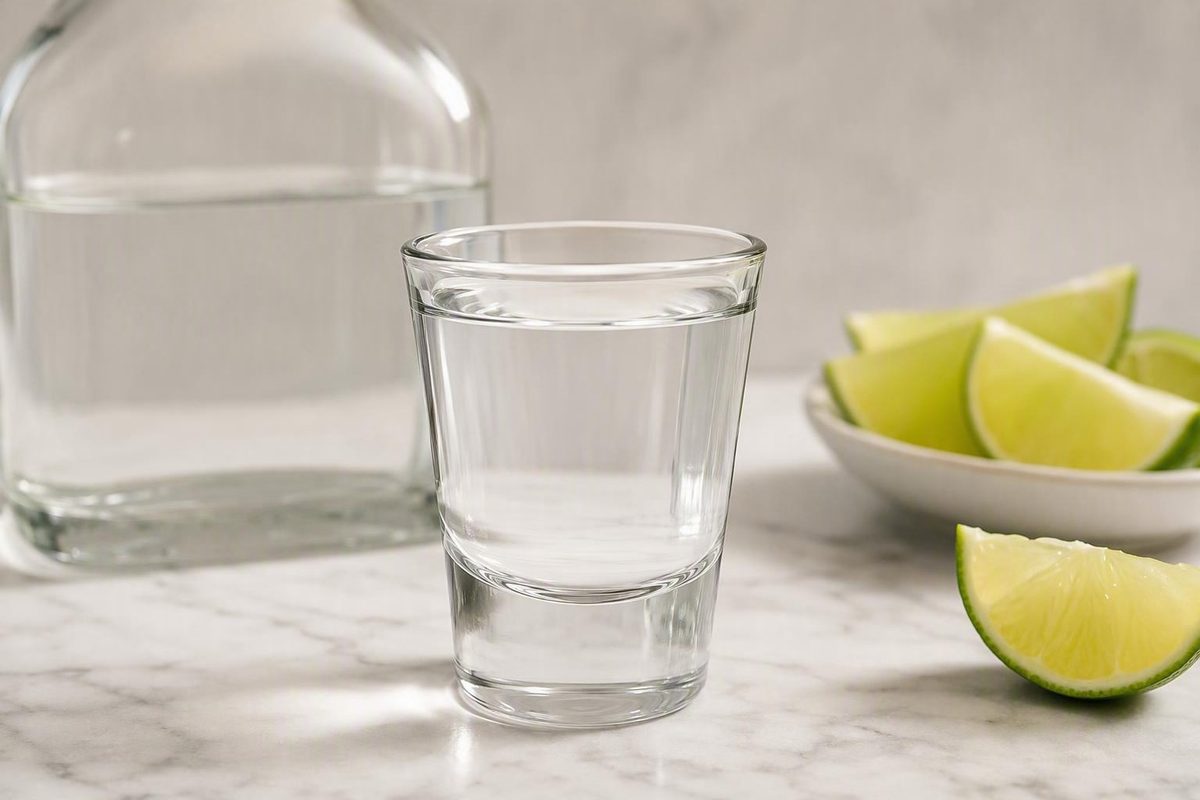
That 190-calorie number applies only to one third-party 27-gram serving, not every shot. Proof-and-volume results should be recorded as estimates.
The short answer: proof and pour size determine the calories
There is no single manufacturer-verified calorie count for a shot of Everclear in the available evidence. To log a serving credibly, you need:
- The proof printed on the bottle
- The measured volume poured
The available product-named database entry lists 190 calories for a 27-gram serving of Everclear grain alcohol. It does not identify the proof, provide the serving’s fluid volume, or establish that 27 grams equals a conventional shot. The database also says macronutrient data are unavailable, despite displaying zeroes in several nutrient fields. Those zeroes should not be treated as verified product facts. MyNetDiary provides the 190-calorie, 27-gram entry and its stated limitations.
Related: Calories in a Tequila Shot: Amounts by Size and Proof.
Quick tracking answer
- Do not automatically log an Everclear shot as 190 calories.
- Measure the pour and check the bottle’s proof.
- If no bottle-specific nutrition information is available, use a proof-and-volume calculator and label the result as an estimate.
- Log mixers separately.
- For context only, health-reference tables list 97 calories for 1.5 fluid ounces of 80-proof distilled alcohol and 116 calories for the same amount of 94-proof distilled alcohol. Those figures are not Everclear nutrition facts. UF Health lists the proof-specific comparison values.
This is necessarily an evidence-limited answer. The cited material does not provide manufacturer-confirmed Everclear nutrition values or the authoritative inputs needed to publish a complete proof-by-volume Everclear calorie table. Giving exact values for common 151- or 190-proof pours would therefore create a level of certainty the evidence does not support.
If your tracker requires a number, the most defensible approach is to enter the bottle’s exact proof and the measured pour into a calculator that uses proof and volume as explicit inputs. Save the result as an estimate rather than renaming it as an official Everclear value.
Methodology: This guide prioritizes defined serving sizes and authoritative health-reference tables, treats retailer calculators and nutrition databases as secondary evidence, and does not convert between mass and fluid volume without a supported conversion.
First define what counts as a shot
The word shot describes a style of serving, not a sufficiently precise tracking unit.
U.S. health-reference tables commonly use 1.5 fluid ounces, shown as about 45 milliliters, for distilled spirits. That makes 1.5 fluid ounces a useful comparison serving, but it does not prove that every home, bar, or restaurant pour contains that amount. MedlinePlus uses 1.5 fluid ounces, or a rounded 45 milliliters, in its distilled-alcohol table.
A different convention appears in the United Kingdom. Drinkaware describes 25 milliliters as a typical single measure of spirits and cautions that calorie estimates vary with drink size, alcohol percentage, brand, ingredients, production method, and mixers. Drinkaware explains the 25-milliliter measure and the variables affecting estimates.
These descriptions establish different things:
| Log description | What it establishes | What remains unknown |
|---|---|---|
| “One shot” | A serving was poured | Exact volume, proof, and calories |
| Measured fluid ounces | Pour volume | Proof and bottle-specific calories |
| Measured milliliters | Pour volume | Proof and bottle-specific calories |
| 1.5 fluid ounces | A defined comparison volume | Whether the pour is one standard drink at that proof |
| 25 milliliters | A defined UK-style measure | Whether it matches another country’s shot convention |
| 27 grams | Serving mass | Fluid volume without a supported conversion |
A useful tracker entry should look like this:
Everclear, proof shown on bottle, measured fluid ounces, straight spirit
For a mixed drink, use:
Everclear, proof shown on bottle, measured milliliters, plus separately logged mixers
This preserves the information needed to review the estimate later. By comparison, “one shot of Everclear” omits the two most important inputs.
Serving size is not the same as a standard drink
Serving volume and standard-drink quantity are related but distinct:
- Serving size is the physical amount poured.
- Proof or ABV describes the alcohol concentration.
- Standard drink refers to a defined quantity of pure alcohol.
Two equal-volume pours can therefore contain different amounts of alcohol. A high-proof Everclear pour and an equal-sized serving of conventional 80-proof liquor may look identical in a glass, but they do not contain the same concentration of ethanol.
Do not assume that one glass, one shot, and one standard drink are interchangeable. For both calorie tracking and alcohol awareness, record the actual volume and proof.
Everclear proof changes the answer
A third-party Everclear overview lists products at 120, 151, 189, and 190 proof, corresponding to 60%, 75.5%, 94.5%, and 95% alcohol by volume. These figures help explain why the brand cannot be assigned one universal calorie count, but the cited source is not a current manufacturer nutrition page. The Everclear overview lists the reported proof and ABV values.
The calorie relationship is straightforward: at the same fluid volume, a higher-proof distilled spirit generally contains more ethanol and therefore more alcohol-derived energy. A 151-proof pour and a 190-proof pour should not receive the same estimate when their volumes are equal.
The tracking process is:
- Measure the amount poured.
- Read the proof or ABV from the bottle.
- Enter those values into a transparent alcohol-calorie calculator.
- Record the output as an estimate.
- Add caloric mixers separately.
A larger pour generally raises the result because more spirit was used. A higher proof generally raises it because ethanol makes up a larger share of the measured liquid. If both proof and volume change, both inputs affect the estimate.
Check the bottle rather than assuming the proof
Do not assume that every bottle labeled Everclear is 190 proof. The evidence describes multiple strengths, and a generic tracker result may refer to a different one from the bottle in front of you.
Look for:
- The proof
- The ABV
- Any bottle-specific serving or nutrition information
- The actual amount used
A calorie entry without proof cannot reliably distinguish between different Everclear strengths. Likewise, proof without measured volume is insufficient because total calories depend on how much was poured.
Where the calories in straight grain alcohol come from
Alcohol can contribute calories even when a tracker shows little or no fat, carbohydrate, or protein. Ethanol supplies energy separately from those familiar macronutrient categories.
A third-party explanation of distilled-spirit calories uses approximately 7 calories per gram of pure alcohol. That principle helps explain why alcohol concentration matters: for equal volumes, increasing the proof generally increases the amount of ethanol and therefore the estimated calories. Purdy’s explanation describes the approximately 7-calorie-per-gram principle.
Conceptually, the calculation is:
measured volume × alcohol concentration → estimated ethanol amount → estimated calories from ethanol
That relationship is useful, but it does not by itself provide an official Everclear nutrition value. A complete calculation also depends on conversion assumptions that must be documented and supported. Because the available evidence does not adequately establish all of those inputs from authoritative sources, this article does not publish exact modeled values for 151- or 190-proof Everclear pours.
Why a calculated result is still an estimate
A calculator result is not the same as a product nutrition label. It begins with labeled proof and measured volume, then applies general assumptions about ethanol.
Its reliability depends on its inputs:
- An estimated pour weakens the result.
- Selecting the wrong proof weakens the result.
- A default “shot” may not match the amount consumed.
- An opaque mass-to-volume conversion may not apply to the product.
- Mixers can make the complete drink higher in calories than the straight-spirit estimate.
False precision does not correct uncertain inputs. If the volume was eyeballed or the proof was assumed, a detailed decimal output is not more authoritative than a sensibly rounded estimate.
Do not overinterpret macro fields
A tracker’s fat, carbohydrate, sugar, or protein fields do not necessarily represent manufacturer-confirmed testing.
The defensible conclusion is limited: ethanol contributes energy even though it is not categorized as fat, carbohydrate, or protein. A row of macro zeroes does not mean the beverage is calorie-free, and it does not establish a complete nutrient profile for a particular bottle.
Use lower-proof spirits as benchmarks, not Everclear nutrition facts
Health-reference tables provide a useful reasonableness check, even though they do not list Everclear or spirits at its highest reported proofs.
| Distilled-spirit strength | Reference serving | Listed calories |
|---|---|---|
| 80 proof | 1.5 fl oz (about 45 ml) | 97 |
| 94 proof | 1.5 fl oz (about 45 ml) | 116 |
The cited tables give the same values for gin, rum, vodka, and whiskey at each listed proof. In that comparison, the stated calorie value changes with proof while the serving volume remains fixed. MedlinePlus provides the proof-specific table.
A separate third-party calculator article illustrates the pattern at a higher strength: it reports approximately 98 calories for 1.5 ounces of 80-proof bourbon and approximately 165 calories for 1.5 ounces of 135-proof bourbon. The article presents these as estimates derived from ethanol, not as Everclear label values. Bourbon Obsessed gives the 80- and 135-proof examples.
These comparisons support two practical conclusions:
- High-proof Everclear should not be logged as ordinary 80-proof liquor.
- The applicable estimate depends on both proof and serving volume.
They do not directly establish calories for 120-, 151-, 189-, or 190-proof Everclear. Extending the pattern beyond the documented table values produces a model, not an official nutrition fact.
Use benchmarks as a reasonableness check
If a tracker offers only “distilled spirits, 80 proof,” that entry may accurately describe an ordinary spirit at its stated serving size. It is not an appropriate Everclear-specific entry when the bottle has a substantially higher proof.
A benchmark can help you ask:
- Did I enter the correct proof?
- Did I measure the actual pour?
- Does the result rise when proof or volume increases?
- Does the entry cover only the spirit?
- Have mixers been logged separately?
Do not rename a vodka, whiskey, or generic distilled-spirit benchmark as Everclear. Use it to evaluate whether an estimate appears directionally plausible, not to replace missing product data.
Why the 190-calorie database entry is not a standard-shot answer
The claim that “a shot of Everclear has 190 calories” overstates what the database establishes.
The record defines:
- Product name: Grain alcohol by Everclear
- Serving mass: 27 grams
- Calories: 190
It does not define:
- The product’s proof
- The serving’s fluid volume
- Whether the serving represents 1.5 fluid ounces
- A supported mass-to-volume conversion
- A bottle-specific analytical or manufacturer source
Those omissions matter because grams and fluid ounces measure different properties.
Grams and fluid ounces are not interchangeable
Grams measure mass. Fluid ounces measure volume.
It is therefore not valid to relabel 27 grams as a conventional fluid-ounce shot without evidence for that conversion. An app may offer automatic unit conversions, but an unexplained database conversion should not be assumed to apply to every Everclear proof.
This is also why the 190-calorie entry should not be averaged with generic liquor figures. Combining numbers that refer to different products, strengths, or serving units does not create a more reliable answer.
A practical logging hierarchy
Use this order of preference:
-
Verified bottle-specific information for the exact product and serving Use it as written. Scale it only when the serving relationship is clear.
-
The exact bottle proof and a measured pour entered into a transparent calculator Record the output as an estimate and retain the original proof and volume in your notes.
-
A generic distilled-spirit entry that matches proof and volume as closely as possible Label it as a proxy rather than Everclear-specific nutrition information.
-
A database serving defined only by mass Use it only when your consumed amount is known in that same mass unit. Do not assume it equals your fluid pour.
If a tracker forces you to choose an imperfect entry, preserving the proof, measured volume, and estimate status is more useful than attaching an exact-looking number to an undefined shot.
Count mixers separately and keep the safety context proportionate
The calories attributed to straight Everclear are only one part of a mixed drink. Soda, juice, syrup, cream, liqueur, sweetened concentrate, and other caloric ingredients must be counted separately.
For a mixed drink:
- Record the measured Everclear as one ingredient.
- Record each mixer using its label or a verified serving entry.
- Enter the amount of each ingredient actually used.
- Include caloric sweeteners and garnishes when relevant.
- Do not log the final drink volume as though it were all Everclear.
Health-reference guidance notes that cocktails made with soda, juice, cream, or ice cream can have especially high calorie counts. The actual total depends on the products and portions used, so there is no defensible generic mixer value.
Water changes concentration, not existing calories
Adding plain water increases the drink’s total volume and lowers its alcohol concentration per sip. It does not remove the ethanol already poured or erase the calories attributable to that spirit.
Unless some of the drink is left unconsumed, dilution does not reduce the amount of alcohol originally added.
For a batch or punch, record:
- The amount of Everclear added
- Its proof
- Every caloric mixer
- The total batch size
- The portion consumed
Calculate the ingredients for the complete batch first, then assign a portion of that total to each serving.
High proof changes the safety context
Very high-proof Everclear should not be treated like ordinary straight liquor. It carries alcohol-poisoning and extreme flammability risks. Keep it away from flames and heat sources, measure it carefully, and do not assume that a familiar-looking glass represents the same alcohol exposure as an equal volume of ordinary liquor.
For calorie tracking, use this checklist:
- Check the bottle’s proof.
- Measure the pour in fluid ounces or milliliters.
- Record the straight spirit separately.
- Add every caloric mixer from its own label or verified entry.
- Identify proof-and-volume calculator results as estimates.
- Do not convert the 27-gram database serving into a fluid-ounce shot without supported conversion data.
This article provides general information, not individualized medical or dietary advice. Anyone with health conditions or concerns about alcohol use should seek guidance from an appropriate health professional.
Frequently asked questions
Is a shot of Everclear exactly 190 calories?
No. The available database figure applies to a 27-gram serving containing 190 calories, not to every serving described as a shot. The entry does not identify the proof, provide a fluid volume, or show that the serving equals 1.5 fluid ounces. See the serving definition in the MyNetDiary entry.
Use that value only when the database’s defined mass serving matches the amount being logged. Otherwise, check the bottle proof and measure the pour.
Does 190-proof Everclear have more calories than 151-proof Everclear?
For equal fluid volumes, generally yes. The reported strengths are 95% ABV for 190 proof and 75.5% ABV for 151 proof, so the higher-proof pour contains a greater concentration of ethanol. A third-party proof guide compares the two reported strengths.
That conclusion applies only when the volumes are equal. A sufficiently smaller pour of the higher-proof product can contain less total alcohol-derived energy than a larger lower-proof pour.
Why does Everclear have calories when alcohol is not a carbohydrate, fat, or protein?
Ethanol is an energy source in its own right. It is not categorized as carbohydrate, fat, or protein, but it still contributes calories.
That is why adding only the familiar macronutrient categories does not explain an alcoholic drink’s total energy. Tracker zeroes or missing macro fields also should not be promoted as manufacturer-confirmed composition data.
Do mixers add calories to Everclear?
Many do. Juice, syrup, cream, liqueurs, sweetened soda, and other ingredients can increase the drink’s total calories. Each ingredient should be logged using its actual product and portion.
Is a 1.5-ounce pour of Everclear the same as one standard drink?
Do not assume so. A standard drink is based on the amount of pure alcohol, not simply on the volume of liquid in the glass. A cited calculator reference describes a U.S. standard drink as containing 14 grams, or 0.6 ounces, of pure alcohol and explains that the required serving volume decreases as proof rises. See the standard-drink explanation in the proof-and-pour calculator article.
Because Everclear can be substantially stronger than ordinary 80-proof liquor, a 1.5-ounce Everclear pour should not automatically be recorded as one standard drink.
The usable answer remains: check the bottle’s proof, measure the actual pour, and count mixers separately. The available evidence supports 190 calories only for one third-party 27-gram database serving—not for every shot—and any proof-and-volume result should be labeled as an estimate until authoritative Everclear-specific nutrition data are available.