
A Practical Calorie Estimate for Pink Whitney by Pour Size
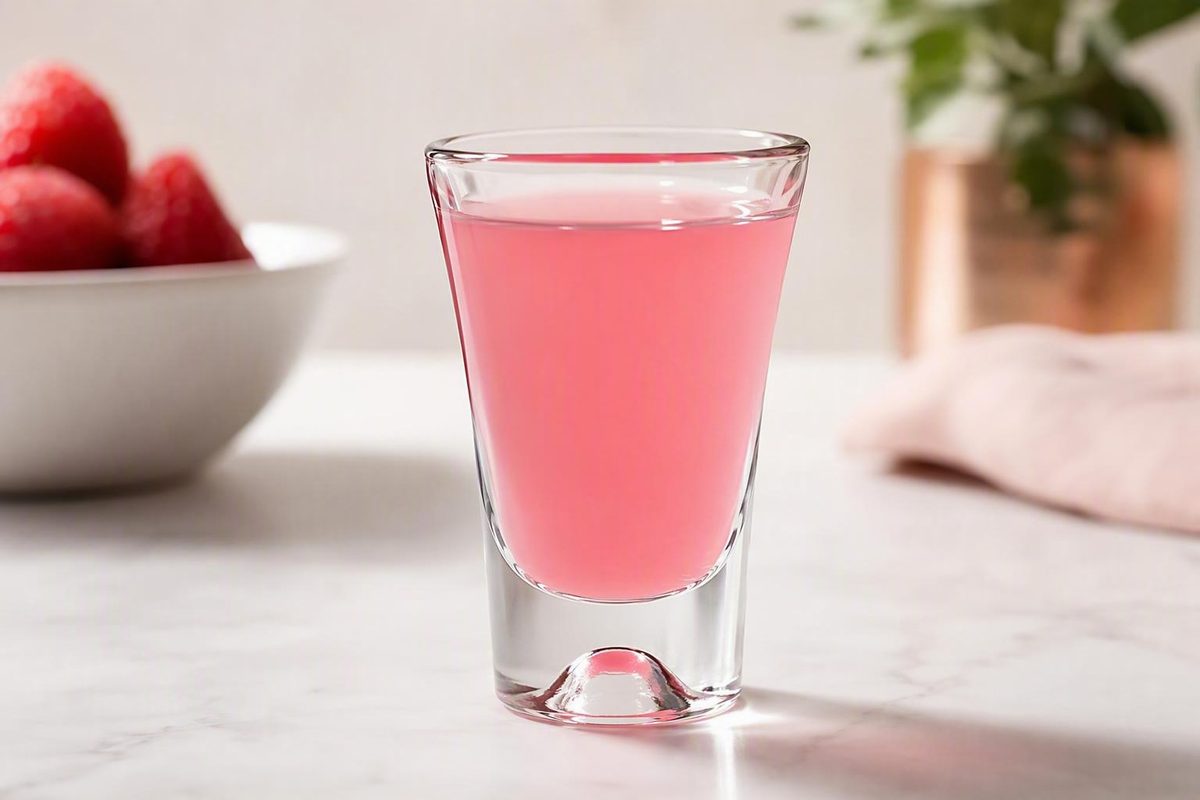
Start with about 100 calories for a measured 1.5-ounce shot. Scale other pours by volume, then add mixers separately when tracking the whole drink.
The short answer: estimate about 100 calories per 1.5-ounce shot
Estimate approximately 100 calories for 1.5 US fluid ounces of Pink Whitney. That serving is about 44 milliliters and is commonly rounded to 45 milliliters. The estimate covers only the Pink Whitney—not soda, juice, lemonade, tonic, syrup, or another mixer. Fastic reports approximately 100 calories for a 1.5-ounce, 44-milliliter serving.
Anaheim Lighthouse gives a slightly broader estimate of approximately 93–100 calories for the same 1.5-ounce pour. Its article does not cite a manufacturer nutrition label or product-specific laboratory analysis for that range. See Anaheim Lighthouse’s serving estimate.
None of the supplied product pages displays an official New Amsterdam nutrition panel confirming Pink Whitney’s exact calories, sugar, or carbohydrate content. That makes “about 100 calories” more defensible than “exactly 100 calories.”
For practical tracking, the simplest rule is:
For one measured 1.5-ounce shot of Pink Whitney, log about 100 calories and add any mixer calories separately.
If your pour is larger or smaller, scale the estimate according to the measured volume. Avoid relying on a generic “one shot” entry when you do not know how much was actually poured.
Pink Whitney calories by pour size
Calories scale with the amount poured. The word “shot” is not precise enough by itself because jiggers, glasses, recipes, and home pours can use different volumes.
The table below uses approximately 100 calories per 1.5 ounces as its qualified starting point. A third-party calculator reports that approximate value for a 45-milliliter—or 1.5-ounce—serving, but it is not a manufacturer nutrition statement. Review the 100-calorie serving basis used for these calculations.
| Pink Whitney pour | Calculation | Estimated calories |
|---|---|---|
| 1 ounce | 1 ÷ 1.5 × 100 | About 67 |
| 1.5 ounces | 1.5 ÷ 1.5 × 100 | About 100 |
| 2 ounces | 2 ÷ 1.5 × 100 | About 133 |
| Two 1.5-ounce shots | 2 × 100 | About 200 |
| Three 1.5-ounce shots | 3 × 100 | About 300 |
The reusable formula is:
Measured ounces ÷ 1.5 × 100 = estimated Pink Whitney calories
For example, a 2-ounce pour is one-third larger than a 1.5-ounce serving:
2 ÷ 1.5 × 100 = 133.3
For tracking, enter about 133 calories, or round to approximately 130–135 if your app uses broader increments. The decimal is mathematically correct, but it should not be mistaken for laboratory-level product precision.
You can also calculate by milliliters:
Measured milliliters ÷ 44.4 × 100 = estimated calories
Using 45 milliliters as the rounded reference is also reasonable:
Measured milliliters ÷ 45 × 100 = estimated calories
The difference between 44.4 and 45 milliliters is less important than measuring the pour and remembering that the original 100-calorie figure is approximate.
A 50-milliliter serving is larger than a standard 1.5-ounce pour. Fifty milliliters is about 1.69 US fluid ounces, while the reference serving is approximately 44–45 milliliters. Proportional scaling from the working estimate would therefore produce a value above 100 calories:
50 ÷ 44.4 × 100 = about 113 calories
That result is only a volume-based estimate. It is not a confirmed calorie count for a 50-milliliter bottle or serving, and it conflicts with a separate database entry discussed below.
All values in the table inherit the uncertainty of the starting estimate. Exact arithmetic cannot make an approximate input more authoritative. The practical approach is to measure the pour, calculate proportionally, and round to a useful logging number.
Why the estimate is plausible—but not official
Alcoholic drinks can derive energy from alcohol as well as carbohydrate-containing flavoring or sweetening. That general principle makes a roughly 100-calorie estimate plausible, but it does not reveal Pink Whitney’s exact formulation or nutrient profile.
Drinkmeter estimates that approximately 75 of the roughly 100 calories in a 45-milliliter serving come from alcohol, with the remainder attributed primarily to sugars and carbohydrates. The calculator also lists the product at 30% alcohol by volume. These are calculated third-party figures rather than values taken from a displayed manufacturer nutrition panel.
Other supplied third-party pages also describe Pink Whitney as 30% ABV or 60 proof. Repetition across calculators, articles, and retailer pages indicates that the figure is commonly associated with the product, but the evidence pack does not include a current first-party New Amsterdam specification confirming it.
Sugar estimates require the same caution. Anaheim Lighthouse reports approximately 6.6 grams of sugar per 1.5-ounce shot, but it does not cite a manufacturer label, laboratory analysis, or product specification supporting that number. Review the reported sugar figure and its source context.
The reported sugar amount should not be used to construct a definitive calorie breakdown. Even if a proposed combination of alcohol and sugar appears mathematically compatible with a total near 100 calories, that compatibility does not prove the product’s formulation.
It would also be unjustified to assume that every calorie not attributed to alcohol must come from sugar. Establishing the precise carbohydrate content and source of all energy would require authoritative product documentation or analysis.
The supported conclusion is therefore limited but useful: third-party estimates make about 100 calories per 1.5 ounces a reasonable tracking convention, not an exact nutrition fact.
Why one source lists 89 calories for a larger 50 ml serving
Published Pink Whitney figures contain a material discrepancy. Cooklist lists 89 calories for a 50-milliliter serving, along with 4 grams of carbohydrate, no fat, and no protein. The page also warns that its nutrition values are calculated using the USDA nutrient database and may be inaccurate; it does not show an official Pink Whitney nutrition label. Examine Cooklist’s 50-milliliter entry and accuracy warning.
That entry does not scale consistently with estimates of approximately 93–100 calories for the smaller 44–45-milliliter serving. If the same product has roughly 100 calories in 44–45 milliliters, a larger 50-milliliter quantity would not ordinarily be expected to have only 89 calories.
The conflicting numbers should not be averaged. Averaging would create a new figure that no source reports and would conceal the fact that the underlying entries may use different assumptions.
The evidence also does not establish why the discrepancy exists. It would be speculative to attribute it to database matching, serving definitions, packaging, reformulation, or market differences. Those are possible questions, not supported explanations.
Cooklist’s entry should not be treated as definitive merely because it appears in a product database. Conversely, it should not be hidden because it conflicts with the more common estimate. Its value is in showing why the 100-calorie figure must remain qualified.
The most defensible approach is to:
- Use about 100 calories per measured 1.5 ounces as the primary working estimate.
- Recognize that Cooklist reports a conflicting 89 calories per 50 milliliters.
- Avoid describing either figure as manufacturer-confirmed.
- Replace the working estimate if authoritative, product-specific documentation becomes available.
Mixers count separately from the Pink Whitney pour
The approximately 100-calorie estimate applies only to a measured 1.5-ounce serving of Pink Whitney. It is not the total for a mixed drink unless every other ingredient contributes no calories.
Soda, juice, lemonade, tonic, syrup, sweetened flavoring, and additional alcohol must each be counted separately. Use this structure:
Estimated Pink Whitney calories + mixer calories + calories from other ingredients = estimated drink total
For a simple mixed drink:
One 1.5-ounce Pink Whitney pour + one labeled serving of mixer = about 100 calories + the mixer’s stated calories
Use the mixer’s package or another reliable product-specific nutrition record. If its stated serving differs from the amount poured, scale the mixer calories to the measured volume.
A mixer labeled as zero-calorie may limit additional mixer calories, but it does not remove the energy in Pink Whitney. Under the convention used here, the measured 1.5-ounce spirit portion would still be logged at about 100 calories.
Generic cocktail entries can be misleading because a drink name does not define its recipe. One version might contain 1.5 ounces of Pink Whitney, while another uses 2 ounces, combines multiple spirits, or includes freely poured syrup or sweetened lemonade.
For a more transparent total:
- Measure the Pink Whitney in ounces or milliliters.
- Scale its estimated calories to that volume.
- Measure the mixer and use its labeled serving information.
- Add syrups, garnishes, and additional alcohol separately.
This ingredient-by-ingredient method makes the assumptions visible and avoids inventing a universal calorie total for drinks that may have very different recipes.
How to log Pink Whitney without false precision
Begin by measuring the pour with a jigger, marked measuring cup, or another vessel showing fluid ounces or milliliters. Estimating from the liquid level in a glass is less dependable because glass shapes vary.
For a measured 1.5-ounce serving, enter about 100 calories. If your tracker permits custom names or notes, label the entry as an estimate so it is not confused with a manufacturer-published nutrition value.
For another volume, use proportional scaling:
- Ounces: measured ounces ÷ 1.5 × 100
- Milliliters: measured milliliters ÷ 44.4 × 100
- Standard pours: number of 1.5-ounce servings × 100
Round the result sensibly. About 67 calories for 1 ounce and about 133 calories for 2 ounces communicate the calculation without implying that the product has been measured to single-calorie accuracy.
Log every mixer and additional ingredient separately. This is especially important when a recipe contains more than one alcohol pour or when a sweetened ingredient is added without measuring.
If better product-specific information becomes available, use this general priority:
- A current manufacturer nutrition statement or product specification.
- Bottle-specific documentation for the relevant product and market.
- A retailer reproduction clearly derived from that documentation.
- A third-party product database or calculator.
- A generic entry based only on the drink’s name.
Do not automatically substitute the 89-calorie database value for a 50-milliliter serving without recognizing that it conflicts with higher estimates for smaller 44–45-milliliter servings. Until authoritative documentation resolves that conflict, consistency and transparency are more useful than switching unpredictably between databases.
This method is a tracking convention. It provides a reproducible estimate, but it does not prove the exact energy, sugar, or carbohydrate content of a particular bottle.
What the available evidence can and cannot establish
The strongest supported statement is:
Third-party sources commonly estimate approximately 100 calories for a 1.5-ounce serving of Pink Whitney.
The evidence supports using that number as a practical serving-based estimate. It does not establish:
- Exact calories in every 1.5-ounce serving
- Exact sugar or carbohydrate content
- A definitive division of calories between alcohol and flavoring
- Whether nutrition values differ by market or package
- Whether the product has changed over time
- Why the 50-milliliter database entry conflicts with other estimates
The reported 6.6 grams of sugar per 1.5 ounces and Cooklist’s 4 grams of carbohydrate per 50 milliliters come from different third-party pages using different serving sizes. Neither is supported by a displayed manufacturer label, and the two figures should not be treated as interchangeable parts of a single verified nutrient profile.
Similarly, third-party descriptions of 30% ABV or 60 proof are not equivalent to first-party verification. They show what is commonly reported, but they do not resolve whether the information is current for every bottle or market.
This article explains calorie arithmetic for general informational purposes and is not individualized medical or dietary advice, consistent with the CaloriePages general-information notice.
The practical decision rule is simple: count about 100 calories for a measured 1.5-ounce shot, scale the estimate to your actual pour, and add mixers separately—unless authoritative bottle-specific information provides a better value.
How many calories are in two shots of Pink Whitney?
Two measured 1.5-ounce shots contain about 200 calories when calculated from the third-party estimate of approximately 100 calories per shot. A retailer reports the same approximate 100-calorie basis for a typical 1.5-ounce serving. See the retailer’s serving estimate.
2 × 100 = about 200 calories
That estimate covers 3 total ounces of Pink Whitney. Count mixers and other ingredients separately.
How many calories are in a 2-ounce pour of Pink Whitney?
A 2-ounce pour contains about 133 calories when proportionally scaled from the approximate 100-calorie estimate for 1.5 ounces. The underlying serving figure is a third-party estimate rather than an official nutrition value. See the reported 1.5-ounce serving basis.
2 ÷ 1.5 × 100 = about 133 calories
Treat the result as a practical estimate, not an exact product measurement.
How much sugar is in a shot of Pink Whitney?
Fastic reports approximately 6.6 grams of sugar per 1.5-ounce serving, but it provides no manufacturer nutrition label, laboratory analysis, or cited product specification confirming that amount. See Fastic’s approximate sugar estimate.
The 6.6-gram figure should therefore be described as an unverified third-party estimate, not Pink Whitney’s definitive sugar content.
Is the 100-calorie estimate confirmed by New Amsterdam?
No manufacturer confirmation appears in the supplied evidence. The approximately 100-calorie figure comes from third-party calculators, an article, and a retailer page rather than a displayed New Amsterdam nutrition label.
Use it as a reasonable working estimate for tracking, not as an exact manufacturer-published value.
Does a 50 ml Pink Whitney mini contain the same amount as one standard shot?
No. A standard 1.5-ounce shot is approximately 44–45 milliliters, while 50 milliliters is about 1.69 US fluid ounces. A 50-milliliter quantity therefore contains more liquid than the reference shot.
Cooklist nevertheless lists 89 calories for a 50-milliliter serving, which conflicts with third-party estimates of approximately 93–100 calories for smaller 44–45-milliliter servings. Cooklist warns that its calculated nutrition values may be inaccurate, and the available evidence does not explain the inconsistency. Review the 50-milliliter database entry.