
Can You Get Drunk on Kombucha? Check the ABV and Portion
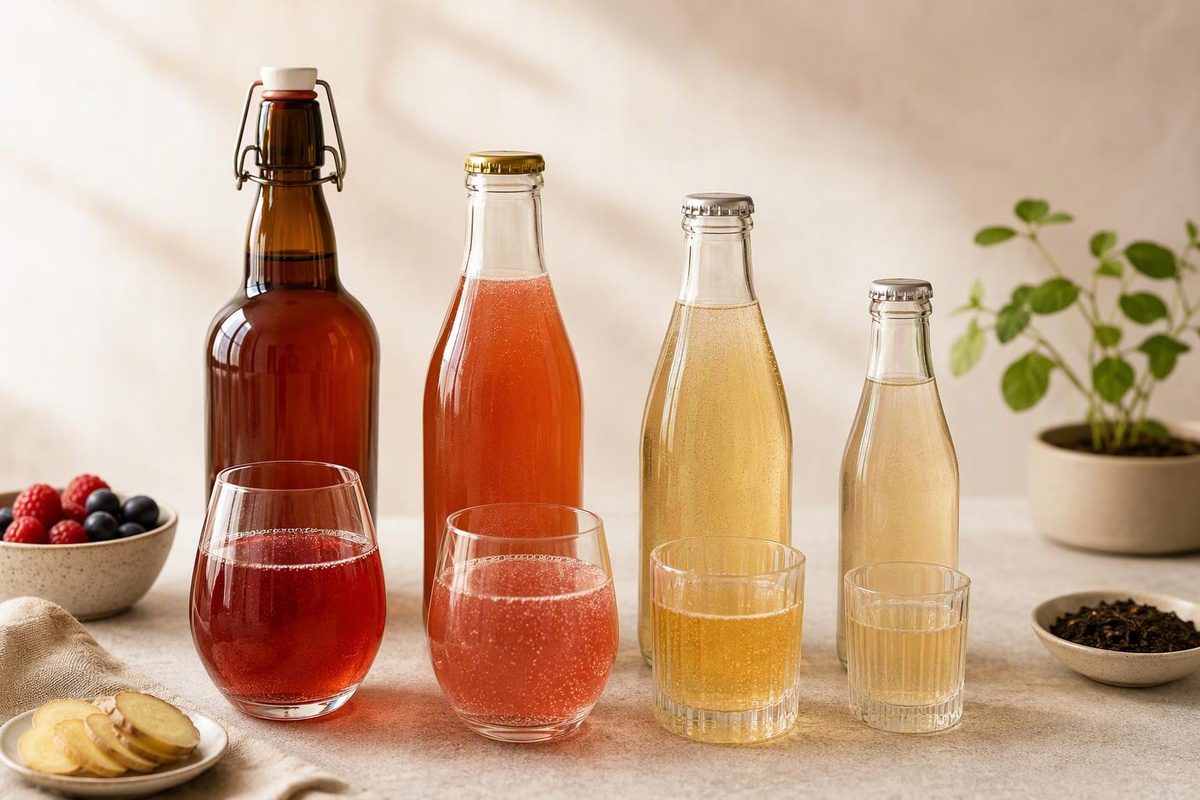
Hard kombucha can intoxicate; a single serving below 0.5% ABV is unlikely to. Compare bottle sizes, alcohol amounts, and storage caveats.
Yes—hard kombucha can make you drunk. For most adults, a single 12–16 fl oz serving of kombucha that is genuinely below 0.5% alcohol by volume (ABV) is unlikely to, because it contains only a small fraction of the alcohol in a beer. Homemade kombucha and bottles that have continued fermenting are less predictable.
The useful distinction is not “kombucha versus beer.” It is the drink’s ABV multiplied by the amount you drink.
Regular and hard kombucha are different drinks
Kombucha is fermented sweetened tea. Yeast converts sugar into alcohol during fermentation, so a non-alcoholic kombucha need not contain zero alcohol. Under U.S. TTB guidance, kombucha falls under federal alcohol-beverage rules if it reaches 0.5% ABV or more at any point during production, bottling, or afterward. That is a regulatory boundary, not an intoxication threshold.
For a non-alcoholic example, Buchi says it tests its kombucha to below 0.5% ABV. Hard kombucha is a different category: JuneShine’s Midnight Variety Pack lists 6% ABV in 12 fl oz cans, as checked October 26, 2026. That is slightly more alcohol per can than a same-size 5% beer.
How much alcohol is in a bottle?
In the United States, NIAAA defines one standard drink as about 0.6 fl oz, or 14 grams, of pure alcohol—the amount in 12 fl oz of 5% beer.
The calculations below use U.S. fluid ounces and the stated ABV assumptions:
| Drink and portion | ABV assumption | Pure alcohol | U.S. standard drinks |
|---|---|---|---|
| Non-alcoholic kombucha, 12 fl oz | Below 0.5% | Below 0.06 fl oz | Below 0.10 |
| Non-alcoholic kombucha, 16 fl oz | Below 0.5% | Below 0.08 fl oz | Below 0.14 |
| Hard kombucha, 12 fl oz | 6% | 0.72 fl oz | 1.20 |
| Beer, 12 fl oz | 5% | 0.60 fl oz | 1.00 |
Calculation: standard drinks = portion in fl oz × (ABV ÷ 100) ÷ 0.6. The 16 fl oz upper bound is rounded up: at exactly 0.5% ABV, it would contain about 0.133 standard drinks.
These are alcohol-content comparisons, not predictions of how drunk someone will feel or whether they can drive. The below-0.5% rows also assume the drink actually remains below that level.
Why homemade kombucha and storage matter
There is no single dependable ABV to assign to every homemade batch. TTB explains that fermentation time and temperature affect alcohol production, and fermentation can continue after bottling, increasing alcohol content.
Follow the bottle’s storage instructions. New York’s Department of Agriculture and Markets specifically warns that unpasteurized kombucha can continue fermenting and raise its alcohol content, especially without refrigeration. Refrigerating it is not a way to verify its ABV.
When choosing a bottle:
- Check for “hard,” an ABV percentage, and the container size. Treat hard kombucha as an alcoholic drink.
- If you need to avoid alcohol entirely, do not treat “non-alcoholic” kombucha as zero-alcohol. Verify the product rather than relying on the category name.
- Do not assume an untested homemade batch is below 0.5%. Its alcohol content needs measurement, not a guess based on brewing time.
Alcohol is separate from caffeine. If that is also part of your drink choice, compare kombucha caffeine amounts by brand and bottle size.