
Count Your Aperol Spritz by the Pour, Not the Glass
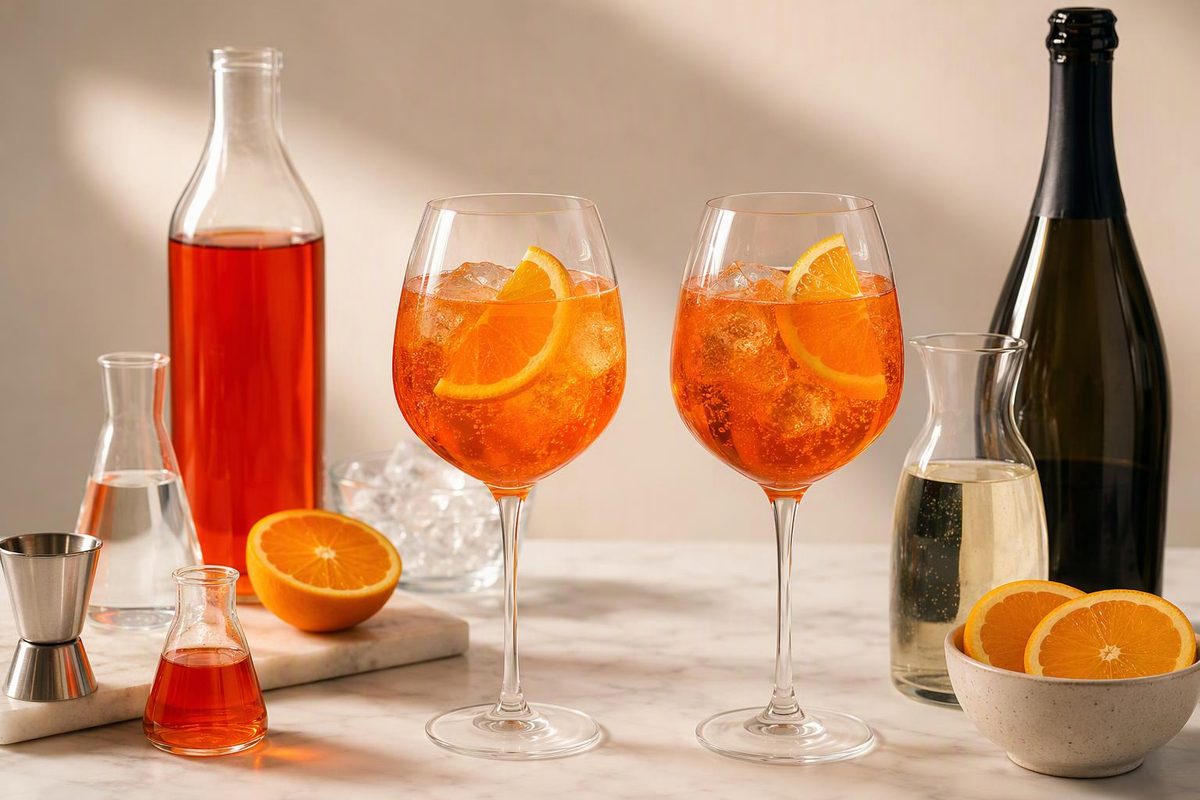
Compare a measured 160-calorie Aperol Spritz with the 186-calorie bottled version, calculate your own pour, and see which ingredients change the total.
An Aperol Spritz made with 60 ml Aperol, 90 ml Tesco Finest Brut Prosecco and 30 ml plain soda water has about 160 calories, excluding the orange garnish. That is a calculated example, not a universal value for every bar pour. The matching 9% ABV bottled spritz has a separate label value: 186 calories per 6.8 US fl oz serving, roughly 200 ml, according to Campari’s US nutrition statement.
For a freshly mixed drink, the useful number comes from the amount of Aperol and Prosecco actually poured. The glass size, the amount of ice and the depth of the drink are not enough to establish its calories.
Enter your Aperol and Prosecco measures; use your wine’s calorie label if you have it.
Measured Spritz Calculator
60 ml Aperol + 90 ml Prosecco at 67 calories per 100 ml. Plain soda adds 0; orange is excluded.
What This Estimate Includes
Calculation: Aperol ml × 1.67 + Prosecco ml × its calories per 100 ml ÷ 100. The answer is rounded to whole calories and marked as an estimate.
Plain soda and melting ice add no calories. Caloric mixers and consumed garnish are not included. Unknown measures cannot produce a complete estimate.
This is not the bottled-product calculation. Campari’s US statement for the matching 9% ABV bottled spritz gives 186 calories and 21 g carbohydrate per 6.8 US fl oz.
Without JavaScript, the displayed result remains the default measured example.
Sources: Campari US Aperol nutrition, 74 calories per 1.5 US fl oz (~44.4 ml); Tesco Finest Brut Prosecco, 67 calories per 100 ml. Plain soda: 0 calories.
A Measured 3–2–1 Spritz Has About 160 Calories
Aperol’s official recipe uses a 3–2–1 ratio: 90 ml Prosecco, 60 ml Aperol and 30 ml soda water, served over ice with an orange slice. Those measures make 180 ml of liquid before the ice melts.
Using the published product values in the researched draft, the calorie calculation is:
| Ingredient | Measured Amount | Calories |
|---|---|---|
| Aperol, 11% ABV | 60 ml | About 100 |
| Tesco Finest Brut Prosecco, 10.5% ABV | 90 ml | About 60 |
| Plain club soda | 30 ml | 0 |
| Total, excluding orange | 180 ml before ice | About 160 |
The Aperol estimate scales Campari’s US value of 74 calories per 1.5 US fl oz, approximately 44.4 ml. That works out to about 1.67 calories per ml. Multiplying by the 60 ml pour gives about 100 calories.
The wine estimate uses Tesco’s UK listing of 67 calories per 100 ml for its Finest Brut Prosecco. A 90 ml pour therefore contributes about 60 calories. Schweppes plain club soda lists zero calories.
These are product-specific inputs drawn from US and UK sources. They support this measured example; they do not establish the nutrition of every Aperol formulation or every bottle of Prosecco sold in other markets. If your bottle has a different nutrition statement, use that statement for the product you are drinking.
The total is rounded because the source serving conversion and the ingredient calorie values are not laboratory measurements of your finished glass. Logging about 160 calories reflects the evidence better than presenting the calculated result with decimal-place precision.
The Ratio Alone Does Not Tell You the Calories
A 3–2–1 recipe establishes the proportions, not the serving size. A small spritz and a much larger spritz can both follow that ratio while containing different amounts of alcohol and different calorie totals.
Keeping the same Aperol, Prosecco and plain soda values gives these calculated examples:
| Pour | Prosecco + Aperol + Soda | Estimated Calories |
|---|---|---|
| Smaller | 67.5 + 45 + 22.5 ml | 120 |
| Official metric recipe | 90 + 60 + 30 ml | 160 |
| 50% larger | 135 + 90 + 45 ml | 240 |
All three estimates exclude the orange garnish. The smaller example contains three-quarters of each ingredient in the reference recipe, so its calories are also about three-quarters of the reference total. The larger example contains 50% more of each ingredient, so its calorie estimate rises by the same proportion.
That proportional shortcut works only when the ingredients and their proportions stay the same. Adding more soda alone does not turn the 160-calorie recipe into a proportionally higher-calorie drink. Adding more Aperol alone does not preserve the original calorie-per-volume relationship either.
A large wine glass can hold the smaller recipe with plenty of ice. A glass that looks less full can contain a more concentrated pour. For tracking, the relevant distinction is the measured alcoholic ingredients, not whether the drink looks small, standard or generous.
Calculate Your Own Aperol And Prosecco Measures
For a recipe using the 11% ABV Aperol nutrition value above, calories ≈ (Aperol ml × 1.67) + (Prosecco ml × its calories per 100 ml ÷ 100).
Plain soda contributes zero in this calculation. Add any caloric mixer or garnish you consume separately. The calculator uses the Tesco wine value of 67 calories per 100 ml by default, but that field can be replaced with a value from your own bottle.
The wine input is a calorie density, not the calories in your glass. If the label says calories per 100 ml, enter that number directly. If it gives calories for a different serving volume, first divide the serving’s calories by its volume in ml, then multiply by 100.
Do not enter an alcohol percentage in the calorie field. The Tesco example’s 10.5% ABV and its 67 calories per 100 ml describe different properties. ABV is not a substitute for a calorie declaration, and the calculation here does not infer a wine’s total calories from its alcohol percentage.
If you know the Aperol measure but not the Prosecco measure, you know only part of the drink’s total. If you know both measures but lack the wine’s calorie value, the default produces a clearly defined comparison estimate rather than a verified number for that wine.
A blank input is therefore unknown, not zero. Entering zero for Prosecco would tell the calculator there is no Prosecco in the drink; it would not tell it that the amount is uncertain.
Extra Aperol Adds More Calories Than the Same Wine Volume
With these product values, another 30 ml of Aperol adds about 50 calories, while another 30 ml of the example Prosecco adds about 20. Equal changes in volume do not have equal calorie effects.
Starting with the reference recipe, adding 30 ml Aperol while leaving the Prosecco and soda unchanged gives a calculated total of about 210 calories. Adding 30 ml of the example Prosecco instead gives about 180. Both are derived estimates, and both still exclude the garnish.
This distinction matters when a bar changes the recipe rather than merely scaling it. A stronger Aperol pour cannot be accounted for by choosing a generic “large spritz” entry unless that entry happens to use the same ingredients and measures.
Likewise, a lower Prosecco measure does not necessarily compensate for a higher Aperol measure. In this example, removing 30 ml of wine subtracts about 20 calories, while adding 30 ml Aperol contributes about 50. The ingredient amounts need to be calculated separately when the ratio changes.
For a different sparkling wine, the wine contribution may change. Our guide to Prosecco calories by glass and bottle explains how serving size and bottle-specific values affect that part of the calculation.
Soda And Melting Ice Change Volume, Not the Existing Total
Adding more zero-calorie plain soda to the reference recipe leaves the ingredient calorie total at about 160. It increases the liquid volume and lowers the concentration of the drink, but it does not remove calories from the Aperol or Prosecco already poured.
Melting ice has the same consequence for the total: it adds water, not another contribution from the alcoholic ingredients. The drink becomes more diluted while retaining the calories from those original measures, assuming you drink the whole mixture.
This is why estimating a spritz from its finished volume can mislead. The official measures total 180 ml before melting ice, but the liquid you see later may include additional water. Applying the original recipe’s calorie density to that larger volume would count the dilution as though it were more cocktail.
The zero-calorie assumption also has a specific scope. It applies to the plain club soda used in this calculation, not to every clear or sparkling mixer. If the mixer has a calorie declaration, calculate its contribution from the amount poured and add it to the other ingredients.
The draft does not provide a calorie figure for sweetened mixers or alternative additions. Without a relevant label value and measure, there is no supported extra amount to insert into this estimate.
The Orange Garnish Is Outside the 160-Calorie Estimate
The official recipe includes an orange slice, but the 160-calorie calculation excludes it. The draft does not provide a standardized slice weight or a sourced calorie value for that garnish, so there is no defensible fixed addition for every glass.
If you eat the orange, log the amount consumed separately using an appropriate food entry. If the drink includes squeezed orange juice or another measured addition, that is a recipe ingredient rather than merely a visual garnish and needs its own calorie calculation.
Do not read “excluding orange” as proof that every garnished glass contains exactly 160 calories. It identifies the boundary of the estimate: the measured Aperol, the specified Prosecco and zero-calorie soda are included; the garnish is not.
That boundary is more useful than adding an unsupported allowance. It lets you use the same base calculation consistently while recording any known additions separately.
The Matching Bottled Spritz Has 186 Calories
Aperol Ready to Serve comes in 20 cl, or 200 ml, bottles. Campari’s US nutrition statement for the 9% ABV spritz lists 186 calories and 21 g carbohydrate per 6.8 US fl oz serving.
Use that nutrition entry for the matching bottled product rather than rebuilding its calories from the homemade recipe. The bottled statement describes a finished formulation; the 160-calorie example describes separately measured Aperol, a particular Prosecco and soda.
The two values also refer to different serving volumes: 180 ml before ice for the mixed example and roughly 200 ml for the bottled serving. Their difference does not establish that all bottled spritzes are more caloric than all freshly mixed ones. A larger homemade pour can exceed the bottled serving’s calories, while the smaller calculated example is below it.
The 21 g carbohydrate figure belongs to that matching bottled product and serving. It should not be copied into a homemade spritz entry. The draft does not provide a complete carbohydrate calculation for the measured homemade recipe.
If your ready-to-serve bottle has a different ABV, market label or serving declaration, use its own nutrition information. The US statement for the 9% product is not evidence that every similarly named bottle has the same calories.
Log a Measured Drink Precisely And a Bar Pour As an Estimate
For a homemade spritz, logging the measured ingredients gives you a record that can be adjusted when the recipe changes. The reference entry is 60 ml Aperol, 90 ml of the specified Prosecco and 30 ml plain soda, with about 160 calories before any consumed garnish.
For a bar-made drink, ask for the Aperol and Prosecco measures if they are available. Knowing that it follows a 3–2–1 recipe is useful, but the total still depends on the size of each part. Knowing only the glass size does not resolve that uncertainty.
When the measures are unavailable, 160 calories can serve as a reference portion, not a precise reading of the glass. The 120- and 240-calorie examples illustrate how measured servings of the same recipe differ; they are not a sourced range covering every bar drink.
Record the entry as estimated rather than choosing a highly specific number that the evidence cannot support. If you later learn the actual measures, replace the reference portion with the ingredient calculation.
For the matching bottled version, use the 186-calorie serving declaration. For a measured homemade version, use your pours and the relevant product values. Keeping those entries separate avoids the main tracking error: treating every drink called an Aperol Spritz as the same serving.