
Breaking Down the Calories in Chocolate Covered Marshmallows
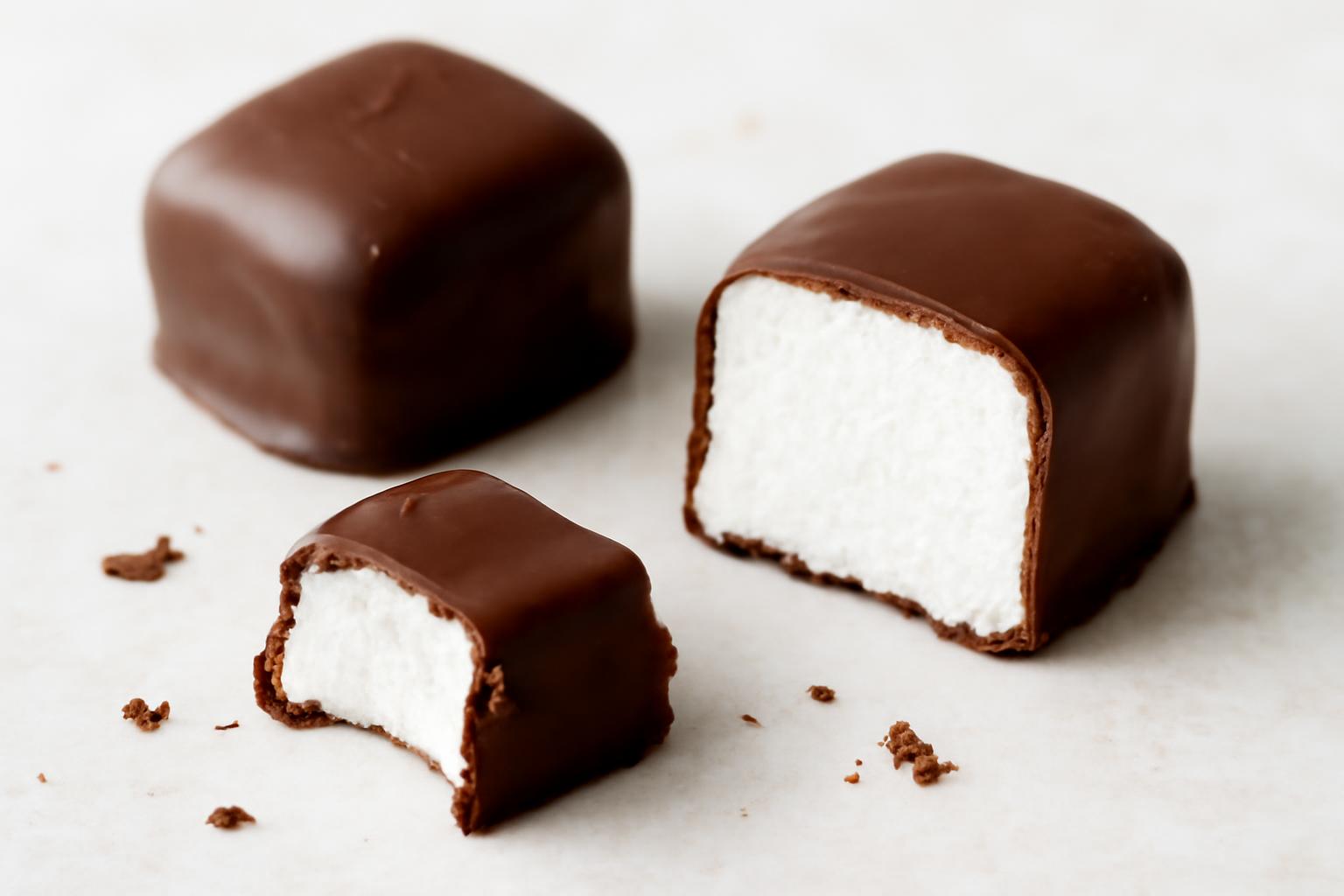
For unlabeled hand-dipped pieces, a cautious weight-based entry is usually better than a generic piece-count entry.
Chocolate covered marshmallows look easy to log, but they are one of the messier sweets to estimate honestly. A bite-size square, a hand-cut jumbo piece, and a marshmallow pop with caramel and extra chocolate can all be described with the same food name while meaning very different things in calorie terms.
That gap matters because this is a food category with lots of public product pages and recipe pages, but relatively few published nutrition panels. Some listings tell you the ingredients, the coating style, the package weight, or whether the piece is jumbo. Some recipe posts include calorie estimates, but those are recipe-specific approximations rather than universal label facts. So the useful question is not “What is the one exact calorie number for chocolate covered marshmallows?” It is “What can I know with confidence, what can I only estimate, and how should I log it without pretending the estimate is exact?”
The most reliable answer is three-part:
- understand the food’s structure,
- use standard label math when you have macros,
- and fall back to weight and context when you do not.
That approach is less satisfying than a single app entry, but it is much more accurate. Chocolate covered marshmallows are basically a marshmallow center plus a chocolate shell. The center is mostly sugar syrup and gelatin. The shell adds more sugar plus cocoa butter and, in milk chocolate, milk components. That means the food is usually carb-heavy, meaningfully fatty for its size, and low in protein. It also means that “one piece” is a weak unit unless you know how big that piece is.
This article stays inside that reality. Where the evidence gives a clear fact, it uses the fact. Where the evidence only supports a rough estimate, it says so directly. And where recipes or retail examples are doing the work, it treats them as examples, not as nutrition labels.
What Makes Up Chocolate Covered Marshmallows?
At a basic level, chocolate covered marshmallows are a two-part candy: a marshmallow center and a chocolate coating. The center is usually built from sugar or corn syrup, gelatin, starch, and flavoring. One commercial ingredient panel lists marshmallow ingredients as corn syrup, sugar, modified corn starch, gelatin, flavors, and minor additives, with the coating supplied by either milk or dark chocolate containing sugar, cocoa butter or chocolate liquor, milk ingredients in the milk-chocolate version, soy lecithin, and vanilla flavoring (Stage Stop Candy ingredient panel).
The chocolate shell adds more carbohydrate, but it also brings fat from cocoa butter and related chocolate fats. So the finished candy is not just “sugar fluff.” It is sugar plus a real fat contribution from chocolate.
Homemade versions follow the same general template but add more variability. A representative home recipe uses a bag of marshmallows, semi-sweet chocolate chips, and about 1 to 2 tablespoons of coconut oil or shortening to help the chocolate melt and coat more smoothly; it also notes that one bag of chocolate may be enough for half-dipping while a fuller coating may need more (My Baking Addiction recipe). A thin half-dip, a full dip, a second drizzle, or a little added fat for smoother coating can all move the final number.
Size is the other major variable. Some chocolate covered marshmallows are true snack-size pieces. Others are more like small confections. In practice, retail and handmade examples include larger formats meant to be several bites rather than one quick mouthful. That is why “one chocolate covered marshmallow” is not a stable calorie unit. The ingredient list may be familiar across products, but the amount of marshmallow and the thickness of the chocolate can change a lot from one version to another.
The practical implication is simple: if you are tracking calories or macros, identify the format before you log it. Is it a small square? A big hand-cut piece? A marshmallow pop? A caramel-layered version? The answer changes the estimate more than the name does.
How Food Labels Calculate Calories: The Atwater System
CaloriePages’ methodology also notes that food-label calorie counts can be off by up to 20%, which is one reason labels are useful but not perfectly precise (CaloriePages About).
That label math fits chocolate covered marshmallows well. Most of the marshmallow center’s calories come from carbohydrate because the center is mostly sugar and syrup. The chocolate coating contributes additional carbohydrate, but also a higher-energy fat component from cocoa butter. The gelatin in the marshmallow contributes some protein, yet usually not enough to change the overall picture much.
If you do have a published panel, the arithmetic is straightforward. Suppose a serving lists carbs, protein, and fat. Multiply carbs by 4, protein by 4, and fat by 9, then add the three totals. If the label says 24g of carbs, 1g of protein, and 7g of fat, the Atwater math gives 24×4 + 1×4 + 7×9 = 163 kcal before any rounding. That kind of example is why label-based logging is usually more reliable than guessing from appearance alone.
The trouble is that many chocolate covered marshmallow products in the evidence set do not publish those macros in the first place. Product pages often give ingredients, allergen statements, package sizes, or descriptive details, but not a full nutrition panel. Recipe pages sometimes provide calories per serving, but they usually label those as estimates or automatic calculations rather than laboratory measurements. So for this food, Atwater math is best understood as a method for checking a label when you have one, not a magic way to discover exact macros that were never published.
That distinction matters. There is a big difference between:
- a label fact based on a serving with stated macros,
- a recipe estimate based on software,
- and a tracker placeholder you build because no better data exists.
If you keep those categories separate, calorie logging becomes much cleaner. If you blur them together, you end up treating a rough guess like a verified nutrition panel.
Calorie Estimates by Serving Size
This is the section most readers want first: how many calories are in one chocolate covered marshmallow? The honest answer is that the public evidence supports examples, not one universal number.
A jumbo retail listing that gives about 14 pieces per 1-pound box works out to roughly 32g per piece, which is large enough that it should not be logged like a plain mini marshmallow or even like a standard single store-bought marshmallow (James Candy jumbo listing). At the smaller end, a dark-chocolate product described as bite-size squares has a net weight of 3.5 oz / 99g for the full package, which confirms that some versions are much smaller individual pieces even though they share the same generic food name. That helps explain why count-based entries drift so badly: “one piece” can refer to very different weights.
The calorie examples in the source set come mostly from recipes, and they should be treated that way. One double-dipped recipe gives 126 kcal per serving for a chocolate-covered marshmallow with two layers of coating, while a larger recipe that stacks 2 marshmallows on a stick, adds caramel, and then coats the outside gives an approximate 180 kcal per serving (The Crafty Blog Stalker recipe; Tastes Better From Scratch recipe). Those numbers are useful as guardrails, not as universal facts. They show that once the piece gets larger, more fully coated, or layered with caramel, calories climb quickly.
From a tracking perspective, the safest way to interpret those examples is this:
- a small bite-size square and a jumbo hand-dipped marshmallow should not share the same entry;
- a two-marshmallow caramel pop is a different food from a simple dipped piece;
- and “one piece” only becomes meaningful when the piece size is known.
If you need a practical workflow, use the following order:
-
Check for a label first. If the package gives serving size and calories, use that instead of any generalized estimate.
-
If there is no label, weigh the piece or the portion.
-
Then compare the style. A bite-size square is one thing. A jumbo single piece is another. A caramel-coated two-marshmallow serving is another again.
-
Use a cautious placeholder, not an optimistic one.
A lot of trackers like a per-100g fallback because it lets them log any odd-size portion. In other words, it is a practical tool for imperfect situations, not something the evidence set proves for every brand or recipe.
That last point is worth emphasizing because it is where many articles overreach. The evidence here does not justify pretending that every chocolate covered marshmallow is exactly the same. What it does justify is a cautious hierarchy of confidence:
- highest confidence: published nutrition label,
- middle confidence: recipe-specific calorie estimate for a very similar format,
- lowest confidence: generic app entry with no clear weight or product match.
For most people tracking real-world intake, that hierarchy is more useful than false precision.
Macros Breakdown: Carbs, Fat, Protein, and Sugar
Macro-wise, chocolate covered marshmallows are usually easy to understand even when exact grams are not published. Ingredient lists consistently point in the same direction: this is a candy built mostly from sugar sources plus chocolate fat, with only minor protein. A commercial milk-or-dark product lists sugar and syrup ingredients in the marshmallow and sugar, cocoa ingredients, cocoa butter or milkfat components, and soy lecithin in the coating; a bite-size dark-chocolate version similarly lists dark chocolate, corn syrup, gelatin, corn starch, lemon juice, and sugar (Stage Stop Candy ingredient panel; Jacques Torres product listing).
That means the macro pattern is usually:
If you are used to thinking in satiety terms, that profile matters more than the exact macro split. They are the opposite of a high-protein food. CaloriePages’ protein-density guide puts canned tuna at about 4.5 kcal per gram of protein and cooked chicken breast at about 5.3 kcal per gram of protein, which illustrates how much more satiety and protein you typically buy per calorie from lean foods than from confectionery (CaloriePages protein-density guide).
The sugar question is especially straightforward. Both parts of the candy contribute it. The marshmallow center usually starts with corn syrup and sugar. The chocolate shell often includes added sugar as well, whether it is milk chocolate or dark chocolate. So even though the candy feels airy and soft, it is still a high-sugar food by design.
What you usually cannot know without a label is the exact grams of carbs, fat, sugar, and protein per serving for a specific piece. That is why broad macro claims should stay broad. The evidence set supports the direction of the macros much better than it supports precise gram targets. In other words, it is reasonable to say “mostly carbs, meaningful fat, little protein.” It is not reasonable to invent a fake precision that the packaging never published.
For trackers, that distinction leads to a practical rule: use macros precisely only when the food gives you precise macros. Otherwise, track the calories realistically and treat the macros as approximate.
Commercial vs. Homemade: Calorie Differences
Commercial versions are often more standardized in shape and coating. Some are clearly sold as large, multi-bite confections rather than tiny snack pieces. One listing describes its chocolate covered marshmallows as a 3- to 4-bite confection, which is a useful reminder that store-bought examples are not automatically small just because the ingredient list sounds simple (Wilbur’s of Maine listing). When commercial pieces are larger and more fully coated, the chocolate share rises, and so does the chance of underlogging if you use a generic entry that assumes a smaller piece.
Homemade versions are less standardized but not automatically lighter. The home cook controls almost everything: whether the piece is half-dipped or fully submerged, whether the chocolate is thinned with oil, whether there is a second drizzle, whether sprinkles or nuts are added, and whether the marshmallow itself is a regular bagged marshmallow or a softer homemade version. That flexibility is exactly why homemade chocolate covered marshmallows can vary so much from batch to batch.
Sometimes it does. A lightly half-dipped homemade marshmallow can easily be smaller and lighter than a candy-shop jumbo piece. But a homemade holiday version with full coverage, drizzle, and toppings can go the other direction just as easily. “Homemade” changes the range; it does not tell you which end of the range you are on.
This is where weight keeps the math honest. If you are comparing a homemade batch to a commercial one, the cleanest question is not “Which is healthier?” but “How much does the finished piece weigh, and how much chocolate is on it?”
Why Labels Can Be Off By 20% and How to Adjust
Even when you do have a label, it is better treated as a useful estimate than as laboratory truth. CaloriePages notes that calorie labels can be off by up to 20%, which is enough to matter if you eat a food often or log it in large amounts (CaloriePages About).
With chocolate covered marshmallows, there are really two layers of uncertainty. The second is physical variation inside the candy category itself. Hand-dipped pieces are not always coated identically. Marshmallows are soft and light. Some pieces are truly bite-size; some are jumbo; some are half-dipped; some are double-dipped; some are wrapped around caramel; some are stacked on a stick. So even if a box gives calories per serving, your specific piece may not match the average piece especially well if the product is artisanal or hand-finished.
That does not mean calorie logging is pointless. It means you should log with the right level of confidence. If you have a labeled commercial product, start there. If you have an unlabeled hand-dipped piece, use a cautious estimate based on weight and style. Then look at your longer trend rather than obsessing over one candy.
That longer-trend idea matters because your energy expenditure is also an estimate. CaloriePages’ TDEE explainer says carbohydrates have a thermic effect of roughly 5 to 10% and fat about 0 to 3%, while common TDEE formulas can miss reality by about ±10% and NEAT can differ by up to 2,000 kcal per day between people with similar size and exercise habits (CaloriePages TDEE explainer). In plain English: the label is approximate, your portion is approximate, and your daily burn is approximate too. The solution is calibration, not perfection.
A sensible adjustment process looks like this:
-
Use the best available entry now. Label first, close recipe match second, cautious generic estimate last.
-
Weigh portions when possible. That reduces one of the biggest error sources.
-
Watch multi-week body-weight trends, not one day. A noisy food entry does not matter much if the overall trend still matches your target.
-
Adjust only if the miss is persistent. If your logs and your results disagree for weeks, revise the entry or your assumed TDEE rather than clinging to the first number.
This is one of those foods where discipline beats precision. You do not need a fantasy-perfect number. You need a realistic one used consistently.
Fitting Chocolate Covered Marshmallows into Your TDEE
Chocolate covered marshmallows can fit into a calorie budget. The question is not whether they are forbidden; it is what they cost you in appetite, calories, and tradeoffs elsewhere in the day.
CaloriePages’ protein article explains why protein is more filling: it has a higher thermic effect, stimulates satiety signals such as PYY and GLP-1 more strongly than carbs or fat, and helps preserve lean mass during a deficit (CaloriePages protein article). That is why the same calorie amount from yogurt, chicken, tuna, or cottage cheese often keeps hunger quieter than the same calories from candy.
In practice, that means chocolate covered marshmallows are usually easiest to fit into maintenance or fat-loss plans when they are pre-portioned rather than grazed from an open box. If you know the piece is large, log it before you eat it. If the format is unclear, weigh it first.
This is also where people misread cause and effect. If a few chocolate covered marshmallows “fit fine” one week and seem to “wreck the diet” another week, the difference is not always the candy itself. Daily activity changes, intake accuracy changes, appetite changes, and adherence changes. That is why TDEE works best as a calibrated trend rather than a fixed promise.
So the practical takeaway is not dramatic:
- log the candy honestly,
- treat it as a discretionary sweet rather than a filling snack,
- and evaluate it inside the context of your full week, not as a moral event.
For most trackers, that mindset is more useful than trying to label the food good or bad.
Allergens and Storage Impact on Nutrition
Dietary notes matter with chocolate covered marshmallows because ingredient lists and allergen statements are common even when nutrition panels are missing. One commercial listing says the product contains milk and soy and is made on shared equipment with peanuts, tree nuts, eggs, soy, and wheat; another bite-size dark-chocolate listing warns that the product contains or may have come in contact with tree nuts, wheat, egg, milk, and soy (Stage Stop Candy ingredient panel; Jacques Torres product listing).
A representative homemade recipe says chocolate covered marshmallows can be kept in an airtight container for up to 7 days at room temperature, longer in the fridge, and up to 2 months in the freezer (Lifestyle of a Foodie recipe). Another recipe gives a similar room-temperature window. That does not mean storage has no effect; it means the effect is mostly sensory. Chocolate may dull, the surface may pick up moisture, and the marshmallow can firm up. But a chilled piece does not suddenly become lower-calorie because it got firmer.
For tracking purposes, the checklist is short:
- check allergens and cross-contact warnings,
- do not assume vegan status,
- and do not change the logged calories just because the candy was refrigerated or frozen.
If anything, storage matters more for food safety, texture, and serving control than for the number you enter into a tracker.
How many calories in a typical chocolate covered marshmallow?
There is no single reliable calorie number for a “typical” piece because the category includes bite-size squares, jumbo pieces, and loaded versions with extras. In the source set, one double-dipped recipe is estimated at 126 kcal per serving, while a larger two-marshmallow caramel-and-chocolate version is estimated at about 180 kcal per serving; a jumbo boxed product also works out to roughly 32g per piece, which shows why larger hand-dipped pieces can add up quickly (The Crafty Blog Stalker recipe; James Candy jumbo listing). The safest answer is to log by weight when possible.
Are chocolate covered marshmallows high in sugar?
Yes. The ingredient lists are clear on that point: the marshmallow portion is typically built from corn syrup and sugar, and the chocolate coating adds sugar as well. So even though the candy feels airy, it still fits best in the high-sugar treat category.
Can I estimate calories without a label?
Yes, but treat the result as a working estimate, not as a fact. The cleanest method is to weigh the portion, match it to the closest format you actually have, and use standard label arithmetic when macros are available; also remember that label-style calorie numbers themselves can be off by up to 20%. For unlabeled hand-dipped pieces, a cautious weight-based entry is usually better than a generic piece-count entry.
Do homemade versions differ nutritionally from store-bought?
Usually yes, but not in one predictable direction. Homemade recipes can use half-dipping or full-dipping, and may add about 1 to 2 tablespoons of coconut oil or shortening to help the chocolate coat more smoothly, which changes the final calorie load. Homemade can be lighter, but it can also be richer; the deciding factors are size, coating depth, and extras.
How much error to expect on nutrition labels?
For the label itself, CaloriePages notes that calorie counts can be off by up to 20%. With chocolate covered marshmallows, piece-to-piece variation can add even more uncertainty around any “per piece” log if the product is hand-dipped or artisanal. That is why weight-based logging usually beats count-based logging for this candy.
Chocolate covered marshmallows are easiest to log when you stop treating them like a perfectly uniform food. Use the label if you have it. Use weight when you do not. Treat recipe calories as examples, not facts. And if you need a placeholder, use one openly and revise it when better information appears. That approach is less flashy than pretending there is one magic calorie number, but it is much closer to how real tracking actually works.