
Free-range eggs add outdoor access; cage-free eggs do not
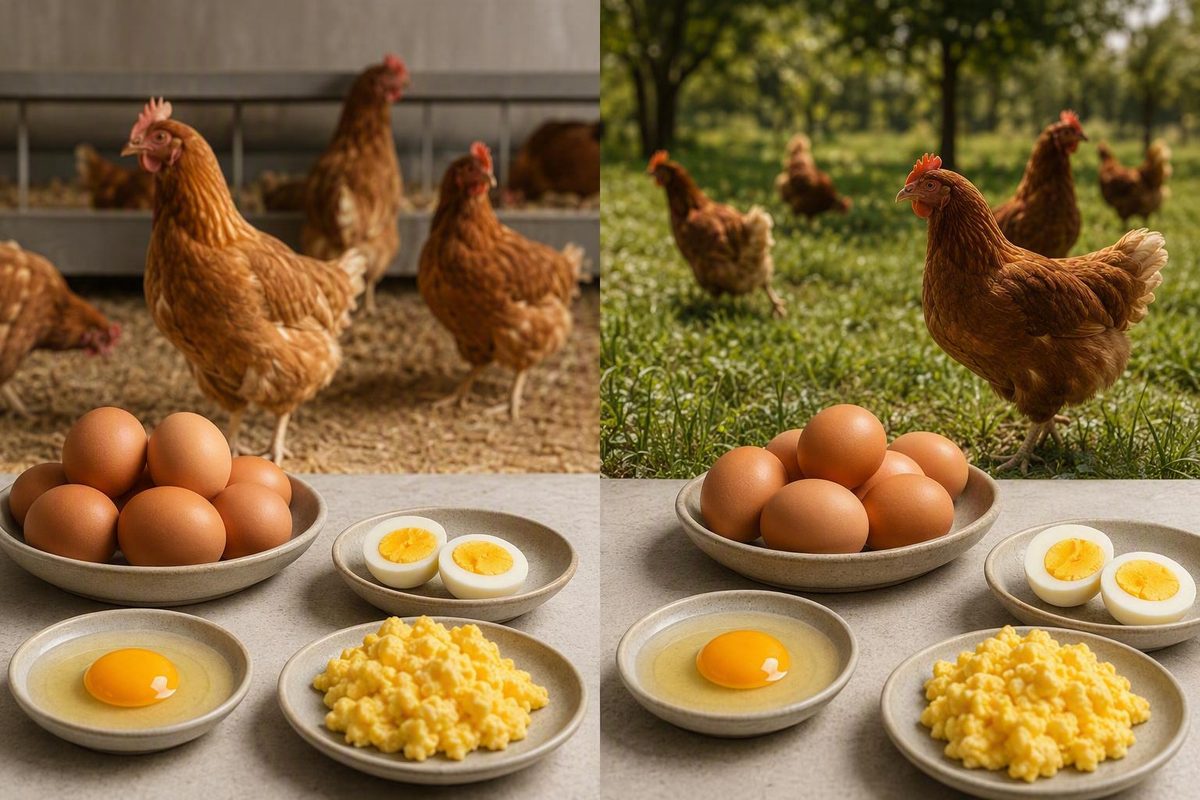
Cage-free hens can move indoors. Free-range hens must also have outdoor access. Neither term guarantees a nutritional or calorie advantage.
The short answer: cage-free hens can move around inside a henhouse; free-range hens must also have access to an outdoor area. Both terms describe how the hens are housed—not a guaranteed difference in calories, protein or other nutrients.
| Carton term | Indoor movement | Outdoor access |
|---|---|---|
| Cage-free | Yes | Not required |
| Free-range | Yes | Required |
These are the USDA requirements for eggs in USDA-grademarked consumer packages. Claims on cartons governed by other programs may use additional standards, so a certification name and its published rules matter.
What cage-free means
For USDA-grademarked cartons, cage-free eggs come from hens able to roam vertically and horizontally inside. The housing must provide fresh food and water, litter and enrichments such as nests, perches and scratching areas. Cage-free systems may include multi-tier aviaries, so the term does not necessarily mean a single open floor plan. USDA describes the full housing requirements here.
Cage-free does not require outdoor access.
What free-range adds
Free-range includes the indoor movement and housing features required for cage-free production, plus continuous access to the outdoors during the hens’ laying cycle. USDA notes that the outdoor area may be fenced or covered with netting. That definition applies to USDA-grademarked free-range cartons.
“Outdoor access” is the key distinction. The term by itself does not tell you the design or size of the range, or how much time an individual hen actually spends outside. Look for a named third-party certification if those details affect your choice, then check that program’s standards rather than relying on the front-of-carton phrase alone.
Do the calories or macros differ?
Neither housing claim guarantees a nutritional advantage. USDA says it does not have definitive scientific data showing that hen housing creates a difference in egg nutrition. The agency classifies both “cage-free” and “free-range” as descriptions of the hens’ environment. USDA addresses the nutrition question directly.
For calorie or macro tracking, do not create a higher- or lower-calorie entry solely because an egg is free-range rather than cage-free. Use the nutrition facts from the carton when available and match the serving count and egg size you ate. Differences in size can matter to the logged total even when the housing words do not.
Housing labels are not egg grades
Grade AA, A or B is a separate quality classification based on the shell’s condition and the appearance and condition of the yolk and white. It is not a ranking of outdoor access or hen welfare. USDA grading is voluntary, and only eggs processed under a USDA grader’s supervision may carry the USDA grademark. USDA explains what its grades and shield cover.
Choose free-range when verified outdoor access is the feature you want. Choose cage-free when indoor freedom from cages meets your priority. For nutrition tracking, let the carton’s serving information and the egg’s size—not the housing claim—drive the entry.