
Use 260 Grams for One US Cup of Peanut Butter
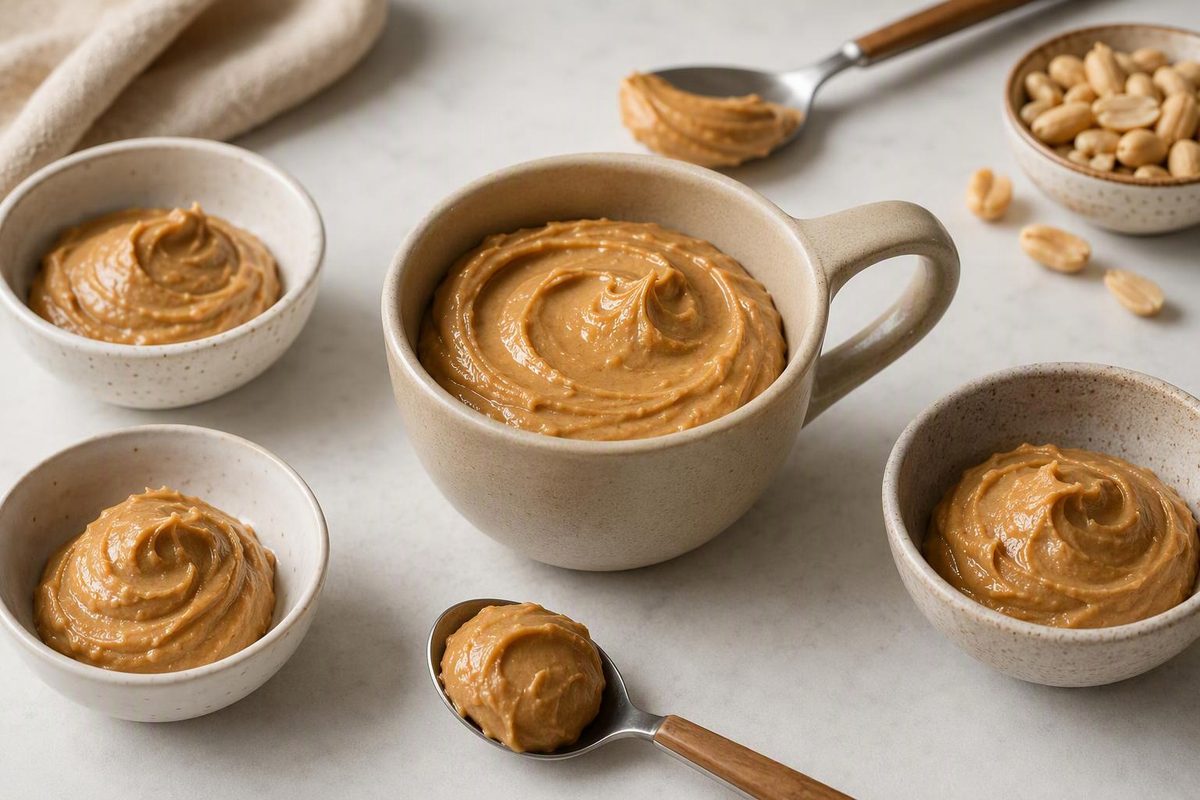
Compare peanut butter cup-to-gram conversions from product labels and a baking chart, then choose the right weight for recipes or food logging.
One US cup of peanut butter weighs about 260 grams. The documented conversions checked here range from 256 to 270 grams per cup, so 260 grams is a practical default when a recipe or product label does not provide a more specific weight.
Enter the number of US cups and choose the conversion that matches your recipe or jar.
Peanut Butter Cup-to-Gram Calculator
The default uses approximately 260 grams per US cup.
| Basis | Listed amount | 1 US cup |
|---|---|---|
| Smucker’s Natural Creamy | 32 g / 2 tbsp | 256 g |
| Practical default | Estimate | ~260 g |
| Jif Creamy | 33 g / 2 tbsp | 264 g |
| King Arthur Baking | 135 g / 1/2 cup | 270 g |
Sources: Smucker’s, Jif, King Arthur Baking, and the USDA tablespoon-to-cup conversion. Results are approximate.
Peanut Butter Cups-To-Grams Chart
| US volume | Approximate weight |
|---|---|
| 1 tablespoon | 16–17 g |
| 1/4 cup | 64–68 g |
| 1/3 cup | 85–90 g |
| 1/2 cup | 128–135 g |
| 3/4 cup | 192–203 g |
| 1 cup | 256–270 g |
The chart scales the lowest and highest documented conversions used here. It is a working range, not a universal density standard for every peanut butter.
For a single number, use 260 grams per US cup. For baking, use the gram weight supplied by the recipe when one is available. For nutrition tracking, weighing the peanut butter and using the serving information on its own jar is more precise than converting from cups.
A US Cup Does Not Equal 240 Grams
A cup measures volume, while grams measure mass. Those units cannot be exchanged without information about the ingredient.
NIST lists one US cup as approximately 240 milliliters. That describes the cup’s volume. It does not mean that everything filling the cup weighs 240 grams.
The familiar numerical match between milliliters and grams applies only when the substance has the relevant mass per unit of volume. Peanut butter does not have that relationship. The product and baking references examined here put a full US cup between 256 and 270 grams, not at 240 grams.
This distinction matters because replacing 260 grams with 240 grams would remove 20 grams from the practical default. In a recipe that depends on ingredient ratios, that is not merely a change in notation. It is a different amount of peanut butter.
The correct conversion structure is: peanut butter weight equals the number of US cups multiplied by the selected grams-per-cup value. The uncertain part is the grams-per-cup value, which is why a product label or recipe-specific chart takes priority over a general estimate.
The Documented Conversions Run From 256 To 270 Grams
Three references support the working range:
| Reference | Listed amount | Scaled to 1 cup |
|---|---|---|
| Smucker’s Natural Creamy | 32 g per 2 tbsp | 256 g |
| Jif Creamy | 33 g per 2 tbsp | 264 g |
| King Arthur Baking | 135 g per 1/2 cup | 270 g |
Smucker’s Natural Creamy Peanut Butter lists 2 tablespoons as 32 grams. A US cup contains eight 2-tablespoon portions, so the calculation is 32 multiplied by 8, which gives 256 grams per cup.
Jif Creamy Peanut Butter lists 2 tablespoons as 33 grams. Multiplying 33 grams by eight gives 264 grams per cup.
King Arthur Baking’s ingredient weight chart assigns 135 grams to 1/2 cup of peanut butter. Doubling that amount gives 270 grams per cup.
These calculations use the USDA conversion of 16 tablespoons per US cup. Sixteen tablespoons are eight groups of 2 tablespoons, which is why the product-label amounts are multiplied by eight.
The three conversions do not identify one universally exact cup weight. They establish a documented range for the specific products and baking reference named above. Smucker’s Natural Creamy data applies to that product, Jif’s figure applies to its Creamy Peanut Butter, and King Arthur’s number is the conversion used in its baking chart. None of them alone defines every peanut butter.
Product formulations and labels can also change. If the jar in front of you lists a different gram amount, use the current jar rather than assuming that one of these examples applies to it.
The 260-Gram Default Is An Estimate
The 260-gram figure is useful because it gives a manageable single conversion when no recipe-specific weight or matching package conversion is available. It should still be treated as approximate.
At the documented low end, one cup scales to 256 grams. The default is 4 grams higher. Jif’s listed serving scales to 264 grams, which is 4 grams above the default. The King Arthur baking conversion reaches 270 grams, 10 grams above the default.
That spread explains why two trustworthy recipes may assign different gram weights to the same stated cup of peanut butter. The difference does not necessarily mean that either conversion contains a calculation error. They may be using different product information or different ingredient-weight conventions.
Rounding also becomes visible with smaller measures. The source conversions imply approximately 16 to 17 grams per tablespoon. Scaling those values produces the ranges in the chart: 64 to 68 grams for 1/4 cup, 128 to 135 grams for 1/2 cup, and 192 to about 203 grams for 3/4 cup.
For 1/3 cup, the scaled range is approximately 85 to 90 grams. Because one-third creates repeating decimals under some conversions, a whole-gram chart necessarily rounds the result. The calculator retains decimal results when they are useful but still marks the answer as approximate.
Recipe-Supplied Gram Weights Take Priority
When a recipe gives both cups and grams, use its gram figure. That preserves the amount used by the recipe developer rather than replacing it with a general conversion.
If a recipe says “1 cup peanut butter (270 grams),” use 270 grams. The recipe has already selected its conversion. Substituting the 260-gram default would reduce the stated ingredient weight by 10 grams.
If the recipe gives only a cup measure, check whether its publisher maintains an ingredient-weight chart. King Arthur, for example, supplies the 135-gram half-cup conversion cited above. Using a publisher’s own chart keeps the conversion consistent with that publisher’s recipes.
When neither the recipe nor its publisher supplies a peanut butter weight, 260 grams per cup is a reasonable estimate. Multiply the requested number of cups by 260. For fractional amounts, the same arithmetic applies; one-half of the selected cup weight gives the half-cup weight, and one-quarter gives the quarter-cup weight.
Do not start with 240 grams merely because a US cup is about 240 milliliters. That substitutes a volume figure for an ingredient weight and bypasses the peanut-butter-specific evidence.
Food Logging Works Better From The Jar’s Gram Serving
For calorie or macro tracking, the most direct method is to weigh the amount eaten and compare that weight with the gram-based serving on the same jar.
The number of servings equals grams eaten divided by grams per labeled serving. Calories or nutrients can then be calculated by multiplying that serving count by the corresponding amount printed on the label. This keeps the serving weight and nutrition values tied to the same product.
For example, a label stating 32 grams per 2 tablespoons implies eight labeled servings in a full US cup and 256 grams for that cup. A label stating 33 grams per 2 tablespoons also implies eight servings, but the resulting cup weight is 264 grams. The serving count is the same because both labels use 2 tablespoons; the gram weight differs because the listed serving weights differ.
A food scale avoids the need to decide how firmly the peanut butter was packed into a cup or whether the surface was perfectly level. Place the container on the scale, tare it, remove the amount used and read the change in grams, or weigh the portion directly in another container. Log that gram amount against the jar’s serving weight.
This approach is especially useful when the amount is not a neat cup fraction. There is no need to translate an irregular spoonful into tablespoons and then into cups. The measured grams can be used directly.
The 260-gram default remains suitable for estimating a recipe when only cups are known. It is less suitable for reconstructing an individual serving when a scale measurement and product-specific label are available.
Measuring Without A Scale Leaves A Range
If no scale is available, use a dry measuring cup. Press the peanut butter into the cup so obvious gaps are filled, then level the top. Treat the resulting amount as an estimate.
Do not pour peanut butter into a liquid measuring cup and assume that reaching a volume line identifies its gram weight. The volume marking still needs an ingredient-specific mass conversion, and reading a level accurately is more difficult with a thick ingredient spread along the vessel.
The tablespoon route is useful for smaller quantities. The documented examples place one tablespoon at approximately 16 to 17 grams. Two tablespoons correspond to the 32-gram Smucker’s serving or the 33-gram Jif serving, while the King Arthur half-cup figure scales to a slightly higher tablespoon equivalent.
For a full cup, measuring 16 separate tablespoons adds repeated opportunities for variation. Filling and leveling one dry cup is simpler, but neither method removes the uncertainty that weighing resolves.
Use The Number Matched To The Task
Use 260 grams when the question is simply how many grams are in one US cup of peanut butter and no more specific conversion is available.
Use 256 grams when scaling the cited 32-gram Smucker’s Natural Creamy serving, 264 grams when scaling the cited 33-gram Jif Creamy serving, and 270 grams when following King Arthur Baking’s ingredient-weight chart. Use a recipe’s own gram amount ahead of all four figures.
For calorie and macro calculations, use the actual measured grams and the current nutrition label on the peanut butter being eaten. That replaces the 256-to-270-gram cup range with the weight of the portion actually used.