
Drop Dumplings: Batter, Cooking, Doneness, and Troubleshooting
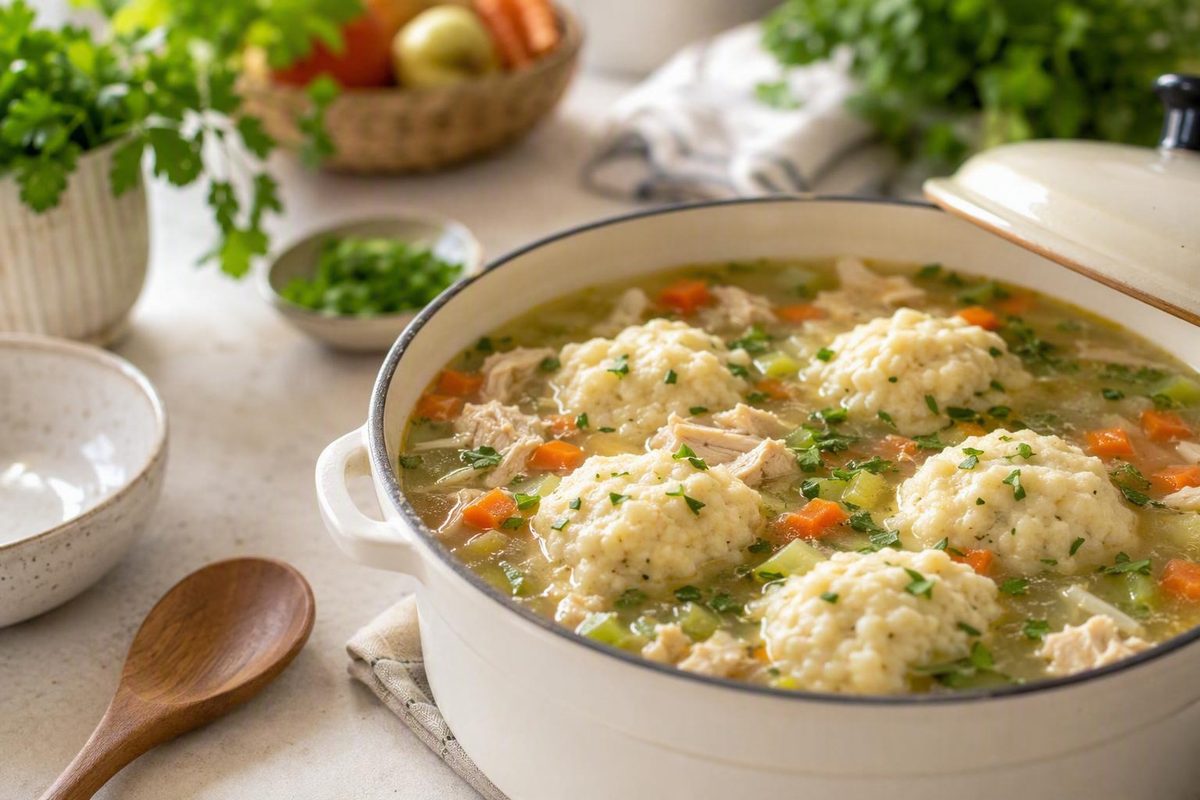
Keep the batter handling minimal, leave the lid closed, and confirm doneness by checking that the dumplings have expanded and their centers are fully cooked.
Overview
Drop dumplings are made by lightly mixing a thick, scoopable batter, spooning it onto hot soup or stew, covering the pot, and cooking at a gentle simmer. Keep the batter handling minimal, leave the lid closed, and confirm doneness by checking that the dumplings have expanded and their centers are fully cooked.
This guide covers American-style drop dumplings, meaning soft spoonfuls of batter cooked directly on a savory liquid. They are distinct from rolled dough or filled dumplings and require no shaping, wrapping, or separate pot.
The dependable pattern is simple: prepare the soup or stew first, mix the dumpling batter only until moistened, allow a brief rest, and add loose spoonfuls to the hot surface. Covering the pot matters because the lower portion cooks against the simmering liquid while the exposed portion cooks in the enclosed, steamy pot. The result should be tender and expanded rather than wet, gummy, or compact.
Ingredients and ratios for fluffy drop dumplings
A workable drop-dumpling batter needs flour for structure, baking powder for expansion, salt for seasoning, and enough liquid to produce a thick mixture that holds on a spoon. Some formulas also contain butter, egg, sugar, buttermilk, or herbs, but these are variations rather than requirements for every batch.
One documented eggless formula from Mom’s Dinner uses:
- all-purpose flour (quantity not established by the supplied evidence)
- baking powder (quantity not established by the supplied evidence)
- kosher salt (quantity not established by the supplied evidence)
- milk (quantity not established by the supplied evidence)
- melted butter (quantity not established by the supplied evidence)
Mixing these ingredients should produce a thick dough or batter that can be portioned with spoons or a scoop. If the mixture pours like pancake batter, it does not match the scoopable consistency specified by the recipes in the evidence set. If it remains dry and will not hold together, the dry ingredients have not been fully moistened.
Other supported formulas show that the dry proportions are not universal. One recipe uses 1 cup flour, 2 teaspoons baking powder, and ½ teaspoon salt, while an egg-enriched version uses 1 cup flour, 1½ teaspoons baking powder, ½ teaspoon salt, ½ teaspoon sugar, 1 egg, and ½ cup milk. These formulas should be followed as complete recipes rather than treated as interchangeable ingredient lists.
Baking powder is consequential, not incidental. Allrecipes identifies it as the leavening agent that releases gas and expands the dough, contributing to a light, fluffy texture. Measuring it according to the chosen formula is therefore more dependable than adding an arbitrary amount in an attempt to increase lift.
Consistency is the final execution cue. The batter should be moist throughout, thick enough to scoop, and soft enough to leave the spoon without being packed or shaped into a firm ball.
How to make drop dumplings
The method has four connected controls: light mixing, a short rest, gentle portioning, and covered cooking over restrained heat. A good ingredient ratio can still produce poor dumplings if the batter is heavily worked, the pot boils aggressively, or the lid is repeatedly lifted.
Prepare the soup or stew before mixing the dumplings. The savory base should be hot and have enough liquid to accommodate both the dumplings and the broth they will absorb. Once the batter is ready, the remaining steps should proceed without stirring the dumplings into the liquid.
Mix lightly and let the batter rest
Combine the dry ingredients evenly before adding the wet ingredients. Stir only until the flour is moistened and the batter comes together. A few lumps are acceptable. The goal is not a smooth, heavily beaten mixture.
This restraint has a direct texture consequence. The Easy Drop Dumplings recipe connects overmixing with dumplings that become tough rather than light and fluffy. The egg-enriched potato soup dumpling recipe gives the same practical instruction in narrower terms: mix only until moistened.
Stop as soon as no substantial pockets of dry flour remain. Do not continue stirring merely to remove every small lump, and do not knead or compress a drop-dumpling batter as if it were rolled dough.
Allow the mixed batter to rest briefly before portioning it. Allrecipes specifies a rest of 3 to 5 minutes, while another source directs the cook to let the batter rest for a few minutes. This is a short pause, not a long fermentation or proofing period.
Resting is one part of the documented process, but it should not be treated as a guarantee of fluffiness by itself. Appropriate leavening, minimal mixing, controlled heat, and sufficient cooking all remain necessary.
Drop, cover, and simmer without stirring
Bring the finished soup or stew to the hot stage specified by the chosen recipe before adding the batter. Some recipes say to use boiling liquid, while others begin at a gentle simmer. These instructions are less contradictory when the addition stage and the cooking stage are separated: the base must be thoroughly hot, but it should not continue at a forceful rolling boil after the dumplings enter.
Use two spoons or a scoop to release loose portions onto the surface. Do not pack the batter into hard balls. Leave available surface area because the dumplings will expand, although the evidence does not establish a universal spacing measurement.
Once all portions are in the pot, do not stir them through the soup. Lower the heat as needed, cover the pot, and maintain a slow boil or gentle simmer. Allrecipes instructs cooks to cover and simmer without lifting the lid for 15 minutes. The Mom’s Dinner method similarly uses medium-low heat and warns against stirring or allowing a rapid boil.
Keeping the pot covered supports the two-part cooking process. The broth cooks the lower surfaces, while the enclosed heat and moisture cook the portions above the liquid. Frequent lid lifting releases that enclosed heat and makes a stated cooking period less reliable.
The liquid should move gently rather than throwing the dumplings around. If the bubbling becomes vigorous, reduce the heat without stirring the newly added batter. The objective is steady covered cooking, not complete stillness and not an aggressive boil.
Cooking time and reliable doneness checks
Cooking time depends partly on portion size, so no single minute count applies safely to every drop dumpling. The supplied recipes include a covered 15-minute method and another recommendation of approximately 15 to 20 minutes. Larger spoonfuls require an adjusted cooking time, but the evidence does not provide standardized portion weights for constructing a dependable size-to-time chart.
Use the selected recipe’s time as the first checkpoint, then confirm the center directly. Do not remove a dumpling merely because it has floated. A cook’s report documented by Cooking Stack Exchange notes that dumplings can rise to the surface almost immediately, demonstrating why floating alone does not establish that the center is cooked.
Expansion is a more useful visual cue. The Spruce Eats describes finished dumplings as approximately doubled in size, followed by a clean toothpick test. The exterior may remain moist because it has cooked in direct contact with soup, so surface wetness should not automatically be interpreted as raw batter.
Insert a toothpick or fork into the center of one of the larger dumplings. It should come out without uncooked dough clinging to it. A second supported cue is the top: the potato soup dumpling recipe describes finished dumplings as puffed and able to bounce back when gently pressed.
The most dependable assessment therefore combines several observations. The dumplings have cooked for the formula’s stated period, visibly expanded, and developed a center that passes a clean fork or toothpick check. A springy top provides additional confirmation. If the center remains wet and pasty, replace the lid and continue gentle cooking rather than increasing the pot to a violent boil.
Why drop dumplings turn tough, gummy, dense, or fall apart
Failed drop dumplings usually point to batter handling, heat control, incomplete cooking, or the amount of liquid in the pot. The symptom matters because increasing either the mixing or the heat can make some problems worse.
A compact failure-mode check helps separate the likely causes:
- Tough or compact: The batter may have been overmixed. Stir the next batch only until the ingredients are combined and accept a few small lumps.
- Gummy in the center: The dumplings may need more covered cooking, or the exterior may have tightened during an overly strong boil. Continue at a gentle simmer and use a clean-center test rather than judging by flotation.
- Broken or ragged: Forceful bubbling may have tossed the portions around and damaged them. Reduce the pot to a slow boil or simmer after adding the batter, then leave the dumplings unstirred.
- Soup or stew becomes excessively thick: The dumplings absorb broth, and their flour can thicken the surrounding liquid slightly. Begin with enough broth to allow for that change.
Overmixing is the clearest supported explanation for toughness. Once the flour is moistened, additional beating is not useful for this style of dumpling. If a batch is dense but not clearly tough, the supplied evidence does not support assigning one universal cause. Check whether the formula contained the specified baking powder, whether the portions expanded, and whether the centers finished cooking before changing several variables at once.
Vigorous boiling can create a misleading combination of damage and undercooking. The Easy Drop Dumplings guide warns that a strong boil can break the outside, cause it to seize, and leave the interior gummy. More heat is therefore not necessarily the corrective action for a wet center. A longer period under the lid at controlled heat is better aligned with the documented methods.
The liquid level also needs attention before the batter enters. The Spruce Eats notes that dumplings soak up substantial broth and that flour slightly thickens the liquid. If the original stew is already very thick or has little free broth, the finished pot may become heavier than intended. Add a modest amount of additional cooking liquid before portioning the dumplings when the base appears too dry to accommodate them.
When diagnosing a batch, change the variable connected to the observed symptom. Less mixing addresses toughness, gentler bubbling addresses breakage, additional covered cooking addresses an uncooked center, and adequate broth addresses excessive thickening.
Choosing ingredients and variations
Drop dumplings do not have one universal formula. The evidence set documents eggless and egg-enriched versions, milk and water as options in one recipe, and buttermilk and herbs in other formulas. These examples establish that several approaches can work, but they do not establish that every ingredient can be exchanged in equal quantities without affecting consistency or cooking.
Choose one complete formula first. If changing its liquid, egg content, or dairy component, preserve the thick, scoopable consistency and rely on direct doneness checks. The supplied recipes do not provide a controlled comparison that isolates how each change affects texture, liquid requirements, or cooking time.
Eggless, egg-enriched, milk, water, and buttermilk formulas
Eggs are not required for all drop dumplings. The Spruce Eats documents a four-ingredient version based on flour, baking powder, salt, and milk, while also listing water as an allowed liquid choice. The Mom’s Dinner formula is likewise eggless but includes melted butter.
An egg-enriched version takes a different approach. The potato soup dumpling recipe combines 1 cup flour, 1½ teaspoons baking powder, ½ teaspoon salt, ½ teaspoon sugar, 1 egg, and ½ cup milk. Because the egg is part of a complete formula with its own liquid and leavening quantities, it should not be added to an eggless recipe without expecting the batter balance to change.
Buttermilk is another documented choice. Nicole’s Tasting Spoon describes buttermilk as contributing tang and acidity in an herb dumpling made with baking powder. That supports buttermilk as a formula option, but it does not prove a universal one-for-one replacement rule for every milk-based batter.
The practical distinction is between selecting a tested formula and improvising a substitution. An eggless recipe can still produce expanded, tender dumplings, so adding an egg is not a prerequisite for success. An egg-enriched or buttermilk formula offers a different ingredient structure and flavor profile, but the supplied evidence does not quantify an exact texture change or establish that it needs the same cooking time.
Water is explicitly permitted by one source as an alternative to milk. That does not establish that milk, water, and buttermilk produce identical flavor or texture. When using any documented choice, the batter still needs to be thick enough to scoop and the finished center must pass a direct doneness check.
Herb variations
Herbs can flavor the batter without changing the basic drop, cover, and simmer sequence. For a quantified option, Allrecipes directs cooks to add 1 tablespoon of parsley flakes to the dry ingredients.
Mixing the parsley with the flour, baking powder, and salt distributes it before the liquid enters. The batter can then be moistened, rested, and cooked using the same method specified by that recipe.
Herb-flavored buttermilk dumplings are also represented in the source set, particularly as a topping for creamy chicken stew. The evidence supports herbs as a general flavor variation, but it does not provide tested quantities for every possible herb. Parsley therefore has the clearest documented amount, while other herbs should be treated as formula-specific additions rather than interchangeable measurements.
What to serve with drop dumplings
Drop dumplings are best treated as a finishing component for a hot savory base rather than a separately boiled side. The batter cooks on the liquid and takes on some of its flavor while adding a soft, bread-like element to the bowl.
Chicken soup and chicken stew are directly represented in the documented recipes, including a creamy chicken stew topped with buttermilk herb dumplings. Beef stew is another established context, as is potato soup. The same method can accompany other sufficiently liquid soups, stews, or gravy-like preparations when the pot can maintain a covered gentle simmer.
The base should be essentially ready before the dumplings are added. Vegetables and meat that require extended cooking should not depend on the dumplings’ short covered period to finish. There should also be enough liquid for the portions to sit on the hot surface and absorb broth without leaving the pot excessively dry.
Match plain dumplings with strongly seasoned bases, or use the documented parsley or herb variation where a mild herbal note suits the soup. The dumplings should remain subordinate to the finished dish: select the formula, portion size, and number of dumplings according to the available cooking surface and broth.
Storing leftover drop dumplings
Cooked drop dumplings or dumpling soup can be refrigerated in an airtight container for two to three days, according to Allrecipes. The Spruce Eats gives a compatible limit of up to three days.
Storage changes texture. Dumplings left in soup or stew continue interacting with the liquid, and The Spruce Eats notes that they may increase in volume, soften, become soggy, or break apart over time. Refrigeration preserves leftovers for a limited period, but it does not preserve the exact texture of a freshly cooked batch.
Use an airtight container and refrigerate the leftovers promptly as a complete soup or as cooked dumplings separated from the liquid, depending on the original recipe and intended reheating method. The evidence supports the refrigeration period more clearly than it supports a universal approach to freezing.
The supplied sources conflict over whether cooked dumplings or uncooked batter is the preferable form to freeze. Without a controlled method resolving that disagreement, neither approach should be presented as dependable for every formula. For predictable texture, make only the quantity needed or rely on the supported two-to-three-day refrigeration window rather than assuming that raw and cooked drop dumplings freeze equivalently.