
How to Make, Track, Store, and Buy Chocolate-Dipped Grahams
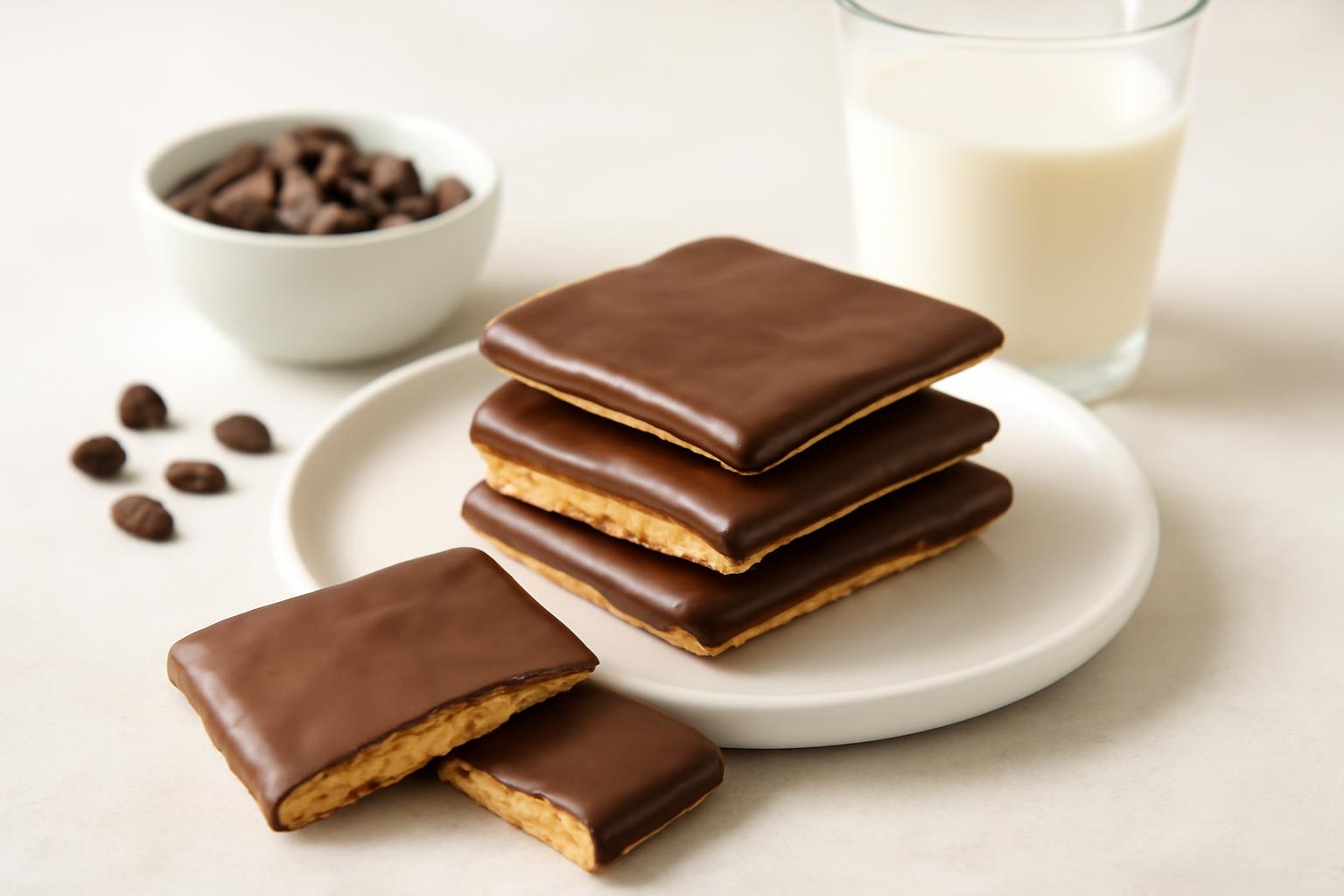
Dip and turn each cracker, tap off excess coating, decorate while wet, then let it set. Ready-made options include minis and wrapped portions.
Editorial note: Updated July 30, 2026. This guide synthesizes the cited recipe, nutrition, label, and merchant information; the recipe and products were not independently tested for this article.
The quick answer: method, timing, and calorie range
A chocolate-covered graham cracker is a graham cracker coated on both sides with melted chocolate or a formulated melting coating, then allowed to harden. The basic method is simple: melt the coating gradually, dip and turn each cracker, tap off the excess, place it on parchment or wax paper, decorate while the surface is wet, and let it set completely.
One practical starting batch uses 24 graham cracker squares and 15 ounces of chocolate melting wafers. That published recipe counts two crackers as a serving and yields 12 servings. Its schedule is 15 minutes of preparation plus 30 minutes of cooling, or 45 minutes total—not 15 minutes from start to finish. See the documented formula and timing from Practically Homemade.
For calorie tracking, a more transferable benchmark is about 135–142 calories per 27–28 grams, rather than a fixed number of crackers. One generic database entry lists 142 calories per 28 grams, with 19 grams of carbohydrate, 7 grams of fat, and 1 gram of protein. Review the generic 28-gram nutrition entry from ReciPal.
Piece count alone is unreliable. A “piece” might mean a miniature square, half of a rectangular graham sheet, a large square, or part of a filled sandwich. Different dimensions and coating thicknesses can produce substantially different serving weights.
Homemade totals also depend on how much coating remains on the crackers rather than in the bowl. A thick layer, minimal draining, fillings, and toppings all increase the finished weight. For more precise tracking, calculate the ingredients retained in the finished batch, weigh that batch, and allocate its nutrition by finished weight.
A scalable no-bake chocolate-covered graham cracker recipe
This recipe uses a documented starting formula rather than presenting one coating ratio as universally correct.
Base batch
- 24 graham cracker squares
- 15 ounces milk, dark, semisweet, or white melting wafers
- Optional toppings or contrasting drizzle
Yield: 24 coated squares, or 12 two-cracker servings. These quantities and the yield come from the same published recipe cited above. Review the complete base recipe.
Equipment
- Baking sheet or another flat tray
- Parchment or wax paper
- Microwave-safe bowl wide enough to hold one graham square
- One or two forks
- Spoon or piping bag for optional drizzle
- Kitchen scale for weight-based nutrition estimates
Method
-
Prepare the tray. Line it with parchment or wax paper before melting the coating. Once a cracker is dipped, it needs an immediate landing place—especially if toppings must be added before the surface begins to set.
-
Choose a wide bowl. Place the wafers in a microwave-safe bowl wide enough to accommodate a graham square. A shallow, wide bowl makes turning and lifting easier than a narrow cup.
-
Melt gradually. Microwave for 30 seconds, stir thoroughly, and repeat only as needed. As the coating approaches a smooth, fluid consistency, reduce further heating to roughly 15-second intervals. Stirring distributes residual heat through pieces that may still look solid.
-
Coat both sides. Lower one square into the coating. Use a fork or two forks to turn it until both faces and the edges are covered.
-
Remove the excess. Lift the cracker on a fork, let the coating drain, and tap the fork gently against the bowl. Returning surplus coating to the bowl produces a thinner layer and helps the batch go further.
-
Transfer and decorate. Place the coated cracker on the lined tray with space around it. Add sprinkles or other dry toppings immediately, while the exposed surface is still wet.
-
Let the coating set. One documented method refrigerates the tray for about 30 minutes. Another recipe using a different quantity and coating method reports a chilled setting period of approximately 5–10 minutes. Those are recipe-specific observations, not guarantees; coating formulation and layer thickness affect the actual time. Compare the alternate formula and shorter chilled set from The Monday Box.
-
Add a contrasting drizzle, if desired. Let the base layer harden first so the second coating remains visually distinct instead of merging into the wet base.
-
Wait before stacking or wrapping. Check that the coating is firm on top and underneath before transferring the crackers to storage or gift packaging.
How to scale the batch
Using the sourced 24-square-to-15-ounce starting ratio:
- Small batch: 12 graham squares and 7.5 ounces of wafers
- Base batch: 24 graham squares and 15 ounces of wafers
- Party batch: 48 graham squares and 30 ounces of wafers
These are proportional planning quantities, not promises that every ounce will be retained on the crackers. Buy extra if you want a heavy coating, are dipping filled sandwiches, have larger crackers, or expect significant coating to remain in the bowl.
Published formulas vary substantially. The Monday Box uses 24 ounces of melts for 24 squares, while Bake & Bacon lists 12–15 ounces for approximately 18 pieces. Tilting the bowl can gather the remaining coating without immediately opening another package.
Melting wafers, chocolate chips, and regular chocolate
There is no universal best coating. The practical choice depends on whether your priority is convenient handling, a particular chocolate flavor, a polished finish, or ingredients that meet specific dietary requirements.
| Coating | Practical advantages | Potential limitations | Best approach |
|---|---|---|---|
| Melting wafers or candy coating | Common in dipping recipes and intended to melt and set conveniently | Formulations and flavors vary | Follow the package directions and heat gradually |
| Chocolate chips | Widely available and used in some published recipes | Stabilizing ingredients may produce a thicker melt or softer set | Use short heating intervals and test one cracker |
| Chopped regular chocolate | Offers broad flavor and style choices | May require tempering for a firmer, glossier result and reduced bloom | Temper when appearance and room-temperature firmness matter |
| Milk, dark, semisweet, or white coating | All are represented in published recipes | Products can behave differently within the same broad category | Use brand-specific instructions |
Melting wafers and candy coating
Melting wafers are the convenient option represented most often in the recipes reviewed here. They are used for dipping and may be allowed to set at room temperature or with a short chill.
That does not mean every wafer has the same fat composition, melting behavior, or dietary status. Check the ingredient list and package directions rather than assuming all products contain cocoa butter, require the same microwave power, or satisfy the same allergen standards.
Chocolate chips
Chocolate chips can work, particularly when a highly polished appearance is not essential. CakeWhiz uses chips and provides both microwave and double-boiler methods. Its microwave directions begin with 30 seconds and continue in 15-second increments with stirring. See the chip-based recipe and melting methods.
The tradeoff is consistency. The Monday Box cautions that stabilizing ingredients can make chips melt more thickly and may produce a coating that does not firm as readily as a formulated dipping product. That is a qualified warning, not proof that chips cannot be used. Brands differ, so a test dip is more informative than assuming every bag will behave the same way.
Chopped regular chocolate
Chopped bars or other regular chocolate can be a flavor-led choice.
It is most relevant when a polished appearance, firmer room-temperature surface, or reduced visible bloom is important. If you use regular chocolate, follow the manufacturer’s tempering directions rather than applying a universal temperature schedule.
Two melting methods
Microwave: Use reduced power or short intervals, stirring after every round. As the coating becomes fluid, shorten the heating intervals. Stop before every visible piece has disappeared and let stirring distribute the remaining heat.
Double boiler: Put the coating in a separate heat-safe bowl or upper pan above hot water. Warm it indirectly and prevent water or steam from entering the coating.
Package directions take priority over generalized recipe advice. A product formulated for a particular power level, temperature range, or preparation method may respond poorly when handled like a different coating.
How to get a thinner, more even coating—and recognize the evidence limits
| Observed problem | Supported explanation or limitation | Practical next step |
|---|---|---|
| Coating becomes excessively hot or scorched | Extended high-power heating increases the risk of overheating | Use short intervals and stir after each one |
| Layer is excessively heavy | Too much coating remains on the cracker during transfer | Lift with a fork, allow it to drain, and tap surplus into the bowl |
| Melting wafers seem too thick | Limited recipe guidance permits small amounts of compatible fat or a designated thinning product for some coatings | Check the package first; if permitted, add a compatible thinning ingredient gradually |
| Toppings fall off | The exposed coating may have started to set before they were added | Apply toppings immediately after dipping |
| Contrasting drizzle merges into the base | The base layer is still fluid | Let the first layer harden before adding drizzle |
| White patches or bloom appear on regular chocolate | Handling or tempering can contribute to bloom, but not every pale streak has the same cause | Consult the chocolate manufacturer’s tempering and storage instructions |
| Coating remains soft, cracks, separates, or develops streaks | The available recipe evidence does not establish a certain diagnosis | Stop altering the batch and compare the method with the product directions |
| Chocolate appears seized | Appearance alone does not establish the cause from the available evidence | Do not assume a remedy; consult the manufacturer before adding ingredients |
For thick melting wafers, The Monday Box suggests approximately 1–2 teaspoons of coconut oil, melted shortening, or an appropriate thinning product such as paramount crystals. This is source-specific guidance, not a universal formula, and the coating package should take priority. Read the recipe’s qualified thinning and tempering guidance.
Some manufacturers may recommend a designated thinning product, while others may advise against additions entirely.
The supplied evidence does not support a comprehensive diagnosis for seizing, cracking, streaking, separation, or a soft set. Water exposure, heat, formulation, temperature changes, and added ingredients may be considerations, but appearance alone is insufficient to identify a cause with certainty.
Test one cracker before coating the full batch. If the product behaves differently from the recipe, pause and consult its package rather than repeatedly adding ingredients.
Toppings, fillings, and flavor variations
The easiest way to organize variations is by when they are added: fillings before coating, toppings while the coating is wet, and drizzle after the base sets.
Fillings: add before coating
Two graham squares can be assembled as a sandwich with a thin layer of:
- Peanut butter
- Marshmallow fluff
- Biscoff spread
- Hazelnut spread
- Caramel
- Frosting
These fillings are represented in published variation suggestions, including CakeWhiz’s list of peanut butter, Biscoff spread, marshmallow fluff, hazelnut spread, caramel, and frosting.
They also change serving weight, calories, sugar, and allergen exposure. A two-cracker sandwich should not be tracked as one unfilled square.
Toppings: add while the coating is wet
Options found across the sourced recipes include:
- Chopped nuts
- Shredded or flaked coconut
- Mini marshmallows
- Sea salt or flaky salt
- Sprinkles
- Crushed peppermint
- Cookie crumbs
- Dried fruit
- Candy pieces
- Crushed sandwich cookies
Prepare toppings before melting the coating. Once dipping starts, the surface may remain tacky for only a short period. Add toppings immediately after each cracker is transferred to the lined tray.
Drizzle: add after the base sets
A contrasting drizzle creates visible separation between layers. Possible combinations include white coating over dark or semisweet, dark over white, or milk over a colored candy coating.
Let the base become firm first. Then apply narrow lines with a spoon, piping bag, or small food-suitable plastic bag with one corner trimmed. Give the drizzle its own setting time before stacking or wrapping.
Three themed combinations
- Dark coating with sea salt: Dip the graham, tap off the excess, and add a small amount of salt while the surface is wet.
- Milk coating with peanut butter filling: Sandwich two squares with peanut butter and coat the assembled sandwich.
- White coating with crushed peppermint: Dip the cracker and immediately scatter finely crushed peppermint over the surface.
For a shortcut s’more, combine a prepared chocolate-covered graham with marshmallow immediately before serving.
Nuts, peanut butter, cookie pieces, candy, and drizzle can introduce milk, wheat, soy, peanuts, tree nuts, sesame, or egg beyond those in the base ingredients. Keep the original packages available when serving anyone who needs to review ingredient or allergen statements.
Storage, refrigeration, freezing, and gift packaging
Store fully set crackers in an airtight container. Place parchment or wax paper between layers to reduce sticking, scuffing, and transfer of toppings.
These recommendations concern storage quality and handling, not a validated food-safety period.
Room-temperature storage
Published estimates conflict. Practically Homemade recommends up to one week, Bake & Bacon suggests approximately one to two weeks, and The Monday Box states up to three weeks. None of the supplied recipe pages reports controlled shelf-life testing.
A conservative approach is to make the crackers relatively close to when they will be served. Follow the storage directions for the specific coating and every filling used. A filled version should be handled according to the requirements of its most perishable ingredient.
Refrigeration
Refrigeration can speed the initial set and may help in a warm room. It is not automatically necessary for an unfilled batch made with a coating designed to harden at room temperature.
To reduce abrupt exposure to humid air, keep the airtight container closed while the crackers warm gradually. This is cautious quality-preserving handling, not a guarantee against condensation or loss of crispness. Review the recipe’s storage, freezing, and condensation guidance.
Freezing
Published instructions do not agree. CakeWhiz discourages freezing because the coating may crack while thawing, while other recipe sources suggest freezer storage but acknowledge possible quality changes. Review the caution against freezing from CakeWhiz.
Freezing therefore should not be presented as a validated way to preserve texture for a fixed period. If you decide to try it, use airtight, crush-resistant packaging and thaw the crackers gradually while they remain wrapped. That is cautious general handling, not a promise that the coating will stay uncracked or the graham will remain crisp.
Gift wrapping
For gifts or favors:
- Let the base coating and any drizzle harden completely.
- Wrap each cracker in a food-suitable bag or wrapper.
- Place individually wrapped pieces in a rigid box, tin, or divided container.
- Add cushioning or dividers so the pieces cannot slide into one another.
- Keep the package away from heat and direct sunlight.
The documented base recipe lists 15 minutes of preparation and 30 minutes of cooling, so packaging should be scheduled after the full 45-minute recipe period—and later if the coating has not completely hardened. A second drizzle layer and individual wrapping add more project time.
Commercial shelf-life claims do not transfer to homemade batches. Nuts.com claims up to six months at room temperature for its own packaged milk-chocolate grahams, but that merchant statement applies only to that product and does not establish a homemade shelf life.
Calories and macros: compare by grams, not by pieces
Generic entries put chocolate-covered graham crackers at approximately 135–142 calories per 27–28 grams. The narrow range does not mean every product has the same composition; it is a weight-normalized reference for generic commercial-style food.
| Generic serving | Calories | Carbohydrate | Fat | Sugar | Fiber | Protein |
|---|---|---|---|---|---|---|
| 27 g | 135 | 18 g | 7 g | 10 g | 1 g | 1 g |
| 28 g | 142 | 19 g | 7 g | 11 g | 1 g | 1 g |
The 27-gram entry defines the serving as three pieces and attributes most calories to carbohydrate and fat, with relatively little protein or fiber. See NutriFox’s generic 27-gram nutrition record.
Do not apply that three-piece serving to an unrelated package. Three miniature pieces and three large dipped squares may have very different weights.
A separate generic listing gives 68 calories for one cracker only when it is defined as a 2.5-inch square weighing 0.5 ounce. It also lists 9.3 grams of carbohydrate, 3.2 grams of fat, and 0.8 gram of protein. Review the size-specific CalorieKing entry.
Branded values
Brand-specific servings can differ from the generic reference:
| Product | Labeled serving | Calories |
|---|---|---|
| Kroger milk-chocolate-covered grahams | 40 g | 190 |
| Nuts.com milk-chocolate grahams | 28 g | 140 |
The Kroger record lists 27 grams of carbohydrate, 9 grams of fat, 19 grams of sugar, 0 grams of fiber, and 2 grams of protein per 40 grams. Added sugar, potassium, and several other fields are missing rather than reported as zero. See the Kroger 40-gram nutrition record.
Nuts.com lists 140 calories, 19 grams of carbohydrate, 7 grams of fat, 15 grams of sugar, 1 gram of fiber, and 1 gram of protein per 28 grams. Those values apply to that named product, not to every milk-chocolate graham.
Do not compare products by piece count unless the pieces have the same dimensions and weight. A label for miniature squares is not directly comparable with one for large, heavily coated crackers.
How to estimate a homemade serving
For the most defensible estimate:
- Record the labeled nutrition for the total amount of crackers, coating, fillings, and toppings placed into the recipe.
- Measure and subtract any meaningful leftovers that were not retained in the finished batch, such as coating left in the bowl.
- Add the adjusted nutrition totals for all retained ingredients.
- Let the coating set, then weigh the finished batch.
- Divide the batch nutrition by the finished weight.
- Multiply the per-gram figure by the weight of the portion eaten.
For example, if a completed batch weighs 900 grams, divide its total calories by 900 to obtain calories per gram. Multiply that figure by 35 for a 35-gram serving.
Equal-piece allocation is simpler but less precise. It works best when every cracker starts at the same size and receives a similar amount of coating. Broken corners, thick drips, filled sandwiches, and uneven toppings weaken that assumption.
Automated recipe nutrition calculations are estimates rather than laboratory measurements. Missing nutrient fields must not be interpreted as zero. These figures can support comparison and tracking, but they do not establish whether the food is appropriate for a medical condition.
Ingredients, allergens, and gluten-free adaptation
Wheat, milk, and soy recur in several packaged examples, but they are not a universal ingredient rule. The relevant information is the current label for the exact product being eaten or used in a recipe.
Nuts.com declares milk, soy, and wheat for its milk-chocolate grahams and states that the product may contain peanuts, tree nuts, sesame, and egg. Its ingredient list includes milk chocolate and wheat-based graham crackers. Check the product’s ingredient and allergen statement.
Abdallah also declares milk, soy, and wheat and states that its product is made on shared equipment with peanuts, other tree nuts, and egg. Review Abdallah’s product-specific label information.
Wilbur lists milk, soy, and wheat and says its product may also contain egg, peanuts, and tree nuts. See Wilbur’s ingredient and allergen disclosures.
These examples show why allergen statements cannot be transferred between manufacturers. “May contain” and shared-equipment wording differ even among superficially similar milk-chocolate products.
Making a gluten-free batch
A gluten-free adaptation requires both:
- Graham-style crackers carrying suitable gluten-free labeling
- A coating carrying suitable gluten-free labeling
Checking only the crackers is insufficient. Fillings, sprinkles, cookie crumbs, candy pieces, and other toppings must be assessed separately.
Using labeled gluten-free ingredients does not eliminate possible cross-contact in a shared kitchen or? Review bowls, utensils, trays, storage containers, open topping packages, and work surfaces previously exposed to wheat. People with celiac disease or wheat allergy should use the label and cross-contact standards recommended by their clinician or registered dietitian.
A particular formulation may contain milk-derived ingredients or carry shared-equipment warnings.
Likewise, a merchant’s “kosher certified” category filter does not prove that every displayed item has product-level certification. Check the exact package or certification record.
Online descriptions can become outdated when ingredients, facilities, nutrition panels, or allergen statements change. The package in hand should take precedence.
This article provides general information, not individualized medical or dietary advice. Readers with food allergies, celiac disease, or other health conditions should consult an appropriate clinician or registered dietitian. See the CaloriePages Terms of Use for the publication’s general-information notice.
Buying ready-made crackers: formats, listed prices, and heat-sensitive shipping
Ready-made chocolate-covered graham crackers are sold as full-size pieces, miniature squares, individually wrapped portions, and bulk packages. Mini and bulk formats may be practical for event service, while individually wrapped pieces may simplify favors or portioned distribution. These are format-based uses, not product endorsements.
Prices, stock states, promotions, package details, and shipping terms can change; verify them before ordering.
| Merchant | Chocolate type | Format | Package weight or count | Listed price and status | Allergen information supplied |
|---|---|---|---|---|---|
| Asher’s | Milk or dark | Coffee bags; individually wrapped caddies | Not supplied in the category listing | Coffee bags $9.95; caddies $25.95 | Not supplied in the category listing |
| Albanese | Milk | Mini squares; bulk | 1 lb or 15 lb; approximately 80 pieces per pound | $10.99 for 1 lb; $148.35 for 15 lb | Not supplied on the captured product page |
| Nuts.com | Milk | Coated grahams in a container | 12 oz | $13.99; marked out of stock | Milk, soy, wheat; may contain peanuts, tree nuts, sesame, egg |
| Abdallah | Milk | Individually wrapped two-graham packages | 12 packages per box | $45.48 | Milk, soy, wheat; shared-equipment statement for peanuts, other tree nuts, egg |
| Wilbur | Milk | Cello bag | 8 oz | $11; marked in stock | Milk, soy, wheat; may contain egg, peanuts, tree nuts |
Asher’s category page does not provide enough package-weight information for a price-per-ounce comparison. Albanese supplies a weight and estimated piece count, but miniature pieces still should not be compared directly with full-size coated grahams.
Abdallah’s listing describes a 12-count box in which each individually wrapped package contains two grahams. Wilbur identifies an eight-ounce milk-chocolate bag. Their allergen and product pages are linked in the preceding section, keeping the source attached to both the label and shopping facts without adding duplicate merchant links here.
These products cannot be ranked responsibly by taste, quality, healthfulness, or value from the supplied information. Package weights are missing for some listings, mini and full-size formats differ, coating thickness is unknown, and shipping charges may materially change the delivered cost.
Warm-weather shipping
Chocolate is heat-sensitive, and merchant policies may delay an order even when expedited delivery is selected. The Fudge Shoppe states that excessive heat can trigger shipping postponements or adjustments and that expedited service does not override weather holds. It advertises ice and insulation for qualifying summer orders. Review the merchant’s warm-weather notice.
Before ordering, check the destination forecast, dispatch schedule, expected delivery day, availability of prompt receipt, and the merchant’s current remedy—if any—for heat damage.
Frequently asked questions
Can I use chocolate chips instead of melting wafers?
Yes. Some published recipes use chocolate chips, but stabilizing ingredients may produce a thicker melt or a coating that does not set as firmly as formulated melting wafers.
Use short microwave intervals, stir thoroughly, and test one cracker before coating the whole batch. A double boiler is another option. If the coating is too thick, follow the chip manufacturer’s directions rather than automatically adding oil.
How many calories are in one chocolate-covered graham cracker?
There is no standardized per-piece answer. One generic listing gives 68 calories only for a specifically defined 2.5-inch-square cracker weighing 0.5 ounce, as cited in the calorie section above. Miniature pieces, larger squares, thick coatings, fillings, and toppings can produce very different totals.
For packaged crackers, use the label’s gram-based serving. For homemade crackers, calculate the retained batch ingredients and divide by finished weight. Piece-based allocation is reasonable only when the pieces are similar in size and coating thickness.
Can chocolate-covered graham crackers be frozen?
They can physically be placed in a freezer, but published quality guidance conflicts. Some recipe authors discourage freezing because the coating may crack during thawing, while others provide freezer-storage suggestions and acknowledge possible condensation.
If you try it, use airtight, crush-resistant packaging and thaw the crackers gradually while still wrapped. Do not assume freezing will preserve crispness or surface appearance for a guaranteed period.
Can chocolate-covered graham crackers be made gluten-free?
Yes, but both the graham crackers and the coating need suitable gluten-free labeling. Fillings, sprinkles, cookie crumbs, candy pieces, and other toppings require separate review.
People with celiac disease or wheat allergy should use the verification standard recommended by their clinician or registered dietitian.
Can I order chocolate-covered graham crackers in warm weather?
Possibly, but shipping may be delayed or held during excessive heat. Some merchants use ice and insulation for qualifying orders, and expedited shipping may remain subject to weather holds.
Check the merchant’s current policy before paying, arrange prompt receipt, and do not treat cold packs, insulation, or faster transit as a guarantee against melting.
The two most useful measurements are the same whether you make or buy chocolate-covered graham crackers: use a documented recipe as a starting point but adjust for how the coating actually flows and sets, and compare finished servings by grams rather than assuming every piece is equivalent.
Store homemade batches conservatively, distinguish quality observations from food-safety conclusions, and check current labels for ingredients and allergens. Treat merchant prices, inventory, promotions, and shipping terms as temporary.
The simplest successful process remains gradual melting, thorough stirring, removal of excess coating, immediate topping, and complete setting before storage or wrapping.