
A practical 40 g fiber builder—without treating 40 as a universal target
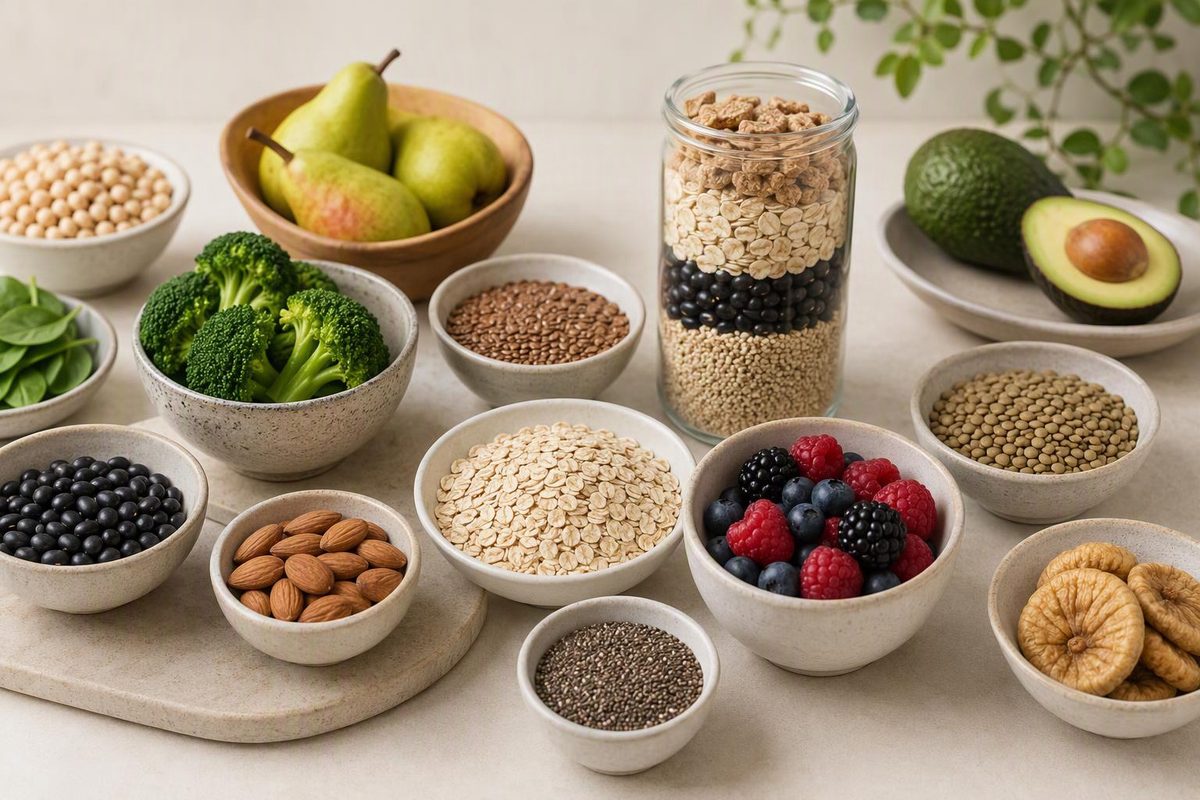
Build a roughly 40 g fiber day from measured portions, read labels correctly, and increase intake gradually to limit digestive discomfort.
“Fibermaxxing” is the social-media term for deliberately increasing fiber intake. The useful version is not “eat as much as possible.” It is: measure your current intake, add fiber-rich foods across the day, and stop at a level that fits your needs and digestion.
Forty grams is a convenient builder target, not a universal recommendation. The FDA’s Daily Value for dietary fiber is 28 g, so 40 g equals about 143% of the DV. The DV is a label reference rather than an individualized prescription; NIDDK gives a broader adult range of 22–34 g per day, depending on age and sex (FDA; NIDDK).
The current Dietary Guidelines for Americans, 2025–2030 emphasizes fiber-rich whole grains, vegetables and fruits, and includes beans, peas, lentils, nuts and seeds among its plant protein foods. It does not tell everyone to chase 40 g (Dietary Guidelines).
Tap foods to add one serving each and watch the fiber bar fill toward 40 grams.
Build A 40 g Fiber Day
Tap foods to add one serving each. The bar fills toward 40 g, the low end of the 40 to 50 g that fibermaxxing posts often aim for; the adequate intake for adults 50 and younger is 25 g for women and 38 g for men, and the average American gets about 16 g.
Nothing picked yet. Beans and seeds get you there fastest; fruit and grains fill the gaps.
Fiber Per 100 g And Per Serving
| Food | Fiber per 100 g | Serving | Fiber per serving |
|---|---|---|---|
| Chia seeds | 34.4 g | 1 oz (28 g) | 9.8 g |
| Flaxseed, ground | 27.3 g | 2 tbsp (14 g) | 3.8 g |
| Popcorn, air-popped | 14.5 g | 3 cups (24 g) | 3.5 g |
| Almonds | 12.5 g | 1 oz (28 g) | 3.5 g |
| Pistachios | 10.6 g | 1 oz (28 g) | 3.0 g |
| Oats, dry | 10.1 g | 1/2 cup (41 g) | 4.1 g |
| Dried figs | 9.8 g | 3 figs (25 g) | 2.5 g |
| Black beans, cooked | 8.7 g | 1 cup (172 g) | 15.0 g |
| Split peas, cooked | 8.3 g | 1 cup (196 g) | 16.3 g |
| Lentils, cooked | 7.9 g | 1 cup (198 g) | 15.6 g |
| Chickpeas, cooked | 7.6 g | 1 cup (164 g) | 12.5 g |
| Red kidney beans, cooked | 7.4 g | 1 cup (177 g) | 13.1 g |
| Prunes | 7.1 g | 5 prunes (48 g) | 3.4 g |
| Avocado | 6.7 g | 1 cup cubed (150 g) | 10.1 g |
| Raspberries | 6.5 g | 1 cup (123 g) | 8.0 g |
| Whole wheat bread | 6.0 g | 2 slices (64 g) | 3.8 g |
| Artichoke, cooked | 5.7 g | 1 medium (120 g) | 6.8 g |
| Green peas, cooked | 5.5 g | 1 cup (160 g) | 8.8 g |
| Blackberries | 5.3 g | 1 cup (144 g) | 7.6 g |
| Edamame, shelled | 5.2 g | 1 cup (155 g) | 8.1 g |
| Kale, raw | 4.1 g | 1 cup (21 g) | 0.9 g |
| Barley, pearled, cooked | 3.8 g | 1 cup (157 g) | 6.0 g |
| Sweet potato, baked | 3.3 g | 1 medium (114 g) | 3.8 g |
| Pear, with skin | 3.1 g | 1 medium (178 g) | 5.5 g |
| Quinoa, cooked | 2.8 g | 1 cup (185 g) | 5.2 g |
| Broccoli, raw | 2.6 g | 1 cup chopped (91 g) | 2.4 g |
| Banana | 2.6 g | 1 medium (118 g) | 3.1 g |
| Apple, with skin | 2.4 g | 1 medium (182 g) | 4.4 g |
| Brown rice, cooked | 1.6 g | 1 cup (202 g) | 3.2 g |
Sources And Caveats
Fiber values: USDA FoodData Central SR Legacy (April 2018 release), total dietary fiber per 100 g; each food name links to its FDC entry. Per-serving grams are computed from the household-measure gram weights listed with each entry and rounded to one decimal. Reference intakes: National Academies adequate intake (38 g men, 25 g women, ages 50 and younger) and Dietary Guidelines for Americans 2020-2025, Appendix 1 (14 g per 1,000 kcal). Average intake: 16.2 g a day in NHANES 2009-2010, per Closing America's Fiber Intake Gap. Trend context: Camille Styles on the fibermaxxing trend.
Jumping from about 16 g to 40 g in a day can cause bloating and gas; guidance is to add fiber gradually and drink water with meals.
The 40 g fiber builder
Use these as building blocks rather than a rigid menu. The amounts below come from the federal Food Sources of Fiber list, published in August 2024 from USDA FoodData Central 2019 data. They are estimates for the stated portions—not recommended serving sizes—and packaged products can differ (USDA fiber table). The builder above uses individual USDA FoodData Central entries instead, so a few figures differ: 3 cups of air-popped popcorn, for example, provide 3.5 g there.
| Building block | Measured portion | Fiber |
|---|---|---|
| Raspberries | 1 cup | 8.0 g |
| Cooked lentils | 1/2 cup | 7.8 g |
| Cooked black beans | 1/2 cup | 7.5 g |
| Popcorn | 3 cups | 5.8 g |
| Pear | 1 medium | 5.5 g |
| Cooked broccoli | 1 cup | 5.2 g |
| Chia seeds | 1 tablespoon | 4.1 g |
| Baked potato with skin | 1 medium | 3.9 g |
| Orange | 1 medium | 3.7 g |
| Almonds | 1 ounce | 3.5 g |
| Banana | 1 medium | 3.2 g |
| Whole-wheat crackers | 1 ounce | 2.9 g |
A simple building pattern is:
- Two 7–8 g anchors: about 15–16 g
- Three 5–6 g foods: about 15–17 g
- Two 3–4 g additions: about 6–8 g
That produces roughly 36–41 g. Use the Nutrition Facts label where one is available; the listed fiber applies to the label’s stated serving, not necessarily the amount in your bowl.
One sample day: 41 g
This example shows the arithmetic, not a required meal plan.
| Meal | Fiber components | Running total |
|---|---|---|
| Breakfast | 1 cup raspberries (8.0 g) + 1 tbsp chia seeds (4.1 g) | 12.1 g |
| Lunch | 1/2 cup cooked lentils (7.8 g) + 1 cup cooked broccoli (5.2 g) | 25.1 g |
| Snack | 1 medium pear (5.5 g) | 30.6 g |
| Dinner | 1/2 cup cooked black beans (7.5 g) | 38.1 g |
| Extra | 1 oz whole-wheat crackers (2.9 g) | 41.0 g |
The same total can come from different foods. For example, 3 cups of popcorn can replace a pear with only a 0.3 g change. A medium baked potato with skin can replace the tablespoon of chia with a 0.2 g change. These swaps make the target easier to fit around preferred meals, cost and culture.
Build up instead of jumping straight to 40
If your present intake is 15 g, moving directly to 40 g adds 25 g at once. A sudden increase can cause gas and bloating and, when fluid intake is inadequate, may contribute to constipation. Increasing fiber slowly and drinking more water can reduce those problems (UCLA Health).
NIDDK’s specific advice for people with IBS is to add fiber by about 2–3 g per day to help limit gas and bloating. It also advises drinking plenty of water and other liquids when increasing fiber or using a fiber supplement (NIDDK on IBS; NIDDK on constipation).
Using that incremental approach, a starting intake of 20 g might move to 22–23 g, then 25–26 g, with further increases only if tolerated. It need not reach exactly 40.
Track the number correctly
- Log portions, not food names alone. Half a cup of cooked lentils is 7.8 g in the federal table; approximately one cup would provide twice that amount.
- Use the package label for packaged food. Fiber content can differ among cereals, breads, tortillas and snack products.
- Do not double-count ingredients. If an app entry already represents the full bowl or recipe, do not add its beans and grains again.
- Compare cooked with cooked. Water changes food weight and volume, so dry and cooked measures are not interchangeable.
- Treat database values as estimates. Variety, preparation and the actual portion can move the total. A day calculated at 39 or 41 g is functionally close to the builder target; false precision adds no value.
People with IBS, Crohn’s disease, ulcerative colitis or another condition affected by fiber may need a different amount or type. UCLA Health advises care when increasing fiber with these conditions. In that situation—or if an increase causes persistent symptoms—seek individualized guidance rather than forcing the total to 40 g.