
The Calorie Math Behind Green Raisins: Servings, Labels, and What Trackers Need to Know
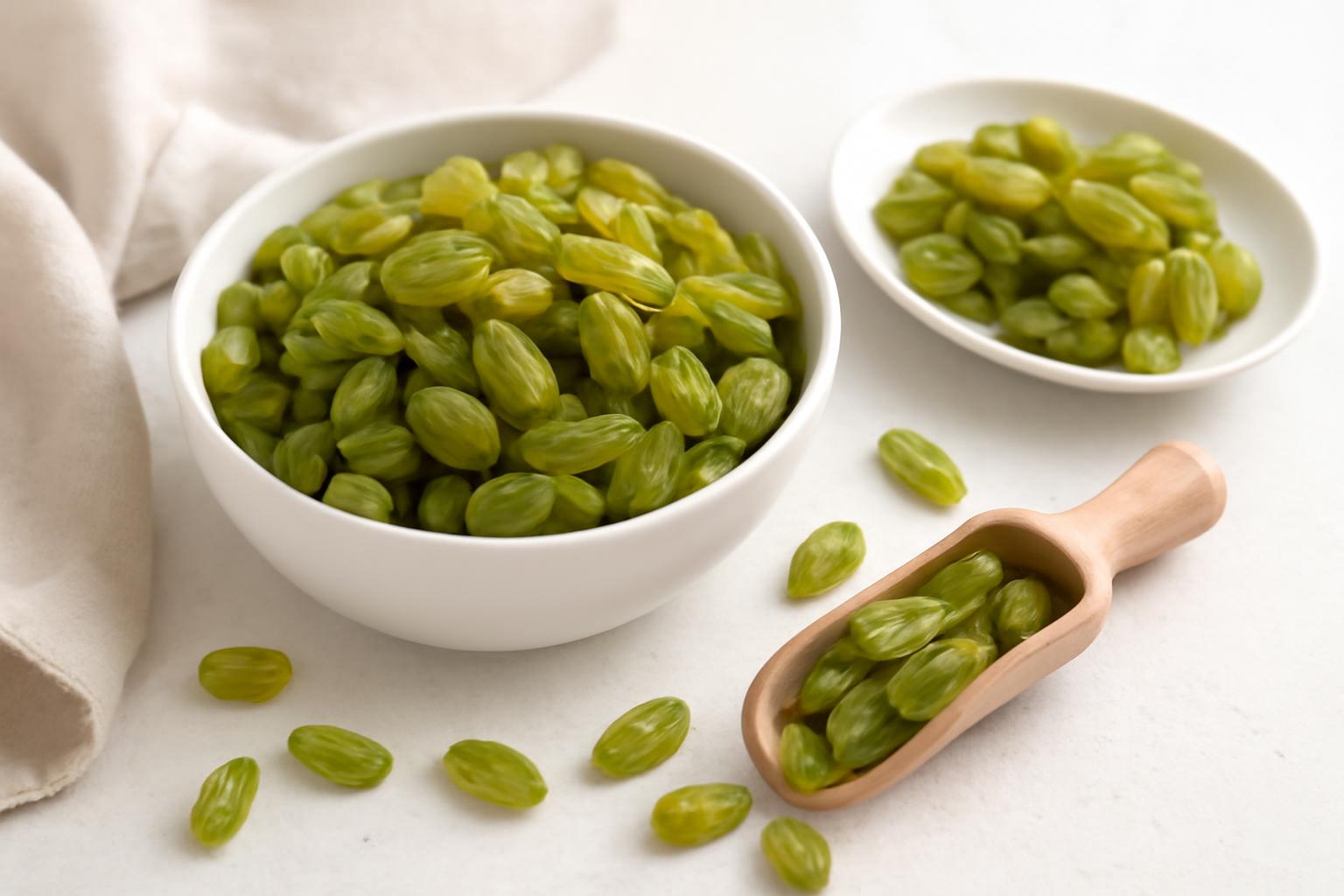
A realistic 40 g serving is about 120-140 calories across current label examples. Compare by gram weight, then check ingredients and sulfite warnings.
Green raisins are easy to underestimate.
They look different from the standard dark box-raisins many people grew up with, so they often get treated like a special dried fruit instead of what they are nutritionally: concentrated grapes. For calorie and macro tracking, that distinction matters. Dried fruit is small, portable, sweet, and easy to overpour, which means the logging error usually comes from portion size more than from any dramatic nutritional mystery.
The practical questions are the useful ones: what green raisins actually are, what a realistic serving provides, why labels vary, and how to log them without turning a small snack into a vague app entry.
This piece stays focused on calories, labels, and tracking rather than broader raisin health claims, storage, or pet safety.
If you want the wider context for how this site handles calorie math, start with the CaloriePages home, browse the articles archive, and note that everything here is general information under the Terms of Use. The site’s reader-data practices are explained in the Privacy Policy.
How Food Labels Calculate Calories (And Where the Number Can Be Wrong): Food labels use the Atwater system, not direct measurement. Here’s how the 4-4-9 factors work, why they allow a 20% margin of error, and what that means for tracking.
What Are Green Raisins?
Green raisins are dried grapes that keep a lighter green-to-amber appearance instead of turning the darker brown or purple-black most shoppers associate with standard raisins. That retail category overlaps with “golden raisins” and “sultanas” more than many labels make obvious. WebMD’s raisin guide says sultanas in the U.S. are usually made from Thompson Seedless grapes, which are green grapes, and are processed differently from darker natural raisins (WebMD raisin guide).
That overlap is why the naming can feel fuzzy in stores. One product may be sold as green raisins, another as golden raisins, and another as sultanas, even when the tracker-level takeaway is basically the same: you are still logging dried grapes. The product name may tell you something about color, grape type, or processing, but it does not automatically signal a major calorie difference.
Processing is part of the color story. General raisin references describe dark natural raisins as sun-dried, while lighter products are often associated with sulfur-dioxide treatment or other color-preserving methods. Aiva’s green-raisin listing, for example, gives the ingredient line as raisin plus sulfur dioxide, which is exactly the kind of detail that matters more to label readers than the marketing name on the front of the bag (Aiva Raisin Green).
They show up in the same places as other raisins: snacking, baking, trail mix, cereals, yogurt bowls, salads, rice dishes, and dessert toppings. If you track calories closely, the clean mental model is simple: dried grapes first, color variation second.
That framing helps because it keeps the focus on what actually changes your log. The color name on the front matters much less than the gram weight on the back.
Nutrition Facts for Green Raisins Per 100g and 40g Serving
For tracking, the easiest way to compare green raisins is by weight. Cup measures are convenient for recipes, but they are weak for precision because dried fruit can settle, clump, compress, or vary in moisture.
Here is a label-based snapshot from three retail entries:
| Listing | Serving | Calories | Carbs | Sugars | Fiber | Protein | Fat |
|---|---|---|---|---|---|---|---|
| Tootsi organic green raisins | 40 g | 120 | 32 g | 24 g | 1 g | 1 g | 0 g |
| Whole Foods Market green raisins | 1/4 cup (1.4 oz) | 140 | 33 g | 29 g | 2 g | 1 g | 0 g |
| Top Op green raisins | 10 g | 34 | 8 g | 6 g | 0 g | 0 g* | 0 g |
*At a 10 g serving, small amounts are likely rounded down.
Label sources used above:
- Tootsi organic green raisins via ReciPal
- Whole Foods Market green raisins via CalorieKing
- Top Op green raisins via MyNetDiary
Once you normalize those labels by weight, the pattern is clear. The examples above work out to roughly 300 to 350 calories per 100 g, with carbohydrates dominating the panel and fat staying at 0 g. That is the range most trackers should expect when they compare plain green-raisin products side by side.
A realistic 40 g serving lands at about 120 to 140 calories from those same label examples. In macro terms, that usually means around 30 to 33 g of carbohydrate, roughly 24 to 29 g of sugar, about 1 g of protein, 0 g of fat, and around 1 to 2 g of fiber. In other words, green raisins are overwhelmingly a carbohydrate food.
That matters because people often log dried fruit as if it were nutritionally “fruit-like” in the same way fresh grapes are. But the drying step concentrates the energy. A 40 g portion does not look especially large, yet it can deliver the calories of a more substantial-seeming snack.
The labels above also show why brand-specific logging sometimes beats generic database entries. The calorie spread is not huge, but it is real. One label prints 120 calories for 40 g; another prints 140 calories for what is effectively the same weight class. That is not enough to make one bag diet food and another bag junk food. It is enough to make app matching worth a quick check if you track closely.
Micronutrients are present, but the practical lesson is variability, not magic. The brand examples above differ on listed fiber, iron, and calcium, which is another reason to treat a package panel as more useful than a vague “raisins, generic” entry when accuracy matters.
For quick logging, the best comparison unit is still 100 g. It lets you see past different serving definitions and compare labels on the same scale. If two products are both dried green grapes and both sit around the low-300s calories per 100 g, you are dealing with normal label variation, not a fundamentally different food.
How Green Raisin Calories Are Calculated: The Atwater System
Packaged-food calories are not built from your exact handful. That same page notes that calorie labels can be off by about 20% in practice, which is why packaged-food numbers are useful estimates rather than precise measurements.
Green raisins are a good example of why that matters. They are mostly carbohydrate, with almost no fat and little protein.
That is why back-of-pack math does not always look perfectly neat when you multiply the printed grams yourself. The grams are rounded. The calories are rounded. The result is that your calculation from the printed macro line may come out a bit different from the printed calorie line, even on a perfectly normal product.
If two products look like the same loose quarter-cup in a bowl, the drier one may weigh less or more densely pack calories into the same visual volume. A tracker sees that as a label discrepancy; a food labeler sees it as normal product variation.
The same logic applies to the sugar line. High sugar does not automatically mean added sugar. With plain raisins, the sugar is concentrated from the grapes themselves during drying. That is why a raisin panel can look sugar-heavy while still fitting an unsweetened ingredient list.
This is also where people overcorrect. Label variation does not mean labels are useless. It means they are approximate tools.
A good rule is to separate two questions:
- What does the package say per gram or per serving?
- How accurately did I portion what I actually ate?
For dried fruit, the second question is often the bigger one. A mislabeled app entry might cost you a small amount of precision. An eyeballed handful can miss by much more.
Serving Size Examples and Calorie Estimates
Once you think in grams, green raisins become easy to estimate.
Using the label examples in the nutrition section, a practical shortcut is to treat green raisins as roughly 3.0 to 3.5 calories per gram. That is not a chemistry-law number. It is a useful tracking range drawn from current label examples that cluster around 300 to 350 calories per 100 g.
That gives you a fast mental cheat sheet:
- 10 g: about 30 to 35 calories
- 15 g: about 45 to 53 calories
- 20 g: about 60 to 70 calories
- 30 g: about 90 to 105 calories
- 40 g: about 120 to 140 calories
- 50 g: about 150 to 175 calories
- 100 g: about 300 to 350 calories
That simple range is good enough for most day-to-day logging. If you are trying to split hairs between 124 and 129 calories, the scale matters more than the formula. But for quick decisions in the kitchen, the per-gram shortcut is very workable.
The smallest clear label example in the evidence pack is 10 g. Top Op lists 34 calories for that amount, which fits the shortcut almost perfectly (Top Op green raisins via MyNetDiary).
The main portion trap is visual volume. Raisins are compact, and green raisins are often sold in formats that make them feel a little more specialty-like than a standard red mini box. That can nudge people into using casual serving language like “just a few,” “a small sprinkle,” or “a light handful.” In practice, those descriptions are rarely precise enough for good logging.
A quarter cup is a decent starting point only when the package also gives the weight. In the label examples above, that quarter-cup neighborhood is around 40 g, which is why it keeps showing up near 120 to 140 calories. But quarter cups are recipe units, not precision units. A loosely filled quarter cup and a packed quarter cup are not the same entry.
If you want better estimates without turning snack tracking into laboratory work, use this order of preference:
- Best: weigh the portion in grams.
- Good: use the package serving if it gives both volume and weight.
- Acceptable: estimate from a previously weighed portion you know well.
- Weak: log “a handful” from a generic app database.
That matters even more in mixed dishes. Green raisins disappear into oatmeal, trail mix, cereal, yogurt, couscous, and baked goods, where the eye tends to undercount small add-ins. In those cases, the error often comes from the pour, not from the food database.
Verywell Fit lists 42 calories for 14 g of dark seedless raisins and says golden raisins are similar in carbs, calories, and fiber, which puts them in the same general neighborhood when weights are matched (Verywell Fit raisin nutrition guide).
The practical takeaway is not that all raisins are identical. It is that your logging accuracy improves far more from weighing the portion than from arguing over color categories.
Brand Variations in Green Raisins Nutrition and Ingredients
On the simpler end, Rani’s product page lists the ingredient as just raisin and describes the product as vegan, kosher, non-GMO, and a product of India. The same page also carries a California Prop 65 warning, which is a legal disclosure attached to that listing rather than a sign that the food has a special calorie profile (Rani Green Raisins product page).
Other listings lean harder into processing disclosures. Some explicitly call out sulphites or cross-contact statements. Deep’s product page says its green raisins contain sulphites and may contain peanuts and tree nuts, which is exactly the kind of package-level information that can matter more to a buyer than a tiny label difference in fiber or iron (Deep Green Raisins product page).
For trackers, this produces a useful hierarchy of questions:
- What is the serving size in grams?
- What are the ingredients?
- Are sulfites or sulphites declared?
- Is there a may-contain or shared-facility note?
- Does the listing show a full nutrition panel or just marketing copy?
That order keeps you focused on things that change your real-world decision. The serving size affects your calorie log. The ingredient line affects what you are actually buying. The sulfite and allergen declarations affect whether the product is even suitable for you.
What usually does not deserve much attention for calorie tracking is front-of-pack halo language. A bag of dried grapes is still a bag of dried grapes.
This is also the section where many shoppers get pulled into false precision. One seller may sound more artisanal; another may look more industrial. But if both panels land in the same low-300s calories per 100 g and both products are mostly raisins, the tracking question has probably already been answered.
Use brand differences where they help:
- to choose the cleanest ingredient list you want,
- to avoid additives you do not want,
- to screen for sulfites or cross-contact,
- and to match your actual label when you log.
Do not use them to imagine a big metabolic divide that the panels do not support.
Label Reading Tips for Green Raisins Accuracy
If your goal is accurate calorie tracking, the most important green-raisin label details are boring.
Start with grams, not cups. A cup measure is useful for recipes, but a gram weight is what lets you compare one brand with another and one serving with another. If the front says “1/4 cup,” flip to the part of the panel that tells you what that actually weighs.
Next, read the ingredient list before you read the marketing language. Some products are just raisins. Others include sulfur dioxide or separately declare sulphites. That distinction tells you more than a front label that says “green,” “premium,” or “natural.”
Then read the sugar line correctly. Dried fruit is concentrated fruit. A high sugar number is normal for raisins because the water has been reduced while the grape sugars remain. High total sugar is not the same thing as added sugar.
After that, check the disclosures that matter to you personally: allergens, sulphites, shared-facility language, and any legal notices attached to the listing. Those details may have no effect on calories, but they can absolutely affect whether the product belongs in your cart.
If the package or product page is missing nutrition data, use a temporary weight-based estimate instead of inventing certainty. Based on the current label examples in this article, 300 to 350 calories per 100 g is a defensible working range for plain green raisins until you can verify the actual package.
A simple missing-label checklist looks like this:
- Confirm the product is actually raisins and not a sweetened mix.
- Check whether sulfur dioxide or sulphites are listed.
- Weigh your portion in grams.
- Use the working range above until you get the full panel.
- Update your log once you have the real package data.
The last label-reading point is psychological. Food labels encourage a false sense of exactness because the numbers look tidy. But a tidy label and a tidy app do not remove the fact that real food varies and people portion imperfectly. Tracking gets better when you accept that and build habits around it: weigh dense foods, match labels when you can, and judge the system over time rather than over one snack.
Tracking Green Raisins in Your TDEE and Macros
Green raisins fit into a macro plan very cleanly once you stop treating them like an uncounted fruit garnish.
From a calorie standpoint, they are dense enough that small measuring errors matter. From a macro standpoint, they are mostly carbohydrate, with little protein and essentially no fat.
The thermic effect is modest for carbs. The site’s explainer on what TDEE measures and how calculators break down puts carbohydrate TEF at about 5% to 10% of intake, notes that common TDEE equations can miss reality by about ±10% on average, and says NEAT can differ by as much as 2,000 kcal per day between similar-looking people.
That matters because some trackers mentally discount sugary foods as if digestion will erase a big chunk of them. That is not how this food behaves. They can absolutely fit your intake, but they are not secretly self-canceling.
That is the same broader principle discussed in our piece on protein and calorie density. The raisins do not become lower-calorie, but the whole snack may become easier to live with if it includes something more filling.
In practice, that might mean:
- raisins in Greek yogurt instead of alone,
- raisins in oatmeal with measured protein on the side,
- raisins with cottage cheese,
- or raisins added intentionally to a meal rather than grazed from the bag.
The other TDEE lesson is perspective. Even careful logging has noise. A 10- or 20-calorie mismatch on a small raisin serving exists, but it sits inside a much bigger real-world system that includes activity swings, scale-water fluctuations, weekend eating drift, and normal label uncertainty.
That is why green raisins should be handled the same way you would handle any dense add-on food:
- Weigh the portion.
- Use a close label match.
- Keep logging consistent for two to four weeks.
- Compare intake against your weight trend.
- Adjust your working maintenance number only if the trend says you should.
That process matters more than chasing the perfect raisin database entry. If your long-run calibration is honest, green raisins become just another line item in a functioning system.
They are not uniquely hard to fit into a cut, bulk, or maintenance phase. They only become troublesome when they are treated as visually small and therefore nutritionally trivial.
If you track carefully, green raisins can fit just fine. Just log them like dried fruit, not like fresh grapes.
How many calories are in 40g of green raisins?
A practical tracking answer is about 120 to 140 calories.
One label example lists 120 calories per 40 g for organic green raisins (Tootsi organic green raisins via ReciPal).
Another lists 140 calories per 1/4 cup (1.4 oz) for Whole Foods Market green raisins, which is why a range is usually more useful than a single exact number (Whole Foods Market green raisins via CalorieKing).
Are green raisins high in sugar, and is it added or natural?
Yes. Dried grapes are naturally sugar-dense because the drying process concentrates the nutrients and sugars already present in grapes (WebMD raisin guide).
That does not automatically mean sugar was added. For plain raisin products, the high sugar line is generally describing concentrated grape sugar rather than added sweetener.
Do green raisins labels always list sulfur dioxide?
No. Some products list only raisins.
Rani’s product page lists the ingredient simply as raisin (Rani Green Raisins product page).
Aiva’s listing, by contrast, lists raisin, sulfur dioxide (Aiva Raisin Green).
How do green raisins calories compare to dark raisins?
Verywell Fit lists 42 calories for 14 g of dark seedless raisins and says golden raisins are similar in carbs, calories, and fiber, which puts green-raisin products in the same general calorie neighborhood when weights are matched (Verywell Fit raisin nutrition guide).
What allergens might be in green raisins products?
The raisins themselves may be the only ingredient, but packaged products can still carry sulphite or cross-contact warnings.
Deep’s product page says its green raisins contain sulphites and may contain peanuts and tree nuts (Deep Green Raisins product page).
So if sulphites, peanuts, tree nuts, or shared-facility exposure matter to you, check the exact package rather than assuming all green-raisin labels are the same.