
What the Vodka and Ginger Beer in Your Mule Add Up To
The short answer: about 150–220 calories in a typical Moscow Mule
For a full-size Moscow Mule, about 150–220 calories is a reasonable planning range. It is not a universal nutrition value: the actual total depends on the vodka pour, the ginger beer’s sugar content, the amount of mixer, and any added sweetener (Celebrator’s Moscow Mule calorie estimate).
If you need one practical number for calorie tracking, roughly 190 calories is a useful midpoint—not an official standard. It reflects two documented but different recipes:
- One drink made with 2 ounces vodka, 1/2 ounce lime juice, and 4 ounces ginger beer is reported as 195 calories (Blossom to Stem’s Moscow Mule recipe).
- A 376-gram serving made with 40 milliliters vodka, 200 milliliters ginger beer, lemon juice, ice, mint, and lime is listed as 190 calories (Fitia’s Moscow Mule entry).
Those examples happen to land close together, but they do not establish a standard calorie count. The recipes differ in spirit volume, mixer volume, citrus ingredients, and total serving weight.
Quick answer
- Documented lighter recipes: about 98–134 calories. These use diet, low-calorie, or sugar-free ginger mixers and measured spirit pours.
- Standard recipe examples: about 190–195 calories. These are useful reference points for a conventional full drink, not universal values.
- Possible upper estimate: as much as 250 calories. One publisher reports a 98-calorie lighter recipe and says some traditional servings can reach 250 calories; “up to” makes that an upper estimate rather than a default (Farm to Jar’s comparison).
The most important rule when comparing published figures is simple: do not compare calorie totals unless the serving size, alcohol pour, and mixer quantity are also shown. A small database serving and a full cocktail containing two ounces of vodka plus several ounces of ginger beer are not equivalent drinks.
For an unknown restaurant Mule, use the broad planning range rather than inventing a precise total. For a homemade drink, calculate the ingredients individually. A measured recipe will almost always provide a more defensible estimate than the cocktail’s name alone.
What is in a Moscow Mule?
A classic Moscow Mule contains:
- Vodka
- Ginger beer
- Fresh lime juice
- Ice
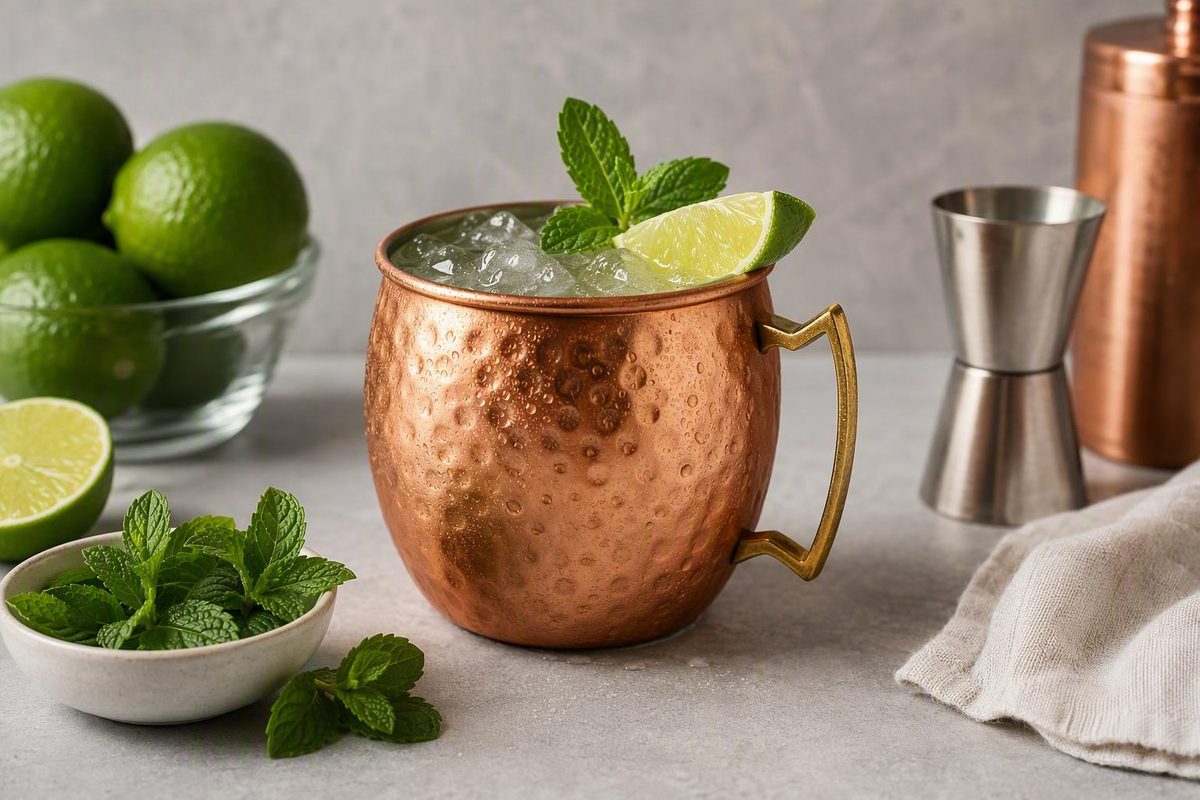
It is commonly served in a copper mug, but the mug is presentation rather than a calorie variable. Calories come from the ingredients poured into the vessel, not the vessel itself.
Even simple three-ingredient recipes vary. One common structure uses 2 ounces vodka, 1/2 ounce fresh lime juice, and 4 ounces ginger beer for one drink (Cookie and Kate’s classic recipe).
Another recognizable version uses 2 ounces vodka, 6 ounces ginger beer, and 1/4 ounce lime juice over ice (Moscow Copper Co.’s recipe).
Both are Moscow Mules, but the second contains two more ounces of ginger beer and less lime juice. If the mixer is sweetened, that difference can materially affect the calorie total. This is why the phrase “one Moscow Mule” does not identify a fixed serving size or recipe.
For calorie calculations, separate the ingredients into two groups.
Ingredients that may contribute calories
- Vodka
- Regular sweetened ginger beer
- Fresh lime juice
- Simple syrup or ginger syrup
- Fruit juice or puree
- Sweetened lime cordial
- Flavored vodka
- Liqueur
- Other caloric mixers or sweeteners
Presentation and dilution
- Ice
- The copper mug or glass
- Headspace in the vessel
- A modest herb garnish
A citrus wedge or mint garnish is unlikely to explain a large difference between published totals. The more important questions are how much vodka was poured, which ginger beer was used, how much mixer entered the drink, and whether the recipe included another sweetener.
Variations add further uncertainty. A bartender might use concentrated ginger syrup, add fruit puree, or supplement the vodka with a liqueur. The result may still be sold as a Moscow Mule, but it no longer has the same calorie profile as a basic vodka–ginger beer–lime recipe.
The mug can also distort perceptions of serving size. A large vessel packed with ice may contain less liquid than expected, while a compact glass with little ice may contain a substantial pour. For tracking purposes, measure or estimate the liquid ingredients—not the apparent capacity of the mug.
Where the calories come from
Most of a Moscow Mule’s calories come from vodka and sweetened ginger beer. Lime juice generally contributes comparatively little, while optional syrups, fruit ingredients, flavored alcohol, and liqueurs can raise the total.
Vodka establishes the alcohol-related base
Vodka contributes calories before any mixer is added. A drink made with a two-ounce pour therefore starts higher than an otherwise identical drink made with one and a half ounces.
The difference can be easy to overlook because both pours appear small when combined with ice and mixer. Increasing the vodka by half an ounce may not change the drink’s apparent size very much, but it still increases the calorie total.
Spirit proof can also affect the estimate. When possible, use dependable calorie information for the vodka and proof actually poured rather than assuming that every product supplies an identical value.
This is also why changing the mixer cannot make an alcoholic Mule calorie-free. A diet or zero-sugar mixer may reduce the mixer contribution, but the vodka remains.
Ginger beer is the most variable component
Regular ginger beer contributes calories through its sugar content, but both the sugar level and poured volume can differ among products and recipes. One recipe may use four ounces; another may use six ounces or more. Two brands also need not have the same label values at an equal volume.
That makes ginger beer one of the easiest places for a generic estimate to go wrong—and one of the easiest variables to verify at home. Read the label, measure the actual pour, and scale the labeled calories to the amount used.
More mixer does not automatically mean a lower-calorie cocktail. Adding regular sweetened ginger beer may add both sugar and calories. Adding more diet or zero-sugar mixer may contribute few or no declared calories, depending on the product label.
The word “ginger” does not identify a nutritional profile. These mixers can produce substantially different totals:
- Regular ginger beer
- Light ginger beer
- Zero-sugar ginger beer
- Diet ginger ale
- Ginger syrup combined with sparkling water
- Fresh ginger combined with a diet mixer
They may provide a similar ginger-and-lime flavor direction, but they are not nutritionally interchangeable.
Lime juice is a smaller contributor
Fresh lime juice contributes relatively few calories compared with vodka and a regular sweetened mixer. Its contribution still depends on the quantity, so it belongs in a detailed calculation. In practice, however, changing the vodka pour or ginger beer usually matters more than a small difference in fresh lime juice.
Fresh juice should not be confused with sweetened lime cordial, lime syrup, or a prepared sweet-and-sour product. Those ingredients may contain added sweetener and should be counted according to their labels or recipe quantities.
Extras can push the drink beyond the typical range
A basic Mule does not require added syrup, but some recipes use simple syrup or concentrated ginger syrup. Flavored versions may contain fruit juice, puree, sweetened fruit preparations, flavored vodka, or liqueur.
Each addition should be counted separately. A cocktail containing a larger spirit pour, plenty of regular ginger beer, and syrup may reach the upper end of the typical range or exceed it.
To diagnose an unexpectedly high total, ask:
- Was the vodka pour larger than expected?
- How much regular ginger beer was used?
- Was syrup, cordial, or sweetened fruit added?
- Was another alcoholic ingredient included?
If any answer is unknown, treat the result as an estimate rather than a precise nutrition value.
Moscow Mule calorie examples compared by recipe and serving size
Published Moscow Mule figures range from below 100 calories to an upper estimate of 250 calories. The differences become easier to understand once each serving and recipe is shown.
| Reported calories | Serving size | Vodka quantity | Ginger beer or mixer quantity | Mixer type | Interpretation and source |
|---|---|---|---|---|---|
| 195 | 1 drink | 2 oz | 4 oz | Ginger beer | Conventional recipe with 1/2 oz lime juice; publisher-reported nutrition (source) |
| 190 | 376 g | 40 ml | 200 ml | Ginger beer | Database serving containing lemon juice, ice, mint, and lime; weight includes ice and is not directly comparable with fluid-ounce servings (source) |
| 94.4 | 4 fl oz / 120 g | Not disclosed | Not disclosed | Not disclosed | Small database serving with no underlying recipe, brand assumptions, or calculation method shown (source) |
| 98 | 1 serving | 1.5 oz | 6 oz | Diet ginger ale | Lighter recipe containing fresh ginger and lime instead of regular ginger beer (source) |
| Approximately 134 | 7 oz | 2 oz per serving if divided evenly | 4 oz per serving, plus sugar-free ginger syrup | Diet ginger ale and sugar-free syrup | Approximate publisher-reported value for a two-serving sugar-free mixture (source) |
| 102 | 1 serving | 1.5 oz | 6–8 oz | Low-calorie ginger beer | Lighter recipe; the total can vary with the mixer brand and amount used (source) |
These are recipe-specific reported figures, not laboratory-verified equivalents. They should not be compared without considering spirit quantity, mixer type, mixer volume, additions, and total serving size.
The lowest database figure requires the strongest qualification. It applies to only four fluid ounces, and the cited page does not disclose the underlying recipe. It should not be logged as a typical full cocktail unless the amount consumed was actually close to that serving and reasonably matched the database item.
The lighter examples are also different drinks rather than replications of one standard formula. One uses diet ginger ale and fresh ginger, another combines diet ginger ale with sugar-free ginger syrup, and another uses low-calorie ginger beer. Their serving sizes and mixer volumes differ.
Serving size is therefore essential. A lower total can reflect a genuinely lighter formula, a smaller drink, or both. Calories per fluid ounce can help compare portions, but that measure does not replace the total: a larger drink can still contain more calories even when its calorie density is similar.
The word “skinny” does not resolve the comparison. It is an informal recipe description, not a standardized nutrition threshold. A publisher might use it for a smaller serving, a diet mixer, a reduced alcohol pour, or a homemade syrup. Exact ingredients and quantities are better evidence than the name.
How to calculate the calories in your own Moscow Mule
The most useful practical estimate for a homemade Moscow Mule is an ingredient-by-ingredient calculation:
Calories assigned to the measured vodka pour + calories from the actual amount of ginger beer poured + calories from lime juice and every addition = estimated calories in the drink
The arithmetic is straightforward, but accurate measurement matters.
1. Measure the vodka
Record the amount in fluid ounces or milliliters. Do not enter “one shot” unless you know the capacity of the shot glass. A one-and-a-half-ounce pour and a two-ounce pour are not interchangeable.
Use calorie information appropriate to the vodka and proof actually used when available. If reliable product information is unavailable, use a reasonable estimate and round the final result rather than implying unsupported precision.
2. Measure and scale the ginger beer
Read both the calories and serving volume on the mixer label. Then measure how much mixer goes into the cocktail.
If the amount poured differs from the labeled serving, calculate:
Mixer calories in drink = (actual mixer volume ÷ labeled serving volume) × labeled calories
For example, do not count an entire bottle if only part of it entered the mug. Conversely, do not count one labeled serving if the cocktail contains more than that serving.
Use this blank template with the values from your ingredients:
Measured vodka: ___ calories Ginger beer: ___ oz or ml poured ÷ ___ oz or ml per labeled serving × ___ label calories = ___ calories Lime juice: ___ calories Syrup, fruit, flavored alcohol, or liqueur: ___ calories Estimated drink total: ___ calories
This method is usually more useful than choosing a generic Moscow Mule entry in an app because it reflects the actual ingredients and quantities in your drink.
3. Count every caloric addition
Include any:
- Fresh lime juice
- Simple syrup
- Ginger syrup
- Fruit juice or puree
- Sweetened cordial
- Liqueur
- Flavored vodka
- Other caloric mixer
A garnish does not need disproportionate attention, but ingredients mixed into the cocktail do. If a flavored Mule contains sweetened fruit puree, count the puree rather than treating it as decorative fruit.
Do not calculate from mug capacity
Measure the ingredients, not the finished vessel. An ice-filled mug does not contain its full capacity in cocktail ingredients. Ice displacement, dilution, foam, and headspace make vessel size a poor proxy for the actual pour.
A more reliable process is:
- Measure the vodka.
- Measure the lime juice.
- Measure any syrup or additions.
- Add ice.
- Measure the ginger beer as it is poured.
This records the inputs directly instead of trying to reconstruct them from the final drink.
Calculate a pitcher before dividing it
For a batch, add the calories from every ingredient and divide by the actual number of evenly portioned drinks:
Calories per drink = total batch calories ÷ number of equal servings
Only use this method when the batch is thoroughly mixed and divided evenly. If one glass receives more of the alcoholic base or syrup, equal division will not describe the actual portions.
For consistent logging, record:
- Vodka product and proof, when relevant
- Exact vodka quantity
- Ginger-beer brand
- Exact mixer quantity
- Lime quantity
- Syrups, fruit, or liqueurs
- Number of servings produced by a batch
Save the combination as a personal recipe if you make it regularly. The result remains an estimate when the proof, label information, pour, or portioning is uncertain, but consistent measurement is still more informative than selecting a different generic database entry each time.
How to estimate a Moscow Mule from a bar or restaurant
A bar-made Moscow Mule is harder to calculate because you see the finished drink rather than the quantities used to make it.
If practical, ask:
- How large is the vodka pour?
- Which ginger beer is used?
- Approximately how much ginger beer goes into the drink?
- Is simple syrup, ginger syrup, fruit puree, or another sweetener added?
These questions are more useful than asking only for a calorie total. Unless the restaurant has calculated nutrition for that exact recipe, the bartender may not have a dependable number. Ingredient and pour information lets you build a more transparent estimate.
If no details are available, use 150–220 calories as a planning range for a typical full cocktail rather than entering a falsely precise value (Celebrator’s estimate). The conventional full-recipe examples cited earlier suggest using the middle of that range when the drink appears to contain a standard vodka pour, regular ginger beer, lime, and no additional sweetener.
Do not use the small database value simply because it is the lowest search result. That entry corresponds to a four-fluid-ounce serving, which may be much smaller than a bar cocktail containing vodka and several ounces of mixer.
If you prefer to avoid undercounting, move toward the upper end of the planning range when the drink contains:
- A visibly or reportedly larger vodka pour
- A substantial amount of regular ginger beer
- Added simple syrup or ginger syrup
- Sweetened fruit ingredients
- Liqueur or another alcoholic addition
That is a cautious tracking choice, not a measured result.
Also distinguish the liquid poured from the apparent size of an ice-filled copper mug. A wide mug may be mostly ice, while a compact glass with little ice may contain a substantial amount of liquid. Neither appearance reveals the alcohol pour or sugar content.
Menu phrases such as “house ginger syrup,” “ginger cordial,” “passion fruit,” “liqueur,” or a named flavored vodka indicate that a basic vodka-plus-ginger-beer estimate may omit ingredients. If the drink is a regular order, ask once about the recipe and save a consistent estimate.
How to make or order a lower-calorie Moscow Mule
The two clearest ways to lower the total while retaining the ginger-lime profile are:
- Use a measured 1.5-ounce vodka pour instead of a larger pour.
- Replace regular ginger beer with a light, diet, or zero-sugar ginger mixer.
A straightforward lighter build is:
- 1.5 ounces vodka
- Fresh lime juice
- A light, diet, or zero-sugar ginger mixer
- Ice
- No added syrup
Check the exact mixer label. “Light,” “diet,” “low calorie,” and “zero sugar” do not mean that every product has identical nutrition. Brand, serving size, and the amount poured still matter.
The lighter recipes in the comparison table demonstrate that there is no single reduced-calorie formula. They use different mixers, serving sizes, and supporting ingredients. One relies on fresh ginger and diet ginger ale, another uses low-calorie ginger beer, and another combines a diet mixer with sugar-free ginger syrup.
A zero-sugar mixer does not make the cocktail calorie-free. It may remove or substantially reduce the mixer contribution, but the vodka remains part of the total. Lime juice and any other additions also need to be counted.
When ordering, try:
“Could I have a Moscow Mule with a measured 1.5-ounce vodka pour, zero-sugar ginger beer, fresh lime, and no added syrup?”
Not every bar carries zero-sugar ginger beer. Diet ginger ale can provide a ginger-citrus drink, although the flavor may differ from a ginger-beer-forward Mule. If only regular ginger beer is available, requesting a measured amount will at least make the result easier to estimate.
For homemade drinks, fresh ginger can increase ginger intensity without requiring more sweetened mixer. Sparkling water can add volume, though it will change the flavor and concentration of the finished drink.
Omit or deliberately count:
- Simple syrup
- Sweetened ginger syrup
- Fruit puree
- Sweetened juice
- Liqueur
- Additional flavored alcohol
Finally, be cautious with the word “skinny.” It has no standardized calorie meaning. The term may refer to a diet mixer, smaller serving, reduced spirit pour, homemade syrup, or simply the publisher’s chosen name. Ingredients, quantities, and serving size provide more useful information.
Frequently asked questions
Is a Moscow Mule high in calories?
That depends on the recipe, serving size, and what you are comparing it with. A full Mule made with regular ginger beer and a substantial vodka pour will generally contain more calories than a smaller version using a measured pour and low-calorie mixer.
Rather than treating every Mule as “high” or “low,” compare drinks with similar serving sizes and alcohol quantities. A low listed total for a much smaller portion is not necessarily a lighter equivalent.
Why does one database list only 94.4 calories for a Moscow Mule?
The entry is for 4 fluid ounces, or 120 grams, and the page does not disclose the underlying recipe, spirit pour, mixer quantity, brands, or calculation method (Carb Manager’s Moscow Mule entry).
Use it only when the consumed portion was close to four fluid ounces and reasonably matched the database item. Otherwise, calculate the ingredients or use the broader full-cocktail estimate.
How many calories are in a Moscow Mule made with zero-sugar ginger beer?
There is no universal total. The answer still depends on the vodka quantity, the mixer’s label, the amount poured, the lime juice, and any other additions.
Add the calories assigned to the measured vodka pour, the mixer’s declared calories for the amount used, and the calories from lime and extras. Even if the mixer declares zero calories, the alcoholic cocktail itself is not calorie-free.
Does lime juice add many calories to a Moscow Mule?
Fresh lime juice generally contributes relatively few calories compared with vodka and regular sweetened ginger beer. It should still be included in a detailed ingredient calculation, particularly when more than a small squeeze is used.
Confirm that the ingredient is fresh juice. Sweetened lime cordial, lime syrup, and prepared sweet-and-sour products are not nutritionally equivalent.
Can I calculate a Moscow Mule from the ginger-beer label?
The label lets you calculate the mixer portion, but not the entire cocktail. Scale the label value to the amount poured:
Actual mixer volume ÷ labeled serving volume × labeled calories
Then add the calories assigned to the measured vodka, lime juice, and any syrup, puree, flavored alcohol, or liqueur. If the vodka pour, proof, or mixer quantity is uncertain, report a rounded estimate or range rather than an exact-looking total.
In short, about 150–220 calories is the most useful general estimate for a full Moscow Mule, and documented conventional recipes may land near 190–195 calories. For a better estimate, measure the vodka, scale the ginger-beer label to the amount poured, and count every syrup or other caloric addition.
This article is for general informational purposes only and does not provide medical or dietary advice.