
From Powder and Water to a Loaded Smoothie: Calculate Your Shake
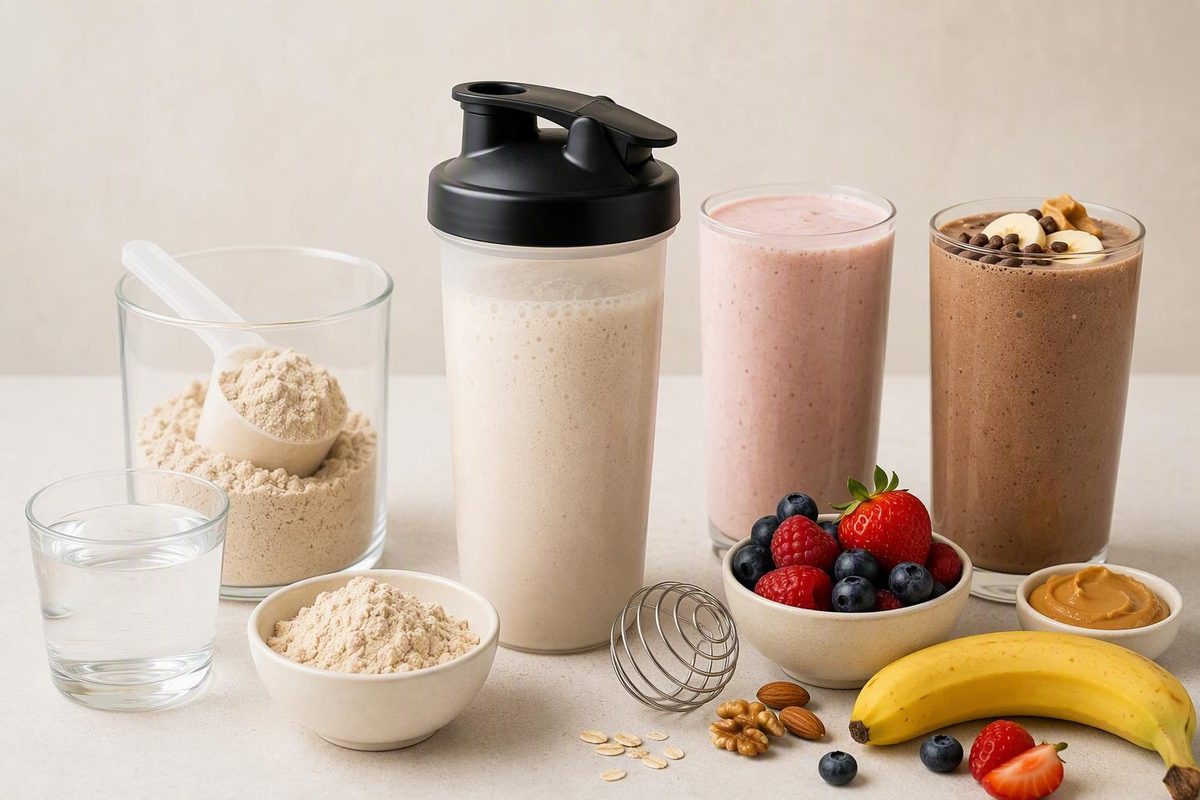
From powder and water to a loaded smoothie, here is how to calculate your shake.
The short answer: it depends on what is in the shake
There is no single calorie count for a protein shake. As a limited reference point, selected commercial listings place a one-serving protein powder mixed with water at approximately 100–140 calories. That is not a market-wide average: the powder’s formula, flavor, serving weight, and amount used can all change the result (see the source-specific powder figures).
Milk-based examples are higher because milk contributes calories of its own. One listed recipe made with 30 grams of whey powder and one cup of 2% milk totals 242 calories. A separate commercial estimate puts one scoop mixed with whole milk at approximately 270 calories. These examples use different products and assumptions, so they do not establish a universal range for milk-based shakes.
Ingredient-heavy smoothies can climb much further. Five medically reviewed weight-gain recipes in the evidence reviewed for this article range from 385 to 895 calories, using combinations of yogurt, fruit, nut butter, oats, avocado, honey, juice, seeds, and protein powder. Those totals apply to the specified recipes and their stated serving treatment—not to a basic scoop of powder mixed with water.
Quick calorie reference
Shake type Source-specific starting point What to verify Selected one-serving powders with water About 100–140 calories Powder label, serving grams, flavor, amount used Cited milk-based examples 242–270 calories Powder, milk type, milk volume, recipe yield Bottled shake Use the calories per bottle or labeled serving Bottle size and servings per container Ingredient-heavy smoothie 385 calories or more in the cited recipes Every ingredient, quantity, batch yield, and portion The 242-calorie example comes from the specified whey-and-2%-milk recipe; the 270-calorie example comes from a commercial water-and-milk comparison.
The 385–895-calorie reference applies to the specified ingredient-heavy weight-gain recipes.
The key distinction is between calories in the powder and calories in the completed drink. When powder is mixed only with water and no other energy-contributing ingredients are added, the finished drink generally has the powder’s labeled calories. Milk, juice, yogurt, fruit, nut butter, oats, honey, and similar additions must be counted separately.
Your exact total depends on:
- the powder’s formulation and flavor;
- its labeled serving weight;
- the number of scoops or grams used;
- the liquid type and measured volume;
- every add-in and topping;
- the serving declaration on a ready-to-drink bottle; and
- the number and size of portions produced by a blender recipe.
The dependable method is straightforward: add the verified calories from every measured ingredient, then divide by the number of portions actually consumed.
What determines a protein shake’s calorie total?
A finished shake can be divided into four countable parts:
- Protein powder
- Liquid
- Add-ins
- Number of portions produced
Keeping these components separate prevents a common tracking error: logging only the powder while drinking a recipe that also contains milk, fruit, nut butter, yogurt, or other caloric ingredients.
1. Protein powder
A category name such as whey, casein, egg, or plant protein is not enough to determine calories. Products in the same broad category can have different serving weights and amounts of protein, fat, carbohydrate, flavoring, and other ingredients.
Use the calorie value on the specific product’s Nutrition or Supplement Facts panel. Check that the label matches the flavor and version you used; do not automatically transfer a calorie count from one flavor or product line to another.
2. Scoop count and powder weight
Using more powder increases the total. In one commercial comparison, a one-scoop whey shake with water is listed at 120 calories and 24 grams of protein, while a two-scoop version is listed at 240 calories and 48 grams of protein. The example demonstrates proportional scaling, but its figures apply only to that source’s assumptions.
A scoop is a volume measure, not a guaranteed weight. A level, heaped, loosely filled, or compacted scoop can contain a different amount of powder. For a more consistent calculation, use the serving weight in grams printed on the label and weigh the powder when practical.
If the label defines one serving as 30 grams, the useful question is not simply whether you used “one scoop.” It is whether the powder you added actually weighed 30 grams.
3. Liquid type and volume
Water adds no calories in the cited powder-and-water examples, making it the simplest base to calculate. If nothing else is added, the powder determines the total.
Milk, juice, and other beverages contribute their own calories. Both type and volume matter. A half cup and a full cup of the same product should not be logged as equal amounts. Sweetened and unsweetened versions should not be assumed to match either.
Dairy and plant-based drinks can vary by brand, flavor, formulation, and serving size. “Oat milk,” “almond milk,” or “2% milk” is not precise enough when the exact carton is available.
4. Add-ins and recipe yield
Fruit, nut butter, oats, yogurt, seeds, avocado, juice, honey, dates, and other sweeteners can materially increase a shake’s calorie total. That does not automatically make the drink better or worse; it makes it a different formulation from powder and water.
Recipe yield is equally important. A blender containing 800 calories does not necessarily represent an 800-calorie serving. If it is divided equally between two glasses, each contains approximately half of the batch total. If one glass is larger, simply dividing by two is inaccurate.
Two shakes may also contain the same amount of protein but have different calorie totals. Protein is only one part of the formula. Differences in fat, carbohydrate, liquid, and add-ins can change the total even when protein grams are identical.
Protein shake calories with water versus milk
With water
For a shake containing only protein powder and water:
Finished-shake calories = calories in the measured powder
One commercial estimate lists a one-scoop whey-and-water shake at approximately 120 calories and 24 grams of protein. Its two-scoop example is approximately 240 calories and 48 grams of protein. These figures illustrate how quantity scales; they are not standard values for every whey powder (review the source-specific serving comparison).
Water can increase the drink’s volume without increasing its calorie total. Ice works the same way unless it is made from a caloric beverage.
With milk
For a shake made from powder and milk:
Finished-shake calories = powder calories + calories in the measured milk
A listed recipe combining 30 grams of whey powder with one cup of 2% milk totals 242 calories. The source describes the recipe as one serving weighing 274 grams. Because adding powder changes the finished mixture, it is clearest to treat 242 calories as the total for that specified recipe rather than assume every finished whey-and-milk drink measures exactly one cup (review the recipe and serving declaration).
Another commercial estimate lists a one-scoop whole-milk shake at approximately 270 calories. That figure reflects the source’s powder, milk, and volume assumptions rather than a standard addition for whole milk.
Dairy and plant-based milk products can vary by:
- brand;
- sweetened or unsweetened formulation;
- original, vanilla, chocolate, or another flavor;
- fat content;
- serving size; and
- volume poured.
Use the exact carton whenever possible rather than substituting a generic milk value.
Reusable liquid comparison
Fill in this table using your powder label and the label for the liquid you actually pour:
| Version | Powder calories | Measured-liquid calories | Add-ins | Finished total |
|---|---|---|---|---|
| Water | ___ | 0 | ___ | ___ |
| Your chosen milk | ___ | ___ | ___ | ___ |
| Another liquid | ___ | ___ | ___ | ___ |
If the same measured amount of powder is used in every row, any difference between the totals comes from the liquid or add-ins. Keep liquid volumes equal when comparing products; comparing eight fluid ounces of one beverage with twelve fluid ounces of another mixes up product differences with portion differences.
Powder servings, scoop sizes, and protein types
The answer to “how many calories are in one scoop of protein powder?” must come from the product’s own label. Physical scoops are not standardized nutrition units, and manufacturers can define servings differently.
One commercial guide reports these ranges for stated 30-gram servings or scoops:
| Powder category | Source-reported calories |
|---|---|
| Whey | About 120–140 |
| Egg | About 120–140 |
| Casein | About 100–130 |
| Pea | About 100–120 |
| Brown rice | About 100–120 |
| Hemp | About 100–120 |
| Mixed plant | About 100–200 |
Source note: These are ranges reported by the cited commercial powder guide, not independently established values for every product in each category.
Do not infer from this table that one protein type is inherently lower in calories. A useful comparison requires the exact formulations and equal serving weights—or an adjustment that accounts for different weights. Comparing a 25-gram serving of one product with a 40-gram serving of another can make the apparent category difference misleading.
Adjust calories for the grams actually used
When your serving differs from the amount on the label, use:
Calories consumed = labeled calories × (grams used ÷ labeled serving grams)
The method is:
- Read the calories per labeled serving.
- Record the serving weight in grams.
- Weigh the amount of powder used.
- Divide the grams used by the labeled serving grams.
- Multiply the labeled calories by that fraction or multiple.
If you use half the labeled gram amount, count half the labeled calories. If you use one and a half times the labeled weight, count one and a half times the calories. This approach handles partial and multiple servings without assuming that every scoop contains the stated weight.
Why weighing is more consistent than eyeballing
Powder can fill a scoop differently from one use to the next. A practical method is to place the shaker or blender jug on a kitchen scale, tare it to zero, and add powder until the display reaches the intended gram weight.
Keep protein grams and calories conceptually separate. A package may list both, but calories cannot be inferred precisely from protein alone because the product may also contain fat and carbohydrate. Pair calorie and protein figures only when both come from the same label or specified recipe.
Calories in ready-to-drink protein shakes
For a bottled shake, use the package as the primary source. Check:
- the serving size;
- the number of servings per container;
- calories per serving;
- whether protein is listed per serving or per bottle; and
- whether the flavor and bottle size match the product you intend to log.
A bottle may contain one labeled serving, but that should be verified rather than assumed. If the package lists two servings and you drink the whole bottle, multiply the per-serving calories by two.
Here are manufacturer-specific examples:
| Product | Labeled serving | Calories | Protein | Source |
|---|---|---|---|---|
| Premier Protein Classic | One shake | 160 | 30 g | Manufacturer category page |
| Premier Protein Chocolate | One 11- or 11.5-fl-oz bottle | 160 | 30 g | Manufacturer product page |
| Rockin’ Protein Chocolate, Vanilla, Strawberry, or Caramel Latte | One 12-oz bottle | 190 | Generally 30 g | Manufacturer product catalog |
Premier Protein states that its Classic shakes contain 160 calories and 30 grams of protein per shake. Its Chocolate product page lists both 11-fluid-ounce and 11.5-fluid-ounce formats and reports the same calorie and protein figures.
Rockin’ Protein lists 190 calories per 12-ounce bottle for Chocolate, Vanilla, Strawberry, and Caramel Latte. The listed products generally provide 30 grams of protein. The manufacturer does not provide a calorie total in the supplied material for every product line it mentions, so missing figures should not be inferred.
These numbers establish facts about the named products, not what is typical of all bottled shakes. A different brand, flavor, size, product line, or reformulation may have a different nutrition panel.
A bottle with one clearly labeled serving may be easier to log than a homemade, multi-ingredient recipe. Tracking errors are still possible, however. Similar packaging can contain different sizes or formulations, so match the nutrition panel to the exact bottle in hand.
How add-ins turn a basic shake into a high-calorie smoothie
“Protein shake” can describe anything from powder stirred into water to a blended recipe containing milk, fruit, oats, yogurt, nut butter, seeds, and sweeteners. The name alone does not reveal the calorie total; the measured ingredients do.
Additions that can raise the total include:
- nut and seed butters;
- oats and other grains;
- full-fat dairy;
- yogurt;
- avocado;
- fruit and dried fruit;
- juice;
- chia, flax, hemp, and other seeds;
- honey, syrups, dates, and other sweeteners; and
- extra servings of powder.
The effect depends on the product and portion. A thin smear of nut butter is not equivalent to two measured tablespoons, and a small piece of fruit is not equivalent to a large one. Ingredients added by eye can be particularly easy to miscount.
An illustrative 555-calorie build
One commercial calculator uses these defaults:
- whey isolate serving: 110 calories;
- eight ounces of whole milk: 150 calories;
- one medium banana: 105 calories; and
- two tablespoons of peanut butter: 190 calories.
Added together:
110 + 150 + 105 + 190 = 555 calories
This is an arithmetic example based on the calculator’s defaults, not a universal recipe. A reader’s powder, milk, banana, and peanut-butter portion may have different values (see the calculator’s displayed assumptions).
Complete recipe examples
The difference is also visible in complete ingredient-heavy recipes:
| Recipe | Reported calories |
|---|---|
| Coffee protein smoothie with whey | 385 |
| Triple-berry smoothie with egg whites | 491 |
| Green smoothie with Greek yogurt | 495 |
| Chocolate peanut butter shake with Greek yogurt | 587 |
| Apple cinnamon hemp-heart smoothie | 895 |
Source note: These totals are reported for the specified medically reviewed weight-gain recipes. The 895-calorie recipe may be divided into multiple servings, so the amount consumed depends on how the batch is portioned.
These recipes should not be used to estimate a powder-and-water shake. They are different formulations despite sharing the word “shake.”
Measure calorie-dense additions rather than estimating a spoonful or handful. Use a scale for ingredients labeled by weight and measuring tools for liquids when practical. Then use the corresponding package label, manufacturer information, or a recognized nutrient database.
No particular calorie total is automatically appropriate for weight loss, meal replacement, workout recovery, or muscle gain. Those decisions depend on a person’s complete diet, energy needs, health, and goals—not merely the calories in one drink.
Calculate the calories in your exact shake
Use this core formula:
Calories per serving = (powder calories + liquid calories + calories from every add-in) ÷ number of servings produced
The numerator is the calorie total for the full batch. The denominator converts that total into the portion actually consumed.
Step-by-step workflow
- Record the powder label. Note the calories and labeled serving weight in grams.
- Weigh the powder used. Do not assume the physical scoop exactly matches the labeled serving.
- Adjust the powder calories. Calculate the relevant fraction or multiple if the gram weight differs from the label.
- Measure the liquid. Record both the product and the volume poured.
- Measure every add-in. Include fruit, yogurt, nut butter, oats, seeds, sweeteners, oils, and toppings.
- Find the calorie value for each ingredient. Prefer the package label or manufacturer’s current product information for packaged foods.
- Add the entire batch. Keep the blender total separate from the per-serving result.
- Determine the actual yield. Establish whether the recipe made one, two, or more portions.
- Divide by portions. Divide only when the batch was genuinely split.
- Record substitutions. Recalculate after changing a brand, flavor, milk, ingredient, or quantity.
For foods without a package label, USDA FoodData Central is one lookup option. Choose an entry that matches the ingredient’s form—such as raw, cooked, dried, or prepared—and convert it to the amount actually used.
Blank protein-shake worksheet
| Ingredient | Amount used | Labeled serving amount | Calories per labeled serving | Calculated calories used | Source of number |
|---|---|---|---|---|---|
| Protein powder | ___ | ___ | ___ | ___ | Package/manufacturer |
| Liquid | ___ | ___ | ___ | ___ | Carton/bottle |
| Fruit | ___ | ___ | ___ | ___ | Label/database |
| Nut or seed butter | ___ | ___ | ___ | ___ | Package |
| Yogurt | ___ | ___ | ___ | ___ | Package |
| Oats or grain | ___ | ___ | ___ | ___ | Package |
| Seeds | ___ | ___ | ___ | ___ | Package |
| Sweetener | ___ | ___ | ___ | ___ | Package/database |
| Other ingredient | ___ | ___ | ___ | ___ | ___ |
| Batch total | ___ | ||||
| Number of servings | ___ | ||||
| Calories per serving | batch total ÷ servings |
Worked two-serving structure
You do not need generic ingredient values to use the method. Insert the verified numbers from your own products:
- calculated powder calories: P
- measured liquid calories: L
- fruit calories: F
- nut-butter calories: N
- other add-ins: A
Then:
Batch calories = P + L + F + N + A
If—and only if—the recipe is divided into two equal portions:
Calories per portion = (P + L + F + N + A) ÷ 2
If one person drinks 60% of the blender and another drinks 40%, dividing equally is not appropriate. For a more consistent allocation, weigh the finished batch and the portion consumed, then apply that fraction to the batch calories.
Accuracy checklist
Before recording the result, check for these common errors:
- Omitted ingredients: Include toppings, drizzles, syrups, oils, and anything added after blending.
- Scoop assumptions: Use powder weight in grams when possible instead of relying on a heaped or compacted scoop.
- Fluid versus weight ounces: Fluid ounces measure volume; ounces shown on a scale measure weight.
- Sweetened versus unsweetened products: Verify the exact carton, brand, and flavor.
- Bottle serving count: Check whether the nutrition panel applies to one serving or the whole container.
- Recipe yield: Do not log the full blender as one serving when it was divided.
- Uneven portions: Two glasses are not necessarily equal simply because there are two of them.
- Substitutions: Recalculate after changing brands, flavors, ingredients, or quantities.
- Database matches: Match the food’s form and measured portion as closely as possible.
- Duplicate counting: Do not log a premixed bottled shake and then separately add ingredients already included in its nutrition panel.
The final result remains an estimate because products, measurements, and portion division can vary. The goal is not false precision; it is a repeatable calculation based on the labels, weights, volumes, and serving definitions actually used.
Frequently asked questions
How many calories are in a protein shake with water?
If the shake contains only powder and water, its calories generally equal the calories in the measured powder. Selected commercial powder listings fall around 100–140 calories per stated serving, but the exact answer comes from your product’s label and the number of grams used.
How many calories are in a protein shake with milk?
Add the powder’s calories to the calories in the measured milk. One cited recipe totals 242 calories for 30 grams of whey powder and one cup of 2% milk, but a different powder, milk, volume, or recipe yield will change the answer.
How many calories are in a Premier Protein shake?
Premier Protein states that its Classic shakes contain 160 calories and 30 grams of protein per shake (manufacturer information). Check the exact product line, flavor, bottle size, and current label rather than applying that figure to every Premier Protein product.
Can a protein shake contain 500 calories or more?
Yes. Milk, extra powder, fruit, nut butter, oats, yogurt, seeds, avocado, juice, and sweeteners can move a shake above 500 calories. The illustrative calculator build totals 555 calories, while the cited complete recipes include examples at 587 and 895 calories. Whether those totals apply per drink depends on the ingredients and recipe yield.
Should I count the whole blender recipe or one serving?
First calculate the whole blender batch by adding every ingredient. Then divide by the number of portions actually produced. Count the entire batch if you drink it all; divide it only when it is split, and account for unequal portions when the glasses are different sizes.
A powder-and-water shake can remain close to the powder’s labeled calories, while milk, extra scoops, fruit, nut butter, oats, yogurt, and other additions can move the total into the hundreds. The practical rule is to weigh the powder, measure the liquid and add-ins, check the bottle or recipe serving count, add every verified calorie value, and divide by the portions consumed.
This article uses source-specific commercial listings, manufacturer product information, a nutrition-recipe page, and medically reviewed recipe examples. The figures are illustrative rather than a validated market average, and product formulations may change. This information is general, not individualized medical or dietary advice. People with health conditions or specific dietary needs should consult a registered dietitian or physician.