
Egg Calories, From the Shell to the Skillet
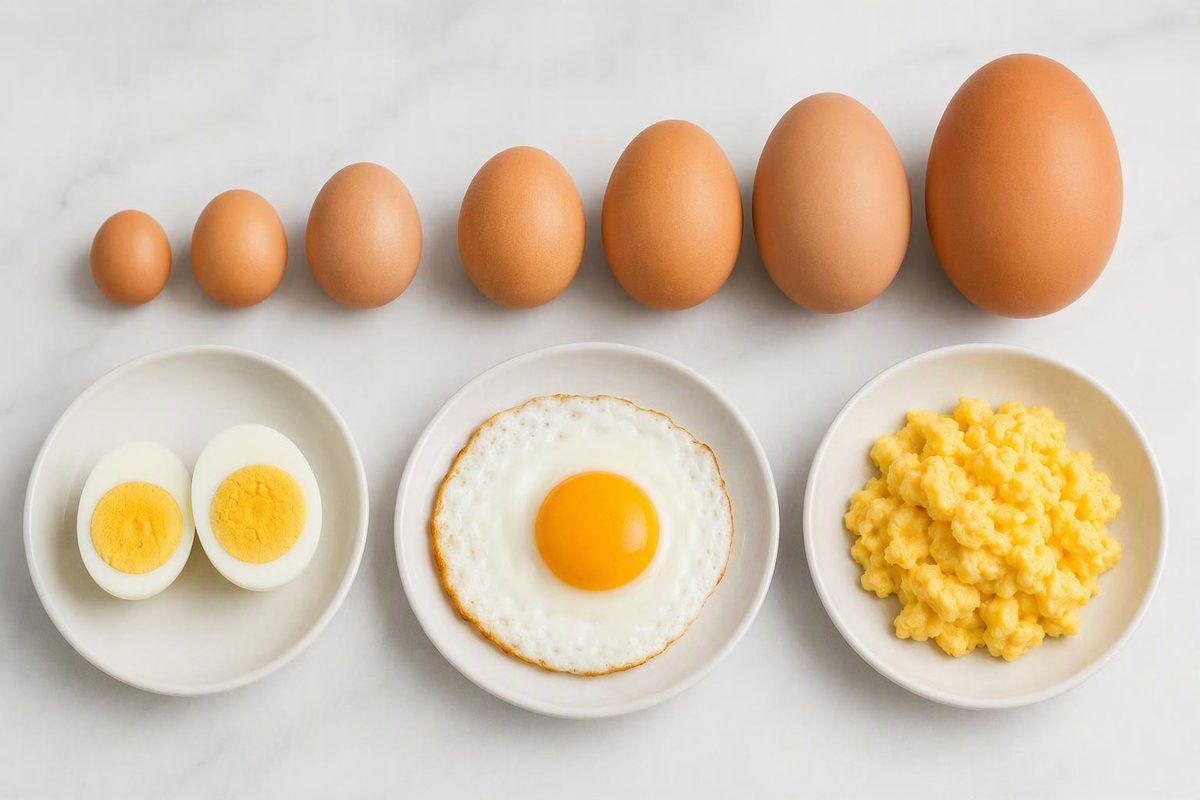
A plain large egg has about 70–72 calories. Size-and-weight charts cover small through jumbo, plus boiled, fried, and scrambled preparations.
The quick answer: about 70–72 calories in a large egg
One plain large chicken egg commonly provides about 70–72 calories under common US sizing conventions. A large egg with approximately 50 g of edible contents is commonly listed at about 72 calories, 6.3 g protein, 4.8 g fat, and 0.4 g carbohydrate. These figures describe the egg itself, before butter, oil, milk, cheese, meat, sauce, bread, or other ingredients are added, according to this USDA FoodData Central-based breakdown.
Published values of approximately 70, 72, or 78 calories can all be reasonable. The result depends on the egg’s edible weight, the regional size category, whether the entry describes a raw or cooked serving, and how the publisher rounds its data.
Egg calories at a glance
Egg size and corresponding edible weight Approximate calories Small, 38 g 54 Medium, 44 g 63 Large, 50 g 72 Extra-large, 56 g 80 Jumbo, 63 g 90
Keep each size label attached to its stated weight. Words such as “small,” “medium,” and “large” are useful only within the grading or database convention that defines them.
Some nutrition tables instead round one large whole egg to 70 calories, with approximately 6 g protein, 5 g fat, and no measurable carbohydrate at the displayed precision. The Iowa Egg Council’s nutrition table is one example. That small difference does not mean either entry applies exactly to every egg.
For quick tracking:
- One common US large egg: about 70–72 calories
- Two common US large eggs: about 140–144 calories
- Three common US large eggs: about 210–216 calories
- Cooking fat and other additions: count separately
Egg calories by size and weight
A larger edible portion generally contains more calories. Individual eggs may vary slightly within a commercial size category, so the values below are practical estimates rather than exact measurements.
The following chart uses one consistent convention throughout: the weights refer to the edible egg without the shell. Its size, weight, and calorie values are supported by this size-specific egg calorie reference.
| Egg size and edible weight | One egg | Two eggs | Three eggs |
|---|---|---|---|
| Small, 38 g | 54 calories | 108 calories | 162 calories |
| Medium, 44 g | 63 calories | 126 calories | 189 calories |
| Large, 50 g | 72 calories | 144 calories | 216 calories |
| Extra-large, 56 g | 80 calories | 160 calories | 240 calories |
| Jumbo, 63 g | 90 calories | 180 calories | 270 calories |
The multiplication is simple, but the size assumption matters. Three small 38 g eggs provide an estimated 162 calories, while three jumbo 63 g eggs provide an estimated 270 calories. Both meals contain three eggs, but they do not contain the same amount of egg.
Size grades also group eggs into categories rather than guaranteeing identical edible weights.
Do not merge the chart above with a table built around a different regional grading convention. For example, a British egg table lists small, medium, large, and very large eggs at 48 g, 58 g, 68 g, and 78 g respectively, with corresponding values of 54, 66, 78, and 90 calories. The supplied table does not establish that its gram figures use the same shell-free basis as the US-style chart, so the categories should not be compared gram-for-gram. Its main lesson is that regional size labels differ, as shown by the British Egg Industry Council’s published table.
If your carton provides nutrition information for the eggs you purchased, use that value. Otherwise, choose a database entry whose stated serving basis most closely matches your eggs. For closer tracking, weighing the edible contents is more transferable than relying on the size word alone.
Why one source says 70 calories and another says 72 or 78
The disagreement usually begins with the word large. It appears precise, but it is not a universal unit of edible weight.
Consider three published examples:
- A large egg with about 50 g of edible contents may be listed at approximately 72 calories.
- Egg Farmers of Alberta lists one large Grade-A egg as 53 g, 70 calories, and 6 g protein in its egg nutrition facts.
- A British table lists a 68 g large egg at 78 calories, although its stated weight should not be assumed to use the same shell-free basis as the 50 g reference.
These are not necessarily competing measurements of one identical egg. They come from different sources and serving conventions.
Rounding creates another small discrepancy. A calculated value may be displayed as 70, 72, 78, or “about 80,” depending on the underlying record and the publisher’s convention. Such values are useful for food logging, but they do not guarantee that every egg contains exactly the displayed number.
Preparation labels can also create apparent differences. Raw, boiled, and poached database entries may use different final serving weights or assumptions about water content. Boiling does not create food energy. If a boiled entry is a few calories higher than a raw entry, the difference may reflect egg weight, water loss, serving basis, or rounding.
This distinction is particularly important for entries reported per 100 g. Cooking can alter water content and therefore change the concentration of nutrients per 100 g, even when no energy-containing ingredient has been added. A per-egg entry and a per-100 g entry are not interchangeable unless their serving weights also match.
For ordinary tracking, use this order of preference:
- Use the carton’s nutrition information when it clearly applies to the eggs you bought.
- If that is unavailable, match the reference serving to the egg’s likely edible weight.
- Keep the same reference value for eggs from the same carton.
- Change the value when you deliberately switch sizes or use a meaningfully heavier egg.
A range tied to weight is more useful than a supposedly exact universal number. For a common US large egg around 50 g, approximately 70–72 calories is a practical estimate. An egg classified as large under a different regional convention may be listed closer to 78.
Calories in one, two, or three eggs
For plain large eggs, the calculation is:
Number of eggs × selected calories per egg = baseline egg calories
Using a 70–72-calorie estimate for one large egg gives:
| Number of large eggs | Approximate baseline calories |
|---|---|
| One | 70–72 |
| Two | 140–144 |
| Three | 210–216 |
For example:
- 2 large eggs × 72 calories = 144 calories
- 3 large eggs × 70 calories = 210 calories
- 3 large eggs × 72 calories = 216 calories
Either 70 or 72 can be a reasonable estimate for a common large egg. Consistency matters more than switching between the two without a reason. If you log one egg from a carton at 72 calories, use that same assumption for the other eggs from that carton.
Do not use a generic large-egg value when you know you ate another size. Applying the size-specific values from the earlier chart:
- Two small 38 g eggs: 2 × 54 = 108 calories
- Two medium 44 g eggs: 2 × 63 = 126 calories
- Two large 50 g eggs: 2 × 72 = 144 calories
- Two extra-large 56 g eggs: 2 × 80 = 160 calories
- Two jumbo 63 g eggs: 2 × 90 = 180 calories
The difference between two small eggs and two jumbo eggs is approximately 72 calories. It comes from the difference in edible portion, even though both meals contain two eggs.
These are baseline egg totals only. Butter, oil, toast, cheese, meat, sauces, avocado, mayonnaise, and other components must be added separately. “Two fried eggs” is not enough information to produce a dependable total because the amount of cooking fat is unknown.
A transparent food-log entry might read:
Two large eggs, 144 calories, no added fat.
Or:
Three medium eggs, 189 calories, plus separately logged butter and cheese.
Recording the size and preparation assumptions makes later comparisons more useful. If the total changes, you can identify whether the difference came from egg count, egg size, or added ingredients.
Egg white versus yolk: where the calories are
In one large egg, the white contains approximately 17–18 calories, while the yolk contains approximately 53–55 calories. The yolk therefore supplies most of the whole egg’s calories and essentially all of its fat.
The American Egg Board lists 17 calories and 3.6 g protein in the white, compared with 53 calories and 2.4 g protein in the yolk. Together, those portions provide approximately 70 calories and 6 g protein. The same source states that most of the egg’s listed vitamins and minerals are in the yolk; see its white-versus-yolk nutrition breakdown.
| Portion of one large egg | Approximate calories | Approximate protein |
|---|---|---|
| White | 17–18 | 3.6 g |
| Yolk | 53–55 | 2.4–2.7 g |
| Whole egg | 70–72 | 6–6.3 g |
This is a numerical comparison, not a declaration that one component is universally better. Whites let a cook add protein with fewer calories and little fat.
Using the ranges above:
- Two large egg whites: about 34–36 calories
- Three large egg whites: about 51–54 calories
- One whole large egg plus one white: about 87–90 calories
- One whole large egg plus two whites: about 104–108 calories
- Two whole large eggs plus one white: about 157–162 calories
These remain baseline totals. Butter, oil, milk, cheese, and other ingredients must still be counted.
For packaged liquid egg whites, use the product’s serving size and nutrition label.
Boiled, poached, fried, and scrambled egg calories
Heating an egg adds little or no energy by itself. The important question is whether the cooking process introduces oil, butter, milk, cream, cheese, or another energy-containing ingredient.
Boiled and poached eggs
Boiling and poaching use water rather than cooking fat, so a plain egg generally remains close to its baseline. Published large-egg estimates commonly fall around 70–78 calories, depending on egg weight and database convention.
A small difference between raw and boiled entries does not mean boiling created calories. It may reflect:
- A different egg weight
- Water loss during cooking
- A per-100 g rather than per-egg entry
- A different size definition
- Rounding
For routine logging, a plain boiled or poached egg can usually be assigned the same practical value used for an uncooked egg of that size. Using a preparation-specific database entry is also reasonable if you apply it consistently.
Fried eggs
A fried egg does not have one dependable calorie count unless the cooking-fat assumption is stated. One published set of examples ranges from approximately 85 calories when a little spray oil is used to about 120 calories when the egg is fried in oil and not drained. Those are illustrative preparation scenarios rather than fixed properties of fried eggs.
An egg cooked on an effectively dry nonstick surface stays much closer to its baseline. An egg cooked in measured butter or oil begins with the same egg calories but requires the cooking fat to be counted.
The amount of fat retained on the egg is usually unknown. Some may remain in the pan, which is why a recipe-input calculation is more transparent than claiming an exact absorbed-fat total.
Scrambled eggs
Scrambled eggs vary for the same reason. They may be cooked alone or combined with milk, butter, oil, cream, cheese, meat, or vegetables.
Published recipe illustrations include approximately 170 calories for two eggs microwaved with a dash of semi-skimmed milk and 200–245 calories for two large eggs pan-scrambled with milk and a small knob of butter. The source does not provide exact measured amounts for the “dash” or “small knob,” so these scrambled-egg examples should be treated as illustrations of recipe variability, not reproducible logging formulas.
A more useful food-log entry states the known ingredients:
- Two large eggs without added fat: approximately 140–144 calories
- Two large eggs plus measured milk: egg total plus the milk’s label value
- Two large eggs plus measured butter and milk: egg total plus both additions
- Restaurant scrambled eggs: an estimate with explicit assumptions about fat and dairy
Omelets
An omelet is a recipe, not merely a cooking state. Its total may include oil or butter, milk, cream, cheese, meat, vegetables, sauces, and toppings.
Do not infer the calories in a cheese omelet from the number of eggs alone. Begin with the eggs, then count each measured ingredient. The same rule applies to frittatas, breakfast sandwiches, breakfast burritos, egg salad, deviled eggs, and Eggs Benedict.
How much butter, oil, milk, and fillings add
Use this formula for a prepared egg dish:
(Calories for the selected egg size × number of eggs) + cooking fat + dairy + fillings + sauces + toppings + accompaniments = estimated dish total
The examples below use a large egg baseline of 70–72 calories. For illustration, a commercial cooking-fat calculator lists 34 calories for 1 teaspoon of butter and 40 calories for 1 teaspoon of olive oil. Because branded products and household measurements can vary, use the package label when available; the published values are shown in this cooking-fat reference.
One large egg plus butter
- Egg: 70–72 calories
- 1 teaspoon butter: 34 calories
- Estimated recipe-input total: 104–106 calories
Calculation:
70–72 + 34 = 104–106 calories
One large egg plus olive oil
- Egg: 70–72 calories
- 1 teaspoon olive oil: 40 calories
- Estimated recipe-input total: 110–112 calories
Calculation:
70–72 + 40 = 110–112 calories
Two large eggs plus butter
- Two eggs: 140–144 calories
- 1 teaspoon butter: 34 calories
- Estimated recipe-input total: 174–178 calories
Calculation:
140–144 + 34 = 174–178 calories
These examples count all measured cooking fat. That does not mean every drop is necessarily eaten. Some butter or oil may remain in the pan, but there is no single retained proportion that applies to every pan, temperature, egg, and cooking technique.
Counting all measured fat is therefore a transparent, upper-bound-style logging convention. It is not a claim about exact absorption. If you use another method, document it and apply it consistently rather than silently assuming that none of the cooking fat counts.
Milk, cheese, meat, and sauces
Use the package nutrition label for packaged ingredients because calorie values and recipe amounts vary.
For milk in scrambled eggs:
- Check the calories per cup, tablespoon, or milliliter.
- Measure the amount added.
- Convert the label serving to that amount.
- Add the result to the egg-and-fat subtotal.
Use the same process for:
- Cheese or cream
- Bacon, sausage, ham, or other meat
- Mayonnaise
- Hollandaise or another sauce
- Avocado
- Bread, toast, tortillas, bagels, or English muffins
- Ketchup, salsa, or other toppings
For a shared dish, calculate the entire recipe and divide by the number of portions actually served. Treat the result cautiously if the portions are visibly unequal.
Reusable egg-dish worksheet
| Item | Your entry |
|---|---|
| Egg size and corresponding weight | |
| Number of eggs | |
| Calories per egg | |
| Baseline egg total | |
| Cooking fat type | |
| Cooking fat amount | |
| Cooking fat calories | |
| Milk or cream | |
| Cheese | |
| Meat or other filling | |
| Vegetables | |
| Sauce or topping | |
| Bread or other accompaniment | |
| Estimated total |
This worksheet prevents a common category error: assigning every calorie in the complete dish to the eggs. Eggs Benedict includes an English muffin, meat, and hollandaise in addition to poached eggs. A cheese omelet includes at least cheese and often cooking fat in addition to its egg base.
For an unknown restaurant recipe, use a clearly labeled estimate rather than false precision. For example:
Two-egg cheese omelet; restaurant estimate includes assumed butter and cheese.
That note records why the result is less certain than the count for a plain boiled egg.
How precise does an egg calorie estimate need to be?
For ordinary tracking, use the value tied to the size you purchased and apply it consistently. A common US large egg with about 50 g of edible contents can reasonably be logged at approximately 70–72 calories. Use a higher figure when the relevant reference clearly describes a heavier serving.
Focus precision on the variables most likely to change the meal total:
- Number of eggs
- Egg size or edible weight
- Butter or oil
- Cheese and meat
- Sauces
- Bread and other accompaniments
- Dairy added during cooking
A one- or two-calorie rounding difference between 70 and 72 is generally less important to the arithmetic than an unmeasured teaspoon or tablespoon of cooking fat. Similarly, logging a jumbo egg as a small egg creates a larger discrepancy than choosing between two reasonable values for a common large egg.
For nutrition context, a large whole egg commonly provides approximately 6–6.3 g protein, about 5 g fat, and less than 1 g carbohydrate. Those values are still estimates tied to a serving convention, not exact measurements of every egg.
A proportionate approach looks like this:
- Routine tracking: Use 70 or 72 calories consistently for the same common large eggs.
- Different carton size: Switch to the appropriate size-specific value.
- Known edible weight: Use a reference matched to that weight.
- Mixed dish: Spend more effort measuring fats, cheese, sauces, and bread.
- Restaurant meal: Record your assumptions and allow for greater uncertainty.
The reusable calculation is:
Choose the calorie value associated with the egg’s actual size or weight, multiply it by the number of eggs, and add every measured cooking fat and accompaniment.
Approximately 70–72 calories is a sound working estimate for a common US large egg, while a heavier egg or a differently defined regional serving may be listed closer to 78. The goal is consistent, transparent estimation rather than false precision.
This guide provides general nutrition information and explains calorie arithmetic. It is not individualized medical or dietary advice, particularly for anyone managing a health condition; the site’s informational-use notice advises consulting a registered dietitian or physician before making relevant dietary changes.
Frequently asked questions
How many calories are in a boiled egg?
A plain boiled large egg generally contains approximately 70–78 calories, depending on its weight and the reference used. A published boiled-egg guide likewise describes 70–80 calories as an approximate range because egg weights vary. Boiling requires no added cooking fat, so the total remains close to the egg’s baseline; see the boiled-egg calorie guidance.
How many calories are in two large eggs?
Two plain large eggs contain approximately 140–144 calories before butter, oil, milk, cheese, sauces, or other additions.
2 eggs × 70–72 calories = 140–144 calories
This follows directly from published large-egg values of about 70 calories and size-specific estimates of about 72 calories for a 50 g egg. Use the value that best matches your carton or chosen reference.
How many calories are in one large egg white?
One large egg white contains approximately 17–18 calories and about 3.6 g protein. The American Egg Board lists 17 calories and 3.6 g protein in the white of one large egg. Removing the yolk reduces calories and fat, but it also changes the egg’s micronutrient profile.
How many calories are in scrambled eggs?
There is no single calorie count for scrambled eggs. Two plain large eggs begin at approximately 140–144 calories, but butter, oil, milk, cream, cheese, meat, and sauces increase the total. A dietitian-authored comparison similarly notes that scrambled-egg totals depend on added fats and other ingredients in its boiled-versus-scrambled guide.
For a useful estimate, add every measured ingredient to the baseline egg total. When the recipe is unknown, record your assumptions and use a wider range.
Why do some sources list 70 calories and others 72 or 78 for a large egg?
“Large” does not always represent the same serving weight across countries, grading systems, and databases. One source may describe a 50 g egg at about 72 calories, while another rounds a large egg to 70 calories. Preparation-specific serving conventions and rounding can create further differences.
Published large-egg estimates can extend to approximately 78 calories, so a range tied to the stated size and weight is more useful than treating one number as universal. For a common US large egg around 50 g, approximately 70–72 calories remains a practical working estimate.