
A Full Philly Cheesesteak Often Lands Near 800–1,100 Calories
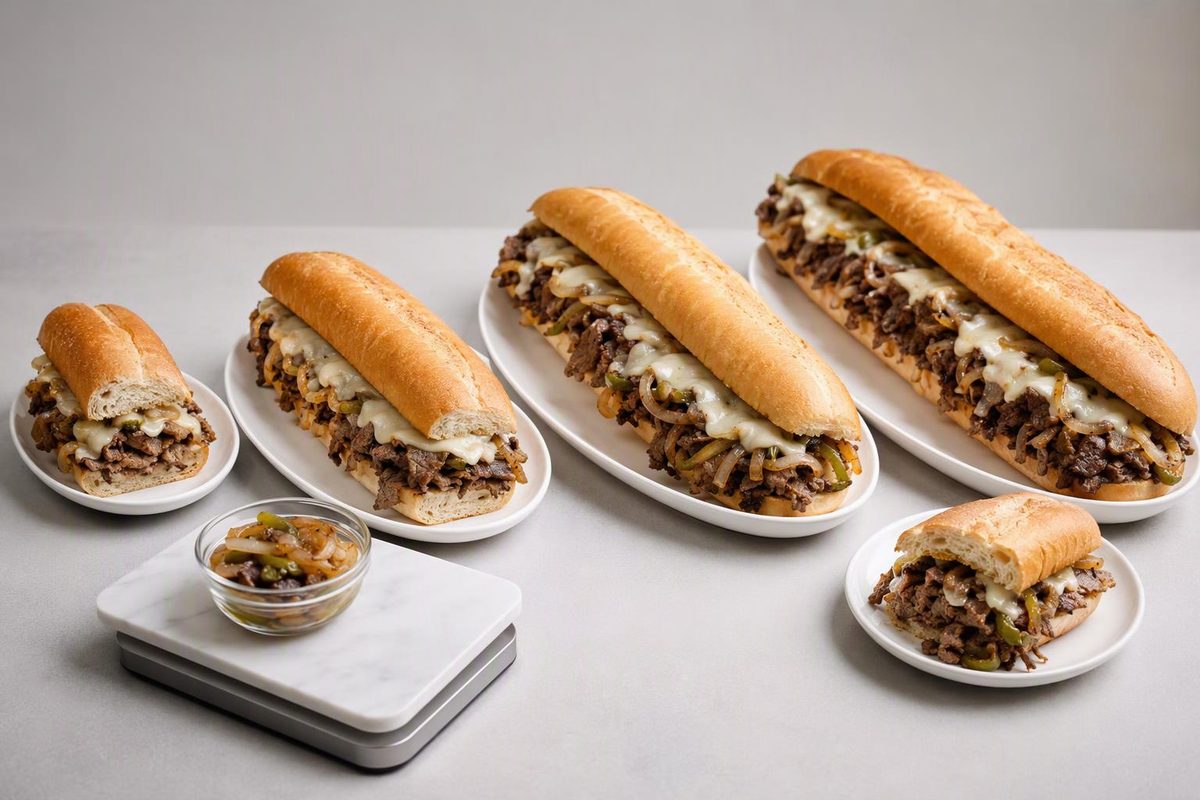
A full cheesesteak often has about 800–1,100 calories. Compare published portions from 4 to 18 inches and adjust for extras or a partial sandwich.
A full restaurant cheesesteak often lands around 800–1,100 calories. If the restaurant provides no nutrition information, 900 calories is a reasonable single-number estimate for a conventional full sandwich—provided you record it as an estimate, not an exact value.
Smaller and oversized portions fall well outside that range. Published examples run from 430 calories for a 4-inch sandwich to 1,950 calories for an 18-inch sandwich. Restaurant size labels also are not standardized, so “regular” does not necessarily mean 8 inches.
Published cheesesteak calorie examples
| Restaurant and portion | Calories |
|---|---|
| Capriotti’s Classic Cheese Steak, 4 inches | 430 |
| Charleys Philly Cheesesteak, small | 470 |
| Charleys Philly Cheesesteak, regular | 780 |
| Capriotti’s Classic Cheese Steak, 8 inches | 800 |
| Philly’s Best Philly Classic, 414 g, plain roll | 930 |
| Capriotti’s Classic Cheese Steak, 10 inches | 1,090 |
| Charleys Philly Cheesesteak, large | 1,100 |
| Capriotti’s Classic Cheese Steak, 18 inches | 1,950 |
The figures come from restaurant nutrition information rather than a standardized cheesesteak recipe. Charleys’ guide lists 38 g fat, 58 g carbohydrate and 51 g protein for its 780-calorie regular sandwich (Charleys nutrition guide, 2025). Capriotti’s provides stated lengths and lists its Classic Cheese Steak at 430, 800, 1,090 and 1,950 calories for 4-, 8-, 10- and 18-inch portions, respectively (Capriotti’s nutrition guide, 2026).
Philly’s Best supplies sandwich weights as well as calories. Its 414 g Philly Classic on a plain roll has 930 calories, 47 g fat, 62 g carbohydrate and 53 g protein. The restaurant lists the corresponding seeded-roll version at 435 g and 1,090 calories (Philly’s Best nutrition information).
What changes the total?
- Overall portion: More bread, steak and cheese generally make the largest difference.
- Meat amount: Extra steak raises both calories and protein.
- Cheese: The type matters less than how much is used; extra cheese should be counted separately.
- Roll: Length, width and density vary, even when two restaurants use the same size name.
- Cooking fat: Oil used on the griddle contributes calories that are not obvious from looking at the sandwich.
- Calorie-dense extras: Mayonnaise, bacon, extra meat and extra cheese can move the total substantially. Charleys, for example, lists mayonnaise at an additional 50 calories for a small, 100 for a regular and 150 for a large (Charleys nutrition guide, 2025).
How to log an unlabelled cheesesteak
Use the restaurant’s own listing whenever possible, matching the exact size and customizations. Otherwise:
- Use about 900 calories for a conventional full sandwich.
- Treat 800–1,100 calories as a more honest planning range.
- Scale by the fraction eaten: half of a 900-calorie estimate is 450 calories.
- Add mayonnaise, bacon, extra cheese or extra meat separately when you can estimate them.
- Count fries and drinks separately; a listed cheesesteak value normally refers only to the sandwich.
For a very small or oversized sandwich, do not force it into the 800–1,100 range. Length, weight or the restaurant’s named portion is more useful than the word “cheesesteak” alone.