
How Many Calories Are in a Bottle of Prosecco? Estimates and Variables
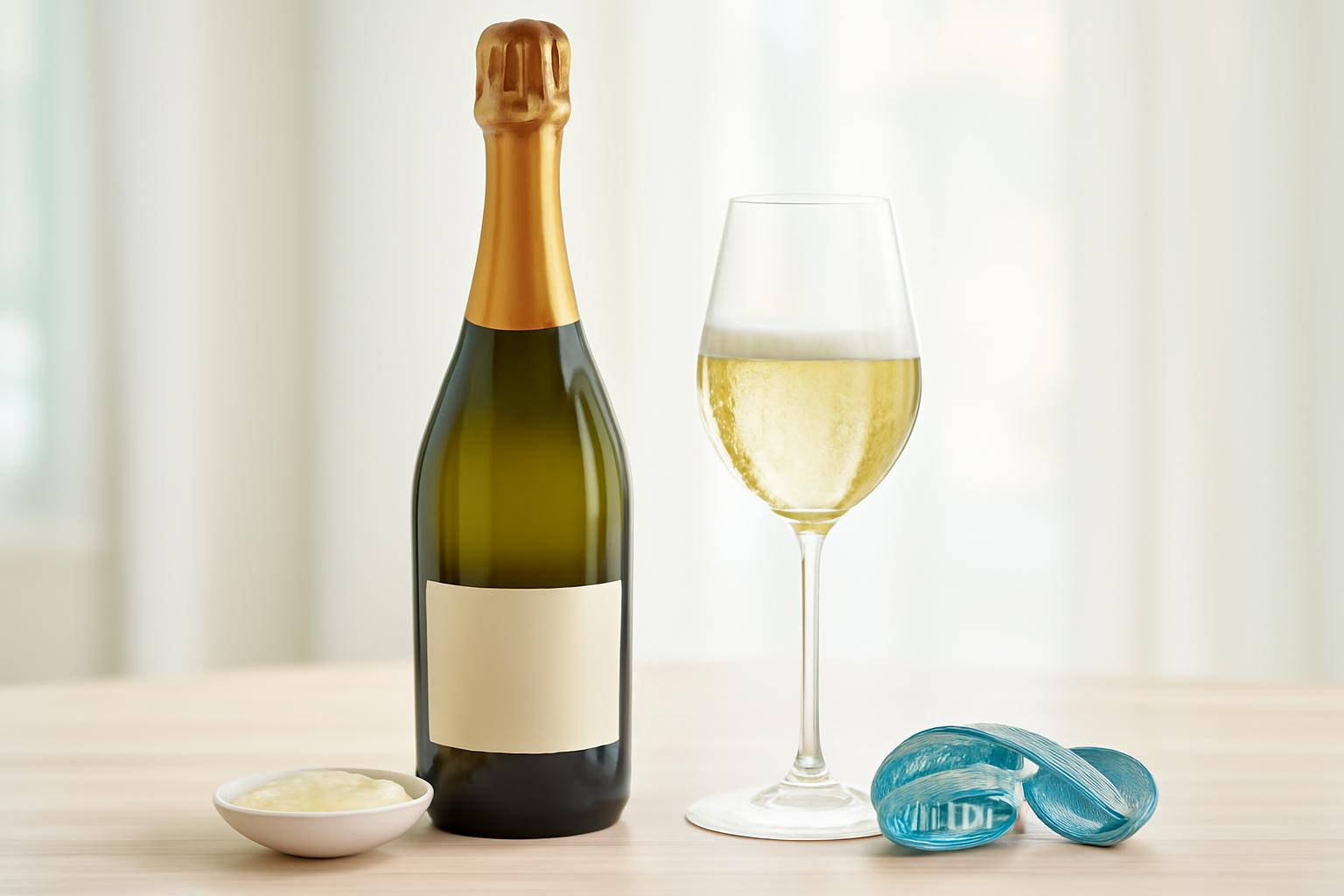
For 750ml, use 450-650 as a practical range. If the label or producer lists calories per 100ml, multiply by 7.5 for a bottle-specific estimate.
Overview
A standard 750ml bottle of Prosecco contains approximately 450 to 650 calories as a practical working range. The exact total depends mainly on alcohol strength and residual sugar, so a bottle’s declared nutrition value should take priority over a generic estimate whenever that information is available.
The lower end can be derived from published estimates of 60 to 73 calories per 100ml for Brut sparkling wine, equivalent to 450 to about 548 calories for 750ml. Other sources place a standard bottle at 495 to 600 calories or 560 to 650 calories.
These figures overlap enough to support 450 to 650 calories as a useful category-level estimate, but they do not establish one universal total. Published claims of 895 and 1,276 calories also appear in the source set. Those much higher values cannot be reconciled conclusively without authoritative, product-specific nutrition data and consistent serving units.
For intake tracking, a reasonable approach is to begin within the 450-to-650 range, then refine the number using the bottle’s calories per 100ml, alcohol by volume, or technical information.
From One Glass to a 750ml Bottle
A 750ml bottle contains exactly six 125ml servings:
750ml ÷ 125ml = 6 servings
This provides a simple way to convert a per-glass figure into a bottle estimate. A source reporting 75 calories per 125ml, for example, implies 450 calories for the bottle because 75 × 6 = 450. A figure of 100 calories per 125ml implies 600 calories because 100 × 6 = 600.
Published serving sizes must be normalized before their calorie figures are compared. Expert Wine Storage identifies six 125ml glasses in a 750ml bottle, while Staffilo gives approximately 80 calories for a 120ml glass. At that rate, a bottle contains 6.25 servings of 120ml. The resulting calculation is 80 × 6.25 = 500 calories.
Another source reports approximately 80 calories in a 5-ounce glass. Using the rounded convention elsewhere in the evidence that 4 ounces is about 120ml, 5 ounces is about 150ml. A 750ml bottle then contains about five such servings, implying approximately 400 calories. Because the ounce-to-millilitre relationship is rounded in those source descriptions, that result should not be treated as a precise bottle value.
Per-100ml figures provide the cleanest comparison. The published estimate of 60 to 73 calories per 100ml for Brut sparkling wine converts as follows:
60–73 calories × 7.5 = 450–547.5 calories per 750ml bottle
On a 125ml basis, the same range becomes 75 to about 91 calories. Keeping every figure on either a 100ml or 125ml basis prevents an apparently low serving value from being compared directly with a larger pour.
What Changes the Calorie Count?
Alcohol strength and residual sugar are the principal reasons two Prosecco bottles can have different calorie totals. Serving volume changes how much is consumed, but alcohol and sugar help determine the energy concentration within that serving.
Alcohol is especially important. It supplies 7 calories per gram, compared with 4 calories per gram for sugar, according to the wine-energy calculation described by QRfox. The same source converts alcohol by volume into grams per 100ml by multiplying ABV by ethanol’s density of 0.789.
For an 11% ABV wine, that calculation is:
11 × 0.789 = 8.679 grams of alcohol per 100ml
The alcohol component alone would therefore contribute approximately 60.8 calories per 100ml because 8.679 × 7 = 60.753. This demonstrates why sugar content alone cannot determine whether a Prosecco is low in calories. Even a relatively dry bottle still contains energy from alcohol.
Residual sugar adds energy on top of the alcohol contribution. It is the sugar left after fermentation, and more residual sugar means more carbohydrate and calories per glass. A sweeter wine may therefore contain more calories than a drier wine at the same ABV. Conversely, a higher-strength dry wine may contain more energy than a lower-strength wine with somewhat more sugar.
ABV is normally shown on the bottle label. Drinkaware recommends checking that label to identify the alcohol strength, but ABV does not provide a complete calorie total by itself.
Brut, Extra Dry, Dry, and Demi-Sec
Prosecco sweetness labels are counterintuitive. In directional order from less sweet to sweeter, the styles are generally Brut, Extra Dry, Dry, and Demi-Sec. In particular, Extra Dry is sweeter than Brut despite the apparent meaning of its name.
The practical implication is that, when alcohol strength and serving size are otherwise similar, Brut will usually have less energy from sugar than Extra Dry, Dry, or Demi-Sec. The evidence supports that direction: Extra Dry and Dry contain more sugar and therefore add more sugar-derived calories.
This ordering does not justify assigning one fixed calorie total to every style. Published figures conflict even for Brut, and alcohol strength may differ between bottles. Sweetness is therefore a useful comparison signal, not a substitute for a nutrition declaration. When comparing two products, the declared calories per 100ml are more informative than the style name alone. If no energy value is available, ABV and sweetness together can support an approximation, but not an exact total.
Why Published Bottle Estimates Disagree
Published figures disagree partly because they use different serving sizes, wine assumptions, and calculation methods. Converting each claim to the same 750ml bottle, 125ml glass, and 100ml basis makes the scale of the disagreement visible.
| Published figure or basis | Equivalent per 750ml | Equivalent per 125ml | Equivalent per 100ml |
|---|---|---|---|
| Brut sparkling estimate of 60–73 calories per 100ml | 450–547.5 | 75–91.25 | 60–73 |
| Direct bottle estimate of 495–600 calories | 495–600 | 82.5–100 | 66–80 |
| Direct bottle estimate of 560–650 calories | 560–650 | 93.3–108.3 | 74.7–86.7 |
| Higher published claim recorded in the evidence set | 895 | 149.2 | 119.3 |
| Highest published claim recorded in the evidence set | 1,276 | 212.7 | 170.1 |
The first three ranges overlap or sit reasonably close after normalization. Their combined span supports the practical 450-to-650 estimate, while also showing that a single precise category average would overstate certainty.
The 895-calorie claim would require each of six 125ml servings to contain about 149 calories. The 1,276-calorie claim would require about 213 calories per 125ml. Those implied serving values are much higher than the normalized figures associated with the lower published bottle estimates.
This is an internal plausibility check, not proof that either high claim is impossible. The supplied evidence does not include an authoritative nutrition declaration for the bottles behind those figures. It also does not establish whether the high totals arose from a calculation error, a different product composition, an inconsistent bottle size, or another unstated assumption.
The appropriate check is arithmetic consistency. Divide any claimed bottle total by six to obtain its implied calories per 125ml, or divide by 7.5 for calories per 100ml. Compare that result with any serving figure reported for the same bottle. If the two do not agree after normalization, they should not be used interchangeably.
How to Estimate Calories in a Specific Bottle
The most reliable available figure is the energy declaration for the particular bottle. If its label or producer information gives calories per 100ml, multiply that value by 7.5 to estimate the calories in 750ml. This avoids relying on a category average that may assume a different ABV or residual-sugar level.
If no declared energy value is available, a fuller estimate requires more than volume and sweetness style. The Winefo calculation guidance identifies four inputs: alcohol content, residual sugar, organic acids, and polyols such as glycerol. The result is expressed per 100ml.
A practical evidence hierarchy is:
- Use the bottle’s declared calories per 100ml, then multiply by 7.5.
- If that is unavailable, obtain the bottle’s ABV and technical values for residual sugar, organic acids, and glycerol or other polyols.
- Convert each component to grams per 100ml and apply its energy factor.
- Add the component values to obtain calories per 100ml, then multiply by 7.5 for the bottle.
One published calculation expresses the relationship as:
Energy per 100ml = (alcohol grams × 7) + (sugar grams × 4) + (glycerol grams × 2.4) + (organic-acid grams × 3)
The QRfox formula calculates alcohol grams per 100ml as ABV × 0.789. Residual sugar is commonly supplied in grams per litre, so dividing that value by 10 converts it to grams per 100ml. Organic acids and glycerol also need to be expressed on the same 100ml basis before their contributions are added.
A calculation using only ABV and residual sugar omits the energy from organic acids and polyols. It can still produce a closer estimate than a generic style average, but it is not necessarily identical to the bottle’s declared value. Technical values may also be unavailable to the consumer, in which case the honest result remains a range.
The distinction is important for tracking. “A bottle of Prosecco” is a product category, while a declared nutrition value describes a particular wine. Generic estimates are useful when no better evidence exists, but they should not override bottle-specific information.
Choosing a Lower-Calorie Sparkling Option
Reducing calories from sparkling wine can involve changing alcohol strength, serving quantity, or the drink itself. Because alcohol supplies substantial energy, a lower-strength or non-alcoholic sparkling alternative can reduce the alcohol-derived portion of the total. The individual product’s nutrition declaration is still needed for an exact comparison.
Practical options include:
- Choose a lower-strength sparkling wine or a non-alcoholic alternative, as suggested by Drinkaware.
- Pour a measured 125ml serving instead of assuming that every glass contains the same volume.
- Alternate Prosecco with water when drinking more than one serving.
- Make a longer drink with soda water, while counting any caloric mixer separately.
A soda-water spritzer reduces the amount of Prosecco in a drink if soda water replaces part of the pour. California Winery Advisor notes that fruit juice adds calories, so a spritzer made with juice cannot be evaluated from the Prosecco quantity alone.
For a bottle-level comparison, the clearest method remains calories per 100ml. It controls for serving-size differences and allows alcoholic, lower-strength, and non-alcoholic sparkling options to be compared on the same volume basis.