
Count Guacamole Carbs by the Portion You Actually Eat
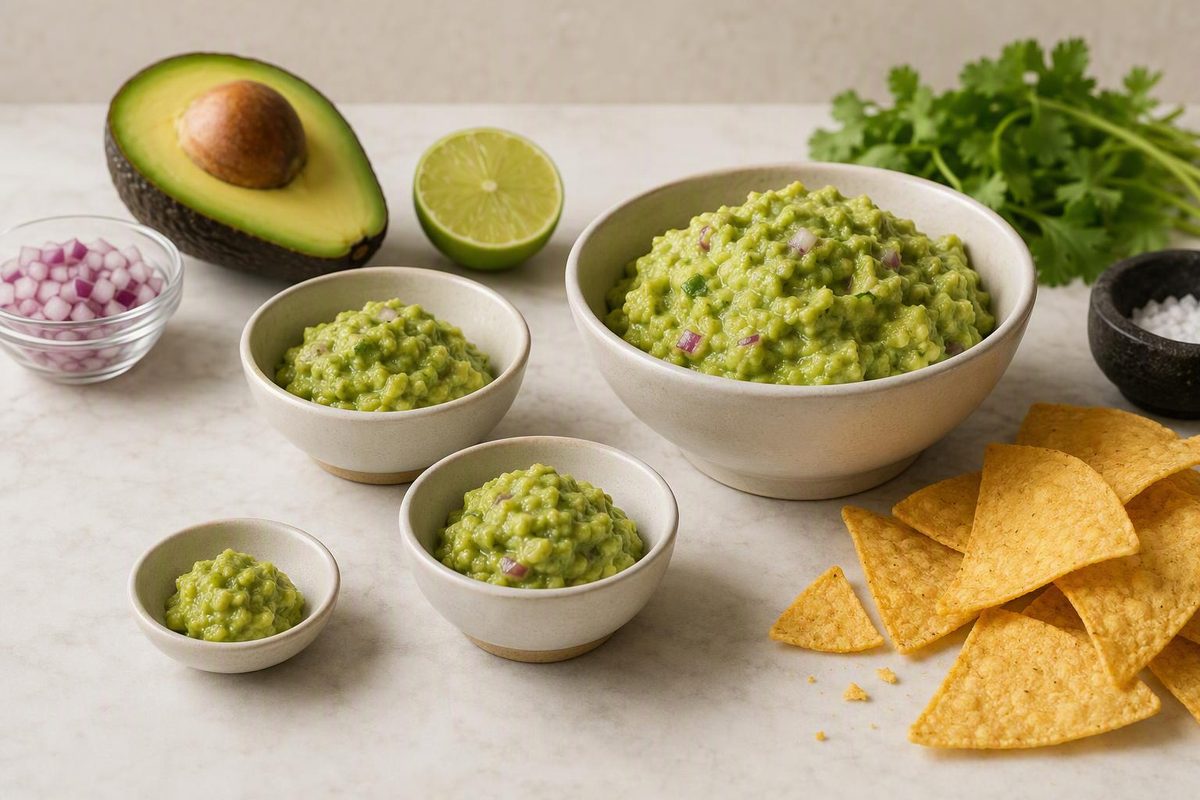
Compare guacamole carbs by serving size, calculate a weighed portion, and see why fiber subtraction and tortilla chips change the number in your food log.
Two tablespoons (30 g) of guacamole contain about 2 g of total carbohydrate, using Fairway’s listing for Wholly Guacamole Classic, 16 oz, as the reference. That serving also contains 1 g of fiber, leaving about 1 g when fiber is subtracted—often called “net carbs.” This is a product-specific starting estimate, not a fixed value for every guacamole recipe. Source: Fairway product listing
Enter your guacamole’s weight to scale this product’s carbs and fiber.
Guacamole Portion Calculator
Reference: 2 g total carbs and 1 g fiber per 30 g. For this product only.
Estimated for 30 g of this product.
With JavaScript disabled, the result stays at the 30 g reference portion. Scaled values are estimates, not extra label precision.
Serving Reference and Restaurant Comparison
| Portion | Carbs | Fiber | Minus fiber |
|---|---|---|---|
| Wholly: 1 tbsp / 15 g | ~1 g | ~0.5 g | ~0.5 g |
| Wholly: 2 tbsp / 30 g | 2 g | 1 g | 1 g |
| Wholly: ¼ cup / 60 g | ~4 g | ~2 g | ~2 g |
| Wholly: ½ cup / 120 g | ~8 g | ~4 g | ~4 g |
| Chipotle U.S.: 4 oz | 8 g | 6 g | ~2 g |
Wholly rows use its 30 g serving assumption. Other Wholly portions are scaled; Chipotle is a separate listed product and portion.
Sources: Fairway’s Wholly Classic listing and Chipotle U.S. nutrition chart.
Chipotle’s U.S. nutrition chart lists 8 g of total carbs and 6 g of fiber for a 4-ounce guacamole portion. Subtracting fiber gives about 2 g. That portion is much larger than the packaged product’s 2-tablespoon serving, and its nutrition values should not be treated as interchangeable with that product’s values. Both examples describe guacamole alone, without tortilla chips. Source: Chipotle U.S. nutrition chart
Guacamole Carbs Increase With the Portion
The following table scales the Wholly Guacamole Classic listing: 2 g of total carbs and 1 g of fiber per 2 tablespoons (30 g). Only that reference serving comes directly from the listing. The other rows are calculated estimates using the same ratio.
| Portion and Assumed Weight | Total Carbs | Fiber | Carbs Minus Fiber |
|---|---|---|---|
| 1 tablespoon / 15 g | ~1 g | ~0.5 g | ~0.5 g |
| 2 tablespoons / 30 g | 2 g | 1 g | 1 g |
| ¼ cup / 60 g | ~4 g | ~2 g | ~2 g |
| ½ cup / 120 g | ~8 g | ~4 g | ~4 g |
For this product’s serving assumption, ¼ cup is 4 tablespoons and ½ cup is 8 tablespoons. Doubling the listed serving doubles each nutrition value; halving it halves each value. The half-gram entries show the arithmetic, not separately measured nutrition or additional precision in the original listing.
The weights matter as much as the spoon measures. A heaped tablespoon need not weigh 15 g, and another product may assign a different weight to its tablespoon serving. If you have a kitchen scale, use the gram amount you ate rather than assuming every spoonful matches the reference.
The calculator uses this same product-specific ratio. It can estimate a weighed portion of Wholly Guacamole Classic, but it cannot identify the nutrition of another brand or a homemade recipe from weight alone. If your package differs, scale its own label instead.
Total Carbohydrate Already Includes Fiber
On a U.S. Nutrition Facts label, Total Carbohydrate includes dietary fiber. Fiber is listed beneath the total because it is part of that total, not an additional quantity to add. Total sugars are also included within total carbohydrate. Source: FDA, October 2021
For the Wholly Guacamole reference serving, the food log entry for total carbohydrate is therefore 2 g, not 3 g. Adding its 1 g of fiber to its 2 g of total carbohydrate would count that fiber twice.
Checking only the sugar line would make the opposite mistake: it would miss other carbohydrates included in the total. A low sugar entry does not establish the total carbohydrate amount. When your tracker asks for carbohydrates, use the Total Carbohydrate line unless you are deliberately tracking a different measure.
Keep the label’s serving size attached to the number. “2 g carbs” means little without “per 30 g” or “per 2 tablespoons.” A nutrition entry with the correct carb value but the wrong serving unit can still produce the wrong daily total.
Net Carbs Are a Separate Calculation
For the guacamole examples here, the calculation is total carbohydrate minus dietary fiber equals carbs after fiber subtraction.
That gives 1 g for the 30 g Wholly Guacamole serving: 2 g total carbohydrate minus 1 g fiber. For Chipotle’s listed 4-ounce guacamole portion, it gives 2 g: 8 g total carbohydrate minus 6 g fiber.
“Net carbs” has no legal definition, and this subtraction is not a precise prediction of blood-glucose response. The American Diabetes Association recommends using total carbohydrate rather than net carbs for carbohydrate counting. Source: ADA
If your food log displays both total and net carbs, keep them in their respective fields. Entering the net figure into the total-carbohydrate field understates the listed total. Entering total carbohydrate as net carbs loses the distinction you intended to track.
The tool labels its third result “Carbs minus fiber” to make the calculation explicit. It is not a separate laboratory measurement and should not be interpreted as a guaranteed amount of carbohydrate absorbed. The total-carb result remains the appropriate number when you are following total-carbohydrate counting.
A Weighed Portion Gives a Clearer Food-Log Entry
For packaged guacamole, start with the exact product’s label and the weight of the portion you ate. The calculation is label carbohydrate multiplied by portion weight, divided by label serving weight.
Using the reference label, a 75 g portion calculates to 5 g of total carbs: 2 × 75 ÷ 30. You do not need to convert that portion into tablespoons first. Both weights are in grams, so their ratio tells you how many label servings you ate.
Apply the same ratio to fiber if you track it. Do not scale total carbohydrate by weight while leaving fiber at the original serving amount; that would combine values for two different portions. Any subsequent fiber subtraction needs both numbers to describe the same amount of food.
In a tracker that accepts grams, choose the matching product and enter the grams consumed. In a tracker that accepts only label servings, use portion weight divided by label serving weight. Check the displayed serving definition before saving: a database entry called “one serving” may not mean the 30 g reference serving used here.
The calculated number is still an estimate based on the listed nutrition. Weighing resolves the portion-size question; it does not make rounded label values more precise or guarantee that every scoop has an identical ingredient mix.
Tablespoons Work When They Match the Label
You can use tablespoons when your product supplies a tablespoon serving and your portion reasonably matches it. For the Wholly Guacamole listing, 2 tablespoons correspond to 30 g. A 4-tablespoon portion is twice that reference serving, so the estimated total is 4 g of carbs.
The difficulty is not the multiplication. It is deciding whether the food on your plate actually matches the measure. A level spoonful, a heaped spoonful, and a broad scoop from a serving bowl can represent different amounts despite being described casually as a tablespoon.
If you logged 2 tablespoons but ate ¼ cup under this product’s assumptions, you would log half the estimated carbohydrate for that portion. The total would be about 4 g rather than 2 g. This is a portion mismatch, not a disagreement about the guacamole’s nutrition.
Use the table as a quick reference when its assumptions fit. Use a weighed portion when they do not. Do not transfer its gram equivalents to another brand whose label defines a different serving weight.
Homemade Guacamole Needs a Batch Calculation
There is no single sourced carbohydrate figure here for homemade guacamole. Its total depends on the ingredients and amounts in your recipe. Applying the packaged reference to every homemade batch would imply a match that the available evidence does not establish.
To calculate your batch, total the carbohydrates in the quantities of ingredients actually used, then weigh the finished guacamole. Portion carbohydrate equals batch carbohydrate multiplied by portion weight, divided by finished batch weight.
Use the finished batch weight, rather than an assumed number of bowls or spoonfuls. That gives the portion and batch the same measurement basis. It also lets you calculate different serving sizes without redefining the recipe each time.
If you want carbs after fiber subtraction, total ingredient fiber separately and allocate it by the same portion share. The total-carb and fiber calculations must use the same recipe quantities and finished weight.
When ingredient nutrition or finished batch weight is missing, the calculated portion remains unknown. You can choose to log an explicitly identified estimate, but it is not an exact recipe calculation. The packaged-product tool cannot fill in missing recipe evidence.
Restaurant Guacamole Uses the Restaurant’s Portion
Chipotle’s listed U.S. guacamole portion has 8 g of total carbs and 6 g of fiber per 4 ounces. Use those figures for that listed portion rather than scaling the Wholly Guacamole reference to a restaurant order.
Chipotle notes that portions and recipes can vary. Its posted values provide a reference for the listed serving, not a measurement of the particular scoop you receive. If you eat only part of the side, adjust the nutrition values to the fraction you actually ate.
The restaurant and packaged examples also show why total and net carbs should stay separate. Chipotle’s side contains more listed total carbohydrate than the 30 g packaged serving, but it also contains more fiber. Comparing only the fiber-subtracted values would conceal much of that difference in total carbohydrate and portion size.
These Chipotle figures come from its U.S. chart. They do not establish the nutrition of another restaurant’s guacamole or a differently defined menu portion. When a restaurant provides its own nutrition information, match your order to that listing first.
Chips Can Change the Total Far More Than Guacamole
Log tortilla chips separately from guacamole. Chipotle’s posted U.S. chart lists 73 g of carbohydrate for its regular 4-ounce chips portion. Eating that full chips portion with the full listed 4-ounce guacamole portion gives a calculated 81 g of total carbs: 73 + 8.
That is not an 8 g snack. The 8 g figure describes the guacamole alone, while 81 g describes those two complete listed portions together. A food-log search result labeled “guacamole” may exclude chips even when you ate them as one snack or ordered them together.
If you share the chips or leave some behind, count the amount consumed rather than automatically logging the entire order. The same applies to the guacamole. Scale each item separately, then add their total carbohydrates; the two items need not have been eaten in the same proportion.
The draft’s restaurant evidence supplies total carbohydrate for chips, but not a chip-fiber figure. It therefore supports the 81 g total-carb calculation, not a net-carb total for the combined order. Subtracting only the guacamole’s fiber and presenting the result as the snack’s complete net-carb count would leave missing information unresolved.