
What One Protein-Powder Scoop Actually Measures
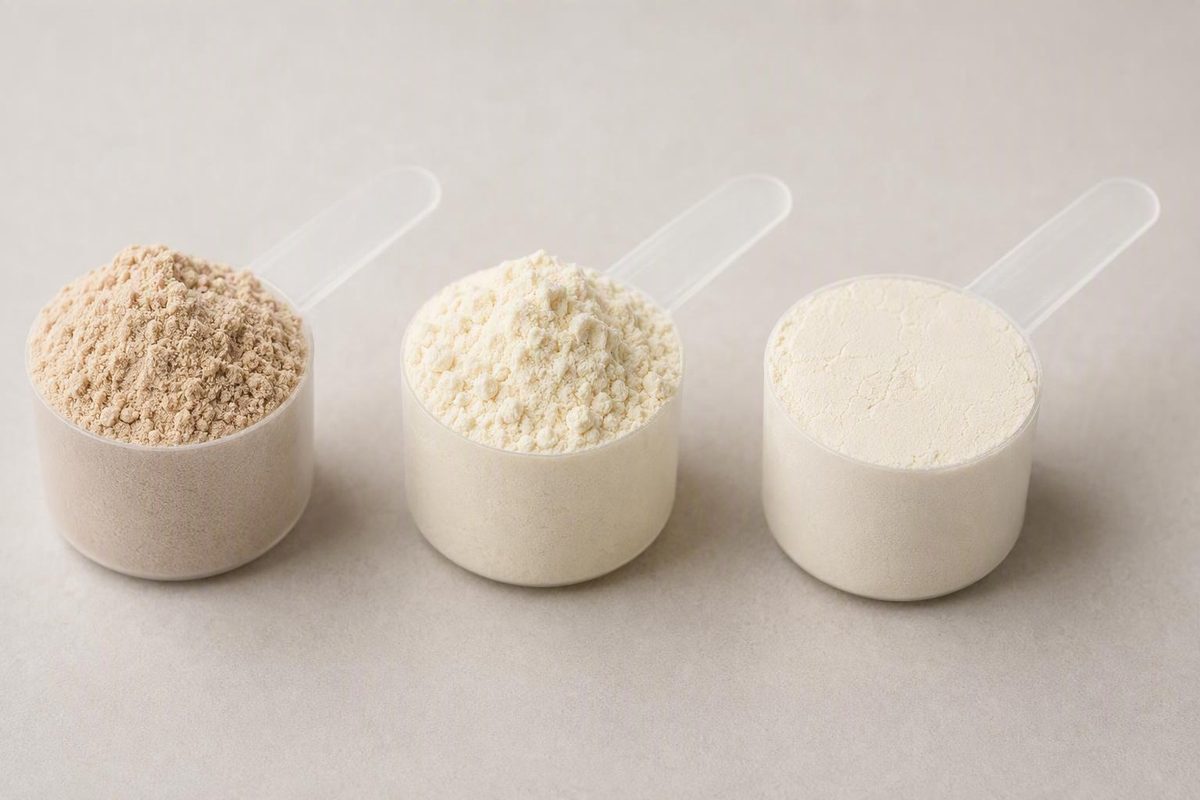
A rough guide is 25-35 g of powder and 20-25 g of protein per scoop. Your product's label and a weighed portion establish the amount to track.
The short answer: powder weight is not protein weight
“How much is in a scoop of protein powder?” can refer to three different measurements:
- Scoop volume: the space inside the plastic scoop, usually expressed in milliliters (mL) or cubic centimeters (cc).
- Total powder weight: the weight of everything in the scoop, expressed in grams.
- Protein content: the grams of protein within that portion of powder.
These values are related, but they are not interchangeable. There is no universal protein-powder scoop size or gram weight.
For rough orientation only, Optimum Nutrition’s commercial guidance describes a typical scoop as approximately 25–35 grams of powder, often supplying around 20–25 grams of protein. These are manufacturer-reported estimates, not an official standard or an independently established range for the entire market (Optimum Nutrition’s scoop explanation).
A scoop containing around 30 grams of powder may therefore provide roughly 20–25 grams of protein—not 30 grams of protein. The rest of the powder may include carbohydrate, fat, flavoring, minerals, sweeteners, thickeners, or other ingredients.
As a concrete manufacturer example, Optimum Nutrition reports that one level scoop of the Gold Standard 100% Whey product discussed in its India-market article weighs approximately 30.4 grams as powder and provides 24 grams of protein, approximately 3 grams of carbohydrate, and 117 calories. Those figures belong to the cited example and may not match every flavor, formulation, package, or market.
The practical answer is:
A commercial orientation estimate is about 25–35 grams of powder and 20–25 grams of protein per scoop, but only your product’s label and a weighed portion can establish the useful answer for tracking.
If accurate calorie or macro tracking matters, weigh the powder instead of assuming that a hand-filled scoop precisely matches the labeled serving.
Why a scoop has no fixed gram weight
A plastic scoop measures volume. Grams measure weight. Converting a scoop’s volume into grams requires knowing the density of the powder.
That is why the same scoop can hold different weights of different powders. A light, aerated powder can weigh less than a fine or settled powder filling the same space. Formulation, added ingredients, particle distribution, settling, and compression can all affect how much powder fits into the apparent volume (XXL Nutrition’s scoop-measurement FAQ).
Several variables matter:
- Scoop capacity: Included scoops can differ in width, depth, shape, and total volume.
- Powder density: Fine or closely settled particles may weigh more per unit of volume than a fluffier powder.
- Formulation: Whey, casein, plant-protein blends, and other formulas need not have the same density.
- Added ingredients: Flavoring, carbohydrate, fat, minerals, gums, and other ingredients can alter weight and texture.
- Settling: Powder may become denser as it sits or moves during shipping and handling.
- Compaction: Pressing the scoop into the powder or against the container can pack more material into it.
- Filling technique: A loose level scoop will not necessarily weigh the same as a rounded, heaped, or packed scoop.
Common scoop descriptions also have different meanings:
- A level scoop is filled to the rim, with the excess removed.
- A rounded scoop has a modest mound above the rim.
- A heaped scoop carries a larger mound.
- A packed scoop contains powder that has been compressed, intentionally or accidentally.
There is no universal gram difference among these methods. The extra amount in a rounded, heaped, or packed scoop depends on both the powder and the scoop.
Numbers molded into the plastic can create another source of confusion. A scoop marked “70,” for example, does not necessarily hold 70 grams. Such a marking may indicate 70 mL or 70 cc—units of volume rather than powder weight.
The scoop is therefore a portioning tool, not a weighing instrument. Recheck the serving when you change:
- brands;
- product lines;
- whey, casein, plant, or blended formulations;
- flavors;
- or the way you fill the scoop.
Do not assume that a scoop saved from an old container represents the same gram weight in a new powder.
How to read the label without mixing up the numbers
The label is more informative than the physical scoop because it connects a defined powder weight with the nutrients listed for that portion.
Before measuring, find these five entries:
- Serving size in grams
- Number of scoops per serving
- Protein per serving
- Calories per serving
- Servings per container
Read them as one connected statement. Consider this hypothetical label:
Serving size: 2 scoops (60 g) Protein: 48 g per serving Calories: 240 per serving Servings per container: 20
This does not mean each scoop weighs 60 grams or provides 48 grams of protein. Because two scoops make the hypothetical serving, one equal scoop corresponds nominally to:
- 30 grams of powder;
- 24 grams of protein;
- 120 calories.
Those are label-derived amounts per scoop. An actual hand-filled scoop may weigh slightly more or less.
Serving weight means all the powder
If the serving size is 30 grams, that is the total weight of the powder portion. Protein is one component of that total.
For example, imagine a hypothetical 30-gram serving containing:
- 24 grams of protein;
- 3 grams of carbohydrate;
- 1 gram of fat;
- flavoring, minerals, and other ingredients.
The serving still contains 30 grams of total powder even though only 24 grams are listed as protein. The important distinction is straightforward:
Serving grams describe the powder portion; protein grams describe one nutrient within that portion.
A scoop and a serving are not synonyms
Depending on the label:
- one scoop may equal one serving;
- two scoops may equal one serving;
- a fraction of a scoop may equal one serving;
- or the serving may be defined principally by its weight.
Always read the complete serving-size line. Do not stop after seeing “1 scoop,” and do not assume that the supplied utensil defines the serving accurately by itself.
If the label says “2 scoops (60 g),” the gram figure is the weight target for the complete serving. It does not guarantee that every pair of scoops you fill by hand will weigh exactly 60 grams.
Product examples are illustrations, not standards
The Optimum Nutrition example above reports approximately 30.4 grams of powder and 24 grams of protein for its cited Gold Standard 100% Whey example.
Raw Nutrition, meanwhile, reports 25 grams of protein per scoop for its cited Whey Protein Blend and 20 grams per scoop for its cited Vegan Protein. The company also notes that scoop capacity can vary with formulation, concentration, density, and added ingredients (Raw Nutrition’s scoop and serving-size guide).
These are named-product illustrations, not market standards. They show why “one scoop” is not a complete nutritional description: different products can assign different powder weights and protein amounts to that phrase.
Scoop size does not reveal calories
Calories cannot be inferred from the scoop’s physical size alone. A larger-looking scoop may hold a low-density powder, while a smaller scoop may contain a denser formula. Products can also contain different proportions of protein, carbohydrate, and fat.
Use the calorie entry for the exact product and serving. If you use a different powder weight, scale the listed calories in proportion to the amount used.
Do not copy a generic “calories per scoop” figure into a tracker unless it matches the exact product, serving definition, and portion weight.
Two formulas for converting the label into your portion
Once you have the label, two calculations answer most scoop questions.
Formula 1: Convert a multi-scoop serving into grams per scoop
If the label defines a serving as more than one scoop:
Nominal grams of powder per scoop = labeled serving weight ÷ scoops per serving
For a hypothetical label stating:
- Serving weight: 60 grams
- Scoops per serving: 2
The calculation is:
60 g ÷ 2 = 30 g of powder per nominal scoop
You can apply the same division to protein and calories if the scoops are intended to be equal. In the same hypothetical example:
- 48 grams of protein per two-scoop serving becomes 24 grams per nominal scoop.
- 240 calories per two-scoop serving becomes 120 calories per nominal scoop.
This calculation converts the label into an equal per-scoop amount. It does not prove that every scoop filled by hand weighs exactly 30 grams.
Formula 2: Scale nutrients to the portion you actually weighed
If your weighed portion differs from the serving weight:
Estimated nutrient in your portion = measured powder weight ÷ labeled serving weight × labeled nutrient amount
You can use this formula for protein, calories, carbohydrate, fat, or another listed nutrient.
Suppose a hypothetical label says:
- Serving weight: 30 grams
- Protein per serving: 24 grams
Your portion weighs 35 grams.
The calculation is:
35 ÷ 30 × 24 = 28 grams of protein
The same method works for calories. If that hypothetical 30-gram serving contains 120 calories:
35 ÷ 30 × 120 = 140 calories
This proportional calculation assumes that the powder is evenly mixed and that the nutrient concentration is consistent throughout the portion. It is a label-based estimate, not a laboratory analysis of the individual scoop.
For reliable arithmetic:
- Use the same unit for both weights.
- Divide your measured portion by the labeled serving weight.
- Multiply by the nutrient amount listed for that serving.
- Keep extra decimal places during the calculation.
- Round only the final result to a useful tracking precision.
Optional: compare protein concentration by powder weight
To compare products with different serving sizes:
Protein percentage by listed weight = protein grams ÷ serving weight × 100
For a hypothetical serving containing 24 grams of protein in 30 grams of powder:
24 ÷ 30 × 100 = 80%
This means protein accounts for 80% of the serving’s listed powder weight. It does not mean that 80% of the calories necessarily come from protein; that is a different calculation.
This comparison can be more informative than “protein per scoop.” A product using a larger scoop may list more protein per scoop without having a higher concentration of protein by powder weight.
Optional: estimate labeled servings in the container
If the package lists the net powder weight:
Estimated labeled servings = net powder weight ÷ labeled serving weight
For a hypothetical 900-gram container with a 30-gram serving:
900 ÷ 30 = 30 labeled servings
This is a package-based estimate. Powder left on the scoop, container, counter, or blender can affect how many complete portions you obtain in practice.
The most repeatable way to measure a scoop
Use a kitchen scale when accurate calories, protein, or other macro totals matter. Weighing avoids the uncertainty created by scoop capacity, powder density, and filling technique.
How to weigh one serving
- Put a dry bowl, shaker, or other container on the scale.
- Press tare or zero so the display returns to 0 grams.
- Find the serving weight on the product label.
- Add powder gradually until the scale reaches that gram target.
- Record the protein, calories, and other nutrients listed for the serving.
- If you use a different amount, apply Formula 2.
Taring a separate container is generally easier to interpret than placing the entire powder tub on the scale and calculating the portion from its decrease in weight.
How to calibrate the included scoop
If you want the convenience of a scoop while improving consistency, calibrate it for that specific powder:
- Place a dry container on the scale and tare it.
- Fill the scoop loosely without pressing it into the powder.
- Level the top in the same way each time.
- Weigh the portion and record the result.
- Empty the container and repeat several times.
- Add the recorded weights and divide by the number of trials.
For example, suppose five level scoops weigh 28, 30, 29, 31, and 29 grams:
(28 + 30 + 29 + 31 + 29) ÷ 5 = 29.4 grams per scoop on average
That average provides a practical expectation for your scoop, powder, and technique. It does not make every future scoop exactly 29.4 grams, and it is not a controlled scientific test.
Consistency matters. If you calibrate using loose, level, uncompressed scoops, use the same approach later. Do not alternate among level, rounded, heaped, and packed scoops and expect equivalent weights.
Recalibrate after changing the product, formulation, or flavor. The label’s gram target remains more informative than the scoop’s apparent size.
What to do when the scoop is missing
A missing scoop does not prevent accurate measurement. It makes the serving weight and kitchen scale more important.
Scale-first workflow
- Find the serving-size line on the container.
- Identify the serving weight in grams.
- Place your shaker or bowl on a kitchen scale.
- Tare the scale.
- Add powder until you reach the labeled weight.
You do not need the manufacturer’s plastic scoop when you can weigh the serving directly.
Do not automatically substitute a saved scoop from another product. Even if two scoops look identical, their capacities may differ. Even if their capacities are the same, powders with different densities can produce different gram weights.
Tablespoons are only a rough fallback
If no scale is available, first look for product-specific instructions from the manufacturer. Use the same filling method for every spoonful—preferably level rather than switching between level and heaped tablespoons—and treat the result as approximate.
Vega, for example, says one tablespoon of its protein powder is approximately 10.5 grams, while explicitly noting that the amount varies by product and flavor. It advises readers to use the serving weight printed on the tub to estimate the required number of tablespoons (Vega’s missing-scoop guidance).
That product-and-flavor caveat is enough to show why no universal tablespoon conversion should be used. Generic conversions based on another powder—or on comparisons with flour—do not establish the weight of the product in your container.
Therefore:
- Do not assume that a fixed number of tablespoons always equals one scoop.
- Do not assume that a quarter cup always equals 30 grams.
- Do not invent a conversion when the manufacturer provides none.
- If tablespoons are your only option, use product-specific guidance and fill each spoon consistently.
- Weigh the powder later if you want to calibrate the household measure for repeat use.
Common tracking mistakes and how to avoid them
Small wording differences on a label can create large logging errors. Watch for these recurring mistakes.
Mistake 1: Logging powder grams as protein grams
If the label says “Serving size: 30 g,” that means 30 grams of total powder. It does not mean 30 grams of protein.
Better method: Find the separate protein entry. Log the amount listed there as protein and treat 30 grams as the total portion weight.
Mistake 2: Assuming one scoop equals one serving
A label may define a serving as two scoops. Entering the full serving nutrients after using only one equal scoop would double the amount logged.
Better method: Read the serving-size line in full, including both grams and scoop count. Divide the serving values when using only part of the serving.
Mistake 3: Using a heaped scoop when the routine assumes a level scoop
A mound above the rim adds an unknown amount. Compressing the powder can change the weight again.
Better method: Follow the filling style stated on the label. If none is specified, choose a repeatable technique, calibrate it on a scale, and keep using it.
Mistake 4: Treating mL or cc as grams
Milliliters and cubic centimeters describe volume. Grams describe weight. The figures are not interchangeable for protein powder without product-specific density information.
Better method: Treat molded scoop markings as volume information. Use the label and scale to determine grams.
Mistake 5: Reusing an old scoop or tablespoon conversion
A scoop that held 30 grams of one powder may not hold 30 grams of another. A conversion may also change when the formulation or flavor changes.
Better method: Recheck the label and recalibrate whenever the product changes.
Mistake 6: Copying generic protein or calorie values
“Protein powder, one scoop” is too vague for precise logging. Products differ in powder weight, protein concentration, carbohydrate, fat, and calories.
Better method: Use the entry for the exact product and scale its label values to the powder weight you actually measured.
A compact routine for consistent tracking
Use this four-step process:
- Read the label: Find serving grams, scoops per serving, protein, and calories.
- Separate the values: Powder weight, protein weight, and calories are different measurements.
- Weigh the portion: Use the label’s gram figure as the target.
- Log proportionally: Multiply each listed nutrient by your measured weight divided by the labeled serving weight.
Frequently asked questions
Does a 30-gram scoop contain 30 grams of protein?
Usually not. “30 grams” commonly describes the total weight of the powder portion. Protein is only one component of that weight.
For a hypothetical example, a 30-gram powder serving might contain 24 grams of protein, with the remaining weight coming from carbohydrate, fat, flavoring, minerals, or other ingredients. Check the separate protein entry instead of treating serving weight as protein weight.
Even if your filled scoop weighs exactly 30 grams, that measurement alone does not reveal its protein content. You still need the nutrition information for the specific powder.
Is one scoop always one serving?
No. One scoop may equal one serving, but a label can also define a serving as multiple scoops or a fraction of a scoop.
If a hypothetical label says “2 scoops (60 g),” two scoops make the labeled serving. One equally filled scoop represents half of the listed protein, calories, and other nutrients.
The scoop count explains how the volume tool is intended to be used. The gram figure provides the more useful target for weighing.
How many tablespoons are in a scoop of protein powder?
There is no universal tablespoon conversion. Scoop capacity and powder density vary.
Vega estimates approximately 10.5 grams per tablespoon for its own powders but states that the amount depends on the product and flavor. That figure should not be applied automatically to another manufacturer’s powder.
Use product-specific tablespoon guidance when available. Otherwise, weigh the serving grams with a kitchen scale. If tablespoons are the only option, use consistently filled level spoons and treat the result as rough.
How many calories are in one scoop of protein powder?
The answer depends on the product, its serving definition, and the actual powder weight. Scoop size alone does not reveal calories.
Check calories per labeled serving and confirm how many scoops make that serving. If your portion weighs more or less than the label amount, calculate:
Measured powder weight ÷ labeled serving weight × labeled calories
For a hypothetical example, if a 30-gram serving contains 120 calories and your portion weighs 35 grams:
35 ÷ 30 × 120 = 140 calories
That is a proportional estimate based on the label and the assumption that the powder is evenly mixed.
What do the numbers printed on a protein scoop mean?
They commonly indicate scoop volume in milliliters or cubic centimeters, not the weight of the powder in grams.
A scoop marked “70 cc” therefore should not automatically be read as “70 grams.” The powder weight depends on what material fills that volume and how densely it is packed.
Use the marking to identify the scoop’s capacity if needed. Use the package’s serving weight and a kitchen scale to determine grams.
The final measurement rule is simple: treat the scoop as a convenient volume tool, treat the label’s grams as the product-specific target, and use a scale when the difference matters. Powder weight, protein grams, and calories are separate values and should be logged separately.
For broader nutrition context, see CaloriePages’ protein and calorie-density explainer.
CaloriePages content is for general informational purposes and does not constitute individualized medical or dietary advice.