
What a Shooter Actually Holds—and Why Volume Is Only Part of the Answer
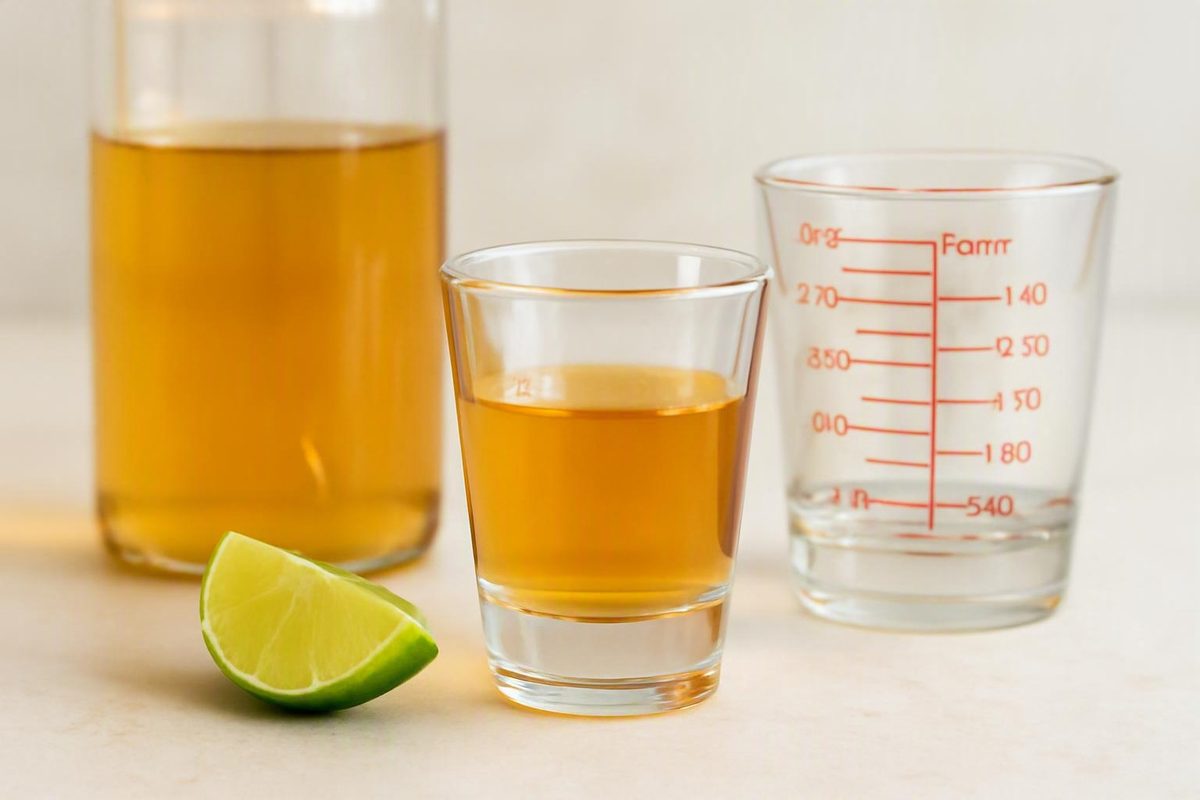
A bartender might put a 2-ounce drink in a 3-ounce glass and leave space at the top. Capacity alone does not establish the serving volume.
The short answer: a shooter is commonly 2–3 ounces
A served shooter commonly contains about 2–3 US fluid ounces, or approximately 59–89 milliliters (mL). This is a practical estimate reported in hospitality and drinkware guidance, not an official or legally fixed serving size. Recipes, glassware, venues, and local customs all vary, and the available evidence largely reflects industry usage rather than regulated measurements. One glassware guide describes most shooters as holding 2–3 US fluid ounces or more.
The broader figure of 2–5 US fluid ounces generally describes the capacity of shooter-style glassware—not necessarily the amount of finished drink poured. Tall shooter glasses come in multiple designs, and industry guidance places their capacity within that 2–5-US-fluid-ounce range.
The practical distinction is:
- About 2–3 US fluid ounces: a useful estimate for many served shooters.
- About 2–5 US fluid ounces: a broader range for shooter-glass capacity.
- No universal measure: “shooter” is not a standardized volume.
A glass capable of holding 5 ounces was not necessarily filled with 5 ounces. Likewise, a 3-ounce drink does not necessarily contain 3 ounces of liquor. Some of its volume may come from juice, cream, syrup, soda, or another nonalcoholic mixer.
For reference, common US fluid-ounce conversions are:
| Volume in US fluid ounces | Approximate volume in mL |
|---|---|
| 1.5 US fl oz | 44 mL |
| 2 US fl oz | 59 mL |
| 2.5 US fl oz | 74 mL |
| 3 US fl oz | 89 mL |
These rounded conversions are consistent with published shooter and shot measurement tables. They use US fluid ounces, not Imperial fluid ounces.
For a drink in front of you, therefore, the most useful questions are: How much liquid was actually poured, and which ingredients make up that volume?
Shooter, shot, glass, or mini bottle: identify what is being measured
The word shooter can refer to a drink, a vessel, or a small retail bottle. Before calculating volume, alcohol, standard drinks, or calories, identify which meaning applies.
A shooter drink is generally a small alcoholic drink intended to be consumed quickly. It is often mixed or layered, combining spirits or liqueurs with ingredients such as juice, syrup, or cream. It is essentially a compact drink rather than a fixed recipe.
Usage is inconsistent, however. Some people call any alcoholic drink served in a shot glass and consumed quickly a shooter, including straight liquor. That broader meaning appears in descriptions of a shooter as an alcoholic beverage served in a shot glass and typically consumed quickly.
A conventional U.S. shot more often refers to a measured pour of liquor, frequently served straight. A shooter may be larger or contain several ingredients, but this distinction is customary rather than rigid. Menus and customers sometimes use “shot” and “shooter” interchangeably.
A shooter glass is the vessel. It is often taller than a conventional shot glass and can display layered ingredients. Its maximum capacity does not guarantee the serving volume: a bartender might put a 2-ounce drink in a 3-ounce glass and leave space at the top.
A jigger is a bartending measuring tool, often with a cup at each end. Its measurements vary by region and design, so “one jigger” does not establish an exact amount unless its capacity or markings are known. The same source that documents varying shot usage also notes that the common 1.5-US-fluid-ounce U.S. shot is a convention rather than a nationwide fixed measure.
Finally, shooter may mean a miniature retail liquor bottle. One common mini size is 50 mL, approximately 1.7 US fluid ounces. That packaged quantity is separate from the volume of a mixed shooter or the capacity of a shooter glass, as reflected in this mini-bottle and shooter-size guide.
Terminology at a glance
Term What it usually means What not to assume Shot A small measured pour, often straight spirits That every venue uses the same measure Shooter drink A small drink consumed quickly, often mixed or layered That all its volume is liquor Shooter glass A tall, small-capacity serving vessel That it was filled to capacity Jigger A bartending tool for measuring ingredients That every jigger has identical markings Double shot Twice the venue’s chosen single measure That it is always exactly 3 US fluid ounces 50 mL mini bottle A miniature liquor bottle sometimes called a shooter That it matches a served mixed shooter
Context normally reveals the intended meaning. At a bar, “a shooter” probably means a prepared drink. In a glassware catalog, it likely means the vessel. In a liquor store, it may refer to a miniature bottle.
How many shot-volumes fit in a shooter?
For a practical U.S. comparison, 1.5 US fluid ounces, approximately 44 mL, can be used as one common shot-volume. It is a widely used convention, not a nationwide legal requirement fixing every shot at that amount.
The calculation is:
Shot-volumes = total shooter volume ÷ 1.5 US fluid ounces
Using that reference:
| Total shooter volume | Calculation | Equivalent shot-volumes |
|---|---|---|
| 1.5 US fl oz | 1.5 ÷ 1.5 | 1 |
| 2 US fl oz | 2 ÷ 1.5 | About 1.33 |
| 2.5 US fl oz | 2.5 ÷ 1.5 | About 1.67 |
| 3 US fl oz | 3 ÷ 1.5 | 2 |
These conversions follow from the commonly used 1.5-ounce reference and published comparisons of shot and shooter-glass measurements.
The table compares total liquid volume only. It does not tell you how many measured pours of liquor are in a mixed shooter.
For example, suppose a 3-ounce shooter contains:
- 1 ounce of spirits
- 1 ounce of juice
- 1 ounce of syrup or another mixer
The drink is twice the total volume of a 1.5-ounce shot, but it contains only 1 ounce of spirits. Calling it “two shot-volumes” does not turn the other ingredients into liquor.
The reverse is also possible. A smaller shooter may be made almost entirely from spirits and liqueurs, giving it more alcohol than a larger drink diluted with nonalcoholic ingredients.
Consequently, “How many shots are in a shooter?” can mean two different things:
- How many 1.5-ounce units fit within its total volume? Divide the finished volume by 1.5 ounces.
- How many measured pours of alcoholic ingredients were used? Check the recipe or measure the pour.
Only the second question determines how much spirit or liqueur went into the drink. If a recipe contains 0.75 ounce of vodka, 0.75 ounce of liqueur, and 0.5 ounce of juice, it totals 2 ounces. That equals about 1.33 shot-volumes by size, while its alcoholic ingredients total 1.5 ounces.
Do not convert shot-volumes directly into standard drinks. Shot-volume compares space; a standard drink measures pure alcohol.
Total volume is not the same as alcohol content
To determine how much alcohol is in a shooter, separate four quantities:
- Glass capacity: the maximum volume the vessel can hold.
- Beverage volume: the finished amount actually poured.
- Alcoholic-ingredient volume: the combined amount of spirits, liqueurs, wine, or other alcoholic components.
- Pure-alcohol volume: the ethanol contained within those ingredients.
These quantities may be substantially different. A 3-ounce glass might contain a 2-ounce drink. That drink might contain 1.25 ounces of alcoholic ingredients, and because those ingredients are not pure ethanol, its pure-alcohol volume will be smaller still.
Calculating pure alcohol
For each alcoholic ingredient:
Pure-alcohol volume = ingredient volume × ABV as a decimal
Calculate each component separately, then add the results.
Under the modern U.S. proof system, a distilled spirit’s proof is twice its ABV percentage. Thus, 80 proof corresponds to 40% ABV, a relationship used by the National Institute on Alcohol Abuse and Alcoholism’s mixed-drink calculator.
Consider a 2-ounce mixed shooter containing:
- 1 US fluid ounce of 40% ABV spirit
- 1 US fluid ounce of 20% ABV liqueur
Calculate each component:
- Spirit: 1 × 0.40 = 0.40 US fluid ounce of pure alcohol
- Liqueur: 1 × 0.20 = 0.20 US fluid ounce of pure alcohol
Add them:
0.40 + 0.20 = 0.60 US fluid ounce of pure alcohol
The drink occupies 2 ounces, but only 0.6 ounce is pure alcohol.
Now compare that with a hypothetical 2-ounce straight pour at 40% ABV:
2 × 0.40 = 0.80 US fluid ounce of pure alcohol
This is an arithmetic example, not a claim that shooters are normally served as 2-ounce straight pours. It demonstrates why equal-size drinks can differ in strength.
| Hypothetical recipe | Total volume | Pure alcohol |
|---|---|---|
| 1 oz at 40% ABV + 1 oz juice | 2 oz | 0.40 oz |
| 1 oz at 40% ABV + 1 oz at 20% ABV | 2 oz | 0.60 oz |
| 2 oz at 40% ABV | 2 oz | 0.80 oz |
All three drinks occupy the same volume, yet the strongest contains twice as much pure alcohol as the weakest.
Layering makes visual estimates especially unreliable. A colored layer might be liqueur, syrup, cream, or juice, and visually similar ingredients may have very different ABVs. A larger shooter diluted with juice can therefore contain less alcohol than a smaller recipe made entirely from alcoholic ingredients.
For a useful estimate:
- Record the measured amount of every alcoholic ingredient.
- Read each ingredient’s labeled ABV.
- If a U.S. label gives proof, divide it by two to obtain the ABV percentage.
- Multiply each volume by its ABV as a decimal.
- Add the resulting pure-alcohol volumes.
Do not infer strength from the drink’s height, number of layers, or glass capacity.
Is one shooter one U.S. standard drink?
Not necessarily. A shooter can contain less than, approximately, or more than one U.S. standard drink, depending on its recipe.
One U.S. standard drink contains approximately 0.6 US fluid ounce, or 14 grams, of pure alcohol. A 1.5-US-fluid-ounce serving of 80-proof, or 40% ABV, distilled spirits is therefore approximately one standard drink, according to this university standard-drink reference.
The arithmetic is:
1.5 × 0.40 = 0.60 US fluid ounce of pure alcohol
The mixed-shooter example above also contains 0.6 ounce of pure alcohol:
- 1 ounce at 40% ABV = 0.40 ounce
- 1 ounce at 20% ABV = 0.20 ounce
- Total = 0.60 ounce
Although the finished shooter is 2 ounces, it is approximately one U.S. standard drink because its ingredients collectively provide 0.6 ounce of pure alcohol.
A 2-ounce shooter is not automatically one standard drink:
| Hypothetical 2-ounce recipe | Pure alcohol | Approximate U.S. standard drinks |
|---|---|---|
| 1 oz at 40% ABV + 1 oz mixer | 0.40 oz | 0.67 |
| 1 oz at 40% ABV + 1 oz at 20% ABV | 0.60 oz | 1 |
| 2 oz at 40% ABV | 0.80 oz | 1.33 |
The calculation is:
U.S. standard drinks = total pure-alcohol volume ÷ 0.6
For a mixed shooter:
- List each alcoholic ingredient.
- Record its measured volume.
- Find its ABV.
- If it uses U.S. proof labeling, divide proof by two to obtain the ABV percentage.
- Convert the ABV percentage to a decimal.
- Multiply each ingredient’s volume by its ABV.
- Add the pure-alcohol volumes.
- Divide the total by 0.6 for the approximate U.S. standard-drink count.
Keep this calculation separate from shot-volume. A 2-ounce shooter equals about 1.33 shot-volumes when compared with a 1.5-ounce reference, but it does not necessarily contain 1.33 standard drinks.
The NIAAA notes that a single cocktail or mixed drink may contain one, two, or more standard drinks because recipes and pours differ among bars, restaurants, and individuals. These calculations are educational estimates and should not be used to predict a person’s blood alcohol concentration, impairment, or a “safe” amount to drink.
Why the answer changes outside the United States
Neither “shot” nor “shooter” has one internationally consistent measurement. A U.S.-focused comparison may use 1.5 US fluid ounces, approximately 44 mL, but that reference should not be transferred to another country’s serving system without checking its definitions.
In the United Kingdom, examples of single spirit measures include 25 mL and 35 mL. At 40% ABV:
- 25 mL × 40 ÷ 1,000 = 1 UK unit
- 35 mL × 40 ÷ 1,000 = 1.4 UK units
One UK unit equals 10 mL or 8 grams of pure alcohol, and the formula is:
UK units = ABV percentage × volume in mL ÷ 1,000
These measures and the calculation are set out in the NHS guide to alcohol units.
A UK unit is not equivalent to a U.S. standard drink. A 25 mL measure at 40% ABV contains 10 mL of pure alcohol, while the U.S. benchmark is based on approximately 0.6 US fluid ounce of pure alcohol. Calling both “one standard drink” would conflate two different systems.
Canada uses another definition: one Canadian standard drink contains 17.05 mL of pure ethanol, according to a University of Victoria-affiliated calculator. That value should not be substituted for either a U.S. standard drink or a UK unit.
International calculations can become confusing because they may combine:
- US fluid ounces
- Imperial fluid ounces
- Milliliters
- U.S. standard drinks
- UK units
- Canadian standard drinks
US and Imperial fluid ounces are not equal. If a calculator asks for ounces, check which kind it uses. Converting the serving volume to milliliters first can reduce confusion, after which the relevant country’s standard-drink or unit formula can be applied.
The international comparison does not change the main U.S. estimate. It explains why a menu or recipe from another country may use a substantially smaller shot reference.
How to estimate a shooter’s calories without guessing
“Shooter” does not identify a recipe, so there is no defensible universal calorie count. Equal-size shooters made from straight spirits, sweet liqueurs, cream, syrup, juice, or zero-calorie mixers can have very different totals.
A useful estimate requires:
- The measured amount of every ingredient
- The proof or ABV of each alcoholic ingredient
- A calorie value for each ingredient at a stated serving size
- The quantities of caloric mixers such as liqueur, syrup, juice, cream, or sugared soda
As benchmarks, MedlinePlus lists 97 calories for a 1.5-ounce serving of 80-proof gin, rum, vodka, or whiskey and 116 calories for the same serving size at 94 proof. Its listed 1.5-ounce liqueur examples range from 154 to 186 calories. These are serving-specific calorie figures, not universal totals for shooters.
Serving size is crucial. A calorie figure for 1.5 ounces cannot automatically be assigned to a 2- or 3-ounce drink.
If a spirit contains 97 calories per 1.5 ounces and a recipe uses 1 ounce:
97 × (1 ÷ 1.5) ≈ 65 calories
That estimate covers only the ounce of spirit. Every liqueur, syrup, juice, cream, or other caloric ingredient must be calculated separately.
Use this scaling formula:
Calories used = listed calories × (amount poured ÷ listed serving amount)
For example, suppose a shooter contains:
- 1 ounce of a spirit listed at 97 calories per 1.5 ounces
- 0.5 ounce of a liqueur listed at 160 calories per 1.5 ounces
- 0.5 ounce of a mixer with its own label value
The spirit contributes about 65 calories:
97 × (1 ÷ 1.5) ≈ 65
The liqueur contributes about 53 calories:
160 × (0.5 ÷ 1.5) ≈ 53
The mixer’s calories must then be calculated from its label and added. Without that information, the total remains incomplete.
Proof matters because alcohol contributes energy, but it is not the only variable. Sweetened liqueurs may contain more calories than an equal volume of unsweetened spirits, while syrup, cream, juice, or sugared soda can increase the total further. Water or a zero-calorie mixer can increase drink volume without adding calories.
This is why a 3-ounce shooter is not necessarily more caloric than a 2-ounce shooter. The larger drink may contain more noncaloric dilution, while the smaller one may rely heavily on liqueur or syrup.
For the most reliable estimate:
- Best: use a known recipe with every ingredient measured.
- Useful: obtain ingredient quantities from the bartender or manufacturer.
- Approximate: work from a menu description that lists ingredients but not amounts.
- Insufficient: estimate from the glass’s size or the drink’s appearance.
This calorie information is general education, not individualized medical or dietary advice.
Frequently asked questions
How many ounces are in a typical shooter?
A practical estimate for many served shooters is 2–3 US fluid ounces, approximately 59–89 mL, although no universal shooter measure exists. Hospitality sources also distinguish these drinks from larger-capacity shooter glassware, with some glasses holding more than the amount normally poured.
Is a 3-ounce shooter the same as two shots of liquor?
Not necessarily. A 3-ounce drink is twice the total volume of the common 1.5-ounce U.S. shot reference, but its recipe may include nonalcoholic mixers. Published shot-and-shooter comparisons likewise treat these figures as volume measurements rather than proof of liquor content.
A 3-ounce recipe containing 1 ounce of spirits and 2 ounces of mixers has only 1 ounce of spirits. Use the measured recipe to determine how much liquor was poured.
Is one shooter equal to one U.S. standard drink?
Only when the recipe contains approximately 0.6 US fluid ounce, or 14 grams, of pure alcohol. A 1.5-ounce pour of 40% ABV spirits meets that benchmark, but a mixed shooter may contain less or more depending on its ingredients and their strengths, as shown by the U.S. standard-drink definition.
Calculate each alcoholic ingredient’s pure-alcohol contribution, add the results, and divide by 0.6. Do not use glass size as the standard-drink count.
How much is in a mini bottle called a shooter?
A mini liquor bottle called a shooter commonly contains 50 mL, approximately 1.7 US fluid ounces. That packaged size is a separate use of the term “shooter” and is documented in retail shooter guidance.
Its standard-drink count depends on the product’s ABV. The 50 mL label states total beverage volume, not pure-alcohol volume.
Can you tell a shooter’s calories from the size of its glass?
No. Glass size does not reveal the quantity poured, proof of the spirits, type of liqueur, or amounts of syrup, juice, cream, or other mixers.
Measure each ingredient, scale its listed calories to the quantity used, and add the components. A known recipe and measured pour provide the strongest estimate; glass size alone is insufficient.
The practical answer depends on what is being measured. Expect roughly 2–3 US fluid ounces in many served shooters, while recognizing that shooter-style glasses may hold 2–5 ounces according to industry glassware guidance. Do not infer liquor volume, pure alcohol, standard drinks, or calories from the vessel alone: identify the meaning of “shooter,” measure the recipe, and calculate its ingredients separately.