
How Many Calories Are in Lime Juice?
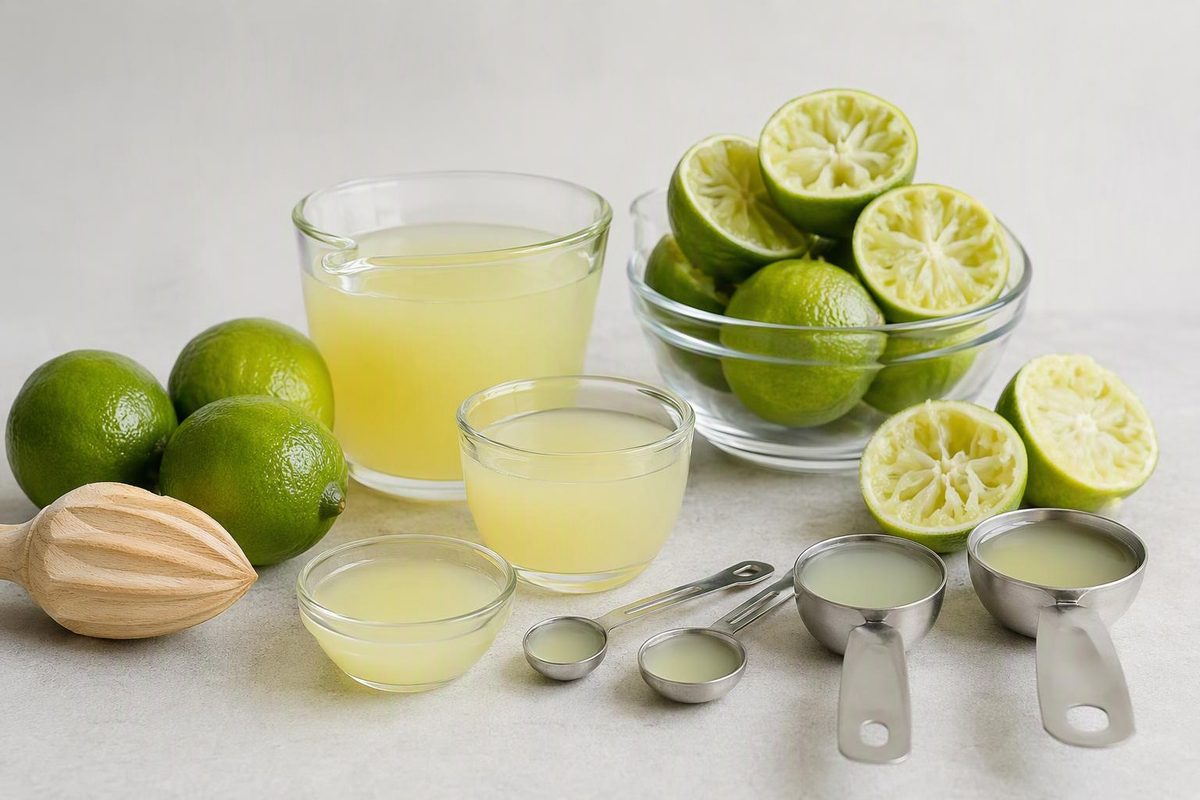
Convert teaspoons, tablespoons, fluid ounces, cups or grams of plain lime juice into calories, and see why some bottled labels legally show zero.
One tablespoon of plain, unsweetened lime juice has about 4 calories. One US fluid ounce—2 tablespoons—has about 8 calories, while a full US cup has about 61. These estimates apply to plain juice, not lime cordial, limeade, margarita mix or another product with added sugar.
Enter the amount of plain lime juice you use; the calculator converts it to calories.
Lime Juice Calorie Calculator
Uses 25 calories per 100 g for raw, unsweetened lime juice.
Source: USDA FoodData Central SR Legacy, raw lime juice. Portion weights: 5 g per teaspoon, 15 g per tablespoon, 30.8 g per US fluid ounce and 242 g per cup.
Lime Juice Calories by Portion
USDA FoodData Central’s SR Legacy entry for raw lime juice reports 25 calories per 100 grams. It also reports 8.42 grams of carbohydrate, 1.69 grams of total sugar, 0.42 grams of protein and 0.07 grams of fat per 100 grams (USDA FoodData Central).
Using the USDA weights of 242 grams per cup and 30.8 grams per fluid ounce, common portions work out as follows:
| Lime juice portion | Assumed weight | Estimated calories |
|---|---|---|
| 1 teaspoon | 5 g | 1 |
| 1 tablespoon | 15 g | 4 |
| 2 tablespoons | 30 g | 8 |
| 1 US fl oz | 30.8 g | 8 |
| 1/4 cup | 60.5 g | 15 |
| 1/2 cup | 121 g | 30 |
| 1 cup | 242 g | 61 |
| 100 g | 100 g | 25 |
The smaller values are rounded estimates. A tablespoon weighs about 15 grams under these assumptions, so its unrounded calculation is 15 × 25 ÷ 100 = 3.75 calories. That becomes 4 calories when rounded to the nearest whole calorie.
The same calculation gives 7.5 calories for 2 tablespoons, 7.7 calories for a US fluid ounce and 60.5 calories for a cup. Those values appear as 8, 8 and 61 calories in the table after rounding.
For ordinary cooking or drink tracking, logging 4 calories per tablespoon is a practical choice. If a recipe gives the juice in grams, multiply the weight by 0.25 to estimate calories from the USDA raw-juice entry. A 40-gram portion, for example, would be calculated from the same database rate rather than from a rounded tablespoon value.
A Fluid Ounce Is a Volume Measurement
The ounce in “one US fluid ounce” is a measure of volume. The table estimates its calorie content using the USDA weight of 30.8 grams for that volume of raw lime juice.
That distinction matters when a kitchen scale reports ounces by weight. The article’s 8-calorie estimate applies to one fluid ounce, not automatically to one ounce displayed on a scale. When the available amount is a weight, entering grams in the calculator avoids mixing the two types of ounce.
Volume measurements are still suitable for normal recipe tracking. A teaspoon, tablespoon or cup is converted to its assumed gram weight before the calorie rate is applied. The result is an estimate because the calculation depends on both the database average and the portion measurement.
The Nutrition per Tablespoon Is Mostly Carbohydrate
The USDA raw-juice entry provides nutrients per 100 grams, so tablespoon values can be estimated with the same 15-gram weight used for calories. At that portion, 8.42 grams of carbohydrate per 100 grams works out to about 1.3 grams of carbohydrate per tablespoon. Total sugar works out to about 0.25 gram, protein to about 0.06 gram and fat to about 0.01 gram.
These are calculated estimates rather than separate USDA serving values. They explain why plain lime juice contributes only a few calories in tablespoon-size quantities: the portion contains little carbohydrate and almost no fat or protein.
For calorie counting, the 4-calorie estimate is usually more useful than carrying the calculation to multiple decimal places. Greater decimal precision would not remove the uncertainty introduced by measuring the serving or using a database average instead of a product-specific laboratory result.
Fresh and Bottled Lime Juice Have Similar Database Values
Plain bottled juice is similarly low in calories. USDA’s entry for canned or bottled unsweetened lime juice lists 21 calories per 100 grams, compared with 25 calories per 100 grams for raw juice (FoodData Central).
The difference between those entries is 4 calories per 100 grams. At a 15-gram tablespoon, that difference is 0.6 calorie, which is less than 1 calorie per tablespoon. The product label therefore matters more than treating every fresh or bottled juice as if it must match one database average exactly.
Based on the two USDA entries, roughly 3–4 calories per tablespoon is a reasonable fallback for plain, unsweetened lime juice when a more specific value is unavailable. Use 4 calories if you are following the raw-juice estimate used in the table and calculator.
The word “bottled” does not by itself mean the juice contains added sugar. Likewise, “from concentrate” or “not from concentrate” does not by itself determine the calorie count. The ingredient list shows whether sugar, syrup or another caloric ingredient has been added, while the Nutrition Facts panel gives the manufacturer’s declared serving value.
A Zero-Calorie Label Can Be a Rounded Value
Some bottles list zero calories for a teaspoon. ReaLime, for example, lists a 1-teaspoon serving with 0 calories, and its ingredients begin with water and lime juice concentrate (Keurig Dr Pepper Product Facts). That statement applies to the identified ReaLime product and serving, not to every bottled lime juice.
A displayed zero does not necessarily mean the product contributes literally no energy. Under US nutrition-labeling rules, an amount below 5 calories per serving may be expressed as zero (21 CFR 101.9). The rule concerns how calories may be declared on a US label; it does not establish that the underlying amount is exactly zero.
This creates a tracking problem when the labeled serving is much smaller than the amount used. Multiplying a rounded zero by several servings still produces zero, even though the unrounded amount could accumulate. The label does not provide enough information to reconstruct the exact hidden value because any qualifying amount below the rounding threshold can appear as zero.
If you use only the labeled teaspoon, recording the label value follows the package. If you use several tablespoons and want a closer estimate, look for a product-specific value per 100 milliliters or 100 grams. When the manufacturer provides no more precise figure, use the plain unsweetened database range of roughly 3–4 calories per tablespoon rather than assuming that repeated teaspoons must remain literally calorie-free.
Do not replace a clear product-specific calorie declaration with the USDA average when the manufacturer supplies a useful value for the amount you consume. The database estimate is most helpful when the label is rounded to zero, the juice is fresh, or the exact product information is unavailable.
Recipe Totals Should Use the Unrounded Amount When Practical
For a recipe, calculate the lime juice from the total amount used rather than rounding every small addition separately. The raw-juice rate is 25 calories per 100 grams, or 0.25 calorie per gram. Converting the recipe’s complete juice quantity to grams and applying that rate prevents repeated serving-level rounding from distorting the total.
If the recipe uses tablespoons, multiplying the number of tablespoons by about 4 is a quick estimate. If it uses a cup or half cup, use the direct table values of 61 or 30 calories. Those numbers come from the total assumed weight for the portion, so they are preferable to repeatedly adding a rounded 4-calorie tablespoon when a cup measurement is already known.
After finding the recipe total, divide it by the number of portions actually served. For example, the lime-juice calories belong in the recipe total before that total is allocated among servings. The serving count changes calories per serving; it does not change the calories in the complete recipe.
The calculator uses the raw USDA rate and the same portion weights as the table. It is suitable for plain juice measured by teaspoon, tablespoon, fluid ounce, cup or gram. It does not calculate sweeteners, alcohol or other ingredients.
Sweetened Lime Drinks Need Their Own Calorie Count
Lime juice is often one of the smallest calorie sources in a prepared drink. Sugar, sweetened cordial, syrup, liqueur and alcohol can increase the total substantially. Those ingredients must be counted separately because the 4-calorie tablespoon estimate covers only plain lime juice.
For a homemade recipe, log plain juice at about 4 calories per tablespoon, then add the declared or calculated calories for every other ingredient. Do not apply the plain-juice number to the finished drink unless lime juice is genuinely the only caloric ingredient.
Packaged limeade, cocktail mixer and canned margarita should be logged from their own Nutrition Facts panels rather than as plain lime juice. Their serving sizes and formulations are product-specific, and the draft sources do not provide a general calorie figure for those categories.
The ingredient name is the key boundary. “Lime juice,” “water and lime juice concentrate,” and another unsweetened formulation can reasonably be compared with the plain-juice estimates. “Lime cordial,” “limeade,” “margarita mix,” or a product listing sugar or syrup requires its own label or recipe calculation.
The Best Number Depends on What You Measured
Use 1 calorie per teaspoon, 4 per tablespoon, 8 per US fluid ounce, 30 per half cup or 61 per cup when tracking raw lime juice with the USDA portion assumptions. Use 25 calories per 100 grams when a scale provides the weight.
For plain bottled juice, use its Nutrition Facts panel when that panel provides a meaningful value for your portion. If its small serving is labeled zero and you consume a larger amount, a fallback of roughly 3–4 calories per tablespoon reflects the two cited USDA entries without treating the rounded zero as an exact measurement.
For a sweetened or alcoholic lime product, neither the raw-juice calculator nor the plain bottled-juice range describes the finished product. Count it from the package or from all ingredients in the recipe.