
What the Label—and the Maple Flavor—Really Add to Breakfast Sausage
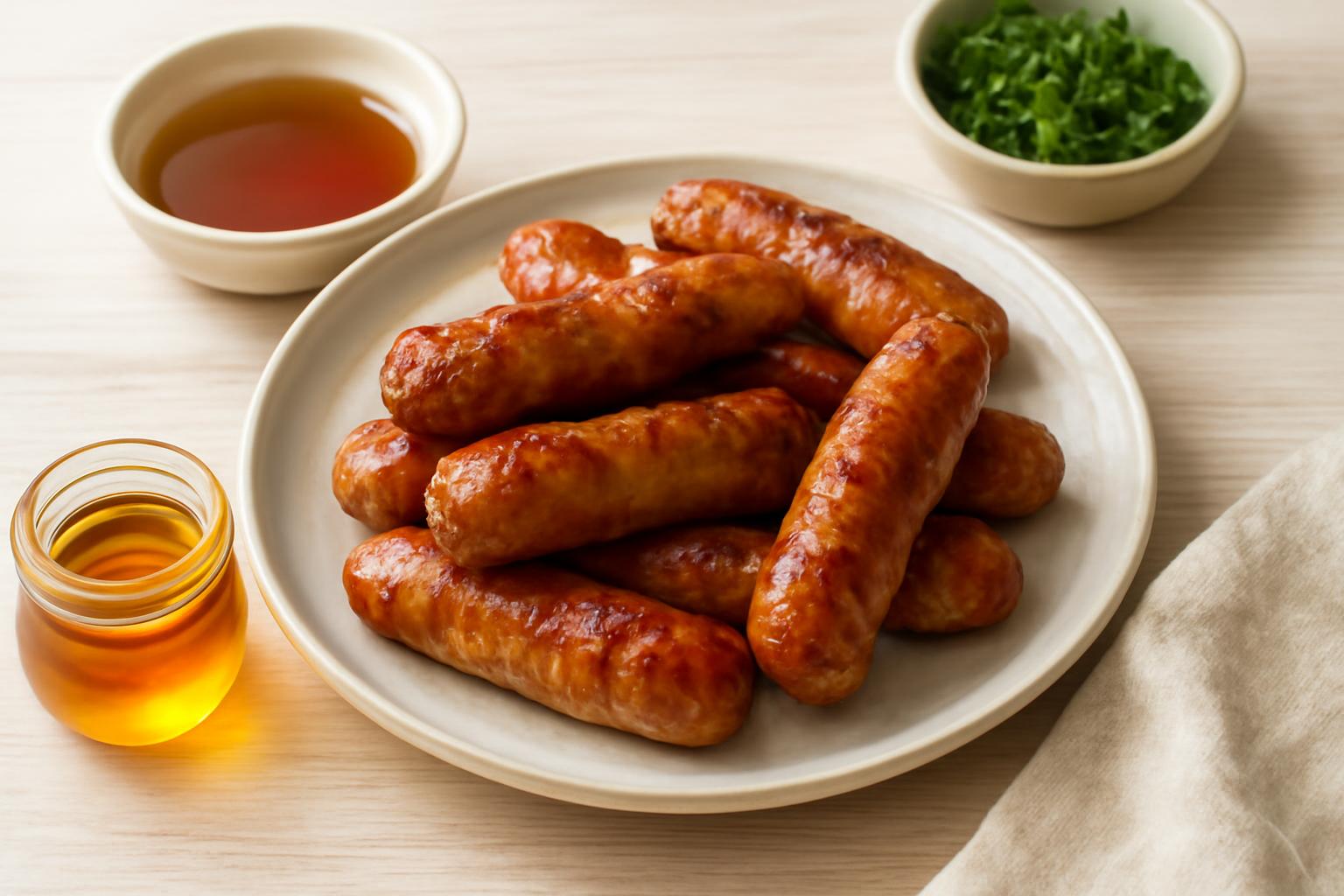
Across documented products, "maple" can mean directly listed syrup, syrup with another sugar, or syrup contained in a composite flavor.
Maple sausage sounds like a single, predictable food. It is not. The name describes a sweet-savory flavor category, while the meat, sweetener, serving size, fat content, link size, and nutrition basis can differ substantially.
Among the named products examined here, listed servings weigh 54–70 g: Meijer uses a 54 g serving, while Maple Leaf uses 70 g. Listed servings contain 150–210 calories, from Greenfield at the lower end to Jimmy Dean at the upper end. These figures describe the documented products rather than every maple sausage on the market. (Meijer; Maple Leaf; Greenfield; Jimmy Dean)
The same caution applies to the word maple. It may refer to explicitly listed maple syrup, syrup combined with another sugar, or a composite flavor containing an undisclosed amount of syrup. A useful comparison therefore requires three checks: serving weight, nutrition facts, and the maple-related ingredient.
Methodology note: This comparison uses six named product records supplied by manufacturer pages and third-party nutrition databases. Original serving values are preserved, and per-100-g figures are arithmetic estimates rounded from those values. Missing nutrients remain blank. Product formulas and database records can change, so a current package should take priority when logging the exact food in hand.
What maple sausage is—and what “maple” can mean
Maple sausage is a sweet-savory breakfast sausage flavored to suggest maple syrup. It may be sold as:
- Ready-made links
- Formed patties
- A sliceable roll
- Bulk sausage to shape at home
- Fresh links intended for smoking
Format affects convenience and portioning. A roll allows adjustable patty sizes, although its nutrition facts may define a specific cooked weight. Ready-made links offer convenient piece portions, but one link is not necessarily one serving.
Three ways “maple” appears in sausage
1. Explicitly claimed real maple syrup
Swaggerty’s says its breakfast links are made with real maple syrup. The captured product material does not provide a complete ingredient list or disclose the syrup quantity, however. “Real maple syrup” is therefore a seller’s product claim rather than a complete formulation description.
2. Maple syrup plus another sugar
True Story lists Vermont maple syrup separately in its ingredients and also lists brown sugar. Maple syrup appears after pork, while brown sugar appears later. The manufacturer does not disclose the amount of either sweetener.
True Story reports 2 g of total sugar per link, but that number cannot be assigned exclusively to maple syrup. Its other listed ingredients are water, potassium lactate, seasonings, salt, and celery powder in a natural sheep casing.
3. A composite maple-flavor ingredient
Jimmy Dean uses a different formulation. Its ingredient list begins with pork, water, and sugar, followed by ingredients present at 2% or less. The maple flavor is itself a mixture containing water, propylene glycol, corn syrup, natural flavor, caramel color, and maple syrup. The amount of syrup inside that mixture is not disclosed.
These examples show why the word maple on the front of a package does not fully identify the sweetener. It does not reveal whether syrup is the only sweetening ingredient, whether it appears inside a flavor mixture, or how much is present.
The presence of real maple syrup also does not establish flavor intensity, nutritional superiority, or overall product quality. A product may use a small amount alongside other sugars or flavoring components. Ingredient order can offer context, but the documented lists do not provide exact percentages for the sweeteners.
How many calories are in maple sausage?
A practical starting estimate for these six products is 150–210 calories per listed serving, with serving weights of 54–70 g. This is a descriptive range for the named products, not a universal boundary for maple sausage.
| Product | Original listed serving | Calories |
|---|---|---|
| Greenfield Natural Meat Co. maple pork breakfast sausage | 63 g | 150 |
| Meijer maple cooked sausage links | 3 links (54 g) | 180 |
| Signature Select maple breakfast sausage links | 3 cooked links (55 g) | 180 |
| True Story Vermont maple syrup breakfast sausage | 1 link (56 g) | 180 |
| Maple Leaf maple pork breakfast sausage | 2 sausages (70 g) | 190 |
| Jimmy Dean maple pork sausage | 56 g cooked portion | 210 |
Why “calories per link” is unreliable
The piece counts in the table are not interchangeable:
- True Story defines one 56 g link as a serving.
- Maple Leaf defines two sausages totaling 70 g.
- Meijer uses three links totaling 54 g.
- Signature Select uses three cooked links totaling 55 g.
- Greenfield provides a weight but no piece count.
- Jimmy Dean provides a cooked weight for sausage cut from a roll rather than a fixed patty count.
One True Story link therefore weighs slightly more than all three Meijer links combined. Treating “one link” as a standard unit could substantially overstate or understate calories, depending on the product.
For tracking, record the labeled serving weight and the number of servings eaten. If practical, weigh the portion instead of estimating it from link count.
How to calculate calories for a custom portion
Use:
Calories eaten = labeled calories ÷ labeled grams × grams eaten
For example, Jimmy Dean lists 210 calories per 56 g cooked portion. If the cooked portion eaten weighs 84 g:
210 ÷ 56 × 84 = 315 calories
The result is approximately 315 calories. It remains an estimate because the source label uses rounded values and a home measurement may not be perfectly exact. It is still more defensible than assuming an arbitrarily sized patty equals one serving.
Keep the measurement basis consistent. If nutrition is stated for a cooked serving, apply it to a cooked portion. Do not apply cooked-weight nutrition directly to a raw weight, or raw-weight nutrition directly to a cooked weight.
A weight-normalized nutrition comparison
Original servings matter because they show how each manufacturer or database presents the product. They are poor comparison units, however, when one serving weighs 54 g and another weighs 70 g.
The table below scales the directly cited serving values in the preceding table to 100 g. These normalized numbers are rounded arithmetic estimates, not new laboratory measurements.
| Product | Original label or database values | Calories/100 g | Protein/100 g | Fat/100 g | Sodium/100 g |
|---|---|---|---|---|---|
| Greenfield | 63 g: 150 kcal, 10 g protein, 11 g fat, 330 mg sodium | 238 | 15.9 g | 17.5 g | 524 mg |
| Maple Leaf | 70 g: 190 kcal | 271 | — | — | — |
| True Story | 56 g: 180 kcal, 8 g protein, 15 g fat, 250 mg sodium | 321 | 14.3 g | 26.8 g | 446 mg |
| Signature Select | 55 g: 180 kcal, 8 g protein, 16 g fat, 449.9 mg sodium | 327 | 14.5 g | 29.1 g | 818 mg |
| Meijer | 54 g: 180 kcal, 7 g protein, 16 g fat, 440.1 mg sodium | 333 | 13.0 g | 29.6 g | 815 mg |
| Jimmy Dean | 56 g cooked: 210 kcal, 9 g protein, 19 g fat, 420 mg sodium | 375 | 16.1 g | 33.9 g | 750 mg |
Normalization materially changes the comparison. Maple Leaf has more calories per listed serving than True Story, Signature Select, or Meijer, but its serving is also larger. At equal weight, Maple Leaf’s estimated 271 calories per 100 g is lower than the estimates for those three products.
Jimmy Dean is the most calorie-dense of these examples after normalization, at approximately 375 calories per 100 g. Greenfield is the least calorie-dense, at approximately 238 calories per 100 g. These are comparisons among the six named records only, not rankings of all maple sausages.
Maple Leaf’s supplied entry does not report total fat, protein grams, sodium, or cholesterol. Those cells remain blank because an absent value cannot be safely reconstructed from a calorie percentage, a Daily Value statement, or another product.
What normalization can—and cannot—fix
Per-100-g calculations correct for unequal serving weights. They do not eliminate every source of variation:
- Jimmy Dean’s serving is explicitly a cooked portion.
- Signature Select describes cooked links.
- Product formulations differ.
- Package labels and databases round their values.
- Cooking may change the amount of water and fat retained.
- Several entries come from third-party databases rather than current manufacturer pages.
- Database fields may be incomplete or outdated.
A normalized table is most useful for directional comparison. For logging a specific purchase, start with the current package rather than assuming that a database record still matches the product.
Fat, protein, sodium and sugar: what the labels actually show
Where each nutrient is available, the documented servings report approximately:
- 7–10 g protein
-
11–19 g total fat
-
About 250–450 mg sodium
These ranges apply only to the named records. A different formulation, meat blend, serving weight, or cooking basis could fall outside them.
Fat is the largest calorie contributor in several records
The Meijer database entry attributes about 80% of its calories to fat, while the Signature Select entry attributes about 79%. Those are third-party database calculations, but both records also list 16 g of fat in a 180-calorie serving.
Saturated fat varies by both product and serving weight:
| Product | Serving | Saturated fat |
|---|---|---|
| Greenfield | 63 g | 3.5 g |
| Meijer | 54 g | 5 g |
| Signature Select | 55 g | 5 g |
| True Story | 56 g | 6 g |
| Jimmy Dean | 56 g cooked | 7 g |
Comparing saturated-fat grams without considering serving weight would hide part of the difference. Greenfield’s serving is heavier than the 54–56 g servings yet lists less saturated fat. Jimmy Dean and True Story both use 56 g servings, making their 7 g versus 6 g figures more directly comparable.
Total sugar is not the same field as added sugar
A modest total-sugar value does not establish that no sweetener was added. The named ingredient lists show sugar, brown sugar, maple syrup, corn syrup, or combinations of these ingredients, depending on the product.
Jimmy Dean reports 2 g total sugar and 2 g added sugar in its 56 g cooked serving. Signature Select’s database record likewise reports 2 g total sugar, all identified there as added sugar, per three cooked links. Other records report total sugar without supplying an added-sugar value.
A blank added-sugar field should remain unknown rather than being changed to zero. The same treatment applies to missing micronutrients, fatty-acid details, protein grams, sodium, or other incomplete fields.
Automated nutrition grades and database-generated blood-sugar assessments are not used here. The evidence does not establish that those ratings determine whether a product is appropriate for an individual’s medical needs.
Choose the comparison metric that matches your purpose
Different questions require different comparisons:
- For calorie tracking, compare calories per gram or per 100 g.
- For sodium, compare equal weights or the portion you expect to eat.
- For saturated fat, check both the number of grams and the serving weight.
- For protein, compare the grams delivered by the portion or calorie amount you plan to consume.
- For sweeteners, check whether the source separately reports added sugar.
- For portion control, use grams rather than assuming that all links are the same size.
These figures are comparison inputs, not proof that one sausage is categorically “healthy” or “unhealthy.” Their relevance depends on portion size, the rest of the meal, individual priorities, and the accuracy of the available label.
How to read maple sausage ingredients and package claims
A disciplined label check prevents the word maple from doing more interpretive work than it should.
Maple sausage label checklist
Before buying or logging a product, check:
- Serving weight in grams: Piece counts alone are not comparable.
- Cooked or uncooked basis: Match the label basis to the portion being measured.
- Calories: Record both the calorie count and serving weight.
- Saturated fat: Compare equal weights when package servings differ.
- Sodium: Scale the value to the portion you expect to eat.
- Protein: Use the reported value rather than assuming all pork links are alike.
- Total sugar: Record what the label or database actually supplies.
- Added sugar: Keep it unknown when the source does not report it.
- Maple-related ingredient: Look for maple syrup, maple sugar, maple flavor, or a flavor mixture.
- Complete ingredients and allergen information: Do not treat a front-label phrase as a substitute for the full package.
Jimmy Dean and True Story illustrate the importance of the last two checks. Jimmy Dean lists maple syrup inside a composite maple flavor that also contains corn syrup and other components. True Story lists Vermont maple syrup separately and also includes brown sugar. Both are maple sausage, but their ingredient structures differ.
Treat gluten-free as a product-specific claim
Dearborn, Swaggerty’s, and True Story label their respective maple sausage products gluten-free. These are first-party claims for those particular products. They do not establish that all maple sausage is gluten-free.
The available documentation is uneven. Dearborn’s captured page identifies its product as gluten-free but provides no ingredient list or allergen statement. Swaggerty’s likewise labels its links gluten-free without supplying a complete ingredient list in the captured material.
Readers who need more information should check the current package and contact the manufacturer when the available ingredient or allergen documentation is incomplete. The evidence here supports reporting the product claims, not independently verifying them or extending them to other brands.
Read qualifications, not just headline claims
True Story states “no added nitrates/nitrites,” but its page includes an exception for naturally occurring sources associated with sea salt and celery powder. The qualified wording is more accurate than repeating the headline without the exception.
The same page says “no preservatives,” while potassium lactate appears in its ingredient list. Because the manufacturer does not explain how it defines the claim, the page does not support an independent conclusion that the product is unambiguously preservative-free.
Terms such as premium, butcher-shop taste, no artificial fillers, and superior quality are promotional descriptions in the supplied material. They should not be substituted for ingredient, allergen, nutrition, price, or independent sensory evidence.
A practical homemade maple sausage patty method
A documented homemade starting formula uses 1 pound of ground meat and 1 tablespoon of very dark, strong-taste or baking maple syrup. It does not require a sausage stuffer or packaged seasoning mix. (Carman Brook Farm recipe)
The seasoning set consists of:
- Cracked fennel
- Sea salt
- Rosemary
- Black pepper
- Pepper flakes
- Sage
- Oregano
- Marjoram
Method
-
Place 1 pound of ground meat in a large bowl.
-
Combine the dry seasonings separately. This is the recipe author’s method for distributing the small quantities of herbs and spices.
-
Add the seasoning and syrup in two stages. Lightly break up the meat, apply half of the dry mixture and syrup, turn the meat, and add the remainder.
-
Mix lightly until distributed. The preference for light mixing is the recipe author’s technique, not a controlled conclusion about texture.
-
Form patties no thicker than one-half inch. A press may make the portions more uniform, but the recipe also permits hand-forming. The thickness is specific to this method rather than a universally tested optimum.
-
Fully heat a lightly oiled pan at just below medium. Add the patties after the pan is heated.
-
Cook for approximately 3–4 minutes per side according to the recipe’s timing description. Treat that time as recipe-specific. The same page contains conflicting pork-temperature statements, so its timing and endpoint should not be generalized into an authoritative rule for every sausage.
The author also suggests an optional light drizzle of maple syrup before flipping to encourage a caramelized surface. That is a recipe suggestion rather than a guaranteed result or a measure of internal doneness.
Turkey and chicken substitutions
The recipe permits ground turkey or chicken in place of pork. It specifies a 165°F endpoint for those poultry versions, but that number is reported here only as the recipe’s instruction.
The supplied evidence does not establish how the substitutions change calories, fat, texture, moisture retention, or finished yield. Those outcomes depend on the particular ground meat and its formulation.
Larger, more syrup-forward variation
A second formulation uses:
- 4 pounds pork shoulder or pork butt
- 1/2 cup maple syrup
- 1/4 cup olive oil
- Rosemary
- Garlic powder
- Black pepper
- Kosher salt
- Dry mustard
- Onion powder
- Chili powder
- Sage
- Red pepper flakes
That equals 2 tablespoons of maple syrup per pound—twice the syrup-to-meat ratio in the simpler method—plus 1 tablespoon of olive oil per pound. The pork is coarsely ground, combined with syrup, oil, and seasonings, and then ground again using a fine setting. (Out Grilling recipe)
This is a separate formulation rather than a correction to the one-tablespoon-per-pound recipe. It may be formed into breakfast patties or stuffed into links for the recipe’s smoking method.
Its nutrition entry reports 409 calories for a stated 1 g serving. Because that serving description is evidently malformed and the calculation method is not explained, it is not usable for portion estimates.
Cooking and storage: follow product-specific directions and acknowledge the limits
The supplied evidence does not establish one authoritative cooking-temperature or storage standard for every maple sausage. It contains different product formats, different methods, and internally inconsistent pork-temperature statements.
Accordingly, the figures below are reported only as manufacturer or recipe instructions. They should not be converted into universal food-safety guidance.
Package directions can differ from a homemade recipe
Jimmy Dean instructs users to:
- Cut the roll into one-half-inch patties.
- Place the patties in a cold skillet.
- Cook over medium heat for 14–16 minutes.
- Turn frequently for even browning.
- Follow the package’s stated 160°F endpoint and “no longer pink” direction.
Carman Brook’s method, by contrast, begins with a fully heated, lightly oiled pan just below medium and gives an estimate of approximately 3–4 minutes per side for patties no thicker than one-half inch. The recipe directions specify 160°F for pork and 165°F for turkey or chicken, while the introductory text gives a different pork figure. (Carman Brook Farm recipe)
That internal conflict is why this article does not present Carman Brook’s pork temperatures as a general standard.
For homemade sausage, readers should use current authoritative food-safety guidance appropriate to the selected meat rather than trying to resolve the conflicting recipe figures from this evidence pack.
Smoked-sausage directions are recipe-specific
The larger pork-shoulder recipe directs cooks to prepare a smoker for indirect cooking at a stated 300°F, use pecan or hickory wood, and smoke the links for approximately 45–60 minutes to the recipe’s specified 165°F endpoint. These are the author’s directions for that formulation and setup, not a universal standard for smoked maple sausage. (Out Grilling recipe)
Storage guidance is also product-specific
Jimmy Dean says to use or freeze its opened sausage roll within seven days. That statement applies to the named roll and should not be expanded into a general storage period for all fresh or cooked sausage.
Swaggerty’s says its cold-shipped links may arrive frozen or refrigerated with cold packs and instructs customers to refrigerate or refreeze them immediately after delivery. (Swaggerty’s product page)
The evidence does not support universal refrigeration, freezing, thawing, or leftover-storage periods. Check the current package and seller instructions for the exact product, and use an authoritative food-safety source when broader handling guidance is needed.
This article is for general informational purposes and is not medical or individualized dietary advice. CaloriePages advises readers with health conditions or individualized dietary questions to consult a registered dietitian or physician. (Terms of Use)
How to choose and log maple sausage without misleading yourself
The most reliable tracking method is straightforward: preserve the source’s original information, then scale it to the amount actually eaten.
A six-step workflow
-
Identify the exact product. Record the brand, variety, meat type, and format. Do not substitute a generic maple-sausage entry when the current package is available.
-
Determine whether the nutrition refers to cooked or uncooked food. Jimmy Dean defines its serving as a cooked portion. Signature Select describes cooked links. Other records may provide a weight without clearly identifying the basis.
-
Record the serving grams. Keep the piece count for convenience, but use grams as the main comparison unit.
-
Weigh the amount eaten when practical. Match a cooked portion to cooked-serving nutrition and an uncooked portion to uncooked-serving nutrition.
-
Scale all available values by the same factor. Apply the portion multiplier to calories, protein, fat, saturated fat, sodium, carbohydrate, and sugar.
-
Keep missing nutrients blank. Do not turn absent protein, fat, sodium, or added-sugar data into zero.
For example, if a 54 g serving contains 180 calories and the portion eaten weighs 72 g:
180 ÷ 54 × 72 = 240 calories
The multiplier is:
72 ÷ 54 = approximately 1.33
That same multiplier can be applied to every nutrient reported for the original serving. It should not be used to manufacture values for nutrients that the source leaves blank.
Keep original servings and equal-weight comparisons
The original serving tells you how the manufacturer or database presents the food. The per-100-g value shows how products compare at equal weight. The actual weighed portion shows what you ate.
- Use the original serving for package-based portioning.
- Use per 100 g for comparing products with different link sizes.
- Use the actual weighed portion for logging consumption.
Cooking can alter the finished weight and therefore the concentration of calories and nutrients per gram. The evidence here cannot quantify the effects of frying, draining, baking, or smoking. Do not apply an unsupported universal deduction for “fat cooked out.”
Bulk prices require more than a sticker comparison
Dearborn’s captured listing shows six pounds for $31.19, which is approximately $5.20 per pound. The page does not provide a link count, ingredient list, nutrition facts, or shipping details. (Dearborn product listing)
Swaggerty’s lists nine pounds—twelve 12-ounce packages containing 14 links each—for $59.88 before shipping. That equals approximately $6.65 per pound. With 168 listed links, the product price is about $0.36 per link before shipping. (Swaggerty’s product page)
These are captured price snapshots, not guarantees. Price, availability, package configuration, shipping terms, and delivered cost may change.
Final decision checklist
Before choosing a packaged or homemade maple sausage, ask:
- What creates the maple flavor?
- Is maple syrup listed directly or inside a composite flavor?
- Are other sugars present?
- How many grams are in the stated serving?
- Does the nutrition refer to cooked or uncooked sausage?
- Which matters for this comparison: calories, saturated fat, sodium, protein, or added sugar?
- Is the ingredient list complete?
- Which dietary or allergen claims appear on the current package?
- Do I want a roll, patties, fresh links, precooked links, or sausage for smoking?
- What product-specific preparation and storage directions apply?
- For a bulk order, what is the total delivered cost?
The evidence does not support ranking these brands by taste, value, quality, or healthfulness. It supports comparing their documented serving sizes, ingredients, nutrition values, formats, and captured prices.
Frequently asked questions
How many calories are in maple sausage?
There is no universal calorie count. In the six-product comparison above, the documented servings contain 150–210 calories, but those servings differ in weight and piece count. Use the exact product’s grams and calories, then scale the label to the portion eaten.
Does maple sausage always contain real maple syrup?
No. The documented products illustrate three possibilities: directly listed maple syrup, syrup combined with another sugar, and maple syrup contained within a composite flavor. The word maple alone does not disclose the formulation or syrup quantity.
How much sugar is in maple breakfast sausage?
That range is product-specific. It also should not be treated as an added-sugar range because some sources report total sugar without separately providing added sugar.
Can I make maple sausage with turkey or chicken instead of pork?
The Carman Brook recipe permits ground turkey or chicken as substitutes. The evidence does not establish how those changes affect calories, fat, texture, moisture, or finished yield. Its poultry temperature is a recipe-specific instruction rather than a universal standard supplied by this article.
Is maple sausage gluten-free?
Some documented products—Dearborn, Swaggerty’s, and True Story—carry manufacturer gluten-free claims. That does not establish that every maple sausage is gluten-free. Check the current package and seek clarification from the manufacturer when ingredient or allergen information is incomplete.
The practical rule
Maple sausage is a flavor category, not a fixed calorie or ingredient profile.
Identify the exact product, compare serving weights rather than link counts, distinguish directly listed maple syrup from composite flavor and other sweeteners, and scale the reported nutrition to the portion actually eaten.
For homemade patties, one tablespoon of strong maple syrup per pound of ground meat is a documented starting point. Cooking and storage instructions should remain product- or recipe-specific, because the supplied sources do not support replacing them with one invented universal standard.