
Which Steak to Buy When Tenderness, Flavor, or Calories Decide
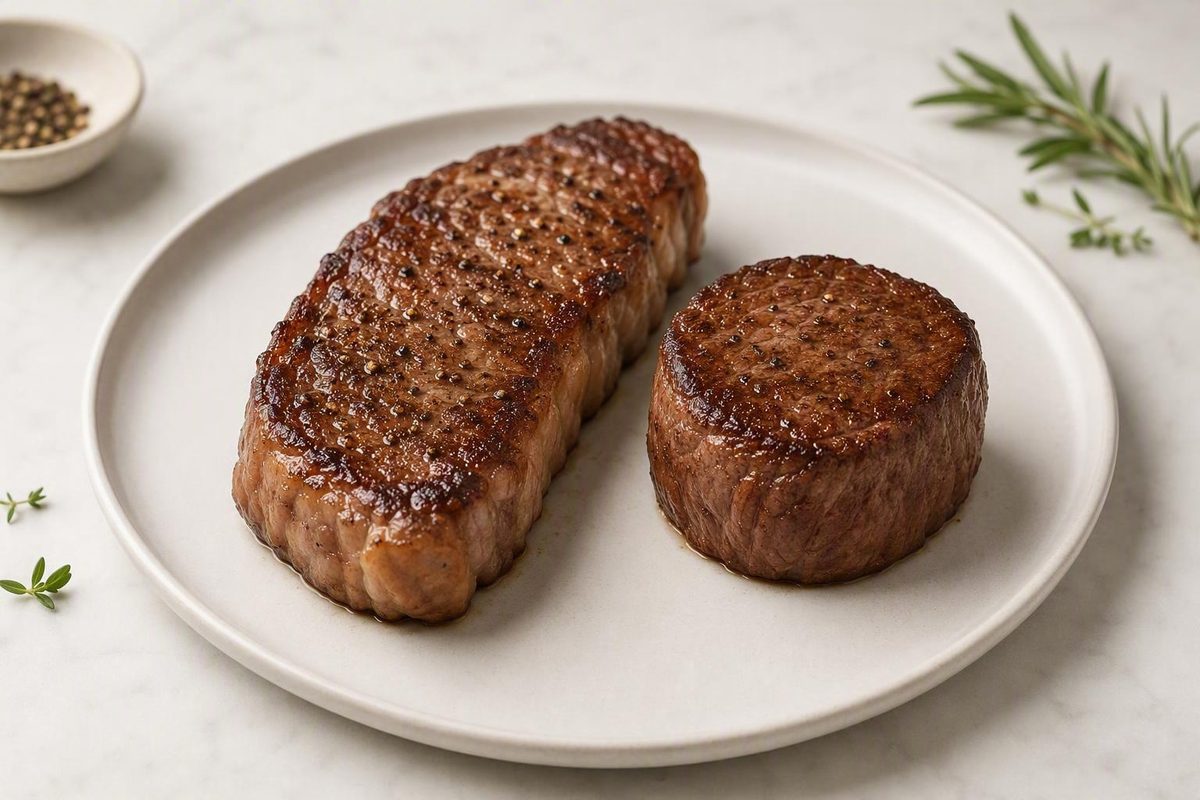
Strip is beefier and firmer; filet is softer and milder. The calorie and fat gap is about 10 kcal per 3 oz and flips by dataset. Scale any portion here.
Choose filet mignon when you want the softest bite, a mild flavor that takes sauce and seasoning well, and little visible edge fat. Choose New York strip when you want a firmer chew and stronger beef flavor from its marbling and fat band. On nutrition, there is no reliable winner: the published comparisons differ by roughly 10 calories and 1–2 grams of fat or protein per serving, and the direction flips depending on which dataset you read. Portion size, grade, trim and cooking fat move the numbers more than the cut name does.
Pick a dataset and enter your cooked portion; both cuts update side by side.
Strip vs filet by portion
Basis: 3 oz (85 g) cooked; grade, trim and cooking method unspecified.
8 oz (227 g) cooked, scaled from the 3 oz cooked record
| Per portion | Strip | Filet | Filet − strip |
|---|---|---|---|
| Calories | 427 | 453 | +27 |
| Fat (g) | 16.0 | 18.7 | +2.7 |
| Protein (g) | 66.7 | 69.3 | +2.7 |
Linear scaling of one record (~); assumes the same trim and composition at every weight. Butter, oil, sauce and sides are not included. Sources: cheatdaydesign.com 3 oz cooked estimate; mensjournal.com 100 g raw trimmed, Aug 8, 2024; signos.com values as listed. None is a matched USDA comparison.
Filet for Tenderness, Strip for Beef Flavor
The trade is texture against flavor intensity. Culinary sources consistently describe filet as softer and milder, and strip as firmer with more pronounced beef flavor (comparison of filet mignon and New York strip characteristics).
| Priority | New York strip | Filet mignon |
|---|---|---|
| Source cut | Boneless top loin (strip loin) | Tenderloin |
| Texture | Firm but tender | Soft, minimal resistance |
| Flavor | Robust, beef-forward | Mild, delicate |
| Visible fat | Edge fat band plus marbling | Little edge fat |
| Shape | Flatter, elongated | Compact, round, often thick |
| Cooking fit | Direct grilling or pan-searing | Sear, then oven-finish if thick |
These are culinary assessments, not results of a controlled sensory trial. Individual steaks vary: a well-marbled filet and a closely trimmed strip will not fit every generalization.
Price is also hard to generalize. One source describes filet as among the more expensive cuts, but the evidence includes no matched current prices. For a budget-first decision, compare the same grade and weight at your own counter and factor in how much exterior fat you will trim or discard.
Where Each Cut Comes From
A New York strip is a boneless top-loin or strip-loin steak. The same cut is sold as “top loin steak,” “strip steak,” or “New York strip.” It is not the same as top sirloin, which is a separate cut despite loose restaurant use of “sirloin.”
A filet mignon is an individual steak cut from the tenderloin. “Tenderloin” can mean the whole muscle or a roast; filet mignon means a steak from it. Nutrition values for a whole tenderloin roast should not be assigned to every filet steak.
A T-bone or porterhouse shows both muscles at once: the bone separates strip on one side from tenderloin on the other, and the porterhouse carries a larger tenderloin section. It is the option if you want both textures on one plate, at the cost of a large total portion.
The USDA’s September 2011 retail-beef dataset keeps separate records for short-loin top-loin steaks and tenderloin steaks, confirming these are distinct cuts rather than alternate names (USDA Nutrient Data Set for Retail Beef Cuts).
Texture, Flavor, and Visible Fat
Filet is the tenderness-first option: uniform texture, very little chewing resistance. Because it is mild, browning, seasoning, a sauce or a butter finish carries much of the flavor. Note that those additions carry calories the steak record does not.
Strip stays tender but has a more substantial bite, which is the appeal for diners who find filet almost too soft. Its internal marbling and edge fat band, especially once rendered and browned, are what culinary sources credit for its stronger beef flavor.
Visible fat is not measured fat in the portion you eat. A filet looks leaner because it lacks the strip’s obvious edge band, but appearance does not prove fewer calories or grams of fat. Grade, intramuscular marbling, trimming, serving weight and whether you eat the edge fat all change the result.
Why the Nutrition Numbers Do Not Pick a Winner
Neither cut is universally leaner on the available evidence. The figures below are source-specific secondary estimates, not a matched USDA comparison. Their serving bases and methods differ, so the rows cannot be blended into one ranking.
| Dataset and basis | New York strip | Filet mignon |
|---|---|---|
| 100 g raw, trimmed (August 8, 2024 source) | 143 kcal; 5.7 g fat; 23.1 g protein | 143 kcal; 6.5 g fat; 22.1 g protein |
| Basis not restated (commercial health-site estimate) | 180 kcal; 8 g fat; 25 g protein | 180 kcal; 7 g fat; 27 g protein |
| 3 oz cooked (third-party cooked estimate) | 160 kcal; 6 g fat; 25 g protein | 170 kcal; 7 g fat; 26 g protein |
The raw comparison puts both at 143 calories per 100 g, with strip 0.8 g lower in fat and 1 g higher in protein. Its stated method covers trimmed raw meat with intramuscular fat excluded, so it may bear little resemblance to a visibly marbled retail steak.
The second source reverses the ranking: both at 180 calories, filet 1 g lower in fat and 2 g higher in protein. The page uses 3.5-ounce servings elsewhere but does not restate the basis beside these entries, so the numbers are not interchangeable with the other rows.
The cooked source puts strip 10 calories and 1 g of fat lower per 3 oz, with filet 1 g higher in protein. A shared serving weight does not mean the steaks were matched for grade, trim, cooking method or endpoint temperature.
Differences of about 10 calories or 1–2 g of fat or protein are too small, and too dependent on the chosen record, to support a health ranking. Scaled from 3 to 8 cooked ounces using the cooked source, filet lands roughly 27 calories, 2.7 g of fat and 2.7 g of protein above strip. That is linear scaling, assuming identical composition and trim at the larger weight. A tablespoon of butter, a rich sauce or a larger steak outweighs it.
Never compare a raw value for one cut with a cooked value for the other. Match both the weight and the state of the meat.
Grade, Trim, and Cooking Change the Numbers More Than the Cut
Before selecting a database entry, check its serving weight, raw or cooked state, USDA quality grade, exterior-fat trim, whether it covers the whole edible portion or separable lean only, the cooking method, and any butter, oil, glaze or sauce.
USDA quality grades and nutrient-based lean labels answer different questions. Prime, Choice and Select describe marbling and quality characteristics: Prime has the most visible marbling, Choice less, Select the least of the three.
A healthcare article summarizing U.S. labeling criteria describes a “lean” beef serving as 3.5 ounces with less than 10 g total fat, 4.5 g saturated fat and 95 mg cholesterol. That is a secondary summary rather than the regulation itself, so treat it as a label guide rather than a complete statement of every condition (summary of beef grades and lean-label thresholds). A heavily marbled Prime strip and a closely trimmed Select strip share a name and little else nutritionally.
Cooking adds its own variation. Steak loses moisture as it cooks, so fat per 100 g rises in the finished meat even though no fat was added. USDA-affiliated research found that moisture, fat concentration and cooking yield varied with cut, exterior-fat trim, cooking method and endpoint temperature. Its tenderloin roast and top-loin steak were prepared under different protocols, so those values are not a direct filet-versus-strip comparison either (USDA-affiliated research on cooking yield, fat, and moisture).
How to Log Either Steak Consistently
- Weigh or estimate the edible cooked portion, excluding bone and any exterior fat you leave on the plate.
- Pick the database record closest in cut, grade, trim and cooking method.
- Log butter, oil, sauce, toppings and sides as separate entries.
- Stay with one logging convention, cooked-to-cooked or raw-to-raw, rather than switching between unlike records.
A consistent method improves a food log more than hunting for one supposedly universal steak value.
Cooking and Buying Each Cut
Both steaks take high heat, but shape governs the method. A filet is thick and compact: sear for browning, then finish with gentler oven heat so the center cooks evenly. A strip is flatter and suits direct high heat on a grill or in a skillet. Actual thickness and your equipment matter more than the cut name.
At the counter, compare the steaks in front of you. Thicker steaks give more time to brown before the center overcooks; evenly shaped steaks cook more predictably than ones with a thin tail. Look at the fine white streaks inside the muscle, not only the exterior fat, since marbling changes richness and the applicable nutrition record. For strip, decide whether the fat band is something you will eat or trim. Compare price on the same grade and weight, ideally per edible ounce rather than sticker price.
Filet for minimal chew, mild flavor, a compact shape and less visible fat. Strip for stronger beef flavor, a firmer bite and direct-grilling ease. Current local prices, grade, aging, size, trimming and edible yield decide which is the better buy; the cut name alone does not.