
Reported McDonald’s Fast Food Meals Under 500 Calories and Verification Tips
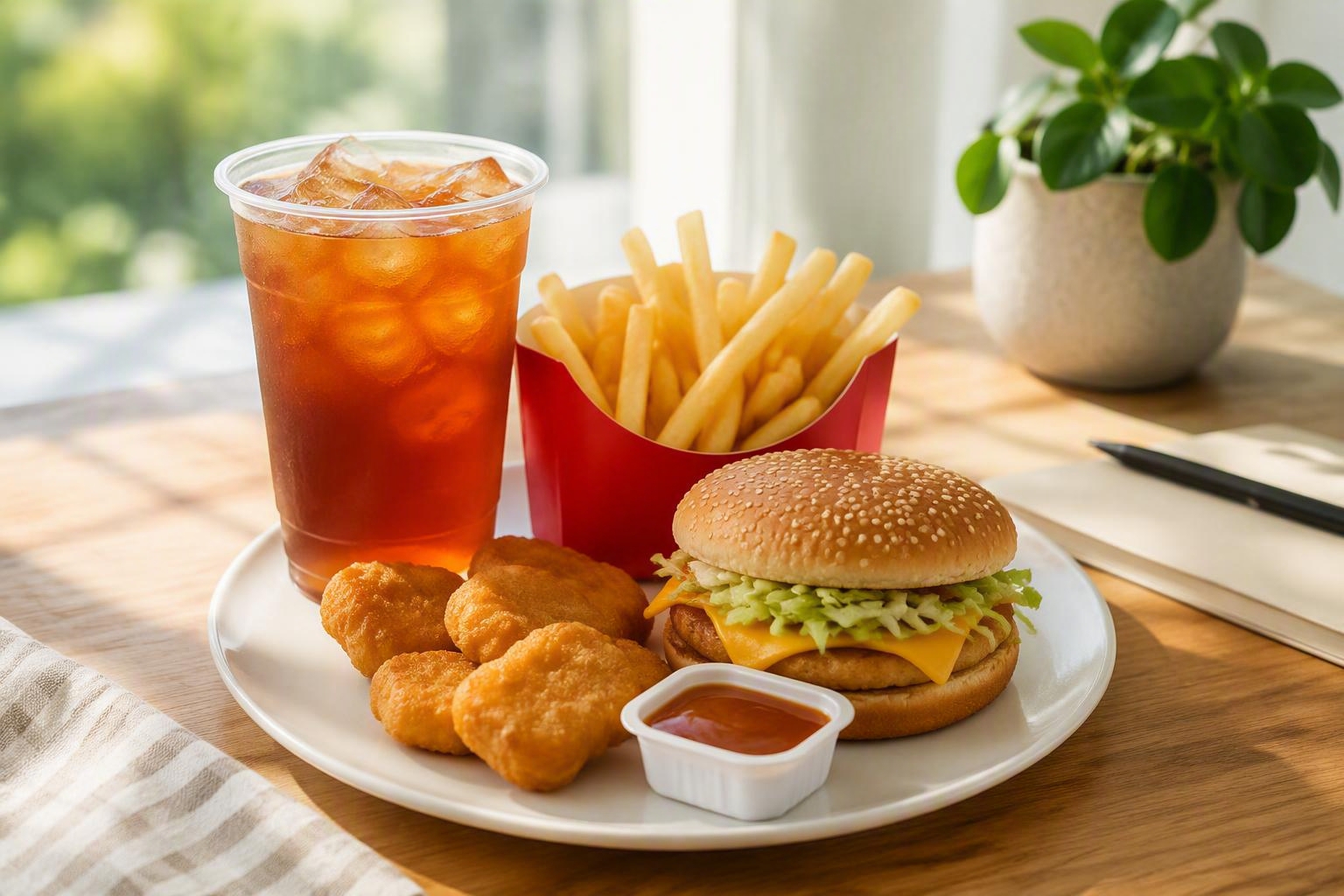
A plain hamburger with apple slices totals 265 calories, leaving roughly 235 calories of headroom. Sauces, drinks and local values can change the final count.
Overview
Several complete McDonald’s orders can total under 500 calories, including a six-piece Chicken McNuggets with sauce and a medium sweet tea at a reported 390 to 480 calories, and a plain hamburger with apple slices and water. The deciding factor is whether every component (main, side, sauce, and drink) is counted, and whether the figures match the current local menu.
The distinction matters because most published lists mix standalone items with full orders. A 250-calorie hamburger is not a 250-calorie meal once fries, a dipping sauce, or a sweetened drink is added. McDonald’s own U.S. nutrition pages also state that serving sizes, preparation techniques, regional and seasonal differences, and periodic formulation changes can all affect nutrition values, and that some menu items are only available at participating restaurants.
This guide separates supported complete-meal examples from standalone item figures, shows the arithmetic behind each combination, compares the limited protein data available in the source material, and explains how to verify totals in the McDonald’s nutrition calculator before ordering.
Under-500-calorie meal decision matrix
The combinations below are the complete orders that the available source material supports, with itemized arithmetic where the source provides it. None of these rows should be treated as a currently verified official total; each reflects figures reported by the cited publication, and McDonald’s states that nutrition values vary by region, season, and formulation.
| Meal | Main | Side | Sauce | Drink | Reported total | Source and status |
|---|---|---|---|---|---|---|
| McNuggets meal | 6-piece Chicken McNuggets (270 cal) | None | 1 sauce packet (10–100 cal) | Medium sweet tea (110 cal) | 390–480 cal | Get Healthy Clark County, U.S. figures; itemized; verify current values |
| McNuggets and fries meal | 4-piece McNuggets | Small fries | 1 sauce packet | Diet Coke | 465–480 cal | Spoon University, reported total only; components not itemized |
| Hamburger meal | Plain hamburger (250 cal) | Apple slices (15 cal) | None | Water (0 cal) | 265 cal (derived) | Item figures from MyOrthrive and Healthline; total is this article’s sum, not a published meal total |
| Egg McMuffin meal | Egg McMuffin | None | None | Black coffee or unsweetened iced tea | Under 320 cal | MyOrthrive, breakfast hours only; see breakfast section |
The hamburger row shows how the arithmetic works: MyOrthrive reports the plain hamburger at 250 calories and apple slices at 15 calories, and 250 + 15 + 0 = 265, leaving roughly 235 calories of unused allowance. The two McNuggets rows illustrate why sauce and drink choices dominate the spread; the Clark County meal ranges 90 calories depending on the sauce packet alone.
Note the calorie conflict in the source material: Get Healthy Clark County lists the six-piece McNuggets at 270 calories, while MyOrthrive reports 250 calories. That 20-calorie gap is small relative to a 500-calorie budget, but it demonstrates why editorial figures should be checked against McDonald’s current calculator rather than reused as fixed facts.
Breakfast choices under 500 calories
Two breakfast items recur in the source material as sub-500-calorie choices when paired with a zero-calorie drink: the Egg McMuffin and the fruit and maple oatmeal. Both depend on breakfast-hour availability, which McDonald’s pages do not confirm for individual locations, so the serving window should be checked locally.
| Breakfast order | Reported calories | Reported protein | Drink pairing | Source |
|---|---|---|---|---|
| Egg McMuffin + black coffee or unsweetened iced tea | Under 320 cal total; 310 cal for the sandwich alone | 17 g | Zero-calorie drink keeps the total at the sandwich figure | MyOrthrive; Train With Dave |
| Fruit and maple oatmeal + water | 320 cal per serving | 6 g | Water adds nothing to the total | Healthline |
Both orders leave meaningful headroom under 500 calories. The Egg McMuffin at a reported 310 calories leaves 190 calories unallocated; the oatmeal at 320 leaves 180. Healthline notes the oatmeal also provides 4 grams of fiber, which the other breakfast option does not match in the supplied data. The tradeoff between them is covered in the protein comparison below. Neither figure includes any add-on such as a hash brown or a sweetened McCafé drink, and the sources do not supply current calorie values for those additions, so any expanded breakfast order needs its own lookup in the nutrition calculator.
Standalone items are not complete meals
An item-level calorie figure describes one component, not an order. Several sources present the numbers below in “healthy options” lists, and readers frequently mistake them for finished meal totals. Each figure leaves the side, sauce, and drink uncounted.
| Item | Reported calories | Source | Note |
|---|---|---|---|
| Plain hamburger | 250 | Healthline; MyOrthrive | Sandwich only |
| 6-piece Chicken McNuggets | 250 (MyOrthrive) vs. 270 (Get Healthy Clark County) | Both listed | Conflicting figures; excludes sauce |
| Egg McMuffin | 310 | Train With Dave | Sandwich only |
| Fruit and maple oatmeal | 320 | Healthline | Single serving |
| Apple slices | 15 | MyOrthrive | Side item |
The practical rule: a standalone figure sets the floor of an order, not its total. A 250-calorie entrée becomes a 500-calorie order quickly once a medium sweet tea (110 calories per Get Healthy Clark County) and a honey sauce packet (around 60 calories per MyOrthrive) join it, and fries would push further. Only the sum of every selected component determines whether the order stays under the limit.
Count every side, sauce, and drink
The 500-calorie limit applies to the full tray, so every component needs a number before ordering. The most common accounting error in the source lists is treating sauces and drinks as free. MyOrthrive reports that barbecue and sweet ‘n sour sauce packets range from 45 to 50 calories each, and honey adds around 60. Get Healthy Clark County shows sauce packets spanning 10 to 100 calories depending on the choice, a range wide enough to decide whether a McNuggets order clears the threshold.
Drinks are the other large variable. Get Healthy Clark County lists a medium sweet tea at 110 calories and cautions that soda is empty calories, while MyOrthrive notes that black coffee, unsweetened iced tea, and water contribute zero calories. A single sweetened medium drink can consume roughly a fifth of the entire allowance before any food is counted.
A workable counting sequence:
- Start with the main and record its listed calories.
- Add the side (fries or apple slices), using its own listed figure.
- Add every sauce or condiment packet individually, including extras.
- Add the drink at the specific size ordered, since calories scale with size.
Two refinements make the total more reliable. First, do not build the order to exactly 495 to 500 calories. McDonald’s states on its nutrition calculator page that variation in serving sizes, preparation techniques, sources of supply, and regional and seasonal differences may affect nutrition values, so an order designed with no margin can drift over the limit in practice. Second, count what is actually handed over, not what was planned; an extra sauce packet added at the counter belongs in the total.
Customize the order without losing the calorie limit
Substitutions preserve calorie allowance most reliably at the side and drink positions, because those swaps use standard menu items with listed values. Healthline recommends skipping the cheese and pairing a hamburger with apple slices instead of fries; MyOrthrive lists apple slices at 15 calories. On the drink side, MyOrthrive identifies water, black coffee, and unsweetened iced tea as zero-calorie pairings, and Train With Dave’s general guidance for fast food orders is to skip sauces and dressings, pick grilled over fried, and swap high-calorie sides for apple slices or fruit.
A useful distinction separates two kinds of numbers here:
- Standard-menu values: figures for unmodified items as listed by McDonald’s, which its calculator states are based on standard product formulations and serving sizes.
- Customization estimates: editorial figures for modified orders, such as MyOrthrive’s estimate that a bunless McDouble drops to around 270 to 300 calories. These are approximations, since McDonald’s published values describe standard builds, not component-by-component subtractions.
Customization estimates are directionally useful but should carry less confidence than standard-menu figures. Removing a bun, cheese slice, or mayonnaise reduces calories, and the sources support those moves as strategies, but the exact resulting number is not an official figure. When a modified order sits close to the 500-calorie line, the safer approach is to choose a combination whose standard components already total comfortably below the limit, then apply the modification as extra margin rather than as the mechanism that gets the order under the threshold.
Compare protein and other nutrition tradeoffs
Among items with both calorie and protein figures in the source material, the Egg McMuffin and the six-piece McNuggets are the two comparable options, and they land close together on protein relative to calories. The table uses only the reported figures and shows the derivation for the per-calorie column.
| Item | Reported calories | Reported protein | Protein per 100 cal (derived) | Sources |
|---|---|---|---|---|
| Egg McMuffin | 310 | 17 g | 17 ÷ 3.10 ≈ 5.5 g | Train With Dave |
| 6-piece Chicken McNuggets | 250 (MyOrthrive) or 270 (Clark County) | 14 g | 14 ÷ 2.50 = 5.6 g, or 14 ÷ 2.70 ≈ 5.2 g | MyOrthrive; Healthline (protein); Get Healthy Clark County (270 cal) |
| Fruit and maple oatmeal | 320 | 6 g | 6 ÷ 3.20 ≈ 1.9 g | Healthline |
The per-100-calorie column is this article’s calculation from the reported inputs, not a published metric, and the McNuggets result depends on which conflicting calorie figure is used. On these numbers, the Egg McMuffin and McNuggets are effectively similar in protein density, while the oatmeal is a fiber-oriented choice rather than a protein one: Healthline reports 4 grams of fiber alongside its 6 grams of protein. MyOrthrive describes the Egg McMuffin as having one of the stronger calorie-to-protein ratios on the menu, which is consistent with the arithmetic above.
A sub-500-calorie total does not resolve the rest of the nutrition picture. Healthline cautions that most items at the chain remain high in sodium, saturated fat, added sugar, or cholesterol, and Train With Dave notes that fast food meals tend to be higher in sodium and lower in micronutrients than home-cooked dishes. The supplied sources do not provide complete-meal totals for sodium, saturated fat, or added sugar for any of the combinations in this guide, so those values remain unquantified here. MyOrthrive’s benchmark for a stronger choice (under 500 calories with sodium below 700 mg and 20-plus grams of protein) is a useful target, but no listed combination can currently be confirmed against it with the available data.
Verify nutrition and local availability before ordering
Every figure in this guide should be checked against McDonald’s current tools before it drives an order, because both the numbers and the menu itself change. The U.S. nutrition calculator lets a reader add each planned component (main, side, sauce, drink) and see a running total for calories, protein, carbohydrates, and fat. That page states its information is based on standard product formulations, that fountain-beverage calories assume standard fill levels plus ice, and and that variation in serving sizes, preparation techniques, sources of supply, and regional and seasonal differences, along with periodic formulation changes, may affect the nutrition values for each product. McDonald’s separate nutrition and ingredients page adds that some menu items may only be available at participating restaurants, that beverage sizes may vary by market, and that its own text is dated February 2015 unless stated otherwise. Neither page identifies which items a specific restaurant currently sells, so the local menu or app remains the final check.
Guidance also differs by market. McDonald’s UK answers the lower-calorie question with a dedicated Meals Under category page covering meals under 400 kcal and under 600 kcal, thresholds that do not map onto U.S. menu listings. A reader outside the U.S. should use their own market’s site rather than the figures reported here.
Menu churn is the clearest reason not to reuse older recommendations. Healthline reports that McDonald’s discontinued many of its lighter selections, including its signature salads and fruit and yogurt parfaits, and MyOrthrive states that salads disappeared from U.S. menus in 2024. Any older list built around a side salad or parfait now describes an order that may not be purchasable. The same logic applies in reverse to the figures in this guide: treat each row as a reported example with a stated source and market, confirm the items exist on the local menu, and rebuild the total in the calculator before treating the order as under 500 calories.