
Protein Doritos Change the Macros, Not the Calories
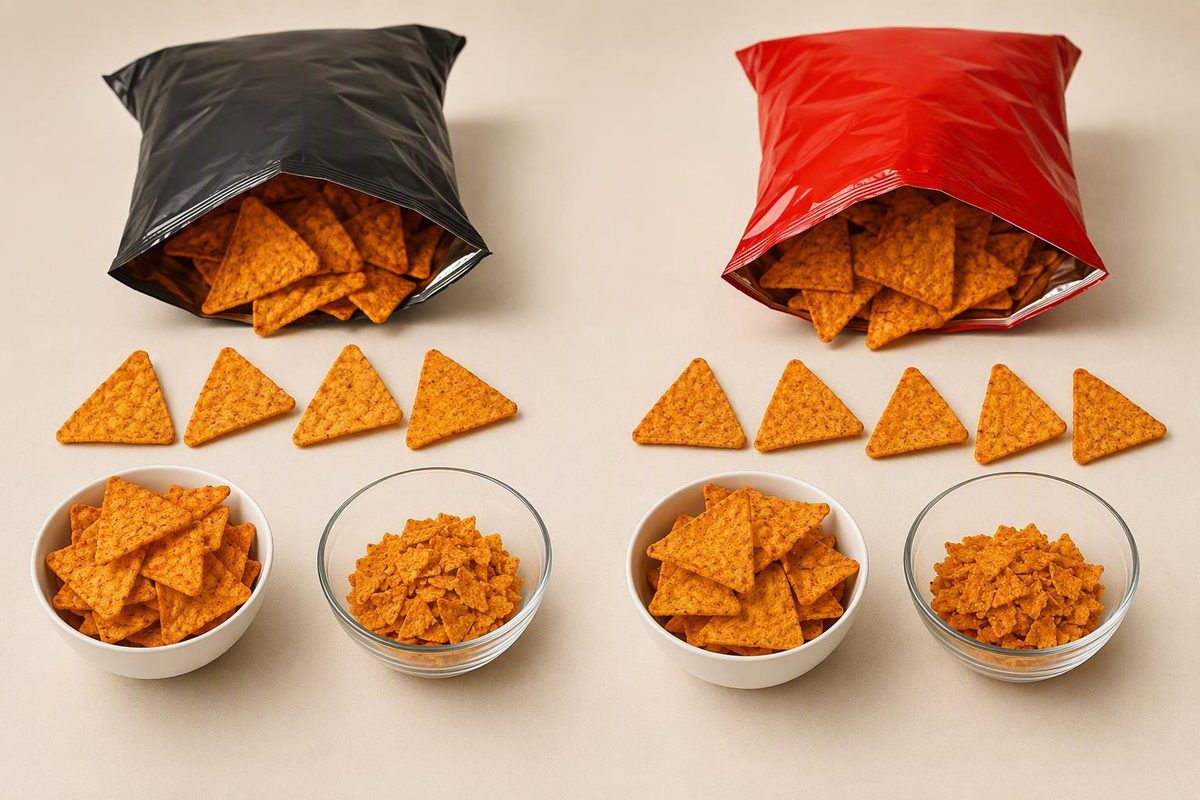
Protein Doritos and regular Nacho Cheese Doritos each list 150 calories per serving. Compare protein, carbs, portion sizes, and whole-bag totals.
No. Protein Doritos and regular Nacho Cheese Doritos are both reported at 150 calories per labeled serving. The protein version supplies 10 grams of protein instead of 2 grams, roughly swaps 9–10 grams of carbohydrates for milk-derived protein, and includes about one or two fewer chips per serving. The verdict is same calories, different macros, smaller chip count.
Choose how many chips you eat, adjust the regular-Doritos serving basis, or enter another chip label to compare the totals.
Doritos Portion And Protein Calculator
The labeled servings both contain 150 calories. Chip-count results are estimates because the reported counts are approximate.
Protein Doritos basis: about 10 chips per 150-calorie serving.
Sources differ, so both reported counts are available.
At 10 chips: Protein Doritos are ~150 calories with ~10 g protein; regular Doritos are ~136 calories with ~1.8 g protein using the 11-chip basis.
These equal-chip estimates do not overturn the label comparison: each product lists 150 calories for its own serving. Weighing the portion is more reliable.
Sortable Label Comparison
| Carbs | Fat | Approx. chips | |||||
|---|---|---|---|---|---|---|---|
| Protein Doritos | 150 | 10 g | 8 g | 8 g | ~10 | 15 | ~1,050 (7 oz) |
| Regular Nacho Cheese Doritos | 150 | 2 g | 17–18 g | 8 g | ~11–12 | 75 | — |
| Another protein chip | — | — | — | — | — | — | — |
Add Another Chip Label
Enter the current package values to calculate calories per gram of protein and calories per bag.
Sources: nutrition figures attributed to PepsiCo by USA TODAY; alternate regular-chip count from Sporked; 7-ounce Protein Doritos package reported by Stack3d. “~” marks estimates; “—” means not available.
Protein Doritos And Regular Doritos Both List 150 Calories
The primary comparison, using nutrition figures attributed to PepsiCo, lists the following values for each product’s own labeled serving:
| Nutrient per labeled serving | Protein Doritos | Regular Nacho Cheese Doritos |
|---|---|---|
| Calories | 150 | 150 |
| Protein | 10 g | 2 g |
| Carbohydrates | 8 g | 17 g |
| Fat | 8 g | 8 g |
| Fiber | 1 g | 1 g |
| Sodium | 150 mg | 170 mg |
| Approximate chips | 10 | 11 |
That comparison shows 8 grams more protein, 9 grams fewer carbohydrates, the same listed fat and fiber, and 20 milligrams less sodium in Protein Doritos. Both servings remain at 150 calories. USA TODAY reports these figures as information supplied by PepsiCo.
Another comparison lists 10 Protein Doritos against 12 regular Doritos and gives the regular serving 18 grams rather than 17 grams of carbohydrates. It still reports 150 calories for both, with 10 grams versus 2 grams of protein and 8 grams of fat in each serving. Sporked provides that side-by-side comparison.
The variation should not be silently corrected. It may reflect the package reviewed, label variation, or how an approximate chip count was expressed. The supported range is about 11–12 regular chips and 17–18 grams of carbohydrates per serving, compared with about 10 protein chips and 8 grams of carbohydrates.
These figures describe Protein Nacho Cheese and regular Nacho Cheese Doritos. They should not automatically be applied to every flavor, package size, or future formulation. A current package label takes priority over a reported comparison, especially because an accessible manufacturer product page with current nutrition facts was not available for independent verification.
The Protein Version Changes The Macros
Protein Doritos are a higher-protein reformulation, not a reduced-calorie version. The available comparisons consistently show:
- 10 grams of protein rather than approximately 2 grams
- 8 grams of carbohydrates rather than approximately 17–18 grams
- 8 grams of fat in both products
- 150 calories in both labeled servings
The reported protein increase is 8 grams per serving. The carbohydrate reduction is 9 or 10 grams, depending on which regular-Doritos label comparison is used. One review describes the same 8-gram protein increase and 9-gram carbohydrate reduction while listing 10 chips and 150 calories for Protein Doritos. The Impulsive Buy reports those serving figures.
Lower carbohydrate does not necessarily mean lower calorie. Protein also contributes energy, and the reported fat remains unchanged. The result is a different distribution of protein and carbohydrates without a reduction in the displayed calorie total.
Reconstructing the calorie total from rounded macro figures will not necessarily equal 150 exactly. Nutrition panels use rounded values, while third-party reports do not provide the underlying unrounded quantities or the manufacturer’s complete calculation. Use the displayed calorie line rather than treating a homemade macro calculation as more precise than the label.
The added protein is reported to be milk-derived casein. A review covering Protein Nacho Cheese and Sweet & Tangy BBQ lists casein as the protein source and reports 150 calories, 8 grams of fat, 8 grams of carbohydrates, and 10 grams of protein for the reviewed 10-chip serving. See the reviewed flavors and nutrition summary.
Anyone making an allergy-related decision should use the ingredient and allergen statements on the current package. The available reports do not establish lactose content or determine whether the product is suitable for a particular medical diet.
Fewer Chips Do Not Make The Serving Lower Calorie
A Protein Doritos serving reportedly contains about 10 chips. The regular serving is described as approximately 11 or 12 chips. Because both servings list 150 calories, the protein version provides the same labeled calories in a smaller approximate number of pieces.
Four comparisons answer different questions:
- Labeled serving versus labeled serving
- Equal weight versus equal weight
- Equal number of chips versus equal number of chips
- Whole bag versus whole bag
The 150-calorie verdict is a labeled-serving comparison. It does not mean that 10 chips of each product contain exactly the same number of calories.
Dividing 150 calories by the approximate chip count produces an estimate of about 15 calories per protein chip and roughly 12.5–13.6 calories per regular chip. Those are not manufacturer-provided per-chip values. The serving calorie figure is rounded, the chip count is approximate, and individual chips differ in weight. Broken pieces make chip-count calculations less reliable still.
The calculator above shows those estimates because chip count is how many people portion the snack. Its equal-chip results should not be logged as exact values. Weighing the portion and using the package’s gram-based serving is more defensible.
A 28-Gram Comparison Avoids The Chip-Count Problem
NutriScan lists the Protein Nacho Cheese serving as about 10 chips or 28 grams and reports regular Doritos at approximately 150 calories per 28 grams as well. See the reported 28-gram comparison and Protein Doritos panel.
Twenty-eight grams is approximately 1 ounce. If both current packages use that serving weight, their calorie and nutrient lines can be compared directly even when their labels show different approximate chip counts.
When serving weights differ, normalize each product to a common weight:
calories per serving ÷ serving grams × comparison grams
For example, a hypothetical snack containing 160 calories per 30 grams would provide approximately 149 calories per 28 grams:
160 ÷ 30 × 28 ≈ 149 calories
That is a demonstration of the method, not a nutrition figure for either Doritos product.
The same calculation works for protein, carbohydrates, fat, fiber, and sodium. Weight normalization avoids treating every chip as a standardized unit when chip sizes are not standardized.
Protein Doritos Provide More Protein Per Calorie
Although total calories do not fall, the amount of protein received for those calories changes substantially.
Protein Doritos provide 10 grams of protein for 150 calories, or 15 calories per gram of protein. Regular Nacho Cheese Doritos provide 2 grams for 150 calories, or 75 calories per gram of protein.
This ratio describes protein efficiency within the reported serving. It does not prove that Protein Doritos keep everyone fuller, cause people to eat less later, promote weight loss, improve blood sugar, preserve muscle, or produce a disease-specific benefit. Those would be outcome claims requiring evidence about people consuming this particular product, not just two nutrition panels.
For someone trying to add protein without increasing the calories in a Doritos serving, the reformulation may be useful. For someone whose only goal is to select the lower-calorie serving, neither product has an advantage in the reported comparison.
Price, flavor, ingredients, allergens, and what the snack replaces may still affect the choice. None of those considerations changes the calorie arithmetic.
A 7-Ounce Protein Doritos Bag Is About 1,050 Calories
The 150-calorie figure applies to a 1-ounce serving, not automatically to an entire package. Stack3d reports a 7-ounce bag with 150 calories per 1-ounce serving. That implies seven servings and approximately 1,050 calories:
7 servings × 150 calories = 1,050 calories
At 10 grams of protein per serving, the corresponding package total is 70 grams of protein. Stack3d reports the package size and serving information.
Those totals apply only to the reported 7-ounce format. A single-serve package, family-size bag, another flavor, or a later formulation may have a different total. For the package being eaten, use:
calories per serving × servings per container = approximate package calories
If the label says “about” seven servings, the result is also approximate. Net weight provides a useful cross-check: a 7-ounce package with a 1-ounce serving implies about seven servings.
This is the distinction between one portion and one bag are not the same. Logging “one bag” without checking its size can create a much larger error than choosing one version of Doritos over the other.
Two reported Protein Doritos servings total approximately 300 calories, 20 grams of protein, 16 grams of carbohydrates, and 16 grams of fat. Three servings total approximately 450 calories, 30 grams of protein, 24 grams of carbohydrates, and 24 grams of fat. These are arithmetic totals based on the reported per-serving values.
Use The Current Package As The Final Source
Before entering either product in a calorie tracker, confirm the exact flavor and read the serving size in grams. Compare Protein Nacho Cheese with regular Nacho Cheese rather than assuming another flavor has identical nutrition.
Check these label fields together:
| Label field | Why it changes the comparison |
|---|---|
| Serving weight | Establishes whether the calorie figures cover equal amounts |
| Approximate chip count | Helps estimate portions but is not a precise measurement |
| Calories | Answers the lower-calorie question directly |
| Protein and carbohydrate | Shows the reformulated macro balance |
| Fat and sodium | Prevents assuming every nutrient changed with the protein |
| Servings per container | Determines the approximate whole-package total |
| Ingredients and allergens | Confirms the current protein source and suitability |
If both packages list 28 grams, compare their panels directly. If their gram weights differ, normalize them before comparing. Record the number of servings actually eaten rather than relying on the product name or bag size.
Choose Protein Doritos when 10 grams of protein and fewer carbohydrates fit the planned snack better. Do not choose them on the assumption that “Protein” means fewer calories: the available comparisons put both products at 150 calories per labeled serving.