
A Practical Guide to the Many-Layered Pastry—and Its Many Forms
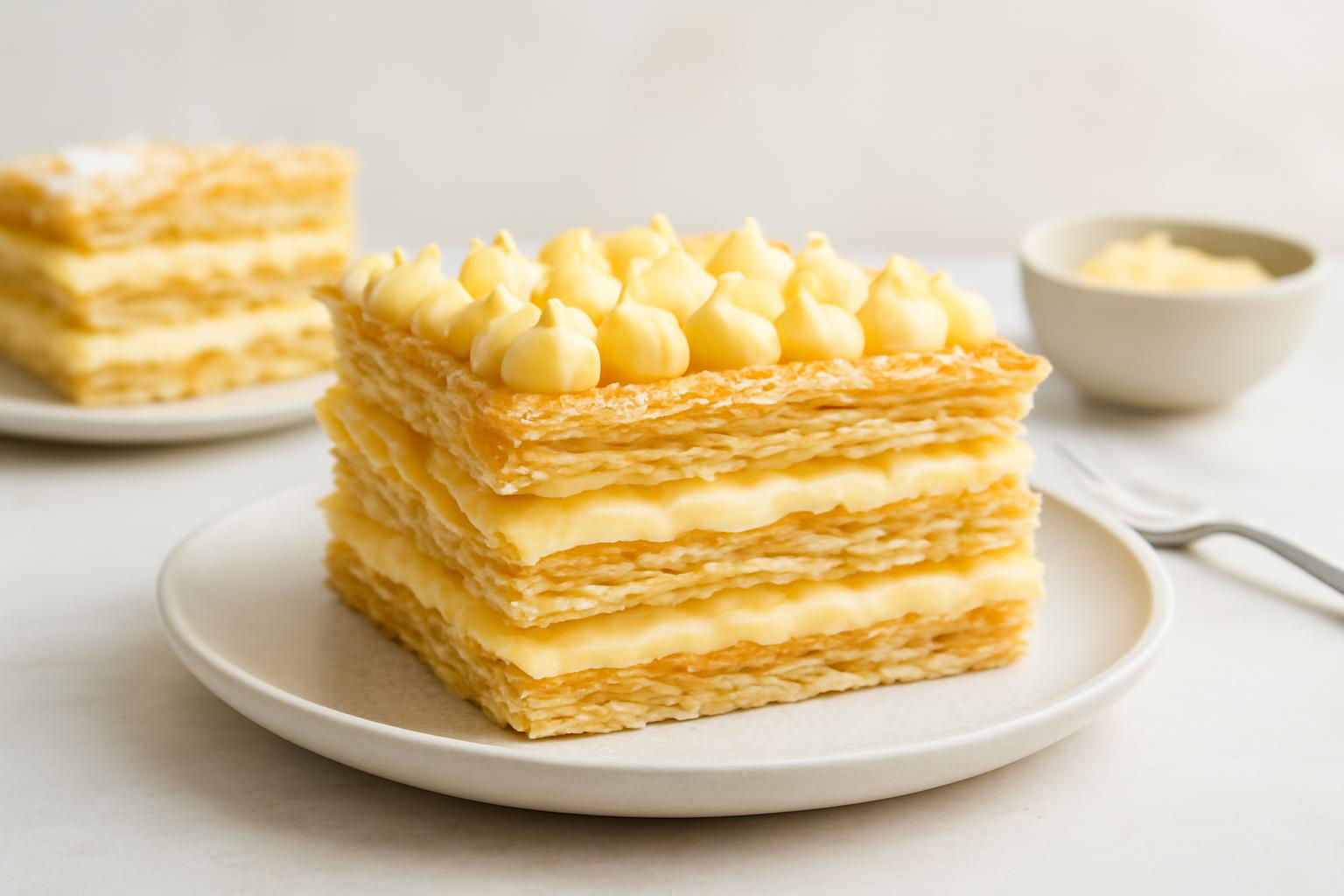
One documented version uses 12-14 separately baked rounds. Other methods split three or four baked pieces into about six or more stackable layers.
Updated July 30, 2026. This guide summarizes published recipes and bakery listings; the methods were not independently tested for this article.
What Is Mil Hojas Cake?
Mil hojas, also written milhojas, is a layered dessert made by stacking crisp pastry or thin baked dough with a sweet filling. Dulce de leche and pastry cream appear frequently, but neither defines every version.
The name is associated with “thousand leaves,” “thousand sheets,” or “thousand layers.” It refers to the appearance created by repeated sheets and laminated flakes—not a literal requirement to bake 1,000 separate tiers.
There is no single universal formula. A cake may be assembled from a few substantial pieces of puff pastry that are split after baking, or it may contain numerous sheets rolled and baked individually. One documented pastry-cream version uses 12–14 separately baked rounds, while split-pastry methods can produce approximately six or more stackable layers from three or four baked pieces.See a documented 12–14-layer construction
Mil hojas is therefore best understood as a family of layered desserts. Its base may be:
- Thin dough rolled and baked one sheet at a time
- Homemade laminated puff pastry
- Ready-rolled refrigerated puff pastry
- Frozen puff pastry
Fillings and finishes are similarly varied. Documented recipes use dulce de leche, pastry cream, jam, whipped cream, nuts, fresh fruit, powdered sugar, icing, pastry crumbs, or combinations of those ingredients.
The dessert should not be assigned one universal nationality. Individual authors and sellers may characterize particular versions as Chilean, Central American, or more broadly Latin American. Those descriptions provide context for a specific recipe or product, but they do not establish one regional convention for every cake called mil hojas.
The most useful definition is structural: mil hojas is a dessert built from repeated crisp layers and sweet filling. Its dough, filling, shape, number of visible sheets, and final texture depend on the version being made.
Mil Hojas, Mille-Feuille, and Napoleon: Related Names, Different Conventions
Mil hojas is often compared with the French mille-feuille. Both names carry the idea of “thousand sheets” or “thousand leaves,” and both refer to pastries whose repeated layers create the defining appearance.
A conventional French mille-feuille is commonly described as three layers of puff pastry alternating with two layers of pastry cream. Powdered sugar, icing, fondant, pastry crumbs, almonds, whipped cream, or decorative chocolate may finish the top, and fruit variations also exist.Review the conventional mille-feuille structure
Latin American-style mil hojas recipes can differ substantially. They may use many more separately baked sheets, replace or supplement pastry cream with dulce de leche, and add walnuts, almonds, jam, pineapple, strawberries, guava paste, coconut, or whipped cream. The dessert may be round, square, rectangular, slice-sized, or large enough for a celebration.
One Chilean-style adaptation explicitly connects mil hojas with mille-feuille while combining puff pastry with dulce de leche, dulce-de-leche pastry cream, brandy, and walnuts. Its baked pastry discs are split horizontally, distinguishing it from both a conventional three-tier mille-feuille and a cake made from 14 individually baked sheets.
Napoleon, vanilla slice, custard slice, and cream slice are related terms used in some places. Their meanings are not consistent enough to assume that every item sold under one of those names has the same filling, dimensions, or layer count as mil hojas.
| Name | Documented construction | Recurring filling | Caution |
|---|---|---|---|
| Mil hojas or milhojas | Individually baked thin sheets, laminated pastry, or baked puff pastry split into thinner layers | Dulce de leche, pastry cream, jam, fruit, or combinations | Recipes and regional conventions vary substantially |
| Mille-feuille | Commonly three puff-pastry layers alternating with two filling layers | Pastry cream | Modern and regional versions change the fillings and finishes |
| Napoleon | Often a layered puff-pastry dessert | Custard, cream, almond filling, jam, or other local choices | The name is not universally distinguishable from mille-feuille |
| Vanilla, custard, or cream slice | Usually a slice-format dessert with cream or custard between pastry layers | Vanilla custard, pastry cream, or whipped cream | Structure and terminology depend on the country and bakery |
Origin stories should be treated cautiously. Published summaries offer competing French, Hungarian, Italian, and other connections, and some rely on tertiary or mixed-quality references. Those unresolved historical questions are not necessary for understanding the dessert in practice. What can be said with greater confidence is that similarly named layered pastries have developed different local conventions.
Doughs, Fillings, and Finishes You May Encounter
Mil hojas recipes generally follow one of two base styles: individually rolled thin dough or laminated puff pastry.
Thin-dough recipes create each visible cake layer separately. The baker divides prepared dough into multiple portions, rolls each one into a thin circle or sheet, docks it if instructed, and bakes it until dry or lightly colored. The resulting sheets tend to form a compact, regular cake outline.
Puff pastry contains repeated layers of dough and fat. It may be made from scratch or purchased ready-rolled or frozen. Some recipes roll laminated pastry very thin and bake the sheets separately. Others bake thicker pieces, cool them, and split them horizontally. These techniques produce different structures even when both desserts are called mil hojas.
One Chilean-style thin-dough formula uses flour, butter, egg yolks, milk, rum or pisco, and salt. That is one documented family recipe, not a universal ingredient list. Other versions use laminated dough containing flour, butter, water, and salt, while shortcut recipes begin with packaged puff pastry.
Recurring fillings
Dulce de leche and pastry cream are the most recurrent fillings among the documented recipes.
Some versions flavor pastry cream with dulce de leche, allowing both styles to appear in the same cake.
Other documented additions include:
- Chopped walnuts or toasted almonds
- Plum or rhubarb jam
- Strawberry jam or fresh strawberries
- Pineapple
- Guava paste
- Whipped cream
- Coconut or coconut jam
- Banana
- Mango
- Rum, pisco, or brandy
- Powdered or icing sugar
- Pastry crumbs
- Decorative icing
How the filling changes the result
The filling affects more than flavor.
| Filling or addition | Flavor profile | Documented accompaniments | Effect on crispness | Ingredients to check |
|---|---|---|---|---|
| Dulce de leche | Sweet, concentrated caramelized-milk flavor | Walnuts, pastry cream, brandy, fruit, crumbs | Contact surfaces soften gradually after assembly | Milk; alcohol if liquor is added |
| Pastry cream | Creamy, custard-like, often vanilla-forward | Dulce de leche, almonds, fruit, icing sugar | Adds substantial moisture and softens pastry over time | Milk, eggs; sometimes wheat or cornstarch |
| Whipped cream | Light-textured and dairy-rich | Pineapple, strawberries, pastry cream | Adds moisture, making assembly timing important | Milk |
| Jam or preserves | Sweet-tart or fruit-forward | Dulce de leche, cream, nuts | Effect varies with the preserve and quantity used | Fruit and packaged additives |
| Fresh fruit | Bright, juicy, and sometimes tart | Cream, whipped topping, dulce de leche | Juice can accelerate softening | Fruit; accompanying fillings may add other allergens |
| Walnuts or almonds | Toasted, rich, and nutty | Dulce de leche, pastry cream, powdered sugar | Adds crunch but does not stop moisture migration | Tree nuts |
| Guava paste and coconut | Fruity and concentrated in sweetness | Whipped cream or dulce de leche in some versions | Depends on moisture and placement | Fruit, coconut, and packaged-label ingredients |
| Rum, pisco, or brandy | Aromatic and warming | Dough or dulce de leche | Generally used as flavoring rather than the main filling | Alcohol |
None of these choices is mandatory or universally authentic. The practical question is what kind of dessert you want: crisp and caramel-rich, custard-softened, fruit-forward, nutty, or a combination.
Method One: Fourteen Thin Dough Layers with Dulce de Leche and Walnuts
This method summarizes one Chilean-style family recipe. It illustrates individually baked thin-dough mil hojas, but it is not the definitive method for every cake carrying the name.
Ingredients and source-specific measurements
For the dough:
- 375 grams all-purpose flour
- 226 grams unsalted butter
- 3 egg yolks
- ¾ cup milk
- 1 tablespoon rum or pisco
- A pinch of salt
For the filling and finish:
- 3 cups dulce de leche
- 2½ cups chopped walnuts
- ¼ cup powdered sugar
The recipe minimizes warm-hand contact with the dough, chills it overnight or for at least six hours, divides it into 14 portions, and rolls each portion into an 8- to 9-inch circle. Each sheet is baked separately at 350°F or 180°C for 5–7 minutes. Assembly uses approximately 3–4 tablespoons of dulce de leche between layers, with walnuts added after every three layers.Follow the complete thin-dough recipe
Step 1: Mix the dough briefly
Combine the flour and salt, then work in the butter, egg yolks, milk, and rum or pisco until a medium-consistency dough forms.
The source calls for a fork, two knives, or a stand mixer rather than prolonged mixing by hand. If using a mixer, stop once the ingredients come together rather than continuing as though developing bread dough.
Step 2: Chill thoroughly
Wrap the dough and refrigerate it for the prescribed period. This is not a quick dough unless it is mixed early enough to receive the full chilling time.
If the dough becomes very soft during shaping, pause and chill it again rather than continuing to handle a warm, greasy sheet.
Step 3: Divide and roll
Divide the chilled dough evenly and roll the portions into circles of similar size. Consistency makes stacking easier, but small differences can be disguised with the exterior coating and crumbs.
Move the thin sheets carefully. Once baked, they are expected to be delicate.
Step 4: Bake each sheet separately
Bake according to the source recipe rather than substituting the temperature from a packaged puff-pastry method. Thin homemade dough and commercially laminated pastry are different products and do not share one universal baking schedule.
Watch the first sheet closely. Thin layers can move from lightly baked to overly browned quickly, and the first one provides useful information about how the oven is behaving.
Step 5: Assemble the cake
Place one cooled sheet on a level serving plate and spread it with dulce de leche. Add another sheet and continue stacking, incorporating walnuts at the intervals specified by the recipe.
A brittle sheet may crack while being positioned. Small cracks can remain inside the stack, while loose fragments can be reserved for decorating the exterior.
Step 6: Finish the exterior
Coat the outside with dulce de leche. Apply chopped walnuts and reserved crumbs, then finish with powdered sugar.
This creates a unified appearance even when the rounds are not perfectly identical. It also reinforces the defining flavor profile of this particular recipe: crisp dough, dulce de leche, and walnuts.
Adaptations and allergen limits
This formula includes wheat, milk, eggs, tree nuts, and alcohol. Omitting the rum or pisco removes the specified liquor from the home formula. Omitting walnuts removes that named ingredient, but neither change establishes that the finished dessert is safe for someone with an allergy or other dietary restriction.
Packaged ingredients, substitute products, utensils, surfaces, and preparation environments may introduce additional ingredients or cross-contact.
No universal yield or calorie count should be attached to this method. Its recipe page displays nutrition information without identifying the serving size represented by the figures.
Method Two: Faster Mil Hojas with Store-Bought Puff Pastry
Yes, mil hojas can be made with ready-made puff pastry. Multiple recipes use ready-rolled or frozen pastry, but their methods should not be blended into an untested hybrid.
Choose one complete pathway and follow its corresponding dimensions, temperature, timing, and filling sequence.
Pathway A: Puff-pastry discs with two dulce de leche fillings
Claire Clark’s version starts with ready-rolled all-butter puff pastry. The pastry is cut into 18-centimeter discs, baked at 180°C for 20–25 minutes, cooled, and split horizontally into thinner sheets.
The cake alternates:
- Dulce de leche mixed with brandy
- Pastry cream flavored with dulce de leche
Chopped toasted walnuts are added between selected layers, and the cake is finished with icing sugar and more walnuts. The method calls for three or four baked discs, each split in two, producing approximately six to eight thinner pastry layers.See the ready-rolled puff-pastry method
This adaptation combines elements associated with mille-feuille and dulce-de-leche mil hojas. It is not texturally identical to the 14-sheet thin-dough cake: the laminated pastry begins thicker, rises during baking, and is then divided into stackable pieces.
Pathway B: Frozen puff-pastry strips with pineapple
A second shortcut uses one 17.3-ounce package of frozen puff pastry. The thawed pastry is cut into strips along its folds, pierced with a fork, and baked at 400°F for about 15 minutes, or until golden. After cooling, each piece is split into two thinner layers.See the pineapple puff-pastry method
Its filling sequence combines:
- Cooled pastry cream
- Fresh diced pineapple
- Whipped topping
- Warmed dulce de leche added immediately before serving
The pastry cream is cooked, cooled completely, and chilled before assembly. The whipped topping is prepared separately. This produces a fruit-and-cream dessert rather than a direct shortcut for the walnut-filled thin-dough cake.
What the shortcut methods share
Both methods:
- Begin with commercially prepared laminated pastry.
- Bake a small number of substantial pieces.
- Cool those pieces before filling.
- Split them horizontally to create additional layers.
- Require careful handling because the split pastry is fragile.
Complete cooling is part of both published methods. Warm pastry or warm cooked cream introduces heat and moisture at the point of assembly, while a fully cooled filling and pastry provide a more controlled starting point.
Ready-made pastry reduces dough preparation and lamination work. It is not objectively better, more authentic, or equivalent to individually rolled thin dough; it is simply a different route to a layered dessert.
How to Build Crisp, Stable Layers
Successful mil hojas requires balancing two goals. The pastry must be dry and structured enough to stack, but it cannot be so irregular, brittle, or inflated that assembly becomes impractical.
The guidance below combines techniques used in the cited recipes with general puff-pastry troubleshooting. It is not a single universally tested protocol for every mil hojas format.
Use docking according to the selected method
Several recipes pierce, or dock, pastry with a fork before baking.
It does not necessarily eliminate all rise. Some shortcut recipes still produce enough height for the baked pastry to be split horizontally. Another laminated-dough recipe rolls pastry to 2–3 millimeters, cuts it into 20-centimeter rounds, docks each round, and bakes the sheets separately.
Follow the construction you selected. Do not automatically combine docking, weighting, splitting, and rebaking simply because each technique appears in a different recipe.
Keep laminated pastry cold
General puff-pastry guidance recommends working quickly, returning softened pastry to the refrigerator, cutting with a sharp tool, and using a fully preheated oven. Premature butter melting is associated with greasy pastry, while warm dough, excessive rolling, compressed edges, and inadequate oven heat can interfere with expansion.Review general puff-pastry troubleshooting
That guidance needs an important qualification: techniques intended to maximize puff are not necessarily ideal for deliberately flat mil hojas sheets. Some bakers need tall lamination that can be split; others want restrained, evenly docked rounds. The selected construction determines which kind of rise is useful.
Cool components before stacking
The documented methods cool baked pastry before filling and cool cooked pastry cream before assembly. This does not prevent eventual softening, because moisture continues moving into the pastry after the cake is assembled. It does avoid beginning the process with additional heat.
Troubleshooting guide
| Problem | Supported or plausible causes | Practical response | What remains uncertain |
|---|---|---|---|
| Greasy pastry | Dough became warm and butter melted too early | Chill softened pastry, handle it briefly, and preheat the oven fully | The ideal dough temperature for every mil hojas format |
| Poor rise | Warm dough, over-rolling, compressed edges, or insufficient oven heat | Use a sharp cutter, avoid crushing the edges, and follow the selected recipe’s temperature | Whether greater rise is desirable for a deliberately flat sheet |
| Shrinkage | Dough was stretched, rolled excessively thin, or insufficiently rested | Roll gently without pulling the pastry into shape; chill it if it resists | The exact rest period required for every dough |
| Uneven layers | Inconsistent rolling, irregular docking, uneven heat, or variable splitting | Aim for consistent thickness and follow the recipe’s pan-position guidance | Whether weighting is preferable to docking for a particular formula |
| Brittle sheets | Pastry was baked dry or moved without adequate support | Cool fully and lift with a broad tool; reserve fragments for crumbs | The best universal method for cutting the assembled cake |
| Soft pastry | Moist filling, warm components, underbaked sheets, or extended holding after assembly | Bake and cool according to the selected recipe; assemble later when crispness is the priority | One ideal filling thickness or assembly-to-service interval |
| Sliding layers | Uneven sheets, dense filling, or excessive filling in isolated areas | Spread the filling evenly and build slowly on a level plate | A universally optimal quantity of filling |
The available recipes do not establish one ideal filling thickness, weighting technique, rest interval, or finished-cake cutting method. Claims of a single perfect protocol should be treated cautiously when they combine instructions developed for different doughs.
Make-Ahead Timing, Texture, and Storage Limits
Mil hojas changes after assembly. Moisture from dulce de leche, pastry cream, whipped cream, jam, or fruit gradually enters the crisp layers. Serving sooner generally preserves more contrast; holding the cake produces a softer, more integrated texture.
That change is not necessarily a defect. Some people prefer distinct brittle sheets, while others favor a rested cake that is easier to portion. The important point is to plan for the texture to evolve rather than expect an assembled pastry cake to remain unchanged.
When crispness is the priority
Prepare components in advance only where the selected recipe allows:
- Make cooked pastry cream ahead when its recipe expressly permits chilling it.
- Bake pastry ahead only when the chosen method provides instructions for doing so.
- Protect cooled, unfilled pastry from humidity.
- Assemble only after the pastry and filling have cooled as directed.
- Add especially wet finishes at the point specified by the recipe.
Claire Clark’s version is intended to be eaten on the day it is assembled. Its pastry layers may be prepared one day ahead; the recipe then directs the baker to reheat them for 10 minutes and cool them again before filling.See the recipe’s make-ahead instructions
Storage instructions are recipe-specific
Recipe authors provide different storage directions for different fillings. A dense dulce-de-leche-and-walnut cake is not equivalent to a cake filled with pastry cream, whipped cream, or fresh fruit.
Because the supplied recipe pages are not authoritative food-safety sources, this guide does not convert their storage periods into universal safety limits. Follow the complete recipe’s directions for the exact cake being prepared. If its handling instructions are missing or unclear, obtain guidance from an appropriate food-safety authority rather than borrowing a room-temperature or freezing rule from another mil hojas recipe.
When buying from a bakery, request its storage and service instructions. Do not assume they match those for a home recipe or another seller’s cake.
A cautious component timeline
One day before serving
- Prepare pastry cream only if the selected recipe permits advance preparation.
- Bake pastry only if the method expressly allows it.
- Cool components completely before covering or storing them as directed.
- Prepare dry toppings such as chopped nuts or crumbs.
On the serving day
- Reheat pastry only if the recipe instructs you to do so.
- Cool reheated pastry before filling.
- Prepare whipped cream at the stage specified by the recipe.
- Cut and drain fruit as directed.
- Assemble closer to serving when crispness is the main goal.
- Follow the selected recipe’s handling instructions for the assembled cake.
Freezing cannot be reduced to one rule for all mil hojas. A dense dulce de leche construction and a cake containing custard, whipped cream, or fruit may respond differently. Use only recipe-specific instructions that apply to the actual formula.
Calories and Allergens: Why the Exact Recipe Matters
There is no dependable single calorie figure for mil hojas cake. Recipes vary in:
- Dough type and butter content
- Number, diameter, and thickness of the layers
- Quantity of dulce de leche or pastry cream used
- Nuts, whipped cream, jam, icing, and fruit
- Finished cake dimensions
- Number and weight of portions
One thin-dough recipe page displays 420 calories but does not state the serving size represented by that figure.Review the recipe card with the unstated serving basis
A different pastry-cream recipe also displays 420 kcal, but its page does not explain the calculation clearly enough to determine how the value was derived or whether it can be compared with the first figure.See the second 420-kcal listing
The matching numbers do not establish an average slice, a useful range, or a standard serving. They come from materially different recipes and lack the information needed for a defensible comparison.
What a calorie estimate requires
A useful homemade estimate would require:
- The weight and nutrition data for every ingredient
- The quantity of each filling and topping actually used
- Any dough, cream, nuts, or decoration left over
- The finished yield
- A defined slice weight or a precise number of equivalent portions
Add the calories from the ingredients actually incorporated, then divide by the number of equivalent portions. If slices vary substantially, weighing an individual serving is more informative than assuming every wedge is identical.
Ingredient substitutions also matter. A cake filled entirely with dulce de leche will not have the same ingredient profile as one using pastry cream, whipped cream, jam, or fruit. Butter-rich pastry, nuts, icing, and thick exterior coatings further change the total, but those differences do not justify assigning an unsupported calorie value to a slice.
Common ingredients and allergens
Across the documented recipes, ingredients that commonly require attention include:
- Wheat, generally in flour or puff pastry
- Milk, in butter, dulce de leche, pastry cream, or whipped cream
- Eggs, in some doughs and pastry creams
- Tree nuts, particularly walnuts or almonds in selected versions
- Alcohol, including rum, pisco, or brandy in certain recipes
A pineapple version, for example, includes packaged puff pastry, milk, egg yolks, butter, heavy cream, fruit, and dulce de leche, illustrating why the complete ingredient list matters more than the dessert’s name.Review the pineapple version’s ingredients
Read each label. At a bakery, ask which dough, filling, and toppings are used and whether staff can provide cross-contact information.
Buying Mil Hojas from a Bakery
Seller-specific products illustrate the dessert’s range, but they do not define every mil hojas recipe.
The storefront details below were reviewed on July 30, 2026. Prices, availability, presentation, fillings, and policies may change.
Compare dimensions, not just format names
Terms such as “small,” “square,” “sheet,” and “full sheet” are not sufficient for a fair comparison. Ask for actual measurements and the bakery’s expected serving count.
La Imperial Bakery’s ordering page listed four rectangular options:
- ⅛ sheet: 6 × 9 inches
- ¼ sheet: 9 × 13 inches
- ½ sheet: 13 × 16 inches
- Full sheet: 26 × 16 inches
The displayed price range was $45–$215. Listed fillings included pineapple preserve, coconut jam, vanilla jam, strawberry jam, walnuts or pecans, fresh banana, seasonal mango, seasonal strawberry, or no filling. Mango and strawberry were displayed with a surcharge. The product description referred to three sizes even though the ordering interface listed four, so current options should be confirmed directly.Check La Imperial Bakery’s current listing
Vilma’s Bakery listed mil hojas slices and invited customers to ask about decorated cakes. The captured listing described stacked puff pastry with dulce de leche but did not provide dimensions, serving counts, or allergen information.Review Vilma’s Bakery’s listing
Don Pan Miami Beach displayed square and sheet options at $45 and $90, respectively, and requested at least 48 hours’ notice for cake orders. The listing did not include dimensions, serving counts, a complete ingredient list, or allergen information.Check Don Pan Miami Beach’s current listing
These listings are snapshots, not permanent specifications. Stock, seasonal fruit, decoration, pickup arrangements, lead times, and cancellation terms may change. Product photographs may also be illustrative rather than a guarantee of the final presentation.
Bakery ordering checklist
Before paying a deposit or placing an order, confirm:
- Dimensions: What are the cake’s actual measurements?
- Serving count: How many portions does the bakery expect at its standard cut size?
- Pastry style: Does it use thin baked dough or puff pastry?
- Filling: Does it contain dulce de leche, pastry cream, jam, fruit, whipped cream, nuts, or alcohol?
- Decoration: Are fruit, writing, piping, and icing colors included?
- Photo accuracy: Is the pictured decoration guaranteed or only an example?
- Lead time: How many hours or business days are required?
- Pickup or delivery: Which fulfillment methods are available?
- Storage: What handling instructions does the bakery provide?
- Allergens: Can the bakery identify ingredients and possible cross-contact?
- Cancellation policy: Are deposits refundable, and what deadlines apply?
- Availability: Are seasonal fruits and custom fillings currently offered?
A price-per-serving comparison is not defensible without reasonably comparable yields. A square cake with no listed dimensions cannot be normalized against a measured sheet cake or an individual slice. Filling, decoration, and customization also affect what is being purchased, so these listings do not establish a best-value bakery.
Frequently Asked Questions
Does mil hojas cake really have one thousand layers?
No. The name describes the repeated, flaky appearance rather than a literal count.
Some cakes use numerous individually baked sheets, while others split a smaller number of baked puff-pastry pieces into stackable layers. Laminated pastry also contains many fine internal flakes within each visible tier.
Is dulce de leche required in mil hojas?
No. Dulce de leche is central to many versions, particularly those paired with walnuts, but it is not mandatory.
Pastry cream, jam, whipped cream, pineapple, strawberries, guava paste, coconut, and combinations of cream and fruit are also documented. Some cakes alternate dulce de leche with pastry cream.
Can I make mil hojas with frozen puff pastry?
Yes. Frozen puff pastry is a documented shortcut. It can be docked, baked, cooled, and split horizontally before filling.
Use one complete recipe rather than combining the temperature, timing, dimensions, and filling sequence from unrelated methods.
Does mil hojas cake need to be refrigerated?
That depends on the complete recipe and filling. Follow the handling instructions supplied with the exact recipe or bakery product rather than applying another version’s storage guidance.
Refrigeration and holding time can also affect texture because moist fillings progressively soften crisp pastry. Texture preference should never be used as a substitute for appropriate recipe-specific handling instructions.
How many calories are in a slice of mil hojas cake?
There is no universal number. Calories depend on the pastry, butter, filling, toppings, finished yield, and portion weight.
A defensible estimate requires the ingredient quantities actually used and a defined serving size. Matching figures displayed on two recipe pages do not establish a typical value when their calculations and serving definitions are unclear.
Mil hojas is ultimately defined by layered construction—not one mandatory dough, filling, nationality, or number of sheets. A baker can choose a 14-sheet thin-dough cake for one documented Chilean-style approach or ready-made puff pastry for a faster variation. In either case, the filling affects sweetness, moisture, allergens, and texture. Exact calories and handling requirements depend on the complete formula and serving size, while bakery dimensions, ingredients, prices, and policies should be confirmed before ordering.
This article is for general informational purposes and is not medical or dietary advice. For individual dietary needs or health conditions, consult an appropriate professional. See the CaloriePages terms and informational notice.