
Prairie Bluebell Chicken: Traits, Blue Eggs, and Ownership Tradeoffs
Strong flight and hybrid variability are material disadvantages when an open run, visual uniformity, or predictable offspring is required.
Overview
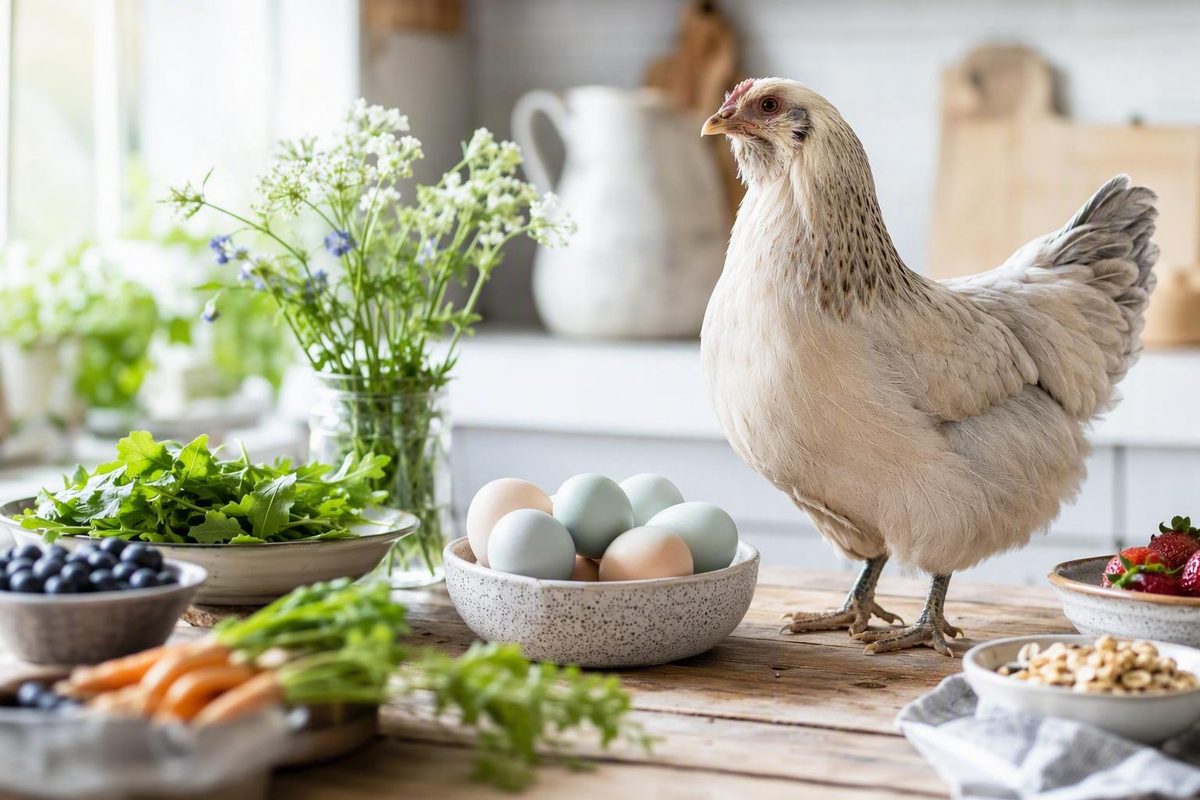
The Prairie Bluebell chicken, usually called the Prairie Bluebell Egger, is a modern Araucana and White Leghorn hybrid developed for blue egg production. It is typically lightweight, active, athletic, and variable in appearance. Its central ownership tradeoff is useful egg output and foraging ability paired with strong flight and a need for secure containment.
Hoover’s Hatchery, which developed the hybrid, specifies approximately 240 medium blue eggs per year, a mature weight of 4 to 5 pounds, a pea comb, rare broodiness, and heat and cold hardiness. Those specifications describe intended hatchery-stock traits, not guarantees for every hen.
Individual appearance, temperament, egg size, and performance can vary. This matters especially when a bird comes from local breeding rather than directly documented hatchery stock. The Prairie Bluebell Egger has no fixed purebred standard, so neither plumage nor a single physical feature can confirm identity reliably.
Prairie Bluebell Egger traits at a glance
The originating hatchery provides the clearest baseline, while retailer listings and owner accounts reveal where expectations differ.
| Trait | Best-supported expectation | Evidence caveat |
|---|---|---|
| Origin | Araucana crossed with White Leghorn | This is a commercial hybrid, not a standardized purebred |
| Egg color | Blue | Later-generation offspring and a small proportion of birds sold under the name may lay white eggs |
| Annual production | Hoover specifies 240 eggs per year | Other published figures range from 200 to 250 or approximately 280; none is a guarantee |
| Egg size | Hoover specifies medium | One owner account reports large to jumbo eggs in a particular group of hens |
| Laying onset | A retailer lists about 5 months | Onset is an estimate, not a fixed date for every pullet |
| Female size | About 4 to 5 pounds | Commercial descriptions support the range, but there is no formal breed standard |
| Temperament | Active, alert, athletic, and generally easy-going | Individual behavior can differ |
| Foraging | Described as a strong forager | Foraging ability does not remove the need for complete nutrition or secure housing |
| Broodiness | Rare or generally low | An owner account reports occasional interest in individual hens |
| Climate profile | Listed as heat and cold hardy | Published material does not define controlled temperature thresholds |
| Flight | Strong for a lightweight laying chicken | Owner reports indicate that ordinary open fencing may not contain every bird |
The table is therefore an expectation guide rather than an identification checklist. Provenance and the individual bird’s observed traits remain important.
A modern hybrid, not a standardized breed
The Prairie Bluebell Egger was created by crossing Araucanas with White Leghorns, according to Hoover’s Hatchery. A detailed profile from Strong Animals describes it as a modern hybrid developed by Hoover’s and first offered in January 2019.
The ancestry explains the intended combination. Araucana ancestry supplies the blue-shell trait, while White Leghorn ancestry contributes to the lightweight, laying-oriented profile. That is a description of the cross’s design, not proof that every descendant will express every expected trait.
Calling the Prairie Bluebell Egger a hybrid is more precise than treating it as a true-breeding purebred or heritage breed. A standardized breed normally has a defined set of traits that breeders reproduce with substantial consistency. The Prairie Bluebell Egger instead has deliberately variable plumage and no fixed purebred standard. Commercial listings sometimes use “breed” as a broad product-category term, but that wording should not be read as evidence that the birds breed true.
This distinction affects purchase expectations. A bird acquired from the originating hatchery may reasonably be evaluated against that hatchery’s published specifications. A bird produced by mating two Prairie Bluebell Eggers, or by crossing one with another chicken, is a later-generation descendant. It may still be informally described by the same name, but its appearance and egg-color genetics need not reproduce the original commercial cross predictably.
It also affects identification. Color, facial feathering, body shape, or egg color can support a tentative assessment, but none establishes ancestry by itself. A seller’s breeding records, hatchery documentation, or a clear account of the parents provides stronger evidence than resemblance alone.
Why blue eggs are expected but not guaranteed across generations
Blue eggs are an intended defining trait of hatchery-produced Prairie Bluebell Eggers. At the biological level, blue shell color is associated with expression of the SLCO1B3 gene in the hen’s shell gland. A peer-reviewed PLOS Genetics study identified an EAV-HP insertion near SLCO1B3 and reported autosomal dominant inheritance of the blue-shell phenotype in the chicken populations it examined.
Dominant inheritance means a hen can express blue shells when she inherits a blue-shell allele from one parent. It does not mean all offspring from every blue-egg-laying line will necessarily inherit that allele. The outcome depends on which relevant alleles each parent carries and which ones a particular offspring receives.
That distinction separates a hatchery-stock expectation from a later-generation guarantee. Hoover markets the original cross as a blue egg layer. However, Spikes and Houles states that a small percentage of Prairie Bluebell Eggers will lay white eggs. An owner guide from Silver Homestead also warns that the hybrid is not expected to breed true and presents a 25% white-layer outcome for a particular assumed F1-to-F1 mating.
That 25% figure should not be applied universally. It depends on the assumed parental genotypes and on both parents actually being the specified first-generation type. The supplied evidence does not provide controlled breeding records that establish the genotype of every hatchery line, locally bred bird, or subsequent generation.
For a prospective breeder, the defensible conclusion is narrow: blue shells are expected from documented Prairie Bluebell hatchery stock, but the name alone cannot guarantee the egg color of all daughters in later generations. Exact probabilities require known parentage, relevant genotypes, and recorded offspring results.
Egg color, size, production, and laying onset
A Prairie Bluebell Egger is primarily selected as a blue egg laying chicken. Hoover’s official specification is 240 medium blue eggs per year. That is the strongest single baseline because it comes from the hatchery responsible for the commercial hybrid.
Shell color is more defensible as an expected characteristic than a precise annual count. A hen’s actual total cannot be inferred from the product specification alone, and the supplied sources do not provide controlled flock records showing how the published figure was calculated. The number should therefore be read as a production estimate for the intended type, not as a promised number of eggs.
Published egg-size descriptions also differ. Hoover labels the eggs medium. In contrast, the Silver Homestead owner account reports that the Prairie Bluebell chicks raised there in 2019 eventually laid large to jumbo eggs rather than the advertised medium size. That observation establishes what happened in one owner’s flock, but it does not establish a revised size standard for the hybrid as a whole.
For laying onset, a Tractor Supply listing says the chickens begin producing at approximately five months of age. “Approximately” is important. The supplied breed evidence does not support a guaranteed first-egg date or explain how season, development, management, or individual variation affected that estimate.
The most realistic purchase expectation is therefore qualitative and bounded: a documented hatchery-stock hen is intended to lay blue eggs in useful numbers, with laying potentially beginning around five months. The precise onset, egg size, and annual total should be confirmed by observing the individual rather than inferred rigidly from a listing.
What the published egg estimates do—and do not—show
The supplied source set contains three different annual-production descriptions: a 200 to 250 range in editorial or retail coverage, Hoover’s specification of 240, and Tractor Supply’s figure of approximately 280 eggs per year. These numbers overlap in portraying the Prairie Bluebell Egger as a production-oriented layer, but they do not establish a single verified average.
Hoover’s 240 figure falls within the broader 200 to 250 range. The retailer’s approximately 280 figure is higher by 40 eggs per year than Hoover’s specification. That arithmetic identifies the difference between the claims, but it does not explain it. The evidence does not show whether the sources used different flocks, ages, record-keeping methods, environments, or marketing conventions.
Creating an average of the published numbers would add false precision. They are not presented as equivalent measurements from a controlled comparison. The most transparent approach is to retain the source labels: 240 is the originating hatchery’s specification, approximately 280 is a retailer claim, and 200 to 250 is a broader published estimate.
The same evidence rule applies to egg size. “Medium” is the hatchery specification; “large to jumbo” is an owner’s observation about hens raised in one flock. Both can be reported, but the owner experience cannot replace the hatchery category without broader measurement records.
Silver Homestead also describes a six-year ownership history. That is useful evidence that some individual birds can continue laying over multiple years, but it does not establish a typical lifespan, an expected six-year production total, or the rate at which laying changes with age. It is an example of possible persistence, not a population-wide promise.
Appearance, size, and identification limits
Prairie Bluebell Eggers are lightweight hens with highly variable coloring. Spikes and Houles lists mature females at 4 to 5 pounds, consistent with Hoover’s 4-to-5-pound mature-weight specification. The available material does not provide a separate, well-supported male weight range.
Plumage is intentionally inconsistent. Hoover says color varies considerably among individuals, producing many color patterns. That variability means there is no single required feather color for a Prairie Bluebell chicken. A light, dark, patterned, or mixed-color bird could resemble examples of the hybrid, but color alone cannot confirm that it is one.
The most consistently documented comb description is a pea comb. Both Hoover and Spikes and Houles specify that comb type. In a BackYard Chickens identification discussion, one participant treated a pea comb and the seller’s bin label as clues that a bird could be a Prairie Bluebell Egger. That is appropriately tentative: a pea comb is compatible with the identification, but other chickens can also have pea combs.
Facial feathering varies as well. The Silver Homestead account reports that birds can have clean faces or facial feathering and notes that Hoover appears to favor cleaner-faced birds. Because the hybrid has no true breed standard, neither muffs nor a clean face should be treated as mandatory.
Egg color can become an additional clue once a hen lays, but even that is not conclusive. Many chickens can lay blue eggs, while Spikes and Houles reports that a small percentage of Prairie Bluebell Eggers may lay white eggs. A blue egg supports identification only when combined with provenance and other expected traits.
A responsible identification therefore uses several kinds of evidence together: where the bird came from, how the seller labeled it, what is known about its parents, its approximate size and comb, and its eventual egg color. Even that combination may support only a probable identification when records are missing. There is no supplied visual marker that functions as a definitive test.
The lack of a fixed standard also helps explain why photographs and owner descriptions can look inconsistent without one necessarily being wrong. Hybrid variability permits meaningful differences among genuine birds. It likewise creates room for mislabeled or later-generation birds to resemble hatchery stock, so visual confidence should remain proportional to the available provenance.
Temperament, foraging, and flight
The recurring behavioral profile is active, alert, athletic, and strongly oriented toward foraging. Hoover uses those first three temperament terms and describes the Prairie Bluebell Egger as very good at foraging. Tractor Supply similarly lists the birds as active, charismatic, easy-going, and great foragers.
These descriptions suggest a mobile chicken that is likely to explore available ground rather than remain stationary. They do not establish that every hen will be equally calm, socially compatible, or comfortable with handling. “Easy-going” is a retailer characteristic, while “active, athletic, alert” comes from the hatchery specification. Both describe general tendencies rather than a behavioral guarantee.
The lightweight build is relevant to movement. Hoover states that Prairie Bluebell Eggers are lightweight, and Tractor Supply calls them great flyers. Strong Animals provides a concrete owner observation: one hen could fly over a fence to reach grass and insects, then return when ready to rejoin the flock.
That account illustrates both the appeal and the management cost of the type. An active forager may make extensive use of an outdoor area, but a bird capable of leaving that area can reach places the keeper did not intend. Flight ability is therefore not a minor appearance trait. It is a practical flock-design consideration.
Individual responses to confinement may differ. Tractor Supply says the chickens bear confinement well, but the same listing also describes them as great flyers and foragers. Those statements are not necessarily incompatible: a bird can tolerate confinement while still being physically capable of escaping an uncovered area. The enclosure itself, rather than an assumption about temperament, must provide the dependable boundary.
Containment for lightweight, athletic flyers
A prospective keeper should plan containment on the assumption that at least some Prairie Bluebell Eggers can clear ordinary open fencing. Strong Animals reports a hen repeatedly flying out and back, while Silver Homestead describes birds reaching a 7-foot fence with a jump-and-flap. These are owner observations, not controlled tests or universal minimum-height specifications.
The 7-foot account should not be converted into a rule that every fence above or below a particular height will succeed. Flight varies among birds, and the supplied evidence does not compare fence designs, covered runs, wing management, nearby launch points, or environmental conditions.
Practical planning can still follow from the documented ability:
- Use secure containment where leaving the run would expose birds to roads, dogs, predators, gardens, or neighboring property.
- Consider a covered run or another enclosure that does not rely solely on an open vertical fence.
- Inspect for structures near the perimeter that could help an athletic bird move upward or outward.
- Observe newly introduced birds before assuming an existing setup will contain them.
The key action is to design for escape prevention rather than search for an unsupported universal fence height. A keeper whose current flock remains behind ordinary fencing should not assume a lightweight Prairie Bluebell Egger will behave the same way.
Is a Prairie Bluebell Egger right for your flock?
A Prairie Bluebell Egger is a strong candidate for a keeper who prioritizes blue eggs, active foraging, low broodiness, and a lightweight bird. It is a weaker fit where open fencing must provide reliable containment or where the keeper expects a uniform appearance and predictable later-generation breeding.
| Decision factor | Potential fit | Tradeoff or limitation |
|---|---|---|
| Blue eggs | Hoover developed the hybrid as a blue egg layer | A small proportion may lay white, and later-generation daughters are not guaranteed to inherit blue-shell genetics |
| Egg output | Hoover specifies 240 eggs per year; retailer claims are as high as approximately 280 | Published figures are estimates from different source types, not a controlled guarantee |
| Foraging | Hatchery and retailer descriptions consistently identify strong foraging ability | Active exploration can increase pressure on containment |
| Body size | Females are listed at approximately 4 to 5 pounds | The lightweight build contributes to athletic movement and flight |
| Temperament | Sources describe active, alert, easy-going, and charismatic tendencies | Individual behavior can differ, and the evidence does not establish universal flock compatibility |
| Broodiness | Hoover lists broodiness as rare; retailers describe the birds as not tending to be broody | An owner account reports occasional broody interest in individual hens |
| Climate profile | Hoover labels the hybrid heat and cold hardy | No breed-specific temperature limits or controlled hardiness thresholds are supplied |
| Appearance | Variable plumage can add visual variety to a flock | No fixed standard means color and facial traits cannot reliably confirm identity |
| Containment | Suitable where secure or covered space can be provided | Owner observations show that some birds can reach or clear substantial fencing |
| Breeding | Useful when the goal is keeping the original hybrid as a layer | It is not expected to breed true, so offspring traits and egg colors can vary |
The central decision is not whether the Prairie Bluebell Egger has universally “good” or “bad” traits. It is whether the keeper’s priorities match the documented combination. Blue eggs, laying orientation, and foraging are advantages when productivity and activity are desired. Strong flight and hybrid variability are material disadvantages when an open run, visual uniformity, or predictable offspring is required.
Heat and cold hardiness should also be interpreted narrowly. Hoover applies both labels, and Strong Animals emphasizes clean housing, fresh water, and balanced nutrition as general support through temperature changes and everyday stress. The sources do not show that the hardiness label removes the need for ordinary weather protection or climate-appropriate management.
Low broodiness favors a laying-focused flock because hens described as rarely broody are less oriented toward sitting on eggs. It is less useful to a keeper hoping the hens will consistently hatch chicks naturally. Even then, the owner evidence indicates that an occasional individual may show broody interest, so the profile remains a tendency rather than an absolute.
What the evidence does not establish as breed-specific
The available evidence supports a useful trait profile, but it does not support a complete Prairie Bluebell-specific care manual. No authoritative material in the supplied set establishes a special numerical coop-space allowance, run-space requirement, universally effective fence height, or covered-run design for this hybrid.
The sources also do not establish a unique feeding program. General poultry nutrition guidance may apply according to a bird’s age and production stage, but there is no evidence here that Prairie Bluebell chicks or hens require a special high-protein regimen simply because of the hybrid name. Anecdotal feeding claims should not be converted into prescriptive instructions without poultry-health or extension evidence tied to the relevant life stage.
No breed-specific health disorder, typical lifespan, or long-term laying curve is established either. A six-year owner history demonstrates one flock experience, not the expected lifespan or annual decline of the wider population. Likewise, the hatchery’s hardiness labels do not quantify disease resistance or eliminate routine health risks.
The evidence-bounded buying decision is therefore based on documented traits rather than unsupported care precision: expect a variable, lightweight hybrid selected for blue eggs and active foraging; allow for differences in egg size and individual behavior; verify provenance when breeding or identification matters; and provide containment appropriate for a chicken with documented flight ability.