
The Real Nutrition Numbers in a 6 oz Salmon Fillet – From Calories to Omega-3s
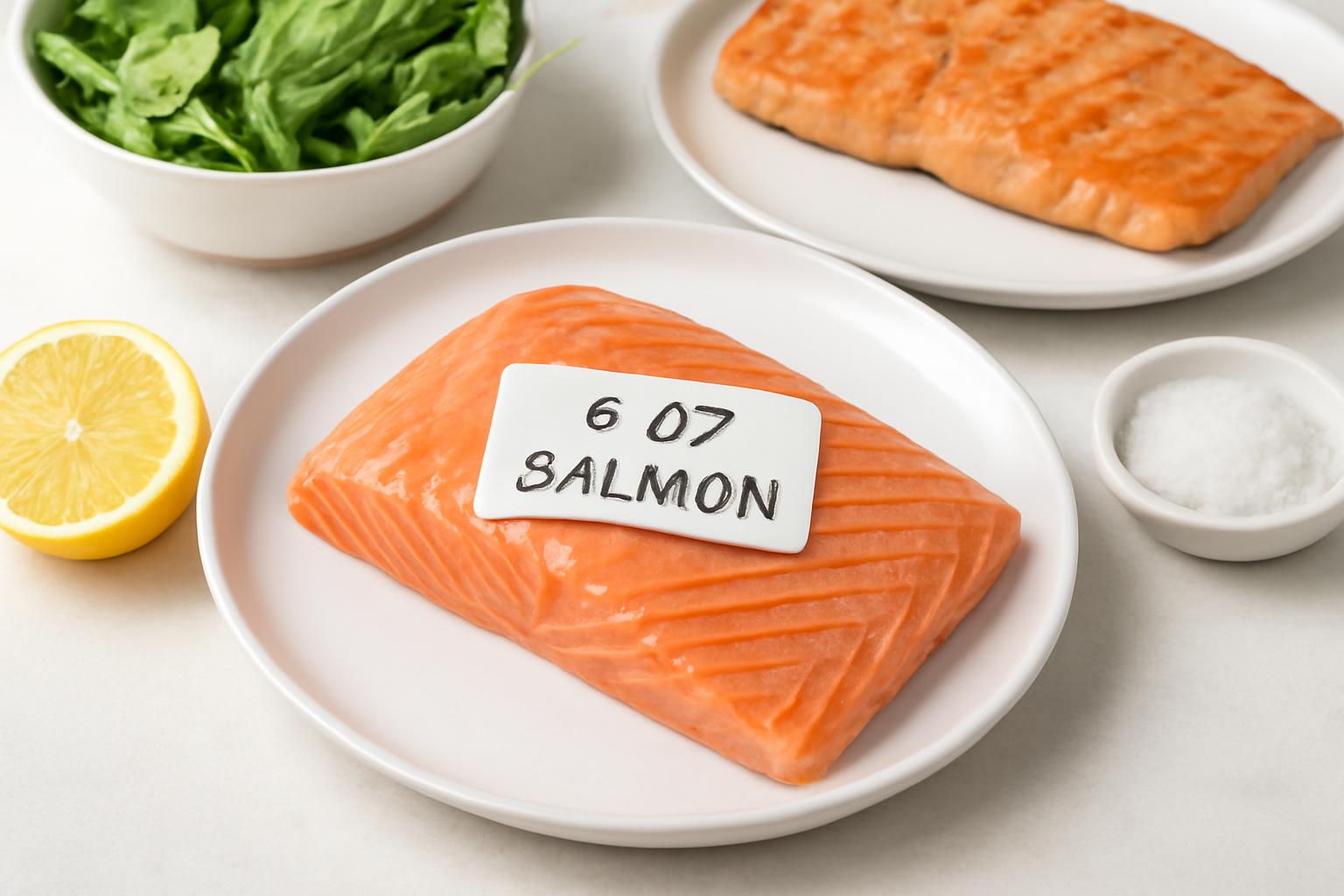
Direct 6 oz entries cluster at about 242-309 calories. The right figure changes with raw or cooked weight and the database entry used.
A 6 oz salmon label looks precise, but it still hides a few big variables. The same “6 oz salmon fillet” can mean a raw packaged portion, a cooked edible serving, a leaner wild species, or a richer farmed Atlantic cut. For calorie tracking, those are not trivial differences. They are the gap between a direct raw entry in the low-to-mid 240s and cooked or fattier references that can move meaningfully higher once species, fat level, and moisture loss change the comparison basis (FatSecret raw salmon; Eat This Much wild Atlantic raw; MyFoodData cooked wild Atlantic; FDA seafood table).
For practical logging, the cleanest rule is still state first, species second. First ask whether the 6 oz refers to raw weight or cooked weight. Then ask what kind of salmon it is: generic salmon, wild sockeye/coho/pink/chum, wild king, or farmed Atlantic.
How Food Labels Calculate Calories (And Where the Number Can Be Wrong): Food labels use the Atwater system, not direct measurement. Here’s how the 4-4-9 factors work, why they allow a 20% margin of error, and what that means for tracking.
What Counts as a 6 oz Salmon Portion?
In the direct nutrition entries used throughout this article, 6 oz is treated as 170 g. That is how both the raw wild Atlantic and cooked wild Atlantic database entries are sized, and it matches how some retailers sell a single dinner fillet (Alaskan Seafood Guys’ exact 6 oz sockeye portion; Eat This Much wild Atlantic raw; MyFoodData cooked wild Atlantic).
Not every seller uses a truly exact cut, though. Some retailers sell a fixed portion, while others sell a dinner-sized range. Wild Bay’s sockeye listing, for example, is an individually vacuum-packed 4–6 oz portion and is explicitly described as a single-person serving (Wild Bay Seafood sockeye portion).
That distinction matters more than it sounds. If your package is a true 6 oz / 170 g portion, you can usually log it directly with a 6 oz entry. If the seller uses a 4–6 oz band, the package is telling you the piece is meal-sized, not guaranteeing the top end of the range. For precision, weigh the fillet before cooking if the label is based on raw weight, or weigh the finished portion if you intend to log a cooked entry.
It also helps to separate retail format from nutrition state. A vacuum-packed frozen sockeye portion, a fresh grocery Atlantic fillet, and a cooked restaurant plate can all be called “6 oz salmon,” but those are not interchangeable for logging. “Portion” tells you roughly how big dinner is; it does not tell you whether the nutrition entry you need is raw, cooked, lean, or rich.
Calories and Macros in Raw 6 oz Salmon
The direct raw entries in the evidence are fairly tight. A generic 6 oz boneless raw salmon entry lists 248 calories, 36.78 g protein, 10.09 g fat, and 0 g carbs, while a 6 oz raw wild Atlantic salmon entry lists 242 calories with 0 g net carbs and a macro split of about 58% protein and 42% fat (FatSecret raw salmon, 6 oz boneless; Eat This Much wild Atlantic salmon, 6 oz raw).
If you are holding a raw, boneless 6 oz fillet and do not have a species-specific nutrition panel, this is a reasonable starting range:
| Direct raw 6 oz entry | Calories | Protein | Fat | Carbs |
|---|---|---|---|---|
| Generic raw boneless salmon (FatSecret) | 248 | 36.78 g | 10.09 g | 0 g |
| Wild Atlantic salmon, raw (Eat This Much) | 242 | about 35 g | about 10 g | 0 g |
A useful cross-check is the 100 g figure. FatSecret lists raw salmon at 146 calories per 100 g, which scales to about 248 calories at 170 g / 6 oz. That is why the generic raw entry and the 6 oz serving line up cleanly rather than looking like unrelated numbers (FatSecret raw salmon).
The wild Atlantic example adds more nutrient detail, not a dramatically different calorie result. At 6 oz raw, it includes roughly 3 g leucine and 3 g lysine, alongside the same basic profile of 0 g carbs, about 10 g fat, and mid-30s grams of protein (Eat This Much wild Atlantic raw).
The more important caution is not the difference between 242 and 248 calories. It is the difference between a direct raw entry and everything else. If you want the shortest usable answer for a raw fillet, it is this:
- Calories: about 242–248
- Protein: about 35–37 g
- Fat: about 10 g
- Carbs: 0 g
For trackers who like exactness, it also helps to remember that food labeling is not laboratory-perfect in real life. As explained on the CaloriePages About page, calorie counts on labels can be off by 20%, so a small database gap like 242 vs. 248 is less important than using the same method consistently.
Calories and Macros in Cooked 6 oz Salmon
Cooked salmon is where “6 oz” gets more confusing, because the evidence falls into three different buckets: direct 6 oz generic cooked entries, direct 6 oz cooked wild Atlantic entries, and scaled estimates from smaller cooked servings.
| Cooked salmon reference | Basis | Calories | Protein | Fat | Carbs |
|---|---|---|---|---|---|
| Generic cooked boneless salmon (FatSecret) | direct 6 oz | 236 | 39.89 g | 7.31 g | 0 g |
| Wild Atlantic salmon, cooked (MyFoodData/USDA) | direct 6 oz / 170 g | 309 | 43.2 g | 13.8 g | 0 g |
| Atlantic/Coho/Sockeye/Chinook salmon (FDA) | 3 oz cooked scaled to 6 oz | about 400 | about 48 g | about 20 g | 0 g |
The most useful direct cooked value for a named fish is the USDA-backed wild Atlantic entry: a 6 oz cooked fillet at 309 calories, 43.2 g protein, 13.8 g fat, and 0 g carbs (MyFoodData cooked wild Atlantic salmon, 6 oz fillet). A separate generic cooked salmon entry comes in lower at 236 calories, 39.89 g protein, 7.31 g fat, and 0 g carbs (FatSecret cooked salmon).
Those numbers are not a clean raw-to-cooked before-and-after pair, and that is the point many trackers miss. They are not matched versions of the same fillet. So when the generic cooked entry appears lower than the generic raw entry, that does not mean cooking makes salmon lower-calorie.
To see why cooked salmon often looks richer, use a separate cooked reference rather than comparing unrelated generic entries. The FDA seafood table lists Atlantic/Coho/Sockeye/Chinook salmon at 200 calories and 24 g protein per 3 oz cooked edible portion, which scales to about 400 calories and 48 g protein per 6 oz cooked when you double it (FDA seafood nutrition table, 3 oz cooked salmon). That is not a contradiction of the 309-calorie cooked wild Atlantic entry; it is a reminder that “cooked salmon” is still a category, not a single fish.
A separate Atlantic salmon entry cooked with dry heat lists 233 calories per 4 oz, which would scale to about 350 calories per 6 oz if you extend it linearly, but that is still a scaled estimate, not a direct 6 oz measurement (CalorieKing Atlantic salmon cooked with dry heat).
So the practical summary for cooked salmon is tiered, not universal:
- Direct 6 oz cooked generic entry: about 236 calories, 40 g protein, 7 g fat (FatSecret cooked salmon)
- Direct 6 oz cooked wild Atlantic entry: about 309 calories, 43 g protein, 14 g fat (MyFoodData cooked wild Atlantic)
- Scaled cooked estimates from smaller servings: roughly 350–400 calories can be plausible for richer salmon references, especially when you are scaling Atlantic/Coho/Sockeye/Chinook data from a cooked edible-weight table (FDA seafood table; CalorieKing)
For logging, the rule stays simple: if the package weight was raw, log it raw; if you are weighing the finished portion and choosing a cooked entry, log it cooked. Mixing those methods is where salmon starts looking inconsistent.
Wild vs Farmed 6 oz Salmon Nutrition Breakdown
At the 100 g cooked level, the evidence points in one broad direction: wild salmon is usually leaner and more protein-dense per calorie than farmed salmon. A USDA-based comparison summarized by Healthline lists wild cooked salmon at 182 calories, 25.4 g protein, and 8.13 g fat per 100 g, versus 206 calories, 22.1 g protein, and 12.4 g fat per 100 g for cooked farmed salmon (Healthline’s summary of USDA wild vs. farmed salmon data).
But “wild” is not one uniform nutrition profile. Alaska species vary a lot even within the wild category. In cooked 3 oz / 85 g portions, Alaska Seafood Marketing Institute lists the following values:
| Wild Alaska salmon, cooked 3 oz | Calories | Protein | Fat | Scaled to 6 oz calories |
|---|---|---|---|---|
| Coho | 120 | 20 g | 4 g | about 240 |
| Sockeye | 130 | 23 g | 5 g | about 260 |
| Keta/Chum | 130 | 22 g | 4 g | about 260 |
| Pink | 130 | 21 g | 4 g | about 260 |
| King | 200 | 22 g | 11 g | about 400 |
Those figures come from the Alaska Seafood Marketing Institute’s USDA-based cooked tables (Alaska Seafood nutrition information). The takeaway is straightforward: wild coho, sockeye, pink, and chum are usually leaner, but wild king is much richer. “Wild” helps, but species still matters.
Farmed Atlantic can swing the other direction. Roger’s Fish Co. lists its Faroe Islands farm-raised Atlantic salmon at 240 calories, 15 g fat, and 23 g protein per 4 oz serving. Scaled to 6 oz, that works out to roughly 360 calories, 22.5 g fat, and 34.5 g protein for a full fillet (Roger’s Fish Co. Atlantic salmon fillet label).
That is why the cleanest shorthand for macro tracking is:
- Wild coho, sockeye, pink, chum/keta: usually leaner
- Wild king/Chinook: still wild, but much richer
- Farmed Atlantic: often higher in fat and calories
Is wild “better”? Not automatically. If you want more protein per calorie, wild often looks better. If you want a fattier, richer fillet, farmed Atlantic often fits that profile. The mistake is treating wild vs. farmed as the whole answer when the actual species is still unknown.
Omega-3s, Vitamins, and Minerals in 6 oz Salmon
Salmon’s value is not only that it is a high-protein fish. The detailed raw wild Atlantic entry shows why people make room for it even when it is not the leanest option. A 6 oz raw wild Atlantic salmon serving is listed with about 3 g total omega-3s, including roughly 2 g DHA, 1 g EPA, and 0.5 g DPA. The same serving also provides about 5 mcg vitamin B12 (225% DV), 62 mcg selenium (113% DV), and 13 mg niacin (84% DV) (Eat This Much wild Atlantic raw).
That combination matters because it changes how you think about calorie value. A 6 oz salmon fillet is not just delivering mid-30s to low-40s grams of protein depending on the entry. It is also bringing meaningful long-chain omega-3s plus strong B-vitamin and selenium coverage in the same serving.
Cooked entries stay strong on minerals. The USDA-backed 6 oz cooked wild Atlantic salmon entry lists about 1,067.6 mg potassium, while the 6 oz raw wild Atlantic entry lists 833 mg potassium. Alaska species also vary in vitamin D: the Alaska Seafood Marketing Institute table lists coho at 9.6 mcg vitamin D per 3 oz cooked and sockeye at 14.2 mcg per 3 oz cooked, which becomes a substantial contribution on a 6 oz plate (MyFoodData cooked wild Atlantic; Eat This Much wild Atlantic raw; Alaska Seafood nutrition information).
For trackers, there is also a useful broader context about protein itself. In our guide to protein and calorie density, protein is described as having a 20–30% thermic effect, compared with 5–10% for carbohydrates and 0–3% for fat, and as stimulating satiety hormones such as PYY and GLP-1. That is general protein physiology, not salmon-specific trial data, but it helps explain why salmon can feel more satisfying than its label number alone suggests.
So salmon is not a “free” food, and it is not the most calorie-efficient protein per gram. What it offers instead is a combination many leaner proteins do not: substantial protein, omega-3s, B12, selenium, and a richer eating experience in one serving.
Buying 6 oz Salmon: Prices, Sources, and Availability
Shopping details for salmon are best read as time-sensitive examples, not permanent market facts. Prices, stock, and even portion sizes move quickly.
If you want the cleanest logging experience, exactly portioned fillets are the easiest. One captured example is Alaskan Seafood Guys, which listed an exact 6 oz wild sockeye portion for $10.50. By contrast, Wild Bay listed a 4–6 oz sockeye portion for $9.35 each, which is still dinner-friendly but not a guaranteed 6 oz cut (Alaskan Seafood Guys sockeye portion; Wild Bay Seafood sockeye portion).
That exact-vs-variable split is usually more useful than obsessing over any one seller’s headline price. Exact 6 oz portions cost more for convenience, but they are easier to log. Variable-weight portions can be a good value if you are willing to use a scale.
At the grocery end, per-ounce costs can drop sharply. Mariano’s search results included examples such as an Aqua Star wild Pacific salmon fillet at $0.45/oz and a Kroger farm-raised Atlantic salmon fillet portion at $0.75/oz, both much cheaper per ounce than premium pre-portioned packs (Mariano’s “6 oz salmon” search results). At the opposite end, SeaBear’s 6-pack of 6 oz wild Alaskan sockeye fillets was listed at $94.99, or $2.64 per ounce (SeaBear wild sockeye dinner fillets).
That leads to a durable buying framework:
- Exact 6 oz portions: easiest for tracking
- 4–6 oz or other variable-weight portions: fine, but better weighed
- Larger grocery fillets: usually cheaper per ounce
- Wild sockeye: common in flash-frozen, vacuum-packed portions
- Farmed Atlantic: common in fresh cases and premium frozen packs
If sustainability matters, the evidence here points mostly to two common retail paths: wild Alaskan salmon, sometimes marketed as sustainably harvested or MSC-certified, and farmed Atlantic salmon from suppliers such as the Faroe Islands. Those labels do not tell you calories by themselves, but they do give clues about the kind of nutrition profile you are more likely to be buying.
Storage, Thawing, and Cooking a 6 oz Fillet
Storage guidance in the evidence varies by seller, which is a good reminder not to treat any one product page as universal. SeaBear says its frozen salmon can be kept 3–4 months in the freezer and 1–2 days in the refrigerator after thawing (SeaBear wild sockeye storage guidance). Wild Bay gives a longer estimate of 6 months frozen and 3–4 days refrigerated under 38°F for its portions (Wild Bay Seafood sockeye portion).
The safest way to reconcile those differences is conservative: thawed salmon is a short-window food. Once it is thawed, plan to cook it soon rather than leaving it in the refrigerator for several extra days.
Roger’s Fish Co. also instructs buyers to cook salmon to an internal temperature of 145°F, notes that frozen orders ship with dry ice, and says thawed product should be used within 24 hours (Roger’s Fish Co. Atlantic salmon fillet label and handling guidance).
For logging, cooking method matters almost as much as food safety. The FDA seafood table used above describes seafood cooked by moist or dry heat with no added ingredients. So if you cook the fish in oil, finish it with butter, brush on glaze, or add a sweet sauce, those calories belong in the log too (FDA seafood table).
A reliable tracking checklist looks like this:
- Raw label, raw weight: weigh and log it raw
- Cooked database entry, cooked weight: weigh and log it cooked
- Added oils, butter, glaze, or sauce: log them separately
- Do not assume a 6 oz raw fillet stays 6 oz after cooking
Tracking 6 oz Salmon in Your TDEE and Macros
From a macro standpoint, 6 oz salmon is easy to build a meal around. In the direct entries reviewed here, a 6 oz serving usually provides about 35–43 g protein, 0 g carbs, and anywhere from roughly 7–14 g fat in the direct cooked entries, with higher totals possible in richer species or farmed cuts (FatSecret raw salmon; FatSecret cooked salmon; MyFoodData cooked wild Atlantic; Roger’s Fish Co. farmed Atlantic label).
That makes salmon especially useful for low-carb eating patterns and for meal plans that prioritize protein without relying only on ultra-lean meats. It is still not the same tool as chicken breast or tuna. Dietitians quoted by TODAY describe salmon and chicken as providing similar protein per serving, while salmon stands out for its unsaturated fat, especially seafood-specific fats such as DHA (TODAY on salmon vs. chicken).
For calorie tracking, that means chicken breast usually wins on pure protein density, while salmon often wins on nutrient density plus meal satisfaction. Which one is “better” depends on whether you are optimizing for lowest calories, more omega-3s, or simply adherence.
It also helps to keep food logging precision in perspective. In our guide to what TDEE actually measures, the Mifflin equation is described as having a mean error of about ±10%, and NEAT can differ by as much as 2,000 calories per day between people with similar body size and exercise habits. Against that backdrop, the meaningful habit is not finding the one perfect salmon number. It is choosing a logging method that matches how you weighed the fish, then checking it against real weight trends over time.
So the best salmon-tracking rule is boring, but dependable: log the form you actually ate, keep your method consistent, and calibrate against outcomes rather than app perfection.
How many calories are in 6 oz of salmon?
The most defensible short answer is that direct 6 oz entries cluster at about 242–309 calories, depending on whether the fish is raw or cooked and which entry you choose. In the evidence here, 6 oz raw salmon is about 242–248 calories, while direct 6 oz cooked entries range from 236 calories for a generic cooked entry to 309 calories for cooked wild Atlantic. Higher numbers around 350–400 show up when you scale smaller cooked servings for richer salmon references rather than using a direct 6 oz entry (FatSecret raw salmon; FatSecret cooked salmon; MyFoodData cooked wild Atlantic; FDA seafood table).
Raw or cooked: which has more calories per 6 oz salmon?
Per equal finished weight, cooked salmon often looks higher because cooking removes water and makes the fish more calorie-dense. But the generic raw and generic cooked entries in the evidence are not matched versions of the same fillet, so they should not be used as a direct before-and-after conversion. The cleaner takeaway is that 6 oz cooked salmon usually represents more starting fish than 6 oz raw salmon once moisture loss is accounted for (MyFoodData cooked wild Atlantic; FDA seafood table; FatSecret raw and cooked salmon).
Is wild or farmed salmon better nutritionally for a 6 oz serving?
Neither is automatically better in every category. Wild salmon is usually leaner and offers more protein per calorie, while farmed salmon is often higher in fat and total calories. But species still matters a lot: wild king is much richer than wild coho or sockeye, and farmed Atlantic labels vary by producer (Healthline USDA-based wild vs. farmed comparison; Alaska Seafood nutrition information; Roger’s Fish Co. farmed Atlantic label).
How much protein in 6 oz salmon?
A 6 oz serving usually provides about 35–43 g protein in the direct entries reviewed here. Generic raw salmon is listed at 36.78 g, generic cooked salmon at 39.89 g, and cooked wild Atlantic salmon at 43.2 g for a 6 oz fillet (FatSecret raw salmon; FatSecret cooked salmon; MyFoodData cooked wild Atlantic).
Where can I buy 6 oz salmon fillets cheapest?
If you care about the lowest per-ounce cost, larger grocery fillets usually beat exact 6 oz portions. In the evidence captured here, grocery-style listings ran as low as about $0.45–$0.75 per ounce at Mariano’s, while premium pre-portioned wild fillets could reach $2.64 per ounce for a SeaBear pack. If you specifically want an exact 6 oz portion for easier logging, one snapshot showed $10.50 for a wild sockeye portion from Alaskan Seafood Guys, while Wild Bay’s looser 4–6 oz sockeye portion was $9.35 each (Mariano’s search results; SeaBear; Alaskan Seafood Guys; Wild Bay Seafood).