
7 Brew Drink Calories: From 0-Cal Teas to 900+ Blends—What Yours Really Contains
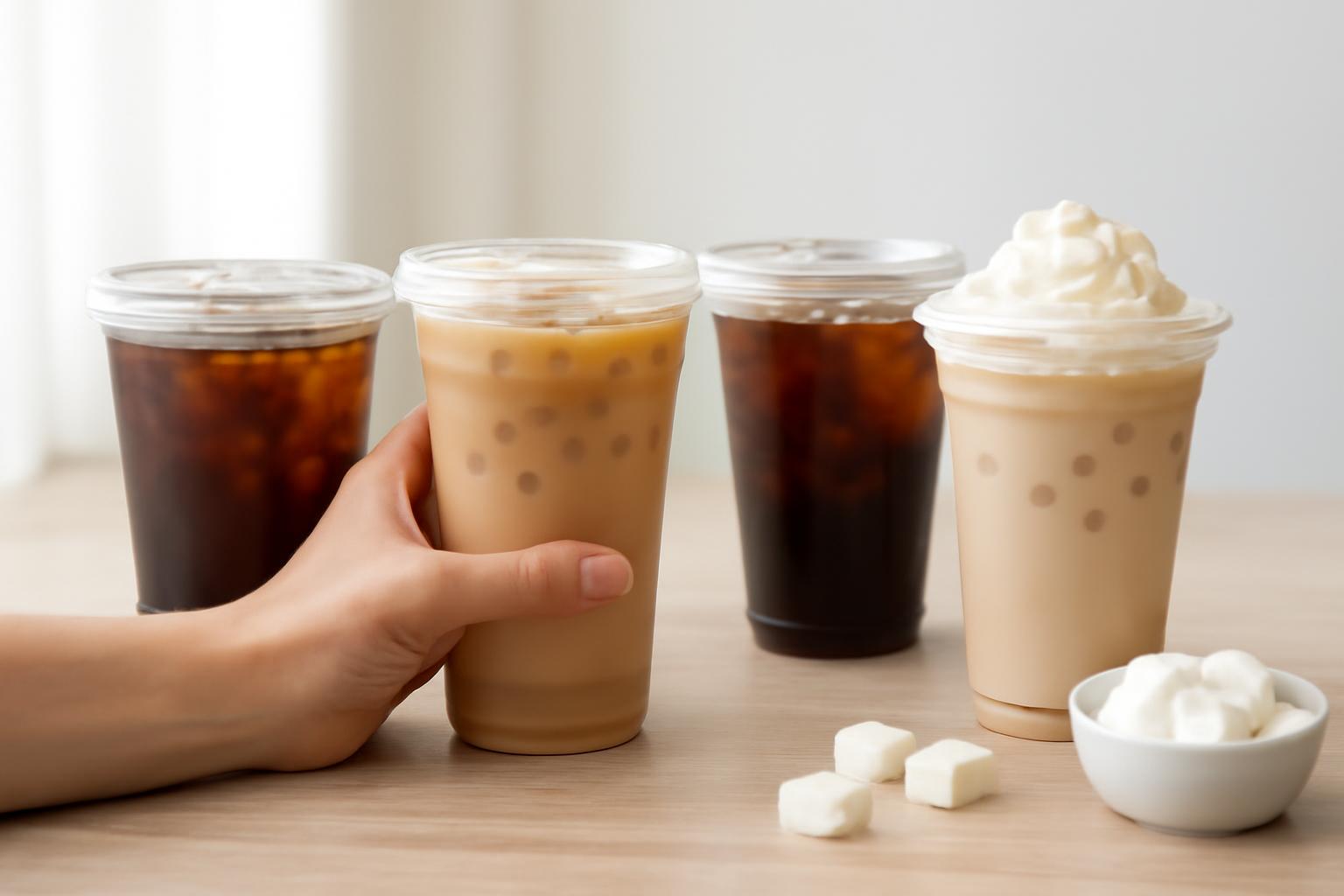
In visible official PDF rows, Sugar-Free Banana Bread Mocha spans about 90-580 calories by size and preparation. Compare ranges and key swaps.
If you count calories, 7 Brew is both useful and annoying. Useful, because the menu really does include near-zero options. Annoying, because the drink name alone rarely tells you much. A plain tea can sit around 0–5 calories, while richer blended drinks and shakes can climb to roughly 950 calories, with a lot of the menu landing somewhere between those extremes depending on size, milk, syrup, and toppings (7 Brew Nutrition Guide: Calories, Sugar & Health Facts 2026).
The safest way to read public 7 Brew nutrition data is as a hierarchy, not a pile of interchangeable numbers. First come the visible rows in 7 Brew’s official nutrition PDF. Second come repeated third-party range tables that broadly agree on drink families. Third come calculator-style tools, which are useful for modeling swaps but should still be treated as estimates rather than exact recipe measurements.
That distinction matters because the menu is highly customizable, the official public data is only partly visible, and several third-party sites appear to repeat the same broad ranges. So the most honest answer is usually not one exact calorie number. It is a range, plus an explanation of which choices move your drink toward the low or high end.
How Food Labels Calculate Calories (And Where the Number Can Be Wrong): Food labels use the Atwater system, not direct measurement. Here’s how the 4-4-9 factors work, why they allow a 20% margin of error, and what that means for tracking.
7 Brew Calorie Ranges Overview
At the category level, 7 Brew is a wide-range menu. Public nutrition guides repeatedly place coffee drinks around 120–850 calories, energy drinks around 10–560, smoothies around 330–740, and shakes around 250–950, with size and customization doing most of the work (7 Brew Nutrition Information – Calories, Sugar & Drink Facts Guide).
Fizz drinks are their own reminder that “not coffee” does not mean “low calorie.” Public menu documents commonly put Seven Fizz around 0–440 calories, depending on flavoring and whether creamy extras are added (7 Brew Menu with Prices & Calories July 2026).
A useful way to think about the menu is by family floor and ceiling rather than by flavor name alone:
| Drink family | Typical public range | Confidence level | What usually pushes the total up |
|---|---|---|---|
| Plain teas / black coffee | 0–20 | Higher | Sweetener, milk, creamy extras |
| Americano / black cold brew | 5–100 | Higher | Milk, syrup, cold foam |
| Lattes / cappuccinos | 100–320-ish | Medium | Richer milk, flavor syrup, larger size |
| Mochas / breves / originals | 200 to 800+ | Medium | Dairy-rich base, sauces, frozen prep |
| Energy / fizz | 0–560 | Medium | Regular sweetening, cream, blended style |
| Smoothies / shakes | 250 to 950 | Lower-to-medium | Sweet base, dairy, dessert-style build |
Small sweet drinks are often described in public guides as starting around 50–100 calories, while larger sweet drinks can move into the 300–500+ range before you even get into mochas, breves, smoothies, or shakes (7 Brew Nutritional Information & Calories 2026).
Preparation style matters more than many people realize. In the visible rows of the official nutrition PDF, Sugar-Free Banana Bread Mocha spans roughly 90–580 calories across the listed sizes and preparations, which is a strong reminder that iced, hot, and frozen versions do not behave like trivial variations of the same drink (Nutrition Guide PDF).
So the big-picture takeaway is simple: 7 Brew is not one calorie level. It is several different calorie environments sharing one menu board. Tea, black coffee, and Americano live at one end. Standard milk-forward coffee drinks sit in the middle. Breves, originals, frozen builds, smoothies, and shakes can occupy a much denser class entirely.
Lowest Calorie 7 Brew Drinks
If the goal is the lightest possible order, the winners are the least complicated drinks on the menu.
| Low-calorie choice | Common public range | Why it stays low |
|---|---|---|
| Unsweetened tea | 0–5 | Tea with no sugar or milk |
| Americano | 5–15 | Espresso plus water |
| House Blend coffee | 10–20 | Plain brewed coffee |
| Black cold brew | 20–90 small; 40–100 medium | Low base calories before add-ins |
| Sugar-free energy base | Roughly 5–50 before extras | Low base, but only if kept simple |
Representative low-end values are taken from public low-calorie guides and category tables rather than a full official menu release (7 brew nutrition 2026: Calories, Sugar & Macros Guide).
That list is short for a reason: calorie control usually comes from what you leave out. A plain tea stays near zero because it is just tea. An Americano stays very low because it is espresso and water. House Blend behaves the same way. Cold brew starts lean too, but it stops being predictable once cream, milk, syrups, or foam enter the cup.
That is also why “healthy 7 Brew drink” can be a fuzzy phrase. A signature drink can still fit your day. But if you mean lowest calorie, the most dependable answers are still unsweetened tea, plain brewed coffee, Americano, and black cold brew. Public guides consistently keep black coffee and plain tea under 20 calories when you leave out add-ins (7 Brew Nutrition Information – Calories, Sugar & Drink Facts Guide).
If you want flavor while keeping the drink light, the usual best sequence is:
- Start with a lean base.
- Use sugar-free syrup if sweetness matters.
- Add the lightest milk you actually enjoy.
- Skip whipped cream and cold foam unless they are the point of the order.
That approach works because the savings stack. A black cold brew with sugar-free syrup still behaves like a low-calorie drink. A black cold brew with milk, regular syrup, cold foam, and whipped cream does not.
Calories in 7 Brew Originals and Breves
The Originals are where many people get tripped up, because the flavor names sound distinct while the calorie behavior is often pretty similar. Public nutrition tables usually cluster the signature Originals in one broad high-calorie family: Blondie about 270–850 calories, Brunette about 280–850, Smooth 7 about 260–840, Cinnamon Roll about 300–770, White Chocolate Mocha about 280–850, German Chocolate about 280–860, and Sweet & Salty about 260–840 (7 Brew Nutrition Facts 2026 – Calories, Sugar & More).
That clustering makes sense once you stop thinking in flavor names and start thinking in build type. Many of these drinks are mocha- or breve-style formulas with sweet syrups or sauces and a richer milk base. From a tracking standpoint, the key questions are usually not “Blondie or Brunette?” but:
- hot, iced, or frozen?
- small, medium, large, or kids?
- standard milk or richer breve-style base?
- regular syrup or sugar-free?
- toppings added or skipped?
In practical terms, that means the Originals are better treated as a family of calorie-dense espresso drinks than as isolated items with one universal number. Smaller or lighter builds can live in the mid-200s. Larger, richer, or frozen builds can push into the 800+ range in public tables.
Breves deserve special attention even inside this section. Public classics tables repeatedly place breves above lattes on calories, and the Originals built on breve-style formulas follow the same pattern. If you log a breve like a latte because both are milk-forward espresso drinks, you are likely undercounting.
Kids sizes and sugar-free versions can be much lower than the adult large end, but they are not automatically “tiny” in calorie terms. The official PDF’s visible sugar-free rows include some kids drinks in the low hundreds and some hot versions much higher, which is why it is safer to think in ranges than assume all kids or all sugar-free versions are light by default (Nutrition Guide PDF).
A good mental shortcut is to split the Originals into three rough bands:
- Lower end: smaller, less sweet, lighter-milk or sugar-free builds
- Middle: standard hot or iced drinks with regular syrup
- Upper end: large, frozen, dairy-rich, or topping-heavy versions
That framework is much closer to how these drinks actually behave than any one-number answer tied to the flavor name alone.
Coffee Classics: Lattes, Mochas, and Cold Brew
One detailed public guide gives a useful size-by-size baseline for several core drinks:
| Classic drink | Small | Medium | Large | How to think about it |
|---|---|---|---|---|
| Americano | 5 | 10 | 15 | Leanest espresso base |
| Cold Brew | 20 | 45 | 90 | Still very light if plain |
| Latte | 120 | 220 | 320 | Solid middle-ground reference |
| Mocha | 200 | 360 | 520 | Latte plus chocolate/sweetness |
| Breve | 250 | 455 | 660 | Richer than a latte from the start |
| Cappuccino | 80 | 140 | 200 | Usually lighter than a latte |
These are public guide figures, not a complete official menu release, so use them as practical baselines rather than exact store guarantees (7 brew nutrition 2026: Calories, Sugar & Macros Guide).
That table creates a useful ladder:
- Americano / plain coffee / plain tea: lowest
- Cold brew: still low if kept black
- Cappuccino / latte: moderate
- Mocha: higher
- Breve: higher still
Cold brew is the standout if you want the leanest coffee option that still feels like a coffee-shop order. Across public guides, black cold brew usually lands around 20–90 calories for a small and 40–100 for a medium before add-ins (7 Brew Nutritional Information & Calories 2026).
Lattes are the easiest middle-of-the-menu reference point. A medium latte commonly lands in the low 200s, which makes it a helpful anchor for estimating nearby drinks. If your order is basically espresso plus milk, you are usually in latte or cappuccino territory. Once chocolate, sauces, richer dairy, or heavier sweetness enter the picture, you move toward mocha or breve territory.
Breves are where undercounting happens most often. On paper, a breve can look like “just another coffee with milk.” In practice, public tables consistently place it in a richer calorie class than a latte. That matters because the cup may not look especially large or dessert-like even when the base itself is much denser.
The practical shortcut is straightforward:
- use Americano or plain cold brew when you want the leanest coffee base
- use a latte as your middle-ground logging reference
- treat mochas and breves as richer categories from the first sip
- stop relying on category averages once multiple extras are layered in
Energy Drinks, Fizzes, Smoothies, and Shakes
Outside coffee, the same pattern still applies: the simpler and less creamy the drink, the lighter it can stay. The more blended, creamy, or dessert-like it becomes, the higher the total usually goes.
Public nutrition guides commonly place Seven Energy around 10–560 calories, Seven Fizz around 0–440, and shakes around 250–950 (7 Brew Nutrition Information – Calories, Sugar & Drink Facts Guide).
Smoothies are where the public data gets messier. Several third-party guides place adult smoothies in the 330–740 range, but a user-uploaded menu document on Scribd lists smoothies at 210–230 calories and Kids Fizz at 0–110, which is useful for directionally understanding that kids drinks are lower, but not strong enough to treat as settled category-wide truth (7 Brew Menu: Nutritional Info & Calories).
The cleanest way to interpret these categories is to split them in two:
Group one: energy and fizz These can stay relatively light when you start with a sugar-free or low-calorie base and keep extras minimal. But once you add regular sweetening, creamy components, or a blended style, the same category can move into several hundred calories.
Group two: smoothies and shakes These are much less forgiving. A smaller size helps. Fewer toppings help. But the base still does most of the calorie work.
That is why menu category matters so much. If your main goal is calorie control, energy and fizz are categories where smart ordering can produce genuinely light drinks. Smoothies and shakes are categories where moderation is still possible, but pretending they are comparable to tea, black coffee, or Americano usually leads to undercounting.
For parents or anyone ordering from the kids menu, the public evidence does support one cautious conclusion: kids options are usually lower than adult versions. What it does not support is pretending every kids smoothie, adult smoothie, or flavored energy drink has one precise universal number across all sources.
Sugar-Free 7 Brew Options
Sugar-free options are one of the strongest calorie levers on the 7 Brew menu, but they need to be understood correctly. They lower calories; they do not erase the rest of the recipe.
That is useful as a planning estimate, but it is still a model, not a lab-tested promise for every stand and every pour (7 Brew Calorie Calculator : Calculate Your Drink Nutrition and Calories).
The official nutrition PDF shows exactly why “sugar-free” is not the same thing as “diet.” In the visible rows, Sugar-Free Banana Bread Mocha still spans about 90–580 calories across the listed sizes and preparations, which means a sugar-free version can remain fairly substantial if the drink is still large, milk-heavy, or built in a richer hot format (Nutrition Guide PDF).
Some third-party tables also place sugar-free Blondie roughly in the 100–250 calorie range, but that should be treated as a low-confidence public estimate rather than a universal menu fact, especially because sugar-free versions can still vary sharply with milk and preparation (7 Brew Nutritional Information & Calories 2026).
The practical rules are safer than the marketing version:
- sugar-free syrup usually lowers calories versus the regular syrup version
-
the savings can be meaningful enough to matter
-
sugar-free does not automatically make a drink low calorie
A sugar-free Americano can stay very light. A sugar-free large milk-based Original can still be a serious snack in a cup. A sugar-free energy base can start low, but creamy mix-ins can push it far above the “light drink” category.
For trackers, the best mindset is not “always order sugar-free.” It is “use sugar-free where it meaningfully improves an already manageable build.”
Customization: How Milk, Syrups, and Toppings Affect Calories
If you want to make 7 Brew fit your intake without giving up the drinks you actually enjoy, this is the section that matters most.
One detailed public ingredient guide gives a very practical set of baseline adders and swaps:
| Customization lever | Public estimate |
|---|---|
| Whole milk (8 oz) | 150 calories |
| Skim milk (8 oz) | 80 calories |
| Oat milk (8 oz) | 120 calories |
| Coconut milk (8 oz) | 80 calories |
| Almond milk (8 oz) | 60 calories |
| Half-and-half (8 oz) | 315 calories |
| Whipped cream | +80 calories |
| Cold foam | +50 calories |
| Regular syrup pump | +20 calories |
| Sugar-free syrup | 0 calories |
These are ingredient-level planning figures, not full-drink totals (7 brew nutrition 2026: Calories, Sugar & Macros Guide).
1. Milk choice is often the biggest hidden lever
If a drink uses a meaningful amount of milk, the gap between whole milk and almond milk is large enough to matter in real life. Public calculator guides often estimate almond milk as saving roughly 50–100 calories versus whole milk in many medium drinks, which is why a milk swap can do more than a minor syrup tweak (7 Brew Calorie Calculator & Menu Prices (2026 Updated Guide)).
This is also why breves get expensive fast. Once the drink moves toward a half-and-half-style base, you are no longer making a cosmetic change. You are changing the calorie class of the drink.
2. Syrup is a stacking problem
A regular syrup pump at about +20 calories does not sound dramatic until you remember that pumps accumulate. Two pumps is about 40. Four pumps is about 80. Five pumps is about 100. That is why “half sweet” can matter more than people expect, and why sugar-free syrup has such a strong effect in drinks that are otherwise fairly lean.
3. Toppings are small individually, meaningful together
Whipped cream and cold foam are classic “it’s not that much” additions that become relevant once they are combined with size increases and regular syrup. Add whip, add foam, go up a size, and a moderate drink can start behaving like a very different order.
4. Size changes compound everything else
Calculator-style tools often model a medium as roughly +50 calories over a small and a large as roughly +100 over a small before the rest of the customizations are stacked on. Those are planning estimates, not universal rules, but they fit the broader menu pattern that richer drinks get expensive quickly as size rises (7 Brew Nutrition Calculator – Check Drink Calories Easily).
For practical ordering, the best low-calorie framework is usually:
- pick the leanest base that still sounds good
- use sugar-free syrup when sweetness matters
- choose the lightest milk you actually enjoy
- skip whipped cream and cold foam unless they are central to the drink
- if the drink is inherently rich, size down first
That will not turn a shake into a tea. But it can absolutely move a daily coffee habit from “hard to fit” to “easy to fit.”
Using 7 Brew Calorie Calculators
The better third-party tools let you choose category, drink, size, preparation, milk, add-ins, and sugar-free toggles, then return an estimate. One public calculator says it covers 154 drinks across 10 categories and 1,283 size/preparation combinations, while also warning that custom results are still approximate and should be checked against local preparation when possible (7 Brew Calories Calculator + Secret Menu Estimator 2026).
That is the right way to use them: as arithmetic helpers, not proof. They are most useful for questions like:
- what happens if I switch from whole milk to almond milk?
- how much does a large cost me versus a medium?
- does sugar-free materially change this order?
- is my “light cold brew” still light after syrup and foam?
- which single change cuts the most calories?
Where calculators are weaker is recipe uncertainty. They cannot perfectly know how much sauce went into your specific drink, how much room ice left for milk, whether a frozen version uses a different base, or how closely a location followed a modeled build.
The best workflow is simple:
- start with the broad category range
- use a calculator to model your custom build
- sanity-check the result against the drink family
If a large frozen breve lands near the top of the menu, that is believable. If a syrup-heavy large mocha somehow comes back lighter than a plain latte, something is probably wrong with the inputs.
Used that way, calculators are genuinely helpful. They make custom orders legible. They just do not replace common sense, official information where available, or the reality that some public menu data is still partial.
In practice, the workable way to count 7 Brew is to use ranges first, narrow the estimate with the biggest levers, and then judge your system by consistency over time. If you calibrate intake by watching weekly body-weight trends, our explainer on what TDEE measures and how to calibrate it is the right companion.
What is the lowest calorie 7 Brew drink?
Usually an unsweetened tea, Americano, or plain brewed coffee. Public low-calorie tables commonly place unsweetened tea at 0–5 calories, Americano at 5–15, and House Blend at 10–20, with black cold brew still very low if you leave out milk and syrup (7 brew nutrition 2026: Calories, Sugar & Macros Guide).
Are there sugar-free options at 7 Brew and how many calories do they save?
Yes. Sugar-free syrups are one of the most reliable calorie-cutting swaps on the menu. Calculator-style sources often estimate savings of roughly 100–200 calories in a larger flavored drink versus the regular-syrup version, but the final total still depends on the rest of the build (7 Brew Calorie Calculator : Calculate Your Drink Nutrition and Calories).
How many calories in a medium 7 Brew latte?
A medium 7 Brew latte is commonly placed in the low 200s. One detailed public guide lists a medium latte at about 220 calories, and broader third-party category tables usually place lattes around 120–320 calories across sizes (7 Brew Nutritional Information & Calories 2026).
Do customizations like almond milk really lower calories?
Yes, often meaningfully. Public ingredient guides place almond milk at about 60 calories per 8 ounces versus 150 for whole milk, which is why many medium drinks can end up roughly 50–100 calories lower with a lighter milk swap before you even touch syrup or toppings (7 Brew Calorie Calculator & Menu Prices (2026 Updated Guide)).
Why do 7 Brew calorie counts vary so much?
Because the drink name is only one variable. Public estimates change with size, milk, syrup amount, toppings, and preparation style, and some categories also have incomplete official visibility and conflicting third-party menu documents. Separately, general calorie labels themselves can carry meaningful error; as noted on our About page, food-label numbers can be off by up to 20%, which is useful context for tracking but not a 7 Brew-specific validation of any one estimate.