
Mushrooms Aren't All High FODMAP: Safe Varieties and Exact Portions for Low FODMAP Diets
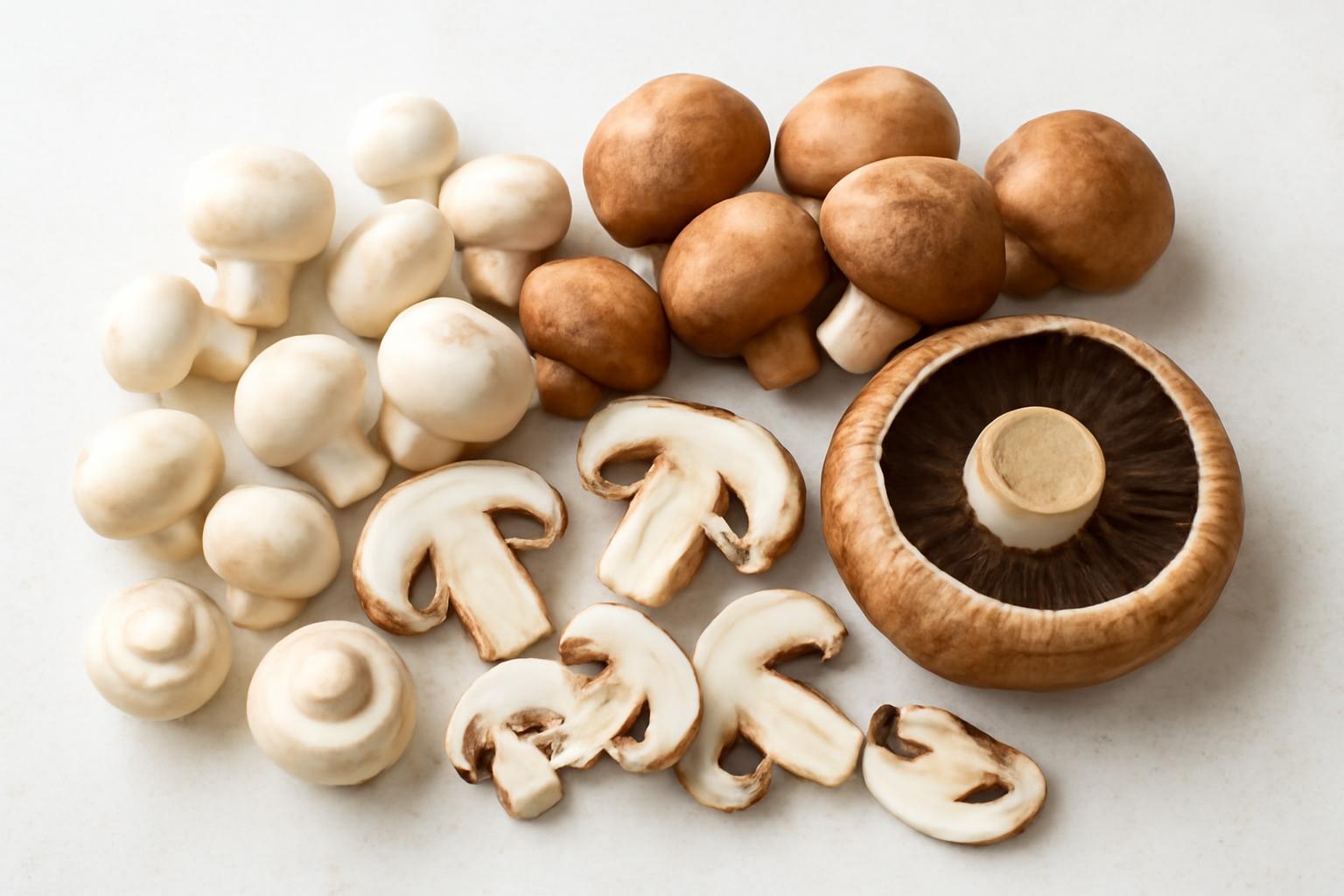
Canned button mushrooms are low FODMAP at 75 g, about 1/2 cup, when drained and rinsed. Fresh button mushrooms run high at meal portions.
Are mushrooms low FODMAP? Some are, but many of the mushrooms people buy most often are not. The best-supported elimination-phase options in the evidence reviewed here are:
- Oyster mushrooms: 75 g, about 1 cup — Monash University
- Canned champignon/button mushrooms: 75 g, about 1/2 cup, drained and rinsed — Monash University
- Dried shiitake: 2 mushrooms — Monash University
- Dried porcini: 1 tablespoon — Monash University
By contrast, fresh button, portobello, fresh shiitake, enoki, and Swiss brown are commonly reported as high FODMAP at normal meal portions, mainly because of mannitol.
The important nuance is that mushroom FODMAP status depends on species, form, and serving size. “Mushrooms” is too broad to be useful. A fresh white button mushroom is not the same as an oyster mushroom, and a fresh button mushroom is not the same as a canned champignon that has been drained and rinsed.
Two practical notes up front:
- Low FODMAP does not mean symptom-free for every person. It means a food has tested low in a specific serving.
- Gram weights are more reliable than cup counts. Household measures are approximate, and app listings can change as foods are retested.
This guide prioritizes Monash University data where available, since Monash developed the low FODMAP diet and publishes lab-tested food results in its app. Where Monash data is not available in the evidence set, FODMAP Friendly is identified separately.
What FODMAPs Are and Why Mushrooms Matter for IBS
FODMAPs are short-chain carbohydrates: fermentable oligosaccharides, disaccharides, monosaccharides, and polyols.
In people with IBS or FODMAP sensitivity, these carbohydrates may be poorly absorbed. The low FODMAP framework is used because those carbs can:
- Draw fluid into the intestine
- Ferment in the gut and produce gas
That combination can contribute to symptoms such as bloating, abdominal pain, distension, excess gas, diarrhea, constipation, or mixed bowel changes.
Why mushrooms are a common problem food
Mushrooms matter because many varieties are rich in mannitol, which is a polyol. Monash’s general food guidance also identifies mushrooms as a vegetable group commonly rich in mannitol.
That is why many broad low FODMAP lists simply mark mushrooms as “high.” The problem is that this shortcut is only partly true. It fits many common fresh mushrooms, but not all mushrooms in all forms.
The evidence reviewed here supports three separate facts at once:
- Many fresh common mushrooms are high FODMAP
- Some mushrooms are low FODMAP in tested portions
- The same mushroom type can behave differently when fresh, canned, or dried
Fresh button mushrooms are the classic example. They are commonly described in Monash-based summaries as high in mannitol, and some sources also note moderate fructans once the portion goes beyond a very small serve.
The low FODMAP diet is a tool, not a forever diet
The low FODMAP diet has three phases:
- Elimination — usually about 2 to 6 weeks of strict low FODMAP eating
- Reintroduction — one FODMAP group at a time is tested
- Personalization — the long-term pattern that limits only the foods and amounts that actually trigger symptoms
That structure matters. The elimination phase is intentionally stricter than long-term eating should be. It is meant to help identify triggers, not to create a permanent short list of “safe foods.”
Because this is an IBS-management tool, not a general wellness trend, it is best treated as general information rather than personal dietary advice. If you are making diet changes for digestive symptoms, CaloriePages’ own terms also recommend consulting a registered dietitian or physician, especially if you have a health condition.
Why generic mushroom lists are unreliable
General food lists flatten mushrooms into one category. Lab-tested data shows that is too simplistic.
The evidence base used here points readers back to Monash University’s app for the most detailed and current data, and several mushroom types are also listed by FODMAP Friendly. That matters because a useful answer to “are mushrooms low FODMAP?” requires all three of these details:
- which mushroom
- what form
- how much
So the practical short version is:
- Not all mushrooms are low FODMAP
- Not all mushrooms are high FODMAP
- Serving size is part of the answer
- Monash and FODMAP Friendly should be distinguished rather than blended together
Low FODMAP Mushrooms: Safe Varieties and Exact Servings
For elimination-phase planning, stick to mushrooms that have a clear tested portion attached to them.
| Mushroom type | Low-FODMAP serving | Primary testing authority | What to know |
|---|---|---|---|
| Oyster mushrooms | 75 g, about 1 cup | Monash University | Best-supported fresh option |
| Canned champignon/button mushrooms | 75 g, about 1/2 cup, drained and rinsed | Monash University | Lower than fresh form in reported testing |
| Shimeji mushrooms | 1 cup | FODMAP Friendly | Specialty option; source differs from Monash |
| Black fungi mushrooms | 1 cup | FODMAP Friendly | Specialty option; source differs from Monash |
| Dried shiitake mushrooms | 2 mushrooms | Monash University | Small measured serve only |
| Dried porcini mushrooms | 1 tablespoon | Monash University | Better used as a flavoring than a main vegetable |
Important: “Low FODMAP” here means low at the tested serve, not unlimited, and not guaranteed symptom-free for every person.
Oyster mushrooms: the clearest fresh option
If you want a fresh mushroom that fits elimination most reliably, oyster mushrooms are the strongest option in this evidence set.
Multiple Monash-based summaries report them as low FODMAP at 75 g or about 1 cup. That is useful because it is a real meal-sized portion, not just a garnish-sized technicality.
In practice, oyster mushrooms are the easiest fresh swap for people who miss mushrooms in dishes like:
- stir-fries
- omelets
- rice bowls
- sautés
- soups, in measured amounts
Some sources summarize Monash data slightly differently in household terms, but 75 g / about 1 cup is the most consistently repeated conservative serve here.
Canned champignon/button mushrooms: low in a specific form
Fresh button mushrooms are usually a poor elimination-phase choice. Canned champignon/button mushrooms, however, are commonly reported as low FODMAP at 75 g or about 1/2 cup when drained and rinsed in Monash-based summaries.
Some sources phrase that serving as about 6 mushrooms. That is one reason weights are more useful than counts: mushroom size varies.
The best-supported explanation for the difference between fresh and canned is that mannitol and fructans can leach into the brine. That means the lower-FODMAP result is tied to the product form and preparation, not just the species name.
So the mushroom is not simply “button mushroom.” The lower-FODMAP option is specifically:
- canned
- packed in liquid/brine
- drained
- rinsed
- used without relying on the brine
Shimeji and black fungi: supported, but from FODMAP Friendly
Two additional mushrooms appear in the evidence as low FODMAP at 1 cup:
- Shimeji mushrooms — FODMAP Friendly
- Black fungi mushrooms — FODMAP Friendly
These can widen your choices, especially if you shop at Asian grocery stores. But they should be labeled clearly as FODMAP Friendly entries, not Monash entries.
That distinction matters because many readers specifically want Monash-based elimination guidance. If you are being very conservative, it is reasonable to treat oyster mushrooms and drained/rinsed canned champignons as the more established core options, then use shimeji or black fungi only after checking current app listings.
Dried shiitake: low only in a small measured serve
Fresh shiitake mushrooms are commonly reported as high FODMAP at normal portions. Dried shiitake are more nuanced.
Monash-based summaries in the evidence set report 2 dried shiitake mushrooms as a low-FODMAP serve. One source also translates that to roughly 7 g rehydrated.
This is exactly why blanket statements about mushrooms fail. “Shiitake” is not enough information. You need to know:
- fresh or dried
- how much
- whether you are treating it as a small accent or a substantial serving
For elimination, dried shiitake works best as a carefully measured flavor addition, not a casual handful.
Dried porcini: low at 1 tablespoon, but larger serves rise quickly
Dried porcini mushrooms are the other main dried mushroom with repeated Monash-based support in this evidence set.
The conservative low-FODMAP serve reported here is 1 tablespoon. Several summaries also report that larger amounts rise in FODMAP load, with 1/2 cup described as moderate and 1 cup as high.
Because some household-measure summaries differ across sources, the safest interpretation is simple: if you are in elimination, treat 1 tablespoon as the working low-FODMAP amount and avoid assuming that larger portions will behave the same way.
That makes dried porcini useful for:
- sauces
- risotto flavoring
- stuffing
- rice dishes
- finishing a dish with mushroom depth
It does not make porcini a dependable elimination-phase “serve yourself a bowl” mushroom.
A practical elimination-phase mushroom shortlist
If you want the simplest conservative list, use this:
Best-supported fresh option from Monash - Oyster mushrooms — 75 g / about 1 cup
Best-supported canned option from Monash - Canned champignon/button mushrooms — 75 g / about 1/2 cup, drained and rinsed
Best-supported dried options from Monash - Dried shiitake — 2 mushrooms - Dried porcini — 1 tablespoon
Additional specialty options from FODMAP Friendly - Shimeji — 1 cup - Black fungi — 1 cup
High FODMAP Mushrooms to Limit or Avoid in Elimination
Most fresh supermarket mushrooms are still better treated as high FODMAP during strict elimination.
| Mushroom type | Reported issue | Practical elimination guidance | Primary authority in evidence |
|---|---|---|---|
| Fresh button/white | High mannitol; some summaries also note moderate fructans beyond very small serves | Usually avoid | Monash-based summaries |
| Fresh portobello | High mannitol at normal portions | Usually avoid | Monash-based summaries |
| Fresh shiitake | High mannitol at normal portions | Usually avoid | Monash-based summaries |
| Fresh enoki | High mannitol at normal portions | Usually avoid | Monash-based summaries |
| Swiss brown | High mannitol | Usually avoid | Monash / FODMAP Friendly summaries |
| Larger serves of dried shiitake | High mannitol/polyols | Avoid | Monash-based summaries |
| Larger serves of dried porcini | Higher mannitol/polyol load | Avoid | Monash-based summaries |
| Dried black chanterelle | Reporting is inconsistent across summaries; higher-sorbitol reports appear at larger serves | Not a strong elimination choice | Mixed summaries |
Fresh button mushrooms are the classic high-FODMAP example
Fresh button mushrooms are the clearest example of why mushrooms get a bad reputation on low FODMAP lists.
Across the evidence set, fresh button mushrooms are repeatedly described as high in mannitol, and some Monash-based summaries also note moderate fructans once the portion exceeds a very small amount.
That dual issue is why fresh button mushrooms appear on so many elimination-phase avoid lists even though canned champignons can fit in a measured, drained, rinsed portion.
Portobello, fresh shiitake, enoki, and Swiss brown are also common problems
Fresh portobello, fresh shiitake, enoki, and Swiss brown are also repeatedly reported as high FODMAP, mainly because of mannitol.
The core practical takeaway is not that these mushrooms are “bad forever.” It is that they are weak choices during the strict elimination phase when better-supported alternatives already exist.
Tiny low-FODMAP amounts exist, but they are rarely practical
One source of confusion is that some otherwise high-FODMAP mushrooms do have very small reported low-FODMAP amounts.
Monash-based summaries in the evidence set describe examples such as:
- Fresh button: about 7 to 10 g, roughly 1 to 1.5 small mushrooms
- Fresh portobello: around 10 to 15 g, or about 1/4 of a medium mushroom
- Fresh shiitake: around 10 to 11 g
- Fresh enoki: around 10 g or about 2 mushrooms
These figures are useful for understanding the testing, but they are not very helpful for normal cooking. If your real question is “Can I make a mushroom stir-fry?” or “Can I add a meaningful amount to pasta?”, these mushrooms are still best treated as high FODMAP during elimination.
Dried mushrooms can move from usable to problematic quickly
Dried mushrooms deserve extra care because the working serves are small.
The evidence here supports:
- Dried shiitake: low at 2 mushrooms, higher beyond that
- Dried porcini: low at 1 tablespoon, then moderate or high in larger serves
For dried black chanterelle, the evidence is less tidy. Some summaries report a small low serve and higher sorbitol above it; others simply classify it as high. That inconsistency is a good reason not to make black chanterelle part of a conservative elimination routine.
The simplest “avoid for now” list
If you want a conservative elimination rule, limit or avoid:
- fresh white/button mushrooms
- fresh portobello
- fresh shiitake
- fresh enoki
- Swiss brown
- larger servings of dried mushrooms unless your exact product and exact amount are clearly tested low
That rule is easier than trying to build meals around the tiny low-FODMAP amounts of mushrooms that are otherwise high.
Why Serving Size and Form (Fresh/Canned/Dried) Change Everything
With mushrooms, the difference between low and high FODMAP is often not just the variety. It is also how the mushroom is processed and how much you eat.
Serving size is not a footnote
A low-FODMAP rating is tied to a tested portion.
That means:
- 75 g oyster mushrooms does not mean unlimited oyster mushrooms
- 75 g canned champignons does not mean the whole can
- 2 dried shiitake does not mean “shiitake are fine”
- 1 tablespoon dried porcini does not mean a large serving of porcini is automatically low
This is also the easiest place for readers to confuse lab testing with personal tolerance. A serving can test low FODMAP and still not agree with you personally. The testing tells you the food is low in the specified FODMAP load; it does not promise zero symptoms for every gut.
Why canned mushrooms can test lower than fresh ones
The fresh-versus-canned difference is one of the most useful practical lessons in this topic.
Fresh button mushrooms are usually reported as high FODMAP. Canned champignon/button mushrooms can test low at a measured serve when drained and rinsed.
The most commonly repeated explanation in the evidence is that mannitol and fructans leach into the brine. That is why the cooking liquid matters for canned mushrooms, and why “button mushrooms” by itself is not a complete answer.
Drying changes the serving math
Drying moves mushrooms in the opposite direction from canning in practical terms: it reduces water and leaves you working with a more concentrated ingredient.
The evidence set supports a cautious interpretation:
- small measured amounts of some dried mushrooms can fit
- larger dried-mushroom servings become much less predictable and often clearly high
That is why dried mushrooms are better treated as measured ingredients than as free-pour vegetables during elimination.
Even low serves still count toward the meal
The broader low FODMAP framework also includes the idea that foods are not eaten in isolation. One source in the evidence set gives a general FODMAP stacking example involving mushrooms alongside other foods.
The cautious takeaway is not that mushrooms are uniquely risky; it is simply that a low-FODMAP serve still contributes to the overall meal load. So if you tolerate oyster mushrooms poorly in one meal, the mushrooms may not be the only variable.
That is a broader low-FODMAP principle, not a mushroom-specific lab finding, but it helps explain why a “green-light” serving does not always feel identical in every meal context.
Preparation Tips: Rinsing, Draining, and Avoiding Leaching
Preparation matters most with canned and high-FODMAP mushrooms.
1. Drain and rinse canned champignon mushrooms thoroughly
For canned champignon/button mushrooms, the evidence-backed routine is straightforward:
- open the can
- pour off all the liquid
- rinse the mushrooms under water
- drain again before cooking
Do not treat the canning liquid as interchangeable with the mushrooms themselves. The point of using canned champignons is that some FODMAPs are thought to have moved into that liquid.
2. Be careful with high-FODMAP mushrooms in soups, broths, and sauces
The evidence set explicitly supports the idea that FODMAPs from high-FODMAP mushrooms can leach into cooking liquid.
That means dishes such as these can remain problematic if they are built on high-FODMAP mushrooms:
- mushroom soup
- brothy stews
- ramen-style broths
- braising liquids
- cream sauces
So “I’ll just remove the mushroom pieces later” is not a dependable elimination-phase strategy.
3. Use oyster mushrooms in measured portions
Oyster mushrooms are the most flexible fresh option, but the same rule still applies: measure the serve.
A practical elimination approach is to use 75 g, about 1 cup, then build the rest of the meal from foods you already know fit your plan.
Several recipe-style sources suggest oyster mushrooms work especially well in sautéed dishes and can be added toward the end of cooking in soups or sauces to preserve texture. That is a culinary tip rather than a FODMAP rule, but it fits their reported use well.
4. Treat dried mushrooms as measured ingredients
For dried shiitake and dried porcini, the evidence supports the serving sizes of the mushrooms themselves:
- 2 dried shiitake mushrooms
- 1 tablespoon dried porcini
What the evidence pack does not clearly establish is a firm rule for rehydration liquid from dried mushrooms. Because that point is not directly settled here, the safest statement is simply this: do not assume the soaking liquid is automatically low FODMAP just because the measured mushroom portion is.
5. Keep product labels specific
A practical problem with specialty mushrooms is vague labeling. “Mixed mushrooms” or “gourmet mushroom blend” tells you much less than a package labeled oyster, shimeji, or champignon.
Since the low-FODMAP answer depends on the exact species and form, more specific labeling makes the food easier to evaluate against current app data.
Untested Mushrooms and Reintroduction After Elimination
A lot of confusion comes from the fact that mushroom choices in stores often expand faster than testing tables do.
Untested does not mean low FODMAP
If you cannot find a current tested entry for a mushroom, the conservative elimination-phase move is not to assume it is safe.
The evidence set gives examples of mushrooms whose status may be unclear or not consistently listed in summaries, including mushrooms such as:
- chanterelle
- cremini
- morels
- lion’s mane
The point is not that these are definitely high. The point is that unclear status is not the same as verified low FODMAP.
Why this matters with mushrooms more than many readers expect
“Mushroom” sounds like one category, but the evidence shows wide differences by type. That is why one mushroom can be workable at a meal-sized serve and another can be high at the same apparent portion.
So an unlisted specialty mushroom should be treated as an evidence gap, not a hidden green light.
Reintroduce one mushroom type at a time
After elimination, the reintroduction phase is where many people learn that their long-term diet can be broader than the elimination list.
The mushroom-specific principle supported in the evidence is simple: reintroduce mushrooms later rather than assuming them during elimination. A practical way to do that is to test one type at a time rather than a mixed mushroom dish.
That makes it easier to interpret your own response to mushrooms such as:
- fresh button
- fresh shiitake
- portobello
Individual tolerance still varies
This point belongs near the serving guidance, not just at the end: lab-tested low FODMAP is not the same thing as guaranteed tolerance.
Several sources in the evidence set note that:
- IBS responses vary by person
- not everyone reacts to every FODMAP
- a food that is low in testing can still be a problem for some individuals
That does not make the testing useless. It just means the testing gives you a better starting point, not a personal verdict.
Check for updates before relying on an old chart
Multiple sources in the evidence set recommend checking the Monash app for the latest information because food testing and serving guidance can change.
That matters especially with mushrooms because even reputable summaries sometimes report servings a little differently in household terms. If you plan to use a mushroom regularly, current app data should outrank an old screenshot or generic list.
Mushroom Nutrition: Benefits Despite FODMAP Concerns
The fact that mushrooms can be tricky for IBS does not make them nutritionally pointless.
Mushrooms bring more than flavor
The nutrition sources in the evidence set describe mushrooms as providing:
- B vitamins
- selenium
- copper
- antioxidants
That is a fair, well-supported general nutrition summary across commonly eaten mushrooms.
Some sources also discuss beta-glucan, a type of fiber found in mushrooms, and describe it as relevant to heart health. One source notes that beta-glucan can also be fermented by gut bacteria. Because this article is focused on FODMAP practicality rather than broader microbiome claims, the cautious takeaway is simply that mushrooms have nutritional value beyond flavor alone.
Mood research exists, but it is observational
One source in the evidence set cites an observational study of about 24,000 people in which 4 g of mushrooms daily was associated with a lower chance of depression over nine years.
That is interesting, but it should be kept in perspective:
- it is observational
- it shows an association, not proof of cause
- it does not mean mushrooms prevent depression
So this is better treated as a side note in the research than as a reason to push mushrooms despite symptoms.
Low calorie density and strong umami make mushrooms useful
Separate from FODMAP issues, mushrooms are often useful because they are generally low in calorie density and bring a strong umami effect to meals.
That makes the low-FODMAP-compatible options especially practical. If you tolerate oyster mushrooms or drained/rinsed canned champignons, you can add:
- savory depth
- texture
- variety
- some useful micronutrients
without needing a large calorie load.
The smarter goal is not “avoid all mushrooms”
The best-supported strategy in this evidence set is not total avoidance. It is to be selective:
- prioritize mushrooms with clear tested servings
- respect the portion
- distinguish fresh from canned and dried
- use current app data rather than old generalized charts
That approach lets some people keep mushrooms in their diet without turning every mushroom dish into guesswork.
FAQ
Are oyster mushrooms low FODMAP?
Yes. In the evidence reviewed here, Monash University is consistently summarized as listing oyster mushrooms at 75 g, about 1 cup, as low FODMAP.
That means a tested meal-sized portion exists. It does not mean unlimited oyster mushrooms are automatically fine, and it does not guarantee symptom-free eating for every person with IBS.
Can I eat canned mushrooms on low FODMAP?
Sometimes, yes. Canned champignon/button mushrooms are commonly reported from Monash-based summaries as low FODMAP at 75 g, about 1/2 cup, drained and rinsed. Some summaries describe that as about 6 mushrooms.
The preparation matters. The reported reason canned champignons test lower than fresh button mushrooms is that some FODMAPs may move into the canning liquid, so draining and rinsing are part of the low-FODMAP use case.
Why are fresh button mushrooms high FODMAP?
Fresh button mushrooms are usually reported as high FODMAP mainly because of mannitol, a polyol. Some Monash-based summaries in the evidence set also note moderate fructans once the portion goes beyond a very small serve.
That combination is why fresh button mushrooms are usually treated as an elimination-phase food to avoid, even though canned champignons can fit in a measured drained-and-rinsed serving.
Do serving sizes matter for mushroom FODMAP levels?
Absolutely. Serving size is one of the main reasons mushroom advice looks contradictory.
A mushroom can be low FODMAP at a tested amount and moderate or high in a larger one. That is why servings such as 75 g oyster mushrooms, 75 g canned champignons, 2 dried shiitake, and 1 tablespoon dried porcini need to be treated as specific limits during elimination, not as loose suggestions.
What untested mushrooms should I avoid during elimination?
Avoid assuming that a mushroom is low FODMAP if you cannot verify a current tested listing.
Examples named in the evidence set as mushrooms with unclear or not consistently reported status include chanterelle, cremini, morels, and lion’s mane. The key point is not that these are definitely high. It is that unclear status should not be treated as confirmed low FODMAP during elimination.
Not all mushrooms are low FODMAP, but they are not all off-limits either. The best-supported elimination-phase choices in this evidence set are oyster mushrooms, drained and rinsed canned champignon/button mushrooms, and small measured amounts of dried shiitake or dried porcini. Most common fresh supermarket mushrooms are still better treated as high FODMAP at normal serving sizes. Use current Monash data where possible, distinguish it from FODMAP Friendly entries, and remember that low FODMAP is a tested food characteristic, not a guarantee of personal tolerance.