
Calories and Sodium in Low-Sodium Baked Beans: Label Data and Recipe Estimates
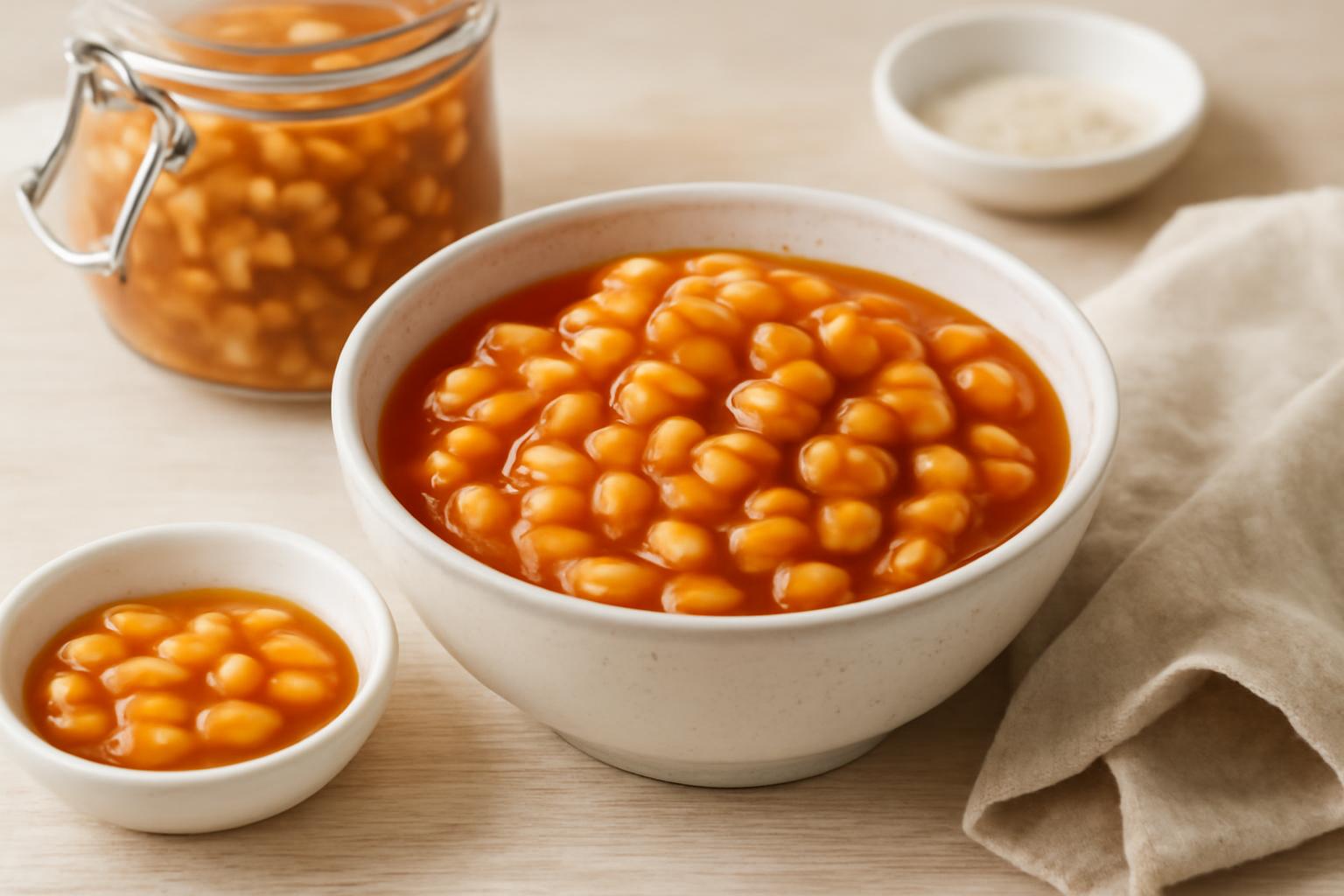
Homemade estimates are 55 mg per 1/2 cup for a slow-cooker recipe, about 107 mg per roughly 1/2 cup for a pinto version and 130 mg per cup for cowboy beans.
If you track calories and sodium closely, baked beans are one of those foods that stop looking simple the moment you compare labels, app entries, and homemade recipes. Calories usually stay within a manageable range. Sodium is where the spread gets wide enough to change how the food fits your day.
That matters because “low sodium baked beans” is not one precise nutrition category in this evidence set. Some commercial reduced-sodium products still land in the several-hundred-milligram range per serving. Homemade versions built from dried beans or no-salt-added canned beans can come in far lower. Serving size adds another layer of confusion: labels are often based on 1/2 cup, while generic nutrition databases may show 1 cup.
So the practical way to track low sodium baked beans is not to trust the phrase on the front of the can. It is to sort what you are looking at into three buckets: regular baked beans, commercial reduced-sodium baked beans, and homemade low-sodium baked beans. Then normalize the portion size before you compare calories or sodium.
One more caution up front: the store-bought evidence here is stronger for product type, serving size, and ingredient patterns than for exact manufacturer sodium panels. The clearest commercial Bush’s source in this pack confirms a reduced-sodium vegetarian product, but the sodium milligrams are not displayed in the provided page text. Where an exact commercial sodium figure appears, it comes from a secondary comparison source rather than a first-party label panel. For trackers, that means label checks still matter even after you read the comparisons below.
What Counts as Low-Sodium Baked Beans?
In practice, low sodium baked beans are a shopping and recipe category, not a single number. Values move around with brand, recipe style, sauce ingredients, and whether the data is given for 1/2 cup or 1 cup.
At the regular end, a kidney-diet comparison citing USDA-based numbers puts vegetarian baked beans at about 435 mg sodium per 1/2 cup and notes that meat versions can be higher; the same comparison also uses a 720 mg traditional benchmark per 1/2 cup for contrast, according to The Kidney Dietitian.
At the high end of generic reference data, a MyFoodData baked-beans entry reports 1,067.7 mg sodium per 1 cup. If you simply halve that for a rough 1/2-cup equivalent, you are still looking at about 534 mg sodium, which is why mixed serving sizes can make one entry look much worse or much better than another at first glance, according to MyFoodData.
Commercial reduced-salt products are lower than standard baked beans, but that does not automatically make them low in an absolute sense. An Australian comparison article places reduced-salt baked beans at about 500 mg sodium per serve and regular baked beans at about 1,000 mg per serve, which is useful as a market-specific reminder that “reduced” can still mean substantial sodium, according to Plant Nutrition and Wellness.
Homemade versions are where sodium can drop the most. In this evidence set, one slow-cooker recipe comes in at 55 mg sodium per 1/2 cup, while a no-salt-added cowboy-beans recipe is estimated at 130 mg per 1 cup. A separate kidney-friendly pinto-bean version lands around 107 mg per roughly 1/2 cup (The Kidney Dietitian; Low So Recipes; The Everyday Kidney Cook).
That is the most useful definition for trackers: low sodium baked beans are not identified by the phrase alone. They are identified by the actual sodium on the label or in the recipe math, the serving basis, and how much of the sodium is coming from the sauce rather than the beans themselves.
Typical Nutrition Profile of Low-Sodium Baked Beans
A generic low-sodium baked-beans listing is moderate in calories and mostly carbohydrate. FatSecret lists 105 calories per 100 g, 133 calories per 127 g serving, and 266 calories per cup, with calories coming from about 79% carbohydrate, 18% protein, and 3% fat, according to FatSecret.
That macro profile tells you what the food usually does well. Low sodium baked beans are generally a carb-and-fiber food with some plant protein, not a lean-protein food in the way chicken breast or tuna is. A commercial Bush’s reduced-sodium vegetarian product in the evidence set lists a 1/2-cup (130 g) serving with 7 g plant-based protein, identifies the beans as a good source of fiber, and notes that the product is vegetarian and gluten free, according to Bush’s Food Service.
Recipe style can move the numbers a lot. One home-prepared baked-beans listing gives 392 calories per cup with 14 g protein and 14 g fiber, which is far denser than the generic low-sodium listing above. It is also missing sodium entirely, which makes it a poor choice for low-sodium logging even though it is useful as a reminder that “baked beans” entries are often recipe-dependent rather than universal, according to Eat This Much.
Minerals vary as much as calories do. A canned, drained baked-beans listing shows 418 mg potassium and 2.1 mg iron per cup, while the home-prepared listing above shows 906 mg potassium and 5 mg iron per cup. For anyone managing kidney-related limits, that spread matters, and it also shows why generic app entries can blur together foods that are nutritionally quite different, according to NutriScan.
A more practical way to think about the nutrition profile is this: low sodium baked beans can behave like a modest side dish or like a heavier bean-based meal component depending on the recipe. Plain or generic low-sodium entries may sit in the low-to-mid calorie range. Sweeter sauces, richer recipes, and added meat can push the food much higher without changing the name in your tracker.
Commercial Reduced-Sodium Baked Beans Options
The clearest confirmed commercial option in this evidence set is Bush’s Bean Pot Reduced Sodium Vegetarian Baked Beans from the company’s food-service line. The product page describes it as vegetarian and gluten free, gives a 1/2-cup (130 g) serving size, lists 7 g plant-based protein per serving, and names ingredients built around prepared navy beans, water, and brown sugar, with 2% or less of salt, mustard, modified corn starch, onion powder, caramel color, spice, garlic powder, and natural flavor (Bush’s Food Service).
The same source also confirms that this is a bulk product rather than a typical retail can: it comes in 55 oz and 115 oz cans, lists 25 servings per container, and gives a shelf life of 2 years (Bush’s Food Service). That is useful for confirming the product exists and for understanding the formulation, but it is less useful for a home shopper standing in front of a supermarket shelf.
For sodium specifically, the evidence is thinner than many readers would want. The Bush’s food-service page in this pack does not display the exact sodium milligram figure in the provided text. The commonly repeated Bush’s comparison number here comes instead from The Kidney Dietitian, which lists Bush’s 25% Less Sodium & Sugar baked beans at about 390 mg sodium per 1/2 cup. That makes the figure useful as a secondary-source comparison point, but not the same thing as a current manufacturer label captured directly from the retail can.
That distinction matters because commercial reduced-sodium baked beans are often the easiest versions to log, yet they are also the versions most likely to be overtrusted. “Reduced sodium” tells you the product is lower than the standard version it is being compared against. It does not tell you, by itself, whether the product fits a tight sodium target for your meal plan.
So for store-bought options, the safest workflow is simple: use comparison articles to set expectations, but use the actual can in your kitchen to log the number that counts.
Homemade Low-Sodium Baked Beans Recipes and Nutrition
Homemade recipes are where the sodium numbers become most favorable. A slow-cooker kidney-diet recipe built from dried great northern beans, low-sodium ketchup, spices, coffee, and liquid smoke is estimated at 55 mg sodium, 191 calories, 10 g protein, 7 g fiber, and 35 g carbs per 1/2 cup (The Kidney Dietitian). Those are author-calculated values rather than lab-tested numbers, but they show what happens when you control both the bean base and the sauce.
A heartier version is the cowboy-beans approach: Low So Recipes estimates 130 mg sodium, 435 calories, 25 g protein, 14 g fiber, 57 g carbs, and 13 g fat per 1-cup serving in a recipe made with no-salt-added pinto, navy, and kidney beans, plus no-salt-added tomatoes and stock, vegetables, spices, and low-sodium barbecue sauce, according to Low So Recipes.
A kidney-friendly pinto-bean recipe lands between those two extremes. The Everyday Kidney Cook estimates about 107 mg sodium, roughly 5 g protein, and 4 g fiber per approximately 1/2-cup serving when no-salt-added canned beans and a low-salt barbecue sauce are used. The same source says that version is about 75% lower in sodium than regular homemade baked beans at 535 mg per 1/2 cup and lower than canned vegetarian baked beans at 480 mg per 1/2 cup, according to The Everyday Kidney Cook.
There is also a useful lower-salt homemade angle that is not framed as a macro-tracking recipe at all. Healthy Little Foodies describes a stovetop baked-beans recipe as lower in salt and sugar than commercial canned baked beans, with no added salt in the base recipe and options for low-sodium or no-salt-added canned beans and low-salt stock when making it baby-friendly, according to Healthy Little Foodies.
What ties these homemade versions together is more important than the exact number in any one card. They lower sodium by controlling two inputs separately: the beans and the sauce. Dried beans or no-salt-added canned beans keep the starting sodium low. Then ingredients such as low-sodium ketchup, low-sodium barbecue sauce, no-salt-added tomatoes, stock, vinegar, smoked paprika, coffee, onion, garlic, and liquid smoke rebuild flavor without relying mostly on salt.
That is why homemade low sodium baked beans are the best route if you want precision. They are still estimates, and brand swaps can move the totals. But they give you much more control than starting from a pre-sauced can whose sodium is already baked into the product.
Sodium Comparisons: Regular, Reduced, and Homemade
For a calorie tracker, the cleanest comparison is not “healthy versus unhealthy.” It is “how much sodium do I get in the portion I will actually eat?”
Start with regular baked beans. In this evidence set, a USDA-linked vegetarian reference sits around 435 mg sodium per 1/2 cup, and a traditional benchmark used for comparison reaches 720 mg per 1/2 cup (The Kidney Dietitian). A generic baked-beans database entry reaches 1,067.7 mg per cup, which works out to roughly 534 mg per 1/2 cup if you simply divide the serving size evenly (MyFoodData).
Then look at reduced commercial products. The Bush’s 25% Less Sodium & Sugar comparison figure in this pack is about 390 mg per 1/2 cup, but that number comes from The Kidney Dietitian rather than a first-party label panel reproduced here. Separate Australian reduced-salt examples sit around 500 mg per serve, while regular baked beans in the same comparison are around 1,000 mg per serve, according to Plant Nutrition and Wellness. Those are useful benchmarks, but they should not be merged into one fake universal number.
Homemade low-sodium versions are the only category in this evidence set that consistently falls far below the regular and reduced-salt commercial references. The documented range here runs from 55 mg per 1/2 cup in the slow-cooker great northern bean recipe, to about 107 mg per roughly 1/2 cup in the kidney-friendly pinto version, to 130 mg per 1 cup in the cowboy-beans recipe (The Kidney Dietitian; The Everyday Kidney Cook; Low So Recipes).
The pattern is clear even when the serving sizes are messy. Regular baked beans often live in the mid-hundreds of milligrams per 1/2 cup and can exceed 1,000 mg per cup in generic entries. Commercial reduced-sodium products do help, but they often still sit in a range that matters if you are keeping the rest of the plate salty. Homemade versions are where sodium can drop from “significant part of the meal” to “fairly easy to budget.”
This is also where portion math matters more than branding. A product that looks manageable at 390 mg per 1/2 cup becomes 780 mg at 1 cup. A homemade recipe that sounds less convenient at 130 mg per cup can be far easier to fit into a sodium budget even when you eat more of it.
For readers who want a quick rule: commercial reduced-sodium baked beans are usually “better than regular,” while homemade low-sodium baked beans are the only versions in this evidence pack that look consistently “low enough to create room elsewhere.”
Tips to Minimize Sodium in Baked Beans
Start with the bean base, not the sauce label. If you are cooking from ingredients, plain dried beans or no-salt-added canned beans give you the most room to work with. EatingWell’s canned-beans guide recommends low-sodium or no-salt-added canned beans and notes that rinsing helps remove sodium from the packing liquid, according to EatingWell.
If you are using canned beans as an ingredient, rinse and drain them before building the dish.
Then fix the sauce. In the low-sodium recipes here, the biggest improvements come from swapping regular ketchup, barbecue sauce, canned tomatoes, and stock for low-sodium or no-salt-added versions. Acidic and smoky ingredients such as vinegar, mustard, smoked paprika, coffee, garlic, onion, chili powder, and liquid smoke help replace some of the intensity that salt would otherwise provide.
If you are managing kidney-related limits as well as sodium, some recipes go further. The Everyday Kidney Cook uses no-salt-added canned beans, draining and rinsing, and an optional boiling step to lower potassium further. That source also emphasizes that kidney suitability varies by stage, lab values, and treatment status, so “kidney-friendly” still needs to be individualized.
For store-bought baked beans, the practical rule is skepticism. Reduced-salt can still mean several hundred milligrams per serving. For homemade baked beans, the practical rule is control: the closer you stay to plain beans plus a scratch sauce, the more predictable the sodium becomes.
Tracking Low-Sodium Baked Beans in Your TDEE
Low-sodium baked beans can fit calorie tracking well, but they usually work better as a satiety food than as a pure protein-efficiency food. In the evidence here, protein ranges from roughly 5 g per about 1/2 cup in one kidney-friendly pinto recipe to 25 g per cup in the cowboy-beans recipe with added meat. Protein matters because its thermic effect is high—about 20% to 30% of protein calories—and because higher-protein foods often improve fullness. But legumes are still relatively calorie-costly as protein sources: CaloriePages’ protein-density guide puts cooked lentils at 12.9 kcal per gram of protein versus 4.5 for canned tuna and 5.3 for cooked chicken breast, according to CaloriePages’ protein-density guide.
That does not make beans a bad tracking food. It just tells you what job they are doing. Baked beans are generally more useful for volume, fiber, and meal satisfaction than for maximizing protein per calorie. If your goal is to stay full on a moderate calorie budget, that can be a strength. If your goal is to hit a high protein target tightly, beans work better as part of the meal than as the protein anchor.
Precision helps, but false precision is still false. CaloriePages notes that calorie labels can be off by 20%, which is a good reason to treat any canned or recipe entry as a workable estimate rather than a guarantee.
The TDEE side is just as approximate. CaloriePages’ TDEE guide explains that total daily energy expenditure includes BMR, TEF, deliberate exercise, and NEAT, with NEAT being the most variable component and differing by up to 2,000 kcal per day between similar people. The same guide recommends calibrating intake against a 2- to 4-week food log and weekly body-weight trend rather than assuming a calculator nailed your maintenance calories on day one, according to CaloriePages’ TDEE guide.
Applied to low sodium baked beans, that means two things. First, portion accuracy matters more than finding the one perfect database entry. Second, whether a given serving “fits your TDEE” is not something the beans can answer on their own. Your average intake, your actual activity, and your weight trend decide that over time.
FAQ
What is the sodium in Bush’s reduced sodium baked beans?
In this evidence set, the clearest Bush’s sodium figure is a secondary-source comparison: The Kidney Dietitian lists Bush’s 25% Less Sodium & Sugar baked beans at about 390 mg sodium per 1/2 cup. The Bush’s food-service reduced-sodium product page confirms the product, serving size, and other nutrition details, but the page text provided here does not show the exact sodium milligrams. So the 390 mg number is best treated as a comparison estimate, not a manufacturer-verified label panel reproduced in this article (The Kidney Dietitian; Bush’s Food Service).
How many calories in a 1/2 cup serving of low-sodium baked beans?
A generic low-sodium baked-beans listing gives 133 calories per 127 g serving, which is close to a typical 1/2-cup label-size portion. Homemade versions can be higher: the slow-cooker recipe from The Kidney Dietitian is estimated at 191 calories per 1/2 cup. So the safest answer is that 1/2 cup can vary meaningfully by recipe style and sauce density (FatSecret; The Kidney Dietitian).
Are low-sodium baked beans suitable for kidney diets?
Sometimes, but not automatically. The kidney-focused recipes in this evidence set were specifically designed to lower sodium, and one also aims to keep potassium and phosphorus lower. But The Everyday Kidney Cook explicitly notes that kidney needs vary by stage, lab values, and treatment status, and The Kidney Dietitian also frames its recipe in the context of individualized kidney nutrition. Commercial reduced-sodium baked beans can still be too salty for stricter plans, and sodium is not the only number that may matter (The Everyday Kidney Cook; The Kidney Dietitian).
How to cut sodium from canned beans for recipes?
Use no-salt-added canned beans when possible, then drain and rinse them before cooking. EatingWell recommends rinsing to remove sodium from the packing liquid, and NutriScan says rinsing can reduce sodium by about 40%. After that, control the sauce by using low-sodium or no-salt-added ketchup, barbecue sauce, tomatoes, and stock. That advice applies best when you are starting with plain canned beans as an ingredient, not when you are trying to “fix” a fully prepared can of baked beans (EatingWell; NutriScan).
What protein and fiber do low-sodium baked beans provide?
It depends heavily on the product or recipe. The Bush’s reduced-sodium vegetarian food-service product in this evidence set provides 7 g protein per 1/2 cup and is described as a good source of fiber. Homemade versions range wider: The Everyday Kidney Cook estimates about 5 g protein and 4 g fiber per roughly 1/2 cup, while Low So Recipes estimates 25 g protein and 14 g fiber per cup for its cowboy-beans recipe with added meat (Bush’s Food Service; The Everyday Kidney Cook; Low So Recipes).
Low sodium baked beans can absolutely fit calorie and macro tracking. But the usable range is broad: in this evidence set, calories run from modest generic servings to much heavier meal-style recipes, and sodium ranges from very low homemade estimates to still-fairly-salty commercial reduced-sodium options.
The practical checklist is simple. Check the sodium on the specific product or recipe you are using. Normalize the serving size before comparing entries. Weigh the portion you actually eat. Then judge whether it fits your plan by your own 2- to 4-week intake and weight trend, not by the comforting phrase on the front of the package.
If you are managing kidney disease, hypertension, or another condition, do not treat “reduced sodium” as proof of suitability. The kidney-focused sources here explicitly note that individual needs vary, especially when potassium, phosphorus, labs, or treatment status are part of the picture (The Everyday Kidney Cook).