
Count Sausage Patty Protein by Product and Portion
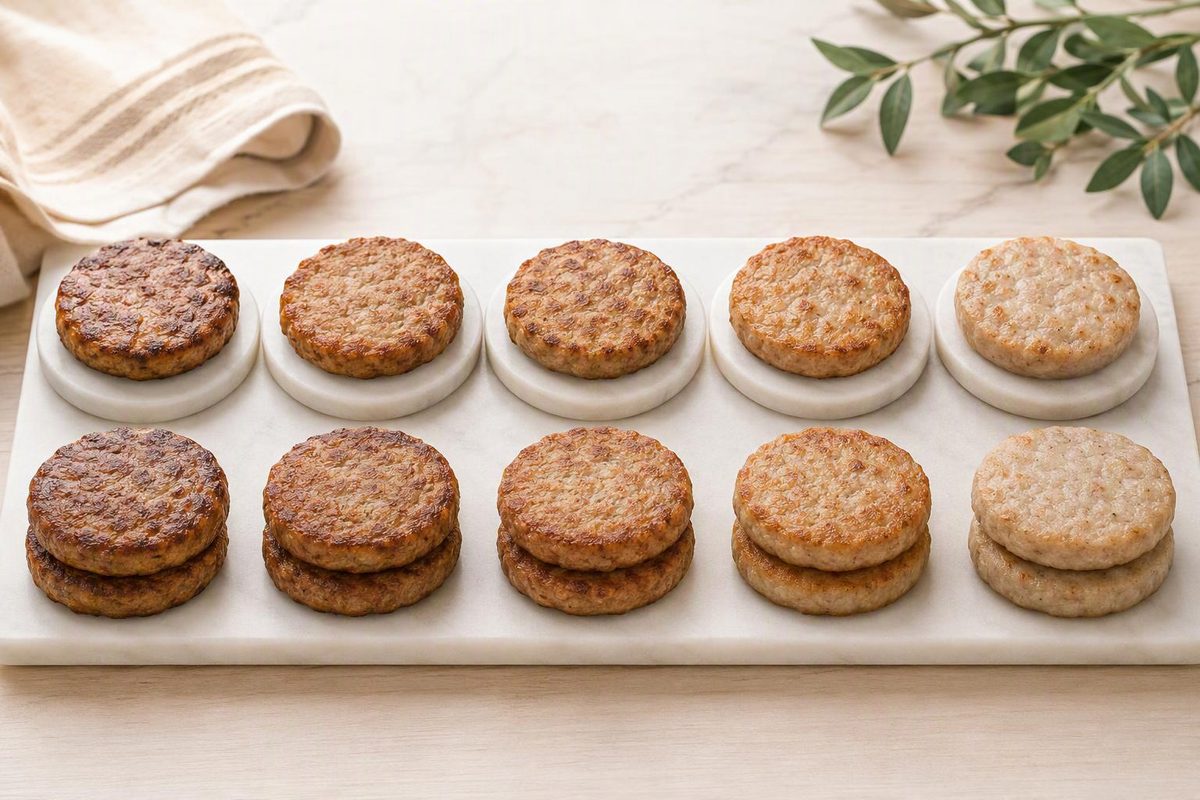
Compare protein in five pork and turkey sausage patties, check one- versus two-patty servings, and calculate the grams to enter in your food tracker.
One breakfast sausage patty weighing roughly 26–43 g provides about 3.5–7 grams of protein in the U.S. product examples below. The pork examples supply 3.5–6 g per patty; the turkey examples supply 5–7 g. These are product-specific ranges, not a standard for every sausage patty. The amount to log depends on the product, the size of its patties and how many you eat.
Check whether the package’s protein number refers to one patty or two. A label showing 8 g per serving can mean just 4 g per patty. If your package differs from the manufacturer listing below, calculate from your package.
Choose your product and enter the patties or matching prepared weight you ate; the calculator shows the protein to log.
Protein for Your Portion
Decimals are allowed, including part of a patty.
Label basis: 8 g protein per 2 patties (68 g).
8 × 1 ÷ 2 = 4 g protein.
Use your package if its nutrition differs. This is a label-based estimate.
Compare the Listed Label Values
| Product | Serving | Protein |
|---|---|---|
| Jimmy Dean Fully Cooked Original pork | 2 patties, 68 g | 8 g |
| Jimmy Dean Heat ’n Serve Original pork | 2 patties, 52 g | 7 g |
| Jones All Natural pork | 1 pan-fried patty, 30 g | 6 g |
| Butterball All Natural turkey breakfast | 2 patties, 57 g | 10 g |
| Butterball foodservice turkey, 1.5 oz | 1 patty, 43 g | 7 g |
Jones is sold uncooked, but its listed nutrition is for a pan-fried patty. Do not enter a raw weight against that cooked serving.
Sources: Jimmy Dean, Jones Dairy Farm and Butterball manufacturer listings cited in the article. ~ marks a label-based estimate.
Protein Per Patty Depends on the Listed Serving
The table keeps the serving visible because the protein number alone is easy to misread. Per-patty values are calculated from each manufacturer’s listed serving, rather than treating every nutrition panel as a one-patty label.
| Product | Listed Serving | Serving Protein | Per Patty |
|---|---|---|---|
| Jimmy Dean Heat ’n Serve Original pork | 2 patties, 52 g | 7 g | 3.5 g |
| Jimmy Dean Fully Cooked Original pork | 2 patties, 68 g | 8 g | 4 g |
| Jones All Natural pork, sold uncooked | 1 pan-fried patty, 30 g | 6 g | 6 g |
| Butterball All Natural turkey breakfast patties | 2 patties, 57 g | 10 g | 5 g |
| Butterball foodservice turkey sausage patty, 1.5 oz | 1 patty, 43 g | 7 g | 7 g |
Even the two pork products from Jimmy Dean have different serving weights and protein amounts. Heat ’n Serve Original lists 52 g for two patties; Fully Cooked Original lists 68 g for two. Their calculated per-patty weights are 26 g and 34 g, respectively.
That difference matters when selecting a food-tracker entry. An entry called “Jimmy Dean sausage patty” is not specific enough to distinguish these products. The brand can match while the serving weight and protein still do not.
The Butterball entries also need to stay separate. The retail All Natural breakfast patties and the foodservice 1.5 oz patty are different products. The foodservice patty’s 7 g figure does not establish the amount in a retail patty, which supplies 5 g in this listing.
Two Patties Supply 7–14 Grams in These Examples
If you eat two matching patties, multiply the per-patty amount by two. For products whose label already defines a serving as two patties, use the serving’s protein directly. Do not multiply that number again.
| Product | One Patty | Two Patties |
|---|---|---|
| Jimmy Dean Heat ’n Serve Original pork | 3.5 g | 7 g |
| Jimmy Dean Fully Cooked Original pork | 4 g | 8 g |
| Jones All Natural pork, pan-fried | 6 g | 12 g |
| Butterball All Natural turkey breakfast | 5 g | 10 g |
| Butterball foodservice turkey, 1.5 oz | 7 g | 14 g |
These two-patty totals are arithmetic based on the manufacturer servings above. They are not additional laboratory measurements or a universal range for a breakfast serving.
The practical distinction is between a patty count and a label serving count. Two Jimmy Dean Fully Cooked Original patties are one listed serving, supplying 8 g protein. Two Jones pan-fried patties are two listed servings, supplying 12 g. Entering “2 servings” for both products would not describe the same number of patties.
Use the unit displayed by your tracker. If its serving unit is “patty,” enter the number of patties. If its unit is the manufacturer’s two-patty serving, one serving already includes both.
Turkey Has More Protein in This Specific Comparison
Turkey sausage can provide more protein than pork sausage, but these labels do not support a blanket rule based on meat type. Compare the actual product and portion.
The Butterball retail All Natural turkey example lists 10 g protein and 110 calories for two patties weighing 57 g. Jimmy Dean Fully Cooked Original pork lists 8 g protein and 280 calories for two patties weighing 68 g.
The turkey product therefore provides more protein at fewer calories despite the smaller serving weight. If those are the two products you are choosing between, the comparison is clear. It does not establish that every turkey patty has more protein, fewer calories or the same serving size as every pork patty.
There is also overlap in the per-patty figures: the Jones pork example supplies 6 g, while the Butterball retail turkey example supplies 5 g. A “turkey” search filter alone would miss that distinction. Patty size and product formulation remain part of the comparison.
For a calorie-focused comparison, see how many calories are in a sausage patty. When tracking both calories and protein, take both numbers from the same product entry and the same portion. Combining one brand’s calories with another brand’s protein does not describe either food.
Calculate Protein From the Number of Patties
For matching packaged patties, protein eaten equals label protein multiplied by patties eaten, divided by patties per serving.
For example, three Jimmy Dean Fully Cooked Original patties supply approximately 8 × 3 ÷ 2 = 12 g protein. The 8 g belongs to two patties, so dividing by two establishes the amount per patty before scaling to three.
The same calculation works for part of a patty. If you eat half of one of those patties, the label-based estimate is 8 × 0.5 ÷ 2 = 2 g protein. A fraction is appropriate when it describes the portion you actually ate; there is no need to round the food amount up to a whole patty.
Count only the patties belonging to that product. If a plate contains different sausage products, calculate each separately and add their protein amounts. A single per-patty value cannot accurately represent a mixture unless the products happen to have the same value.
Patty counting is the simplest method when the pieces match the package’s listed serving. Weighing becomes useful when your portion is broken up, incomplete or otherwise easier to describe in grams than in patty fractions.
Calculate by Weight Only When the Food State Matches
For a weighed portion, protein eaten equals label protein multiplied by portion weight, divided by label serving weight.
Using the Jimmy Dean Fully Cooked Original listing, a matching 34 g portion gives 8 × 34 ÷ 68 = 4 g protein. That agrees with the per-patty calculation because 34 g is half of the listed 68 g serving.
The denominator must be the weight attached to the protein figure. Do not divide 8 g protein by one patty’s calculated 34 g weight when the 8 g belongs to two patties weighing 68 g. Doing so would double the protein estimate.
Grams of food and grams of protein are also different quantities. A 34 g patty does not contain 34 g of protein. In this example, its label-derived protein is 4 g; the food’s total weight includes its other components.
For the Butterball retail product, the weight-based calculation uses 10 g protein per 57 g serving. For the foodservice patty, it uses 7 g per 43 g. Those denominators cannot be swapped simply because both products are turkey sausage.
The calculator offers a gram-based option for these listed products. Its result is a proportional estimate from the listed nutrition, not a separate analysis of your individual patty. Use it only when the weighed food matches the product and preparation description.
Jones Uses a Pan-Fried Serving, Not a Raw Weight
Jones sells its All Natural pork patties uncooked, but the nutrition serving is explicitly one pan-fried patty weighing 30 g. That serving supplies 6 g protein.
You can use that listing to count the matching pan-fried patty. You can also scale a matching pan-fried portion by its weight. You should not use the 30 g cooked serving as though it were a 30 g raw serving.
For example, entering a raw portion’s weight into a calculator based on the pan-fried serving would produce a number, but the inputs would not match the label’s basis. The arithmetic cannot correct a raw-versus-cooked mismatch.
The supplied listing does not give a raw-weight conversion for this product. Without that conversion, there is no supported calculation here for protein in a weighed raw portion. Use a nutrition entry that explicitly matches the raw product, or use the listed prepared serving after following the applicable preparation instructions.
This is why the Jones preparation description stays visible in the table and calculator. “Sold uncooked” describes the product you buy; “pan-fried” describes the nutrition serving used for these numbers.
Match the Tracker Entry Before Changing the Quantity
A tracker’s quantity control scales whatever entry you selected. It does not check whether that entry represents your package. Confirm the product name, serving weight and serving unit before adjusting the amount.
For Jimmy Dean Fully Cooked Original, the matching entry should associate 8 g protein with two patties weighing 68 g. An entry associating 8 g with one patty would not match this manufacturer listing. An entry with 7 g per two patties could instead describe the Heat ’n Serve product shown above.
If your current package gives different nutrition, use its numbers rather than forcing them to fit this table. Product names alone do not override the serving and protein printed on the package you are eating.
When an app lets you create a custom entry, enter the protein for the same serving you define. If you define the serving as one patty, first divide a two-patty label’s protein by two. If you define it as the full label serving, keep the label protein unchanged.
That keeps the subsequent portion arithmetic consistent. The mistake to avoid is changing the serving unit without changing the nutrition attached to it.
Without a Matching Label, the Protein Remains an Estimate
For an unidentified restaurant, homemade or unpackaged sausage patty, the examples here provide context—not a verified nutrition value. Knowing only that it is pork or turkey does not establish its size or protein content.
If the restaurant or maker provides nutrition for the exact patty, use that serving. If you are logging a homemade recipe, these branded patty values do not substitute for the ingredients and portion information for your recipe. The supplied sources do not provide a universal restaurant or homemade-patty figure.
When you must use a comparable tracker entry, treat the result as an estimate and retain its portion description. A specific entry such as a 34 g fully cooked pork patty is more transparent than an unlabeled “sausage patty,” even when it is only a proxy for what you ate.
Finally, keep calculated decimals in perspective. The 3.5 g per-patty figure for Jimmy Dean Heat ’n Serve comes from dividing the listed 7 g serving by two. It is useful arithmetic, not evidence that every individual patty has been measured to that precision. For these packaged examples, the defensible number to log is the label’s protein scaled to your matching portion.