
Calories in an Avocado: Portions, Edible Weight, and Why Estimates Vary
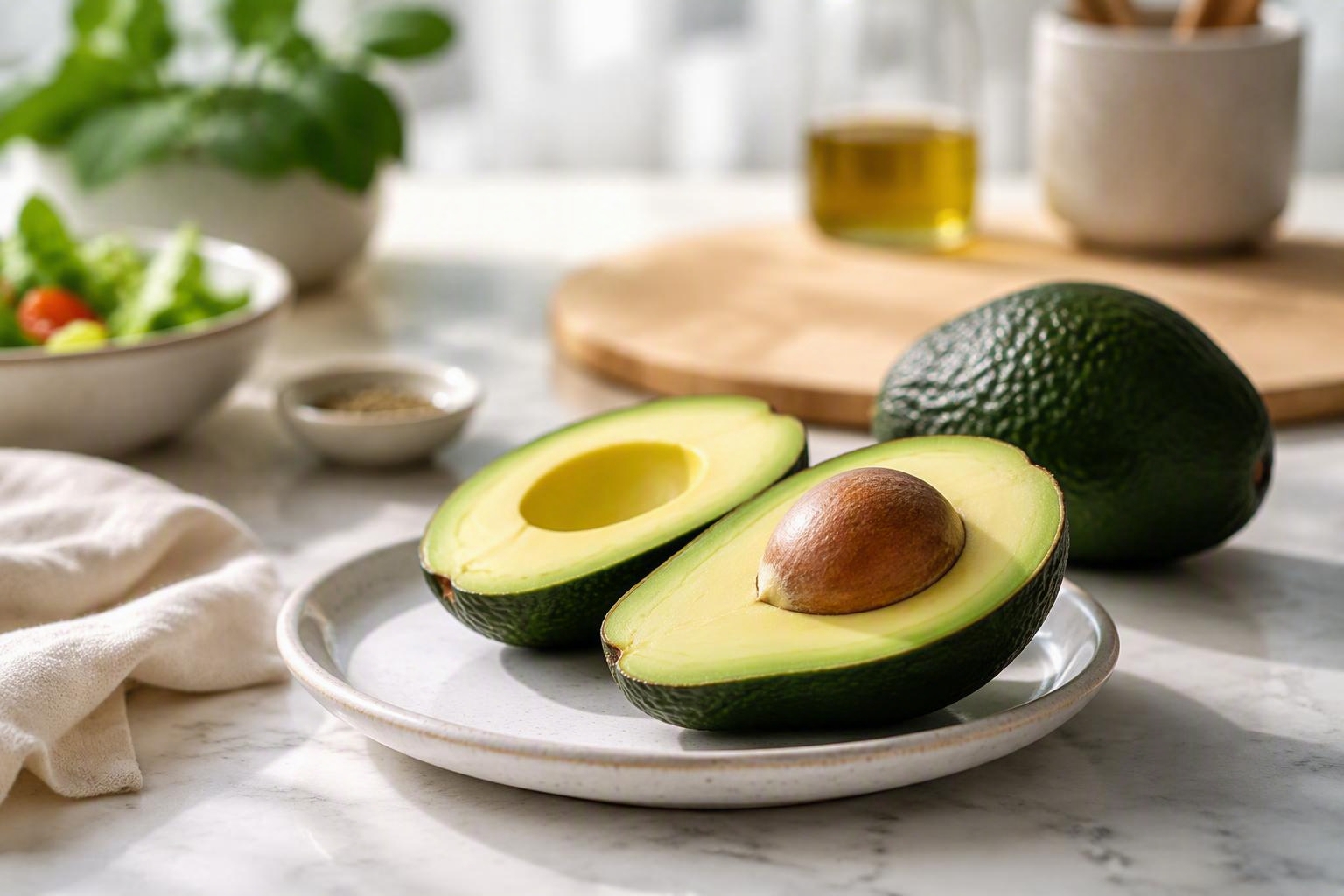
Whole-avocado entries with stated weights run from 150 to 201 g, while their published totals span 250 to 322 calories.
Overview
A whole avocado contains roughly 225 to 322 calories in published figures: Harvard’s Nutrition Source lists about 240 calories for a whole medium avocado, while USDA SNAP-Ed lists 322 calories for a 201-gram avocado. Figures tied to an explicit edible weight are generally more informative than labels like “whole” or “medium,” though estimates can still vary with the calorie baseline each source uses.
Those two numbers are not in conflict. Different fruit sizes may explain part of the gap, though only the USDA entry states a gram weight, so size cannot be confirmed as the sole cause, and the gap between them (roughly 80 calories) is larger than many people’s entire logging margin for a snack. The Ochsner Health blog adds a third figure, 225 calories for one medium whole avocado, which further illustrates how loosely the word “medium” is applied across sources.
For anyone logging food, the practical rule is simple: match the calorie figure to the edible weight being eaten, or weigh the flesh directly. The sections below provide a portion lookup built only from explicitly stated weight-and-calorie pairs, explain why published totals differ, and show how to estimate calories from a weighed portion.
Avocado calories by portion and edible weight
The most reliable way to read avocado calorie figures is to check the gram weight attached to each one. The table below collects only weight-and-calorie relationships stated directly by the cited sources. It deliberately keeps each source’s own definition, because a “half” in one source is not the same half in another.
| Portion as the source describes it | Stated edible weight | Calories | Source |
|---|---|---|---|
| 1/4 of an avocado | Not stated in grams | 60 | Love One Today |
| 1/3 of a medium avocado (one serving) | 50 g | 80 | California Avocado Commission, citing USDA FoodData Central |
| About 1/2 of an avocado (1.5 servings) | 75 g | 130 | Love One Today |
| Half a medium avocado, flesh only | Not stated in grams | 140 | British Heart Foundation |
| 100 g of avocado flesh | 100 g | 177 | British Heart Foundation |
| About 1 whole avocado (3 servings) | 150 g | 250 | Love One Today |
| 1 whole medium avocado | Not stated in grams | ~240 | Harvard Nutrition Source |
| 1 medium, whole avocado | Not stated in grams | 225 | Ochsner Health |
| 1 whole avocado | 201 g | 322 | USDA SNAP-Ed |
Two patterns in this table matter for logging. First, entries with explicit gram weights are more useful than fraction labels, because the fraction depends on the size of the fruit it came from. A “half” ranges from 130 calories (75 g, Love One Today) to 140 calories (half a medium, flesh only, British Heart Foundation), and neither source is wrong; they define the half differently. Second, the whole-avocado entries span 150 g to 201 g of represented weight, which is why the totals span 250 to 322 calories. When a food log offers several avocado entries, the one with a gram weight closest to the actual portion is the better choice.
Why avocado calorie counts differ
Published avocado calorie counts differ mainly because the labels “medium” and “whole” hide different edible weights. USDA SNAP-Ed’s 322-calorie figure describes a 201-gram avocado, Love One Today’s 250-calorie whole avocado is defined as 150 grams, and Nutracheck classifies a “medium” avocado weighed without skin or stone at 145 grams, with its size categories running from mini (70 g) to large (195 g). A reader comparing a 240-calorie “medium” figure with a 322-calorie “whole” figure should note that only the 322-calorie entry carries an explicit weight (201 grams), so the two entries cannot be treated as equivalent portions.
A second source of confusion is the difference between a serving size and a portion size. Love One Today explains that a serving size is a standardized amount representing the average amount of a food typically eaten, and that it is not a recommended amount to eat. The standardized reference reflected on labels traces back to regulation: the FDA’s Reference Amounts Customarily Consumed list a 50-gram reference amount for avocado under fruits used primarily as ingredients. A portion size, by contrast, is whatever amount a person chooses to eat in one sitting, which may be more or less than the official serving.
This distinction matters for interpretation. When a package or database entry shows 80 calories for a 50-gram serving, that is a labeling convention, not guidance that 50 grams is the correct amount for any individual. Someone who eats half an avocado has eaten roughly 1.5 standardized servings by Love One Today’s accounting, and their calorie total should reflect the portion actually consumed.
The practical conclusion: ignore size adjectives when a gram weight is available, and treat serving-size figures as unit conversions rather than recommendations.
How to estimate calories for a weighed avocado portion
The most accurate everyday approach is to weigh only the edible flesh, after the skin and stone are removed, and scale a per-100-gram value proportionally. Nutracheck’s database entry is explicitly titled “Avocado, Weighed without Skin or Stone,” which reflects the standard convention: calorie values describe the part that is eaten, so the skin and stone should never be on the scale.
Once the flesh weight is known, the calculation is a simple proportion using a clearly named source value. The British Heart Foundation states that avocado flesh contains 177 kcal per 100 grams. The steps:
- Halve the avocado, remove the stone, and scoop or peel away the flesh.
- Weigh the flesh being eaten, in grams.
- Multiply that weight by the source’s calories per 100 grams, then divide by 100.
Worked example: a weighed portion of 120 grams of avocado flesh, using the British Heart Foundation’s 177 kcal per 100 g, gives 120 × 177 ÷ 100 = 212 calories (rounded). That result is an estimate tied to the BHF figure, not a universal constant.
The source-bound caveat matters because the supplied evidence does not converge on one primary-source calorie density for raw avocado flesh. The BHF’s 177 kcal per 100 g implies a higher density than the 50-gram serving at 80 calories reported by the California Avocado Commission from USDA FoodData Central; doubling that pair gives 160 calories per 100 grams. Neither the difference’s cause (variety, ripeness, database vintage, or rounding) nor a single reconciled current value is established by the evidence here. For a 120-gram portion, the two baselines produce estimates of 212 versus 192 calories, a spread of about 20 calories.
For consistent logging, the workable practice is to pick one named baseline, apply it every time, and accept that the result carries an uncertainty of roughly this magnitude. Weighing the flesh still removes the largest error source, which is guessing the fruit’s size from a label like “medium.”
What nutrients come with avocado calories?
Avocado calories come overwhelmingly from fat, with meaningful fiber and modest protein and carbohydrate. Harvard’s Nutrition Source reports that a whole medium avocado contains about 240 calories alongside 22 grams of fat, 13 grams of carbohydrate, 10 grams of fiber, 3 grams of protein, and 11 milligrams of sodium. Of that fat, 15 grams are monounsaturated and 4 grams polyunsaturated, with only 3 grams saturated. For the larger 201-gram avocado profiled by Healthline, the totals scale up accordingly: 322 calories, 30 grams of fat, 17 grams of carbohydrate, 14 grams of fiber, and 4 grams of protein.
At the serving level, Love One Today reports that a 50-gram serving provides 80 calories, 3 grams of fiber, 6 grams of unsaturated fat, 1 gram of protein, and no added sugars, cholesterol, or sodium.
This composition explains how avocado can be calorie-dense and nutrient-dense at the same time. The calorie density comes from fat, which carries more energy per gram than carbohydrate or protein. But the California Avocado Commission notes that more than 75 percent of the fat in avocados is unsaturated, and that a 50-gram serving contributes nearly 20 vitamins and minerals. The University of Illinois Extension makes the same point in plainer terms: avocados contain mainly unsaturated fats, which are heart-healthy, but the fruit is still high in calories, so portion awareness matters.
For a food logger, the takeaway is that avocado calories are not “empty” but they are dense. The same 80-calorie serving delivers fiber and unsaturated fat, which is relevant context; it does not change the arithmetic of the portion.
Are avocados healthy despite being high in calories?
The evidence supports a qualified yes: avocados fit a healthy diet, but their calorie density means the portion still counts. The British Heart Foundation states that the high fat content gives avocados more energy than other fruits and vegetables, and that although avocados are a healthy choice, portion size needs attention when weight management is a goal. Healthline makes the parallel point that although avocados are high in calories, they are packed with nutrients and help promote satiety through their fiber and fat content.
The framing that matters is replacement rather than addition. The likely dietary value of avocado comes from where its unsaturated fat displaces saturated-fat foods in a meal, not from adding avocado calories on top of an unchanged diet. Harvard’s Nutrition Source profiles avocado as a food whose fat is predominantly monounsaturated and polyunsaturated, which is the composition dietary guidance generally favors over saturated fat. The supplied evidence does not support claims that avocado outperforms other unsaturated-fat foods such as nuts or olive oil, so the defensible statement is narrower: swapping avocado for a saturated-fat spread or topping changes the fat profile of the meal without necessarily changing its calorie total, while simply adding avocado increases calories.
One evidence-quality caveat applies to health and weight claims specifically. Harvard’s Nutrition Source notes that published health research on avocados is largely funded by avocado industry groups, and Healthline reports that nearly all studies investigating avocado consumption and weight loss are funded by the Hass Avocado Board. Both sources are careful about what this means: industry funding does not by itself discredit results, but it has the potential to influence study outcomes, so avocado-specific weight-loss findings warrant more caution than the basic nutrient data.
The bottom line for a calorie tracker: log avocado by edible weight using a consistent, named baseline, treat its calories as nutrient-dense rather than negligible, and read enthusiastic weight-management claims about avocados with the funding context in mind. Healthline’s broader framing holds here as well: overall dietary pattern, not any single food, is what matters most for reaching and maintaining a healthy body weight.