
How to Make Chocolate-Dipped Marshmallows—and Estimate What Is in Each Piece
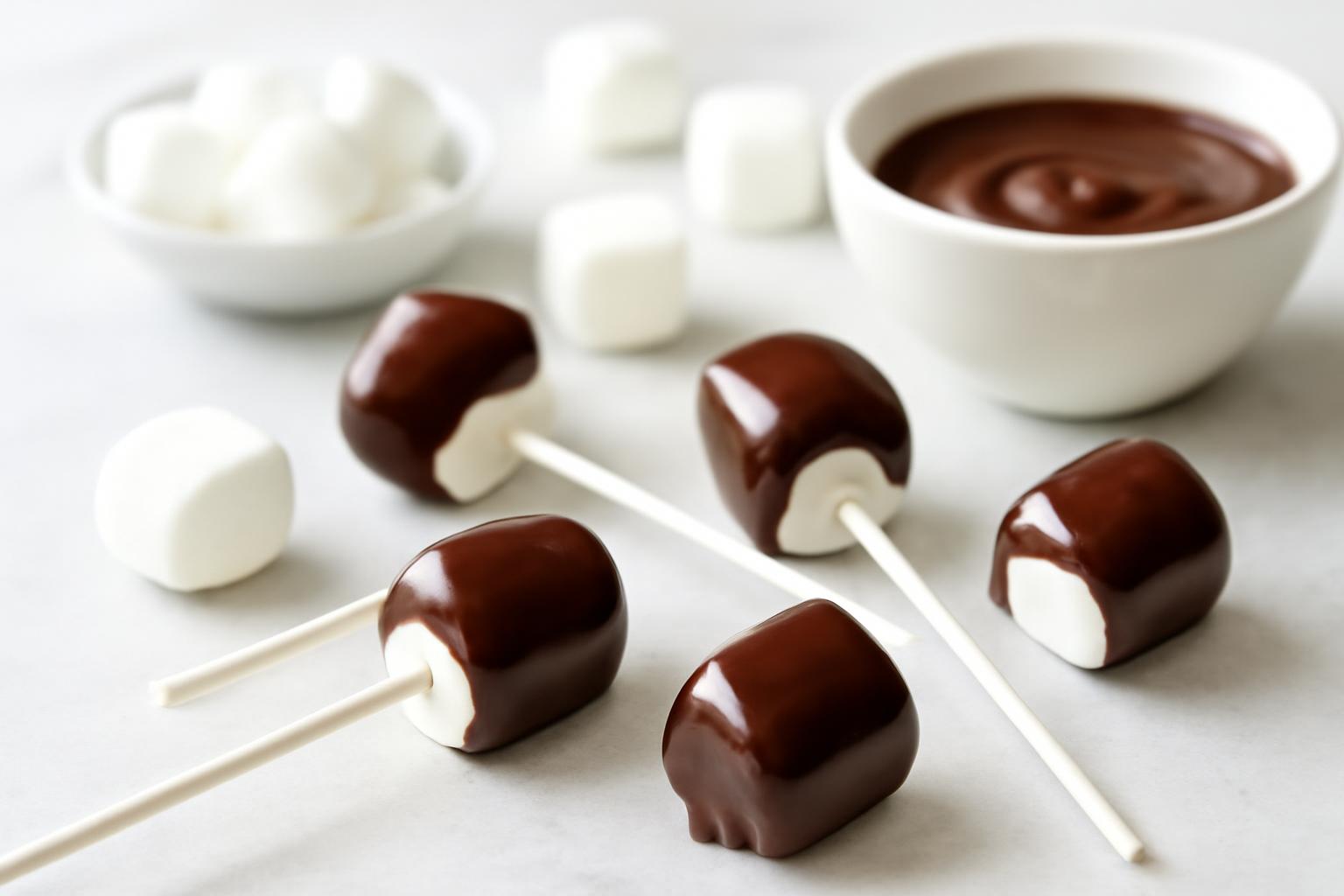
A documented recipe takes about 15 minutes of hands-on work, followed by at least one hour for the coating to set, or until firm.
The quick answer: what chocolate-dipped marshmallows involve
Chocolate-dipped marshmallows are individual marshmallows—or several marshmallows grouped on a stick—partially or fully coated in melted chocolate or confectionery coating. After dipping, the coating is left undisturbed until it forms a firm outer shell.
The basic process is:
- Melt the coating gradually.
- Hold the marshmallow with a stick, toothpick, fork, or dipping tool.
- Dip it partially or fully.
- Lift it out and tap off the excess coating.
- Add sprinkles or other loose toppings while the surface is wet.
- Leave the coating undisturbed until firm.
Milk, dark, and white chocolate are all documented options. Depending on the recipe, the coating may take the form of chocolate chips, candy melts, or melting wafers.
Active preparation can be brief, but setting time must be budgeted separately. Rachel Cooks reports about 15 minutes of hands-on work and instructs cooks to let the coating set for at least one hour, or until firm. Good Food lists 10 minutes of preparation and 5 minutes of cooking, plus additional setting time. A recipe described as taking 15 minutes therefore may not be ready to package after 15 minutes.
Calories vary even more than preparation times. One generic 11 g piece is listed at 41.3 calories, while a 1.7 oz commercial dark-chocolate pop is listed at 190 calories. Those servings are not nutritionally interchangeable. Finished weight, marshmallow count, coating thickness, chocolate type, and toppings all affect the result.
It is also important to check what a database entry describes. A plain marshmallow dipped in chocolate is not necessarily equivalent to a chocolate-coated marshmallow cookie, marshmallow pie, fudge-style confection, or filled chocolate. Cookie bases, cake, and fillings can materially change the nutrition.
The practical takeaway is straightforward: the recipe follows a melt-dip-decorate-set sequence, but a useful nutrition estimate requires a defined serving. “One piece” means little unless you know its finished weight or what went into it.
Ingredients, equipment, and two documented batch sizes
The core ingredients are:
- Marshmallows
- Chocolate or confectionery coating
- Optional decorations
Documented decorations include sprinkles, crushed graham crackers, chopped nuts, freeze-dried fruit, small candy pieces, and a contrasting coating for drizzle. Any decorations should be included when checking allergens or estimating calories.
Useful equipment includes:
- Microwave-safe bowl
- Spoon or heat-resistant spatula
- Parchment or wax paper
- Lollipop or cake-pop sticks
- Toothpicks
- Fork or dipping tool
- Double boiler, or a heatproof bowl used over simmering water
- Optional cake-pop stand, foam block, or tall glass
You do not need every item. Individual marshmallows can be dipped with a fork or dipping tool and placed on parchment. Sticks and upright supports are mainly useful when making pops or trying to preserve a rounded shape while the shell firms.
A batch of approximately 26 pieces
The Good Food recipe provides this documented framework:
- About 200 g marshmallows
- 50 g white chocolate
- 50 g milk chocolate
- Sprinkles
- Lollipop sticks
- Approximate yield: 26 pieces
This is a source-specific recipe, not a universal chocolate-to-marshmallow ratio. The source does not specify the exact size or count of the marshmallows in the 200 g bag.
The recipe divides the coating between milk and white chocolate. If using a different product or only one coating type, follow the directions for that selected recipe or product rather than assuming all coatings behave identically.
A batch of approximately 30 marshmallows
A half-batch in Rachel Cooks’ recipe uses:
- 1.5 cups chocolate chips
- 0.5 tablespoon shortening
- Approximately 30 marshmallows
The shortening belongs to that formula. It should not be treated as a universal addition for every brand of chocolate, candy melt, or melting wafer.
A separate Tastes of Homemade recipe lists 48 large marshmallows, 2 cups of melting wafers, and 24 paper lollipop sticks. Its recipe card reports 24 servings while also allowing more than one marshmallow per stick, so the serving count does not establish a universal marshmallow count per serving.
All three frameworks are source-specific. The amount of coating required can change with:
- Regular, large, or jumbo marshmallows
- One or several marshmallows per stick
- Partial versus full dipping
- Thin versus double coating
- Coating left in the bowl
- The flow and thickness of the selected product
For pops, insert a stick partway into one marshmallow or place several marshmallows on the same stick. For individual pieces, use a fork, toothpick, or dipping tool and transfer each coated marshmallow to parchment or wax paper.
Choosing milk, dark, white chocolate, chips, or melting wafers
The available recipes do not establish one objectively best coating. Several formats are workable:
- Milk chocolate: Used in homemade recipes and commercial products.
- Dark chocolate: Another documented homemade and commercial option.
- White chocolate: Used alone, alongside milk chocolate, or as a contrasting drizzle.
- Chocolate chips: Used in recipes that may include shortening or coconut oil to adjust dipping consistency.
- Melting wafers or candy melts: Used in recipes designed around those products, sometimes without additional fat.
Choose a coating based on the recipe you are following, package directions, availability, desired flavor, and dietary requirements. The evidence does not establish that chips, bars, candy melts, or wafers are universally better in flavor, shine, snap, or stability.
One documented half-batch combines 1.5 cups of chocolate chips with 0.5 tablespoon of shortening. Another recipe uses melting wafers without listing an added fat. That difference is a reason to follow the selected formula, not a reason to apply the chip-and-shortening ratio to every product.
If a recipe specifically calls for shortening or coconut oil, add it in the stated amount. Do not infer a universal thinning ratio from one recipe. The supplied sources also do not provide exact tempering or working temperatures, or establish that tempering is always required or never required.
Dietary suitability must be checked ingredient by ingredient. Review the current labels for:
- The marshmallows
- The chocolate or confectionery coating
- Every topping and decoration
How to melt the coating without overheating it
The goal is a smooth coating that remains fluid enough for dipping. The documented recipes rely on gradual heating and visual readiness cues rather than a universal target temperature.
Microwave method
Rachel Cooks and Tastes of Homemade both use 20-second microwave intervals, with stirring after each interval.
Follow this sequence:
- Put the coating in a microwave-safe bowl.
- Heat it for 20 seconds.
- Stir thoroughly.
- Repeat in 20-second intervals, stirring each time.
- Stop repeated heating when stirring produces a smooth, melted coating.
Rachel Cooks warns that overheating can scorch chocolate. Short intervals provide more control than one long heating period. The supplied recipes do not document a dependable repair for scorched or seized coating, so the method should focus on gradual heating rather than promising a rescue.
Bowl-over-water or double-boiler method
Good Food documents melting chocolate in bowls over simmering water, while Rachel Cooks identifies a double boiler as an alternative to microwave melting.
Stir as the coating softens and stop heating when it is smooth. Use the arrangement and directions specified for your equipment or chosen recipe rather than inventing a target temperature.
Let the coating cool slightly
Good Food directs cooks to let the melted chocolate cool a little before dipping. This is especially relevant for very soft homemade marshmallows: Rachel Cooks notes that they may soften or melt slightly in chocolate that is still too warm.
“Cool slightly” does not mean letting the coating become firm again. It must remain fluid enough to cover the marshmallow. Stir it and test one piece before dipping the full batch.
If the selected recipe calls for shortening or coconut oil, incorporate it as directed. The supplied evidence does not support a universal adjustment that works for every chocolate or confectionery coating.
Dip, decorate, and let the coating set
Prepare the setting area and toppings before melting the coating. Loose decorations need to be added while the surface is still wet.
Use this order:
- Prepare the setting area. Line a tray or work surface with parchment or wax paper. For upright pops, prepare a tall glass, foam block, or cake-pop stand.
- Set out the toppings. Place sprinkles, crushed graham crackers, chopped nuts, freeze-dried fruit, or candy pieces within reach.
- Insert the sticks. Push each stick only partway into the marshmallow.
- Melt the coating. Use short microwave intervals with stirring or the bowl-over-water method documented by your recipe.
- Cool it slightly if needed. This can help protect very soft homemade marshmallows.
- Dip the marshmallow. Cover part of it or submerge it for fuller coverage.
- Remove excess coating. Lift the marshmallow and gently tap or turn it over the bowl.
- Add loose toppings immediately. Apply them while the coating is wet.
- Place the treat on parchment or support it upright.
- Leave it undisturbed until firm. Rachel Cooks gives at least one hour, or until the coating has set, as its instruction.
Partial and full dipping are both documented methods. Full coverage ordinarily uses more coating, increasing the finished weight and changing the calorie estimate. This is why two treats casually described as “one chocolate-dipped marshmallow” may be materially different servings.
Documented topping options include:
- Sprinkles
- Crushed graham crackers
- Chopped nuts
- Freeze-dried fruit
- Small candy pieces
- Contrasting coating
A decorative drizzle follows a different sequence from loose toppings. Let the first shell set, then apply a contrasting melted coating over the firm surface.
For a thicker shell, Tastes of Homemade recommends allowing the first layer to set before dipping the marshmallow again. A double coating adds more chocolate, so include that additional coating in any batch nutrition estimate.
Treat “at least one hour or until firm” as a recipe instruction, not a guarantee that every coating will be ready at precisely 60 minutes. Do not arrange, stack, serve, or wrap the treats until the shell is firm, including at the base.
No sticks, flat sides, thick coating, and other practical variations
Lollipop sticks and cake-pop stands are optional. Rachel Cooks allows toothpicks as substitutes, while Tastes of Homemade describes dipping individual marshmallows with a fork or dipping tool.
Lower the marshmallow into the coating, lift it out, let the excess return to the bowl, and transfer it to parchment or wax paper.
For a rounder pop, documented support options include:
- A cake-pop stand
- A stable foam block
- A tall glass
Keep the coated surfaces separated while they set so the presentation is not disturbed.
If the coating is too heavy
Hold the marshmallow over the bowl and gently tap off the surplus before placing it on the setting surface or upright support. With a pop, avoid tapping so forcefully that the marshmallow comes loose from the stick.
It can also affect the finished weight and calorie total, which is another reason appearance alone is a poor basis for nutrition estimates.
If you want a thicker coating
Let the first layer set before dipping the marshmallow again. The second layer adds coating weight and calories, so account for the full amount of coating used in the finished batch.
If the marshmallows are homemade and very soft
Let the melted coating cool somewhat while keeping it fluid. Very soft homemade marshmallows may deform or soften in coating that remains too warm. Testing one marshmallow first limits the number affected if the coating needs more cooling time.
If you use freeze-dried fruit
Rachel Cooks advises eating freeze-dried-fruit-topped versions as soon as the chocolate has set. This is recipe-author guidance, not a controlled shelf-life result.
The available sources do not validate universal solutions for cracked, dull, seized, sliding, or slow-setting coatings. Avoid assuming that a single repair will work with every type or brand of coating.
Calories and macros: compare by weight, not by appearance
There is no universal calorie count for one chocolate-dipped marshmallow. Published entries describe different weights, coating types, chocolate quantities, toppings, and numbers of marshmallows.
The following comparison preserves each listing’s stated serving:
| Listed food or recipe | Serving as listed | Calories |
|---|---|---|
| Generic chocolate-covered marshmallow | 1 piece, 11 g | 41.3 kcal |
| Generic chocolate-covered marshmallow | 1 medium or unspecified piece | 41 kcal |
| Good Food recipe | 1 marshmallow; recipe makes approximately 26 | 45 kcal |
| Generic listing | 2 pieces, 26 g | 100 kcal |
| USDA-attributed chocolate-coated marshmallow entry | 28 g | 118 kcal |
| Target dark-chocolate marshmallow pop | 1 piece, 1.7 oz | 190 kcal |
Good Food reports 45 calories per marshmallow for its approximately 26-piece recipe. As with other recipe-page calculations, that figure is an estimate for the source’s formula and stated yield, not a universal value.
The 41.3- and 190-calorie listings do not conflict once serving size is considered. An 11 g piece and a 1.7 oz commercial pop are substantially different servings. “Per piece” conceals that difference.
The USDA-attributed 28 g entry reports:
- 118 calories
- 4.7 g fat
- 19 g carbohydrate
- 12.5 g sugar
- 0.56 g fiber
- 1.1 g protein
That food record also includes serving descriptions such as a fudge marshmallow, marshmallow pie, and small cookie. It may therefore represent a broader or potentially composite chocolate-coated marshmallow category rather than only a plain dipped marshmallow. It should not be used as a direct prediction for a homemade piece without first checking that the food description matches what was eaten.
The separate 26 g, two-piece listing reports:
- 100 calories
- 2.5 g fat
- 19 g carbohydrate
- 16 g sugar
- 1 g protein
That page does not identify a primary data source, brand, recipe, or coating type, so it is best treated as a generic reference rather than a verified value for a specific homemade recipe.
Listings around 26–28 g fall at approximately 100–118 calories, but this is only a reference comparison. Because the 28 g record may encompass composite products, the range should not be interpreted as a standard for all plain dipped marshmallows.
Across the cited generic entries, carbohydrate and sugar provide much of the reported nutrition, while protein and fiber are comparatively low. Exact amounts still depend on the selected marshmallow, coating, decorations, and serving weight.
How to estimate your homemade batch
For a closer estimate, use the nutrition labels from the ingredients actually used.
Step 1: Record the marshmallows. Count or weigh the marshmallows and calculate their calories and macros from the package serving information.
Step 2: Record the coating. Record the coating placed in the bowl and, if practical, account for what remains after dipping. Counting all prepared coating will tend to overstate the amount transferred to the treats if a substantial quantity remains behind.
Step 3: Record every topping. Include sprinkles, nuts, candy, crackers, freeze-dried fruit, and decorative drizzle. Small amounts can be totaled for the batch instead of estimated piece by piece.
Step 4: Add the batch totals.
Batch calories = marshmallow calories + coating calories + topping calories
The same calculation can be performed for carbohydrate, sugar, fat, protein, or another nutrient listed on the ingredient labels.
Step 5: Divide by the actual yield.
Estimated calories per piece = total batch calories ÷ number of finished pieces
For example, if the ingredients transferred to a finished batch total 2,400 calories and the batch produces 30 pieces:
2,400 ÷ 30 = approximately 80 calories per piece
This is arithmetic based on ingredient labels and recorded yield, not laboratory measurement. It also assumes that the coating and toppings are distributed reasonably evenly.
When the pieces are not equal
A single batch average can hide substantial differences if some marshmallows are partially dipped and others are fully covered, or if some sticks contain one marshmallow while others contain several.
More useful options include:
- Separating partial- and full-dip pieces into different calculations
- Recording single-marshmallow pieces separately from multi-marshmallow pops
- Weighing finished pieces and using weight as the serving reference
- Reporting a batch average while acknowledging variation among pieces
Finished weight is often more informative than appearance. Recording “one 14 g piece” or “one 35 g pop” makes it easier to compare the serving with an appropriate label or database entry.
Do not substitute nutrition for a chocolate-coated marshmallow cookie, pie, cake, or fudge confection unless that is what you ate. Those foods may contain bases, fillings, or other ingredients absent from a plain dipped marshmallow.
Recipe calculations, ingredient labels, and nutrition databases are estimates. Product formulas, measurements, actual yield, and coating left in the bowl can change the result. This material is for general informational purposes, not individualized medical or dietary advice.
Storage, warm weather, and whether to make or buy
Wait until the coating is firm before arranging or packaging the treats.
Tastes of Homemade recommends storing the treats in a single layer in an airtight container at room temperature for several weeks. That is recipe-author guidance rather than a controlled shelf-life finding or a universal safety period.
The same recipe suggests refrigeration in warm conditions but warns that chilled chocolate may develop condensation after it returns to room temperature. If refrigeration is used, allow for possible surface moisture and cosmetic changes.
The supplied evidence does not validate a freezing-and-thawing procedure, so freezing should not be presented as a dependable default. Nor does the evidence establish one storage duration that applies to every homemade formula.
Planning for transport
Package the treats only after the coating is firm, and keep the decorated surfaces from rubbing against one another.
Seller shipping rules illustrate how commercial businesses handle warm-weather risk, but they are not universal temperature standards. Grandpa’s Cheesebarn states that its chocolate-containing products require express shipping from May 1 through September 30. Lake Champlain Chocolates says designated warm-weather destinations require air service.
Those are seller-specific, changeable requirements. The supplied evidence does not establish a tested protocol for shipping homemade marshmallow treats, so ordinary home packaging should not be represented as guaranteed protection against heat.
Commercial formats
Commercial chocolate-dipped marshmallows are sold in different formats, each of which needs its own serving interpretation:
- Lake Champlain Chocolates lists individually packaged 1.3 oz pops containing two square marshmallows, with milk- and dark-chocolate options.
- Country Mercantile lists sticks containing three marshmallows with sprinkles, with milk-, dark-, or white-chocolate choices and 0.5- or 1-pound size options.
- Grandpa’s Cheesebarn lists whole dipped marshmallows in 0.5- and 1-pound boxes, with milk- or dark-chocolate selections.
These formats are not equivalent servings. A multi-marshmallow stick, an individual pop, and a box sold by total weight require different calorie calculations.
Country Mercantile discloses milk and soy for its listed product. That disclosure applies only to that listing and cannot be generalized to every seller, flavor, coating, or homemade recipe.
Before buying, check the seller’s current:
- Ingredient list
- Allergen and cross-contact statement
- Package or serving weight
- Number of marshmallows per pop
- Chocolate type
- Stock status
- Delivery requirements
- Price
Commercial listings are changeable snapshots. Availability, package formats, prices, ingredients, and shipping terms may change, and seller descriptions of taste, texture, freshness, or quality should not be treated as independent evidence.
Buying them reduces preparation work but may provide a package format that does not match the serving you want. The useful comparison is the actual ingredient list, weight, marshmallow count, and purpose—not a blanket claim that one option is better.
Frequently asked questions
What is the best chocolate for dipping marshmallows?
The available recipes do not establish one objectively best coating. Milk, dark, and white chocolate are all documented options, as are chocolate chips, candy melts, and melting wafers.
Use a product suited to the selected recipe and follow any package directions. If the recipe calls for shortening or coconut oil, use its stated amount rather than applying one ratio to every coating. Check the marshmallow, coating, and topping labels separately when allergens or dietary restrictions matter.
How many calories are in one chocolate-dipped marshmallow?
There is no universal per-piece number. The cited examples range from about 41 calories for a small 11 g generic piece to 190 calories for a 1.7 oz commercial pop. The difference reflects serving size and product composition, not necessarily contradictory data.
For a homemade estimate, total the calories in the marshmallows, coating, and decorations used, then divide by the actual finished yield. If pieces vary noticeably, record their finished weights instead of treating every piece as nutritionally identical.
How long do chocolate-dipped marshmallows need to set?
Rachel Cooks instructs cooks to allow at least one hour, or until the coating is firm. Other recipes provide preparation times without establishing a precise setting period.
Actual timing can vary with coating type, thickness, room conditions, and whether the marshmallow was dipped once or twice. Package the treats only after the shell is firm, including at the base.
Can I make chocolate-dipped marshmallows without sticks?
Yes. Use a fork, toothpick, or dipping tool, then transfer each coated marshmallow to parchment or wax paper.
This approach requires no pop stand, but the marshmallow may develop a flat side or a small pool of coating where it rests. A tall glass, foam block, or cake-pop stand can support upright pops when a rounder presentation is preferred.
Should chocolate-dipped marshmallows be refrigerated?
One recipe author recommends room-temperature storage in a single layer in an airtight container and suggests refrigeration when conditions are warm. The same source warns that chilled chocolate may develop condensation after returning to room temperature.
That is recipe-author guidance, not a universal shelf-life rule. Storage needs vary with ingredients and conditions, so verify any product-specific instructions and avoid promising one storage period for every homemade batch.
The reliable method remains simple: choose a documented coating, melt it gradually, dip the marshmallow, tap off the excess, decorate at the appropriate stage, and wait until the shell is firm. For nutrition tracking, define the serving just as carefully. A finished weight made with known ingredients is more useful than the vague unit “one marshmallow.”